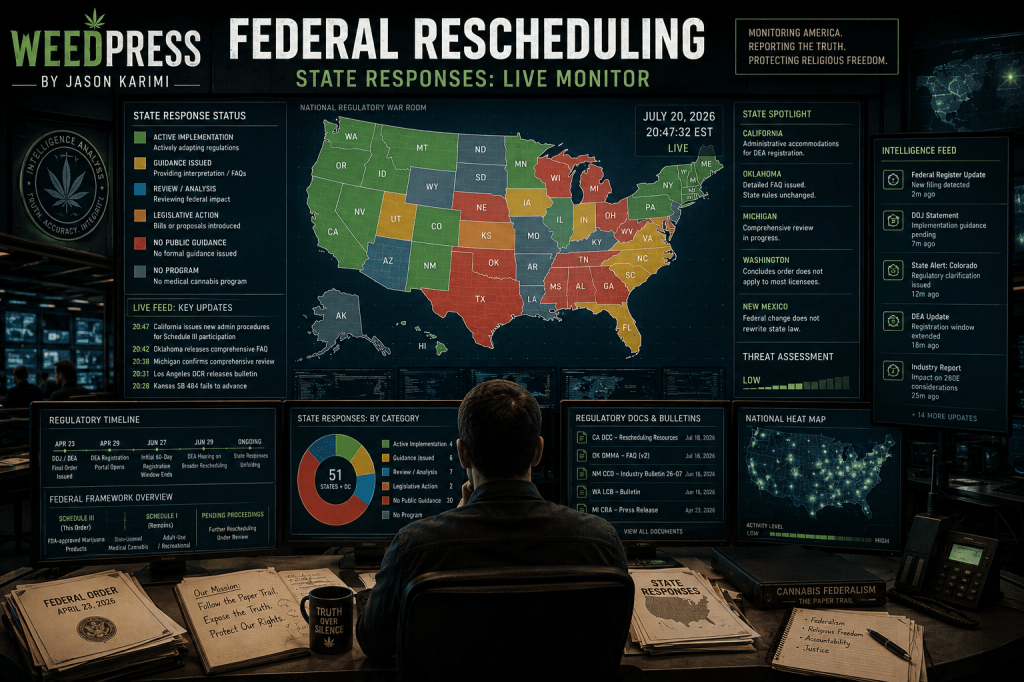
On April 23, 2026, the United States Department of Justice and the Drug Enforcement Administration fundamentally changed federal cannabis policy by issuing a final order placing FDA-approved marijuana products and marijuana distributed pursuant to qualifying state medical marijuana licenses into Schedule III of the Controlled Substances Act while simultaneously initiating broader administrative proceedings regarding additional marijuana rescheduling.¹
For the first time in American history, a federally recognized category of state-regulated medical marijuana now exists within Schedule III.
The federal order immediately raised questions that every state cannabis regulator would eventually confront.
Would existing medical licensing structures satisfy the new federal framework?
Would states modify licensing requirements?
Would regulators require new warnings, packaging, inspections, or registration procedures?
Would medical and adult-use markets be treated differently?
Would state agencies provide guidance regarding DEA registration, interstate commerce, taxation, or federal compliance?
Three months later, one conclusion has become increasingly clear.
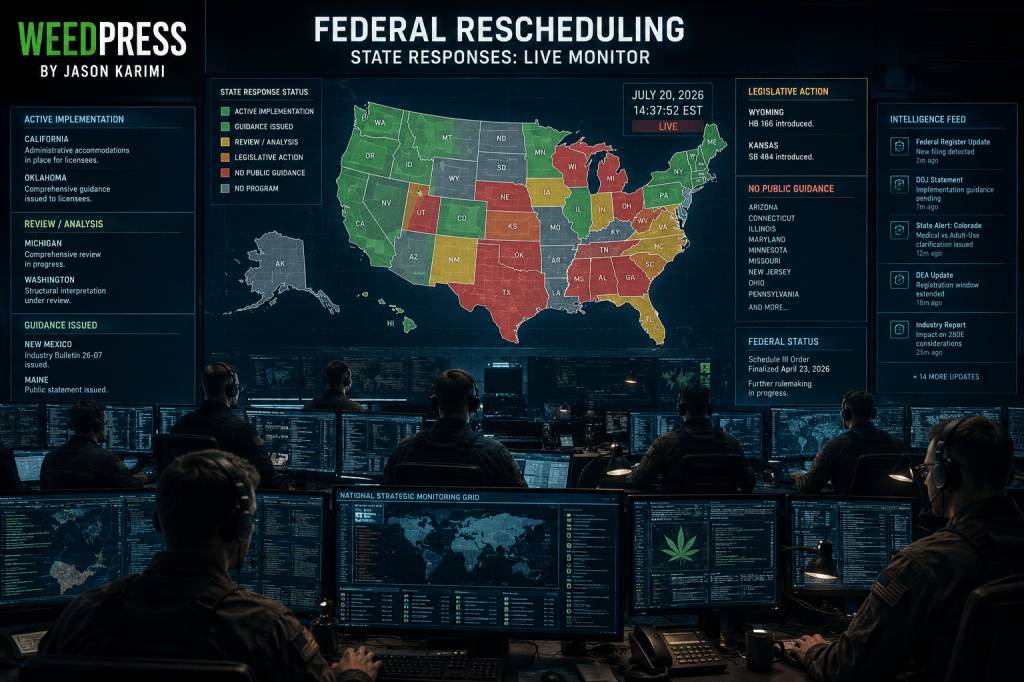
There has been no unified national regulatory response. Instead, states have begun separating into distinct categories based upon how—or whether—they have chosen to respond publicly to the federal changes.
Some states have actively modified their regulatory systems.
Other states have concluded little changes under existing law.
Some have acknowledged the federal action while promising future analysis. Many have issued virtually no meaningful public implementation guidance at all.
Rather than producing national uniformity, federal medical cannabis rescheduling has exposed how differently individual states understand the relationship between federal scheduling, state licensing systems, and ongoing regulatory authority.
And nobody understands it like WeedPress, the only outlet covering this developing state responses.
Kind of thrilling for a policy nerd.
https://ssrn.com/abstract=6726361
California: From Interpretation to Implementation
California currently represents perhaps the nation’s most proactive administrative response.
Rather than merely informing licensees that federal law changed, the California Department of Cannabis Control has begun altering portions of its own licensing administration to facilitate participation in the new federal framework.
Among other measures, California has informed licensees that medicinal cannabis businesses may seek DEA registration under the federal order, explained that DEA continues accepting registration applications after the original expedited period, created procedures allowing cultivation businesses to add or modify medicinal-use designations without waiting for normal renewal cycles, and reduced certain local authorization requirements for qualifying medicinal licensing changes. These measures are administrative accommodations designed to reduce barriers for businesses seeking to participate in the new federal medical framework.
California’s response is significant because it moves beyond simply acknowledging federal rescheduling.
The Department has begun adapting state licensing procedures to account for the practical realities created by federal Schedule III recognition.
In other words, California appears to view federal rescheduling not simply as an external legal development but as an event requiring corresponding adjustments within state administration.
No other state identified during this review appears to have adopted comparably extensive administrative accommodations.
Oklahoma: Detailed Guidance Without Regulatory Change
Rather than restructuring its licensing program, the Oklahoma Medical Marijuana Authority (OMMA) has focused on providing unusually detailed operational guidance while emphasizing that Oklahoma’s own regulatory system remains unchanged.
Immediately following the federal order, OMMA acknowledged that substantial uncertainty remained regarding implementation and advised licensees that numerous operational questions were still unresolved. Executive Director Adria Berry stated that the agency was carefully reviewing the federal action while working to understand its practical consequences for Oklahoma’s medical marijuana industry.
OMMA subsequently expanded that preliminary guidance into one of the most comprehensive state responses published anywhere in the country.
The agency addressed frequently asked questions concerning DEA registration, packaging requirements, Internal Revenue Code § 280E, emergency rulemaking, and interstate commerce.
Notably, OMMA instructed businesses that Oklahoma packaging and labeling requirements remain controlling despite new federal warning language, emphasized that Oklahoma regulations continue to govern commercial operations unless formally amended, and acknowledged that the federal government had not provided sufficient guidance regarding interstate commerce. OMMA also encouraged licensees to seek individualized legal counsel rather than rely solely upon evolving federal announcements.
That guidance reflects an important regulatory philosophy.
Unlike California, Oklahoma has not attempted to modify its own licensing structure in response to federal rescheduling.
Instead, OMMA has sought to explain how licensees should continue operating within existing Oklahoma law while recognizing that many important federal implementation questions remain unanswered.
This distinction is significant.
California’s approach may be described as administrative facilitation—adjusting state systems to accommodate federal developments.
Oklahoma’s response instead reflects regulatory continuity—maintaining existing state requirements while educating licensees about an evolving federal environment.
Michigan: Recognition Without Immediate Interpretation
Michigan represents yet another emerging category.
On April 23, 2026, the Cannabis Regulatory Agency acknowledged that the federal order constituted a “historic and significant development.” However, rather than immediately interpreting the legal consequences of the federal action, the Agency announced that it would conduct a comprehensive review before issuing additional guidance regarding compliance obligations, operational impacts, or potential regulatory adjustments. Until that review was completed, Michigan directed licensees to continue operating under existing state requirements.
That initial announcement demonstrated institutional caution.
Rather than immediately adopting California’s implementation model or Oklahoma’s detailed explanatory model, Michigan chose to acknowledge the importance of the federal order while reserving judgment concerning its practical consequences.
A review of the Cannabis Regulatory Agency’s subsequent public news releases did not reveal a comparable comprehensive statewide implementation bulletin specifically addressing the practical implications of the federal Schedule III framework for Michigan licensees. While the Agency has continued normal regulatory activity—including rulemaking, disciplinary actions, recalls, and public hearings—the promised comprehensive federal implementation guidance does not appear within the Agency’s publicly available announcements reviewed for this article.
That does not necessarily mean Michigan has taken no internal action.
Rather, it illustrates another emerging national pattern: acknowledgment of the federal order accompanied by continued study rather than immediate public interpretation.
Washington: A Structural Interpretation Rather Than an Administrative One
Washington has taken one of the most distinctive public positions identified during this review. Rather than focusing primarily upon implementation logistics, the Washington State Liquor and Cannabis Board (LCB) concluded that the federal medical cannabis order appears to have limited application within Washington’s existing regulatory structure because the overwhelming majority of Washington licensees operate within a unified market that does not depend upon separate state-issued medical marijuana licenses in the manner contemplated by the federal order.
That conclusion is noteworthy because it reflects a structural interpretation of the federal action rather than a purely administrative response. California asked how its licensing system could adapt to facilitate participation. Oklahoma explained how existing regulations would continue operating while federal questions remained unresolved. Washington instead asked a more fundamental question: whether many of its own licensees fall within the federal medical framework at all.
If that interpretation ultimately proves correct, similarly structured states with integrated adult-use and medical markets may confront the same issue. Federal eligibility may depend not simply upon whether cannabis is used medically, but whether the product is distributed pursuant to a qualifying state-issued medical marijuana license as described in the federal order.²
Washington’s position therefore illustrates that federal rescheduling does not merely raise compliance questions. It also raises threshold questions regarding which state licensing systems actually fit within the new federal statutory language.
Colorado: Separating Medical From Adult-Use Markets
Colorado’s response likewise recognizes that the federal order created two distinct regulatory tracks rather than one unified cannabis system.
Colorado regulators have emphasized that federal Schedule III treatment concerns state-authorized medical cannabis while adult-use marijuana remains outside that framework pending completion of the ongoing federal administrative proceedings. This distinction preserves Colorado’s longstanding separation between medical and recreational licensing while avoiding any suggestion that the April 2026 federal action automatically altered state law governing the adult-use market.³
Colorado’s approach illustrates another emerging regulatory philosophy. Rather than expanding the practical effect of the federal order, the state has interpreted the federal action narrowly according to its express terms.
New Mexico: Federal Change Does Not Rewrite State Law
New Mexico’s Cannabis Control Division has adopted perhaps the clearest statement of regulatory continuity.
In Industry Bulletin 26-07, the Division advised licensees that the federal Schedule III order did not automatically modify New Mexico’s Cannabis Regulation Act, the Lynn and Erin Compassionate Use Act, or the state’s implementing regulations. Licensees were instructed to continue complying with existing requirements governing licensing, testing, packaging, labeling, transportation, inspections, and enforcement unless and until New Mexico law itself changed.
The significance of New Mexico’s bulletin lies in its emphasis upon federalism. Federal rescheduling altered federal law, but it did not itself amend state statutes or administrative regulations. Accordingly, the Division instructed businesses to continue operating under existing New Mexico requirements despite the federal development.
That position closely parallels Oklahoma’s continuity model while placing greater emphasis upon the independent operation of state statutory authority.
Emerging Patterns Become Clearer
By this point, several distinct categories have begun to emerge.
California represents an implementation model, actively modifying aspects of its licensing administration to accommodate the federal framework.
Oklahoma and New Mexico represent continuity models, maintaining existing regulatory systems while explaining how licensees should continue complying with state law despite significant federal developments.
Washington represents a structural interpretation model, questioning whether the federal medical framework reaches much of its existing marketplace because of the state’s licensing architecture.
Colorado demonstrates a segregation model, carefully distinguishing between medical cannabis affected by the federal order and adult-use cannabis that remains outside its immediate scope.
These responses are remarkably different considering they all address the same federal action.
Rather than producing regulatory uniformity, the federal Schedule III order has highlighted the substantial diversity among state cannabis licensing systems. The practical consequences of federal rescheduling increasingly depend not only upon federal law itself, but upon how individual states choose to interpret, implement, or accommodate that law within their own regulatory frameworks.
Maine and Delaware: Early Recognition Without Immediate Regulatory Revision
Not every state elected to respond through formal implementation guidance. Some instead issued public statements intended primarily to explain what the federal action did—and did not—accomplish.
The Maine Office of Cannabis Policy emphasized that federal rescheduling should not be mistaken for nationwide legalization. The agency advised that cannabis remained subject to significant federal restrictions, interstate commerce remained prohibited, and Maine’s medical and adult-use regulatory programs would continue operating under existing state law unless affirmatively amended by the Legislature or the agency itself. The statement also noted that the most immediate practical consequences of Schedule III status would likely involve federal taxation, scientific research, and pharmaceutical regulation rather than wholesale changes to state cannabis programs.
Although issued before completion of the final federal implementation process, Maine’s statement demonstrated an institutional effort to temper expectations while reinforcing regulatory stability. Rather than announcing new compliance obligations, the agency reassured licensees that existing state requirements remained controlling unless state law itself changed.
Delaware adopted a similar approach. The Office of the Marijuana Commissioner advised stakeholders that federal rescheduling did not authorize interstate commerce, did not automatically eliminate federal criminal restrictions applicable outside the narrow scope of the federal order, and did not independently rewrite Delaware’s cannabis statutes. Like Maine, Delaware focused less upon operational implementation than upon correcting common misconceptions surrounding federal rescheduling.
These statements occupy an important place within the developing national landscape. They demonstrate that some regulators viewed their immediate responsibility not as rewriting state programs, but as preventing confusion while awaiting additional federal clarification.
Massachusetts: Recognition Without Meaningful Interpretation
Massachusetts appears to represent yet another category.
The Commonwealth updated official legal reference materials to acknowledge the federal Schedule III action and incorporated the federal development into publicly available legal resources. However, the publicly available materials reviewed for this article do not provide the type of comprehensive implementation guidance issued by states such as Oklahoma or the administrative accommodations adopted by California.
Recognition alone should not be confused with implementation.
For licensees attempting to understand practical questions concerning licensing, inspections, taxation, DEA registration, packaging, or interstate commerce, merely acknowledging the federal order provides substantially less guidance than detailed administrative bulletins.
Massachusetts therefore illustrates another dimension of the national response: formal recognition of the federal action without extensive public interpretation of its regulatory consequences.
Local Regulators Begin Filling the Information Gap
Although this review focuses primarily on state regulatory responses, at least one local cannabis regulator has begun providing public education concerning the federal medical cannabis order, suggesting that some municipalities are moving more quickly than their respective states to address licensee uncertainty.
On July 20, 2026, the Los Angeles Department of Cannabis Regulation (DCR) issued its monthly News Bulletin acknowledging that federal medical cannabis rescheduling had generated significant operational questions for cannabis businesses. Rather than issuing a formal legal interpretation, DCR directed licensees to a department podcast discussing recent federal developments and explaining issues that businesses should monitor as implementation of the federal Schedule III framework continues.
Los Angeles’ response is noteworthy because it demonstrates that regulatory communication is occurring below the state level. Municipal regulators generally possess far narrower authority than state cannabis agencies and cannot independently alter state licensing requirements. Nevertheless, local regulators frequently serve as the most accessible governmental resource for licensees attempting to understand rapidly changing regulatory developments.
In jurisdictions where state agencies have not yet issued detailed implementation guidance, local regulators may begin filling portions of the resulting information vacuum by providing educational resources, compliance discussions, and public outreach directed toward licensees.
That development may represent the next phase of regulatory communication following federal medical cannabis rescheduling. While relatively few state agencies have published comprehensive implementation analyses, local cannabis regulators may increasingly become the first governmental entities translating federal developments into practical guidance for businesses operating within their jurisdictions.
The Los Angeles bulletin reinforces one of the central conclusions of this WeedPress review. The absence of extensive state-level implementation guidance has not eliminated demand for regulatory explanation. Rather, it has created opportunities for local agencies to provide educational resources while broader state policy continues to evolve. (Los Angeles Cannabis Portal)
Legislative Responses: Wyoming and Kansas
Administrative agencies have not been the only institutions responding to federal medical cannabis rescheduling.
Several state legislatures have also considered whether state controlled-substance schedules should be revised following the federal action.
Wyoming introduced House Bill 166, titled “Marijuana—Class III Substance.” The proposal itself demonstrates that at least some legislators viewed federal Schedule III recognition as requiring affirmative consideration under state law. Regardless of its ultimate disposition, the bill reflects an understanding that state scheduling does not necessarily change automatically merely because federal scheduling changes.
Kansas likewise considered Senate Bill 484, which proposed moving marijuana from Schedule I to Schedule III under the Kansas Uniform Controlled Substances Act. The proposal ultimately failed to advance.
The contrast between Wyoming and Kansas illustrates an important point often overlooked in public discussion of federal rescheduling.
Federal scheduling and state scheduling are separate legal questions.
Some states incorporate federal scheduling decisions automatically through conformity statutes. Others require independent legislative or administrative action before state law changes. Still others maintain entirely separate scheduling systems. Consequently, federal Schedule III recognition does not produce a uniform nationwide legal effect.
Instead, each state must determine whether existing statutes already address federal scheduling changes or whether additional legislative action is required.
A Fourth Emerging Category: Deliberate Silence
Perhaps the most significant finding of this review is not what certain states have done.
It is what most states have not done.
Despite one of the most consequential federal cannabis developments in modern history, the majority of state cannabis regulatory agencies reviewed have not issued comprehensive public implementation bulletins addressing how the federal order affects licensing, inspections, compliance obligations, DEA registration, taxation, or operational expectations for licensees.
Silence should not necessarily be interpreted as disagreement with the federal action.
Nor should it automatically be interpreted as institutional inaction.
Agencies may be conducting internal legal analysis, consulting with attorneys general, coordinating with governors’ offices, or awaiting additional federal guidance before issuing formal public statements.
Nevertheless, from the perspective of regulated businesses, public guidance matters.
Licensees make operational decisions based upon publicly available information. Where comprehensive guidance is absent, uncertainty necessarily increases, and businesses are left to interpret evolving federal developments with limited official direction.
Conclusion
Three months after federal medical cannabis rescheduling, the United States has not developed a single regulatory model.
Instead, at least four distinct approaches have emerged.
California has begun facilitating participation through administrative accommodation.
Oklahoma and New Mexico have emphasized regulatory continuity while providing practical implementation guidance.
Washington has questioned whether the federal framework structurally reaches much of its existing marketplace, while Colorado has maintained a careful distinction between medical and adult-use regulation.
Other jurisdictions have acknowledged the federal action without providing extensive operational interpretation, while several legislatures have begun considering whether state controlled-substance schedules should be revised independently of federal law.
Most significantly, many states remain publicly silent.
That silence does not eliminate the legal significance of federal medical cannabis rescheduling. Rather, it underscores a central reality of American cannabis federalism: even after historic federal action, implementation remains largely dependent upon individual state choices.
For licensees, patients, attorneys, policymakers, and regulators, the next phase of cannabis reform will likely be shaped less by the federal order itself than by how each state decides to respond to it.
Weedpress plans to keep updating state responses – and compile the responses into a permanent link for research purposes.
Selected Authorities
- U.S. Dep’t of Justice & Drug Enforcement Admin., Final Order placing qualifying state-licensed medical cannabis and FDA-approved marijuana products into Schedule III (Apr. 2026).
- California Department of Cannabis Control, Federal Rescheduling Resources.
- Oklahoma Medical Marijuana Authority, Update: OMMA Monitors DEA Rescheduling Status; Frequently Asked Questions (May 2026).
- Michigan Cannabis Regulatory Agency, Press Release (Apr. 23, 2026).
- Washington State Liquor and Cannabis Board, Bulletin regarding federal medical cannabis rescheduling (June 2026).
- New Mexico Cannabis Control Division, Industry Bulletin 26-07 (June 16, 2026).
- Maine Office of Cannabis Policy, Statement regarding federal cannabis reclassification (2025).
- Delaware Office of the Marijuana Commissioner, Update regarding federal marijuana rescheduling (2025).
- Massachusetts official legal resources regarding federal Schedule III action.
- Wyo. H.B. 166 (2026).
- Kan. S.B. 484 (2026).
Here’s some further context as WeedPress watches with popcorn in hand the incoming state responses.
In its January 8, 2026, white paper “THE FEDERAL MARIJUANA RESCHEDULING SHOCKWAVE,” Weedpress mapped the 50-state controlled-substances landscape and warned of an impending disruption in enforcement architectures that rely on automatic federal conformity. The piece detailed how most states had deliberately tethered their CSA schedules to federal changes to avoid duplicative rulemaking, creating a built-in “shockwave” the moment marijuana left Schedule I.
Weedpress has also pointed out that South Carolina is far from alone. The same automatic-alignment mechanism exists in 27 states total—all categorized as “Green” in the Vicente Sederberg LLP memorandum on state CSA exemptions and regulatory mechanisms (the document on file with the author).⁶
Many do not appear to require new legislation, though agency implementation, objection procedures, emergency rules, or state-specific marijuana carveouts may affect timing and scope. The controlling authority—typically a Department of Health, Board of Pharmacy, or equivalent—must act unless an objection is filed (which can trigger a hearing) or the legislature overrides. Below is the full list drawn directly from the memorandum, with the operative statutory language summarized for each:
South Carolina (as detailed above): S.C. Code Ann. § 44-53-160(C) – mandatory 30-day Board action; full force of law unless overturned by the General Assembly.⁷
Alabama: Ala. Code § 20-2-2 et seq. – State Board of Health must similarly schedule after 30 days from Federal Register publication unless it objects.⁸
Arkansas: Ark. Code Ann. § 5-64-201 et seq. – Secretary of the Department of Public Health shall control the substance after 30 days unless objection; special process for FDA-approved marijuana-derived medications.⁹
Idaho: Idaho Code § 37-2702 et seq. – Board shall promulgate temporary rule or propose statutory amendment within 30 days unless objection.¹⁰
Illinois: 720 Ill. Comp. Stat. 570/201 et seq. – Department shall similarly control after 30 days unless Department or interested party objects (with hearing).¹¹
Indiana: Ind. Code § 35-48-1-1 et seq. – Automatic rescheduling/deletion for less restrictive federal changes; Board must notify legislative council if objecting.¹² Indiana maintains a federal-conformity mechanism for certain scheduling changes, but marijuana remains separately treated as Schedule I under current Indiana practice pending legislative or administrative action.
Iowa: Iowa Code § 124.201 et seq. – Specific automatic provision for FDA-approved cannabidiol products; general alignment for other substances.¹³
Kentucky: Ky. Rev. Stat. Ann. § 218A.020 et seq. – “Each substance that is scheduled or descheduled under 21 CFR 1308.11–1308.15 shall be scheduled or descheduled at the state level.”¹⁴
Louisiana: La. Rev. Stat. Ann. § 40:961 et seq. – Express incorporation of federal CSA schedules (21 CFR 1308.11–1308.15); hemp/CBD already exempted.¹⁵
Maryland: Md. Code Ann., Crim. Law § 5-201 et seq. – New federally designated substance is automatically controlled unless Department objects.¹⁶
Massachusetts: Mass. Gen. Laws ch. 94C, § 1 et seq. & regulations – State schedules mirror federal; Commissioner shall issue regulation within 30 days of federal action.¹⁷
Michigan: Mich. Comp. Laws § 333.7201 et seq. – Board of Pharmacy must act within 91 days unless it holds a meeting to determine otherwise.¹⁸
Missouri: Mo. Rev. Stat. § 195.017 et seq. – Department must similarly schedule unless it objects within 30 days (with hearing process).¹⁹
Montana: Mont. Code Ann. § 50-32-101 et seq. – Automatic adoption unless State Board of Pharmacy objects; special automatic rescheduling for tetrahydrocannabinols under federal Food, Drug & Cosmetic Act.²⁰
Nevada: Nev. Rev. Stat. § 453.011 et seq. – Board shall treat the substance identically after 60 days unless objection by Board or interested party.²¹
New Hampshire: N.H. Rev. Stat. Ann. § 318-B:1 et seq. – Commissioner shall control after 30 days unless objection.²²
New Jersey: N.J. Stat. Ann. § 24:21-1 et seq. – Automatic effect unless Commissioner objects within 30 days.²³
North Carolina: N.C. Gen. Stat. § 90-87 et seq. – Commission shall similarly control unless it objects (with rulemaking if objection).²⁴
North Dakota: N.D. Cent. Code § 19-03.1-02 et seq. – Board shall similarly control after 30 days unless objection.²⁵
Ohio: Ohio Rev. Code § 3719.41 et seq. – Automatic incorporation of federal additions, transfers, or removals; Board incorporates into next schedule update.²⁶
Oregon: Or. Rev. Stat. § 475.005 et seq. – Schedules expressly incorporate federal; Board reviews and adopts changes within 30 days.²⁷
Rhode Island: R.I. Gen. Laws § 21-28-1.01 et seq. – Director of health shall similarly control after 60 days unless objection.²⁸
Tennessee: Tenn. Code Ann. § 39-17-403 et seq. – Automatic conformity after 30 days unless commissioners object.²⁹
Texas: Tex. Health & Safety Code § 481.002 et seq. – Commissioner shall similarly designate/reschedule/delete after 30 days unless objection.³⁰
Washington: Wash. Rev. Code § 69.50.201 et seq. – Board must control after 30 days unless Board or interested party objects.³¹
Wisconsin: Wis. Stat. § 961.11 et seq. – Board shall treat the substance after 30 days (with specific fast-track for cannabidiol); objection stays action.³²
Wyoming: Wyo. Stat. Ann. § 35-7-1001 et seq. – Commissioner shall control in same manner as federal law within 30 days (emergency rule + permanent).³³
These 27 jurisdictions represent a majority of the country’s CSA frameworks. As Weedpress emphasized in its January 2026 shockwave analysis, these statutes were written to prevent states from falling out of sync with federal scheduling decisions. The statutes were not written with a major Schedule I-to-III shift for marijuana itself in mind, but the language is broad, mandatory, and self-executing in the absence of objection


Leave a comment