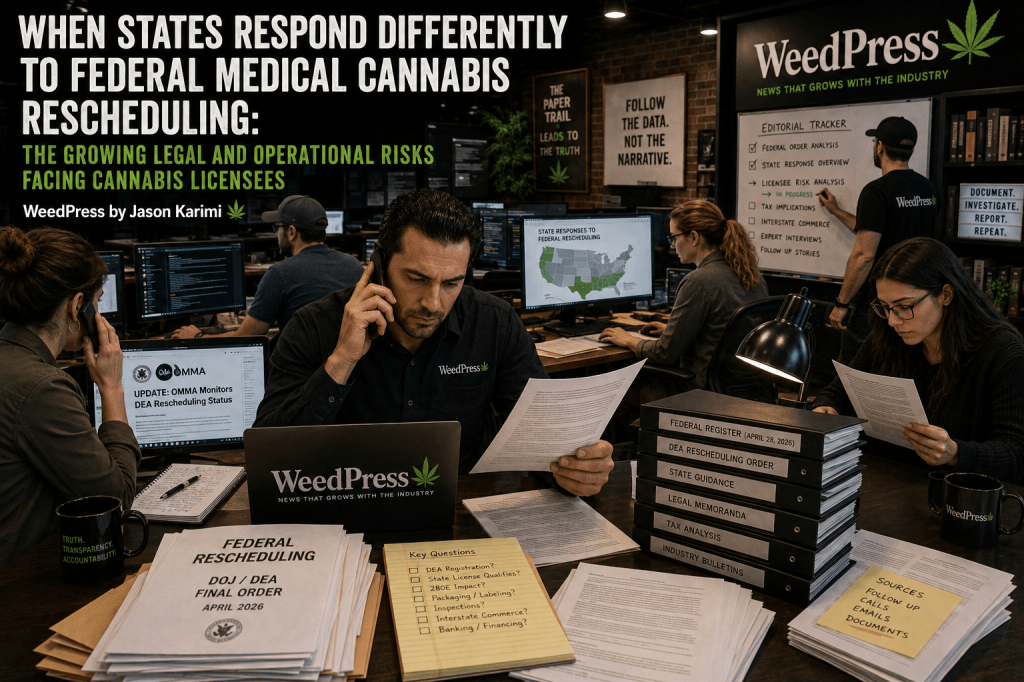
The Department of Justice’s April 2026 final order placing qualifying state-licensed medical cannabis into Schedule III of the federal Controlled Substances Act represented the most significant federal regulatory development affecting state medical cannabis programs since Congress first enacted the Controlled Substances Act in 1970.¹ Although the order did not legalize adult-use marijuana, nor eliminate federal criminal prohibitions outside its defined scope, it fundamentally altered the legal landscape for businesses operating under qualifying state medical cannabis licensing systems.²
Yet the federal order itself answered only part of the regulatory equation.
For cannabis businesses, the practical consequences of federal rescheduling depend not only upon federal law, but upon how individual states choose to interpret, implement, or respond to that federal action. Three months after the final order, states have begun following markedly different paths. Some have actively adjusted administrative procedures to facilitate participation in the new federal framework. Others have concluded that existing state regulations remain fully controlling. Several have acknowledged the federal action while promising additional analysis. Many have issued little detailed public implementation guidance at all.³
Those divergent approaches create far more than academic disagreement.
For cannabis licensees, they produce substantial legal and operational uncertainty affecting licensing strategy, tax planning, compliance programs, product labeling, DEA registration, inspections, investment decisions, and long-term business planning.
Federal rescheduling therefore should not be viewed as a single nationwide regulatory event.
Instead, it marks the beginning of a period during which state implementation—or the absence of implementation—may determine whether similarly situated businesses experience dramatically different legal and economic consequences.
Federal Rescheduling Did Not Create a Uniform National Cannabis Market
One misconception that emerged almost immediately following the federal order was the belief that placing qualifying medical cannabis into Schedule III automatically produced nationwide regulatory consistency.
The opposite is proving true.
The federal order establishes the federal scheduling status of qualifying marijuana, but it does not rewrite state cannabis statutes, amend administrative regulations, modify state licensing structures, or automatically determine whether an individual business satisfies the federal eligibility criteria. Those questions remain governed primarily by state law unless Congress or federal regulators expressly provide otherwise.⁴
Consequently, every state regulator faced a series of practical questions.
Should existing state medical licenses be considered qualifying licenses for purposes of the federal order?
Should state agencies create new licensing categories?
Should regulators modify packaging or labeling rules?
Should inspection procedures change?
Should businesses pursue DEA registration immediately?
Should agencies issue emergency rules?
Should state regulators wait for additional federal guidance?
Different states have reached different answers—or, in many jurisdictions, have declined to answer publicly at all.
For cannabis businesses operating across multiple jurisdictions, this growing divergence significantly complicates compliance planning.
The First Operational Question: Should Businesses Seek DEA Registration?
Among the earliest practical questions confronting medical cannabis businesses was whether they should immediately pursue DEA registration under the new federal framework.
California quickly moved toward administrative accommodation by publishing guidance concerning DEA registration, medicinal license designations, and licensing procedures intended to facilitate participation within the federal medical framework.⁵
Oklahoma adopted a more cautious approach.
The Oklahoma Medical Marijuana Authority advised businesses that while DEA registration may become relevant under the federal order, significant questions remained unresolved. Rather than encouraging immediate reliance upon evolving federal interpretations, OMMA emphasized continued compliance with Oklahoma law while advising licensees to obtain individualized legal counsel regarding federal registration decisions.⁶
The difference is substantial.
A California business reviewing state guidance could reasonably conclude that state regulators were preparing businesses for participation within the federal framework.
An Oklahoma business receives a different message: continue complying with existing state requirements while recognizing that federal implementation remains incomplete.
Neither approach is inherently inconsistent with the federal order.
They simply reflect different regulatory philosophies.
For businesses operating in multiple states, however, those differing philosophies make strategic planning considerably more difficult.
Should a multistate operator pursue DEA registration in every qualifying jurisdiction?
Should capital expenditures be delayed pending additional guidance?
Should companies restructure medical operations before regulators provide additional clarification?
Federal law presently offers only partial answers.

Does Every State Medical License Qualify?
Perhaps the most consequential unanswered legal question involves the phrase “qualifying state-issued medical marijuana license.”
Although the federal order identifies marijuana distributed pursuant to qualifying state medical licenses, it does not resolve every question concerning how diverse state licensing structures fit within that language.⁷
Some states maintain separate medical and adult-use licensing systems.
Others operate unified markets in which medical and adult-use cannabis share much of the same regulatory infrastructure.
Still others combine licensing privileges in ways that blur traditional distinctions.
Washington’s public interpretation illustrates the significance of this issue.
Rather than focusing exclusively upon implementation procedures, Washington concluded that the federal framework may not extend to many of its existing licensees because of the structure of the state’s licensing system itself.
If that interpretation ultimately proves correct, identical cannabis products could receive different federal treatment depending entirely upon how a particular state chose to organize its licensing statutes years before federal rescheduling occurred.
That possibility introduces substantial uncertainty for businesses seeking investment, financing, expansion, or interstate strategic planning.
Determining whether a business qualifies under the federal framework may require analysis extending well beyond possession of a state medical cannabis license.
Instead, qualification may depend upon the specific statutory authority under which that license exists, how the state defines medical cannabis, and whether the regulatory structure aligns with the language adopted by the federal government.
Those questions remain largely unresolved.
Taxation After Schedule III: Federal Relief Depends Upon More Than Federal Scheduling
Among the most widely discussed consequences of federal medical cannabis rescheduling has been the potential impact upon Internal Revenue Code § 280E. For years, § 280E prohibited businesses trafficking in Schedule I or Schedule II controlled substances from deducting ordinary and necessary business expenses, often producing effective tax rates far exceeding those experienced by similarly situated businesses in other industries.⁸
Federal placement of qualifying medical cannabis into Schedule III immediately prompted speculation that those businesses might become eligible for ordinary federal business deductions.
While that possibility may ultimately prove correct for qualifying businesses, state regulatory responses now play a significant role in determining who may actually benefit.
California’s administrative actions suggest that state regulators recognize businesses may begin evaluating federal participation strategies. Oklahoma, by contrast, has expressly cautioned businesses that important implementation questions remain unresolved and has encouraged consultation with qualified legal and tax professionals before relying upon assumptions regarding federal treatment.⁹
The distinction matters because tax planning frequently occurs months before returns are filed.
Business owners must decide whether to invest in expansion, hire employees, acquire equipment, or restructure operations based upon anticipated tax obligations.
If one state’s regulatory environment provides greater certainty than another’s, businesses may make substantially different financial decisions despite operating under the same federal order.
The result is that two medical cannabis businesses with similar products and comparable patient populations could reach entirely different tax planning strategies based largely upon the public guidance—or lack of guidance—issued by their respective state regulators.
Packaging and Labeling: Which Rules Govern?
Packaging presents another area where divergent state responses create practical uncertainty.
Most cannabis businesses already operate under detailed state requirements governing warning labels, product information, child-resistant packaging, batch identification, testing disclosures, and transportation documentation.
Federal rescheduling naturally raises questions regarding whether federal labeling standards will supplement, replace, or coexist with those existing state requirements.
Oklahoma has directly addressed that issue.
OMMA advised licensees that Oklahoma packaging and labeling requirements remain controlling unless and until state regulations are formally amended. Businesses therefore should not independently modify state-required packaging merely because federal law has changed.¹⁰
That guidance provides operational certainty.
Without similar public clarification, businesses in other jurisdictions may be left to determine independently whether federal changes require immediate operational adjustments.
For manufacturers operating in multiple states, inconsistent guidance creates additional complexity.
Should products be packaged differently depending upon jurisdiction?
Should businesses prepare for future federal labeling standards before those standards exist?
Should inventory be redesigned now or after additional federal rulemaking?
These are not merely academic questions.
Packaging modifications require new printing, revised inventory management, updated quality assurance procedures, employee training, and potentially substantial financial investment.
Inspections and Compliance Programs
Routine regulatory inspections also become more complicated when federal and state systems begin evolving at different speeds.
Historically, cannabis inspections focused almost entirely upon state compliance because federal prohibition largely prevented meaningful interaction between state licensing systems and federal regulatory recognition.
The new Schedule III framework introduces a different possibility.
Businesses may eventually operate within an environment where both state licensing compliance and federal regulatory expectations become increasingly relevant.
Yet few states have publicly explained how inspections might evolve if businesses begin participating within the federal framework.
Will state inspectors evaluate DEA registration status?
Will inspection protocols change?
Will states develop new recordkeeping requirements?
Will regulators coordinate more directly with federal agencies?
At present, relatively few public answers exist.
The absence of detailed implementation guidance therefore increases operational uncertainty for compliance officers responsible for developing internal auditing procedures and employee training programs.
Rather than preparing for clearly defined regulatory expectations, many businesses remain in a holding pattern while awaiting additional clarification from both state and federal authorities.

Throw up your peace signs show me how you manifest
We all know those suffering for apathy are locked in a box
So show ’em that you have the key https://youtu.be/6GRliSPYeEg?is=uP-0QuJy5PCZuZWs
Interstate Commerce Remains One of the Largest Unanswered Questions
Perhaps no issue illustrates the limits of federal rescheduling more clearly than interstate commerce.
Some observers initially assumed that Schedule III status would permit transportation of medical cannabis across state lines.
Neither the federal order nor state regulatory responses support such a broad conclusion.
Oklahoma specifically acknowledged that interstate commerce remains an area lacking meaningful federal guidance. Rather than encouraging businesses to prepare for interstate distribution, OMMA emphasized that significant legal uncertainty continues to exist.¹¹
That cautious position reflects the broader national landscape.
Federal scheduling alone does not establish comprehensive interstate commercial rules for cannabis products.
Questions concerning transportation, distribution, federal registration, manufacturing authority, state reciprocity, and enforcement remain largely unresolved.
Businesses hoping that federal rescheduling would immediately create a national medical cannabis marketplace therefore continue to face substantial legal uncertainty.
Until Congress, DEA, FDA, or additional federal authorities provide further direction, interstate expansion strategies remain subject to considerable legal risk.

Financing and Investment Decisions
Regulatory uncertainty extends well beyond day-to-day compliance.
Investors, lenders, insurers, and institutional partners increasingly evaluate cannabis businesses based upon regulatory predictability.
Where state agencies publish detailed implementation guidance, businesses may be better positioned to explain future compliance strategies during financing discussions.
Conversely, in jurisdictions where regulators have issued limited public guidance, investors may find it more difficult to assess long-term legal risk.
That uncertainty can influence lending decisions, acquisition strategies, valuation models, insurance underwriting, and private investment.
Consequently, regulatory communication itself becomes an economic factor.
The clarity provided by state agencies—or the absence of that clarity—may affect capital markets independently of any substantive legal changes.
For an industry already operating within one of the nation’s most complex regulatory environments, predictable communication carries significant economic value.
Multistate Operators Face Increasing Compliance Complexity
The practical consequences of divergent state responses become even more significant for businesses operating across multiple jurisdictions.
Historically, multistate operators (MSOs) have already navigated varying licensing standards, ownership restrictions, testing requirements, advertising rules, and taxation systems. Federal medical cannabis rescheduling adds another layer of complexity because businesses must now evaluate not only differences in state cannabis laws, but also differences in how state regulators interpret and communicate the federal order.
A company operating in California may receive detailed administrative guidance regarding medicinal licensing, DEA registration, and implementation planning. The same company operating simultaneously in Oklahoma encounters a regulator emphasizing continuity of state law while cautioning that significant federal implementation questions remain unresolved. In Washington, businesses confront public statements questioning whether much of the state’s licensing structure even falls within the federal medical framework. In New Mexico, regulators have emphasized that federal action does not automatically modify existing state obligations.
Each approach is legally defensible within its own jurisdiction.
Collectively, however, they require multistate businesses to develop state-specific compliance strategies rather than relying upon a single nationwide operational model.
For compliance officers, attorneys, accountants, and executive leadership, federal rescheduling has therefore increased—not decreased—the need for jurisdiction-specific legal analysis.
Local Regulators Begin Filling the Information Gap
Although this review focuses primarily upon state regulatory responses, at least one municipal regulator has begun providing public education concerning the federal medical cannabis order.
On July 20, 2026, the Los Angeles Department of Cannabis Regulation (DCR) acknowledged that federal medical cannabis rescheduling had generated operational questions among licensed businesses. Rather than issuing an extensive legal interpretation, the Department directed licensees to an educational podcast discussing federal developments and practical issues businesses should monitor as implementation continues.
Los Angeles cannot rewrite California cannabis law.
Nor can a municipal agency independently determine federal regulatory policy.
Nevertheless, the bulletin demonstrates an important emerging trend.
Where comprehensive statewide implementation guidance remains limited, local regulators may increasingly serve as the first governmental entities providing practical educational resources for businesses attempting to understand rapidly evolving federal developments.
This municipal communication should not be viewed as another state implementation model.
Instead, it demonstrates that regulatory communication itself is beginning to occur at multiple levels of government.
That development reinforces one of the central findings of this review: the demand for regulatory explanation has not diminished simply because many states have issued limited formal guidance. Other governmental actors are beginning to fill portions of that informational gap.
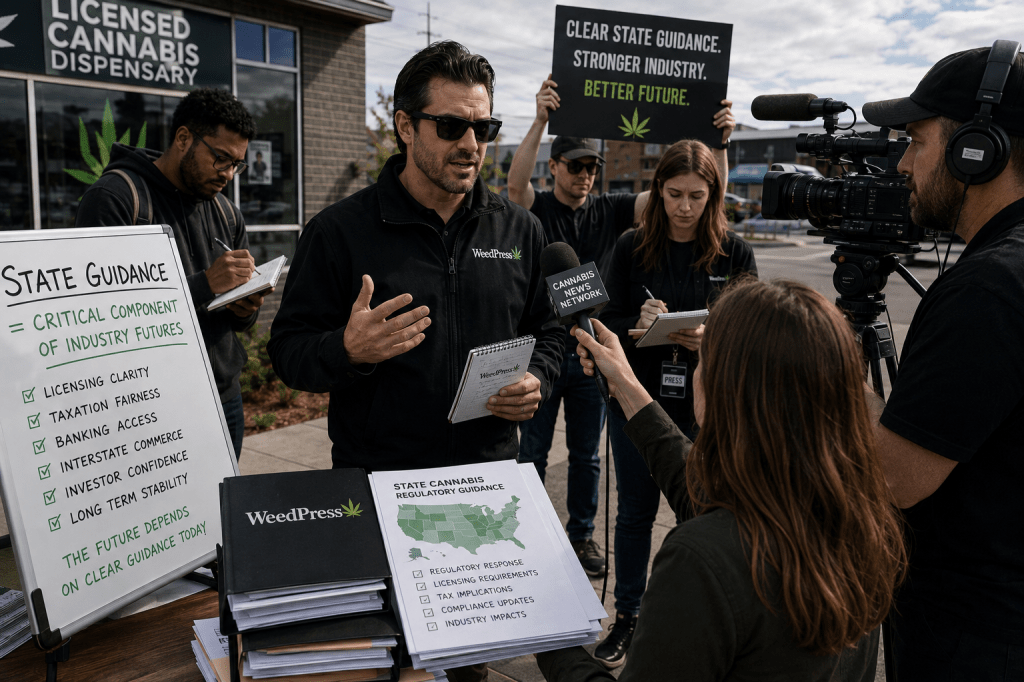
Four Regulatory Models Are Beginning to Emerge
Although federal implementation remains in its early stages, public regulatory responses now suggest four broad approaches.
First, California represents an administrative facilitation model. Rather than merely acknowledging federal rescheduling, California has begun modifying aspects of its licensing administration to accommodate businesses seeking participation within the federal medical framework.
Second, Oklahoma and New Mexico represent regulatory continuity models. Those agencies emphasize that existing state requirements remain controlling while providing practical guidance explaining how businesses should continue operating despite evolving federal law.
Third, Washington illustrates a structural interpretation model. Rather than focusing primarily upon implementation procedures, Washington has publicly questioned whether much of its licensing system falls within the federal framework because of the structure of the state’s cannabis market.
Fourth, several jurisdictions—including Michigan during its initial response—illustrate a deliberative review model. These agencies have acknowledged the significance of the federal order while indicating that additional legal analysis remains necessary before comprehensive implementation guidance is issued.
Many other states have not yet publicly adopted any clearly identifiable implementation model.
That observation should not necessarily be interpreted as regulatory inaction.
Agencies may be conducting internal legal analysis, consulting with attorneys general, coordinating with governors’ offices, or awaiting additional federal direction before issuing public guidance.
Nevertheless, from the perspective of regulated businesses, public communication remains an important component of regulatory certainty.
Practical Considerations for Cannabis Licensees
Until additional federal and state guidance becomes available, cannabis businesses should approach federal medical rescheduling with measured caution.
Businesses should avoid assuming that federal Schedule III status automatically alters existing state licensing obligations.
Operational decisions involving taxation, DEA registration, packaging, labeling, inspections, financing, or expansion should be evaluated within the context of both federal developments and the specific guidance issued by the jurisdiction in which the business operates.
Companies operating in multiple states should recognize that a strategy appropriate in one jurisdiction may not be appropriate elsewhere.
Similarly, businesses should continue monitoring both state regulators and federal agencies for additional implementation guidance as the legal landscape continues to evolve.
Federal rescheduling represents a significant legal development.
It does not represent the end of cannabis regulatory evolution.
Rather, it marks the beginning of a new period during which federal recognition and state implementation must gradually be reconciled through legislation, administrative rulemaking, agency guidance, and, quite possibly, future litigation.
Conclusion
Federal medical cannabis rescheduling did not produce a single national regulatory framework.
Instead, it exposed the diversity of existing state cannabis regulatory systems and highlighted the substantial discretion retained by state governments in determining how federal changes will be implemented within their own licensing structures.
Some regulators have acted quickly.
Others have emphasized continuity.
Still others continue studying the issue.
Many have yet to publicly define their approach.
For cannabis licensees, that divergence carries practical consequences extending well beyond legal theory.
Tax planning, licensing strategy, compliance programs, investment decisions, operational procedures, and long-term business planning increasingly depend not only upon federal law, but also upon the decisions individual states make in response to that law.
The federal government’s April 2026 order therefore should be understood not as the conclusion of cannabis reform, but as the opening chapter of a new regulatory era.
Whether that era ultimately produces greater national consistency or deeper regulatory fragmentation will depend less upon the federal order itself than upon how states choose to respond in the months and years ahead.
Footnotes
- Schedules of Controlled Substances: Rescheduling of Food and Drug Administration Approved Products Containing Marijuana From Schedule I to Schedule III; Corresponding Change to Permit Requirements, 91 Fed. Reg. 22,714 (Apr. 28, 2026). https://www.justice.gov/opa/pr/justice-department-places-fda-approved-marijuana-products-and-products-containing-marijuana
- Id.
- See, e.g., California Department of Cannabis Control, Federal Rescheduling Resources; Oklahoma Medical Marijuana Authority, UPDATE: OMMA Monitors DEA Rescheduling Status, Shares Recently Filed Lawsuit (May 6, 2026); New Mexico Cannabis Control Division, Industry Bulletin 26-07 (June 16, 2026). https://oklahoma.gov/omma/about/news/2026/update-omma-monitors-dea-rescheduling-status-shares-recently-filed-lawsuit.html
- See Controlled Substances Act, 21 U.S.C. §§ 801–971.
- California Dep’t of Cannabis Control, Federal Rescheduling Resources, https://www.cannabis.ca.gov/licensees/cannaconnect-compliance-hub/federal-rescheduling-resources/ (last visited Aug. 2, 2026).
- Oklahoma Medical Marijuana Authority, Update: OMMA Monitors DEA Rescheduling Status; Frequently Asked Questions (May 2026). https://oklahoma.gov/omma/about/news/2026/update-omma-monitors-dea-rescheduling-status-shares-recently-filed-lawsuit.html
Schedules of Controlled Substances: Rescheduling of Food and Drug Administration Approved Products Containing Marijuana From Schedule I to Schedule III; Corresponding Change to Permit Requirements, supra note 1.- I.R.C. § 280E.
- Oklahoma Medical Marijuana Authority, Update: OMMA Monitors DEA Rescheduling Status; Frequently Asked Questions (May 2026); California Department of Cannabis Control, Federal Rescheduling Resources.
- Oklahoma Medical Marijuana Authority, supra note 9.
- Id.
- Los Angeles Department of Cannabis Regulation, July 2026 News Bulletin (July 20, 2026).
- Washington State Liquor and Cannabis Board, Bulletin addressing the applicability of the federal medical cannabis rescheduling order to Washington licensees (June 2026). https://content.govdelivery.com/accounts/WALCB/bulletins/41c1c1a
- New Mexico Cannabis Control Division, Industry Bulletin 26-07 (June 16, 2026).
- Michigan Cannabis Regulatory Agency, Press Release: Federal Order Rescheduling Cannabis (Apr. 23, 2026). https://www.michigan.gov/lara/news-releases/2026/04/23/press-release-federal-order-rescheduling-cannabis
- California Department of Cannabis Control, Federal Rescheduling Resources.
- Oklahoma Medical Marijuana Authority, Frequently Asked Questions Regarding Federal Medical Cannabis Rescheduling (May 2026).
- Department of Justice & Drug Enforcement Administration, Final Order, Schedules of Controlled Substances: Rescheduling of Marijuana (Apr. 2026).
silence is the language of god,
all else is poor translation.
Rumi


Leave a Reply