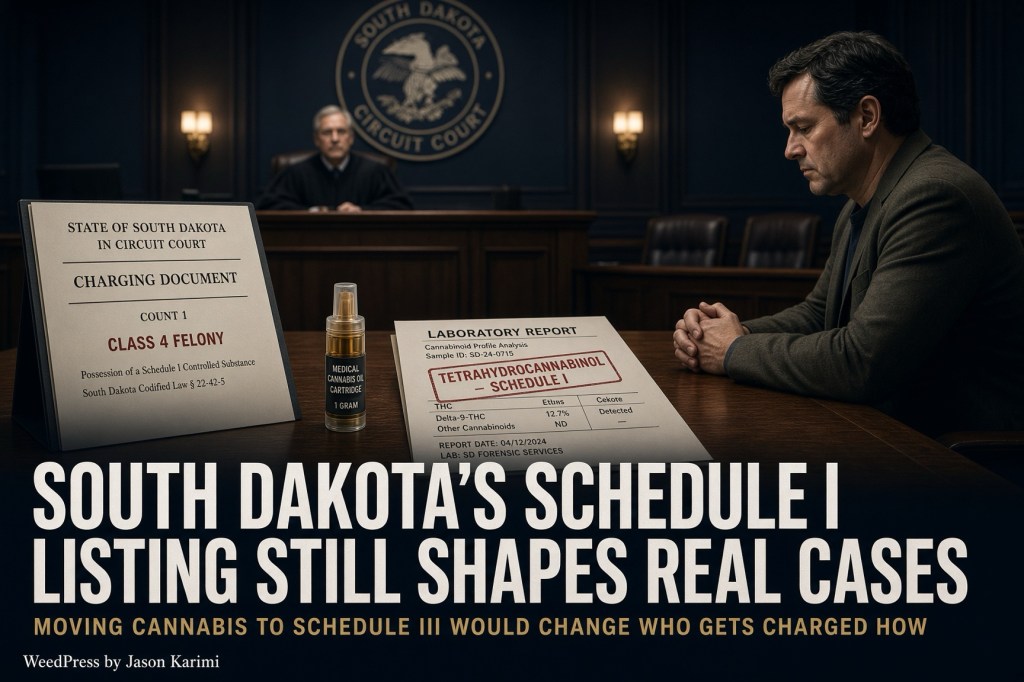
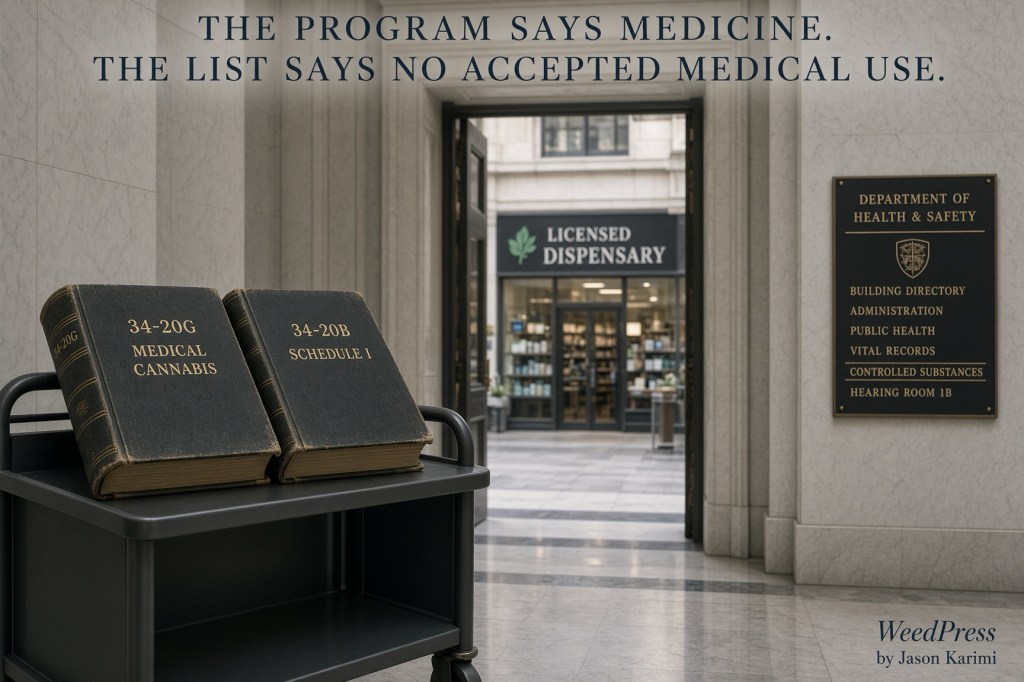
South Dakota already runs a medical cannabis program. It also still lists hashish, hash oil, and tetrahydrocannabinols in Schedule I. Those two facts sit in different titles of the code, and they do not cancel each other out. The medical statutes create a permission structure for qualifying patients and licensees. The Schedule I listing still feeds the charging statutes that treat concentrates as hard controlled substances. That split is how Schedule I continues to affect people even after Initiated Measure 26.¹
The listing is not a slogan. It is a statutory classification with downstream criminal consequences. Changing it to Schedule III would not legalize adult use and would not repeal the separate marijuana-possession ladder. It would change the felony theory that applies when the product is oil, hash, or another concentrate rather than flower. That is the part of the code that still does the most damage.
How South Dakota Split the Plant from the Concentrate
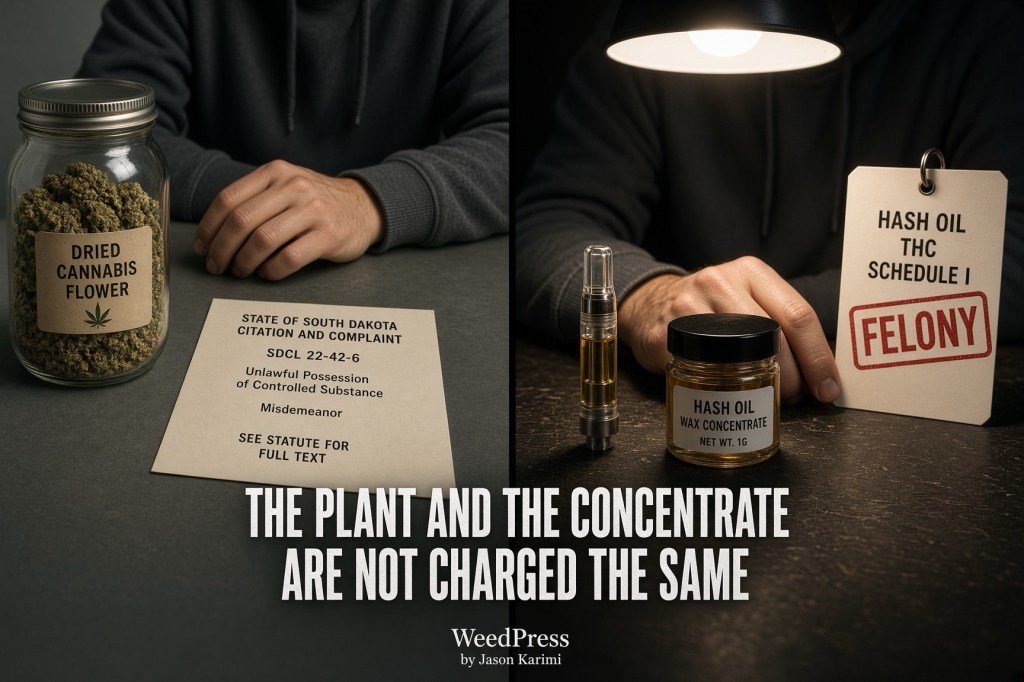
Natural, unaltered marijuana is policed mainly through SDCL 22-42-6. That section bans unauthorized possession by weight. Two ounces or less is a Class 1 misdemeanor. Larger amounts become felonies on a quantity ladder that does not depend on whether the plant is printed in the Schedule I hallucinogen list.²
Concentrates are different. Hashish and hash oil are named in Schedule I. Tetrahydrocannabinols are also named in Schedule I, with limited exceptions for industrial hemp, FDA-approved drug products, and marijuana in its natural and unaltered state.³ Those listings matter because South Dakota’s manufacture, distribution, and unauthorized-possession statutes are written around schedule number.
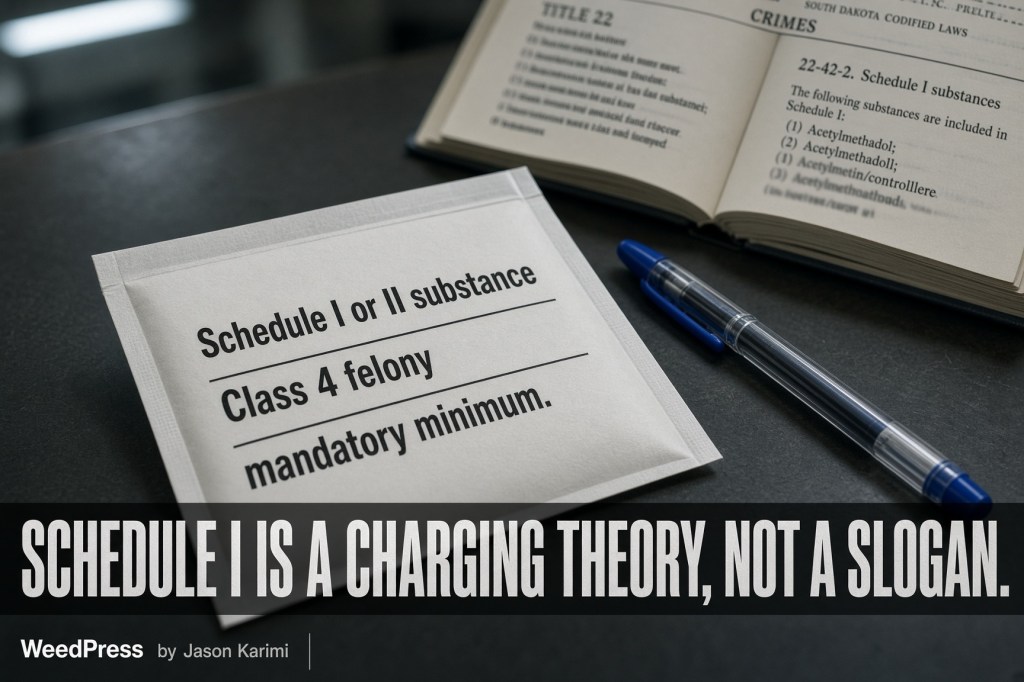
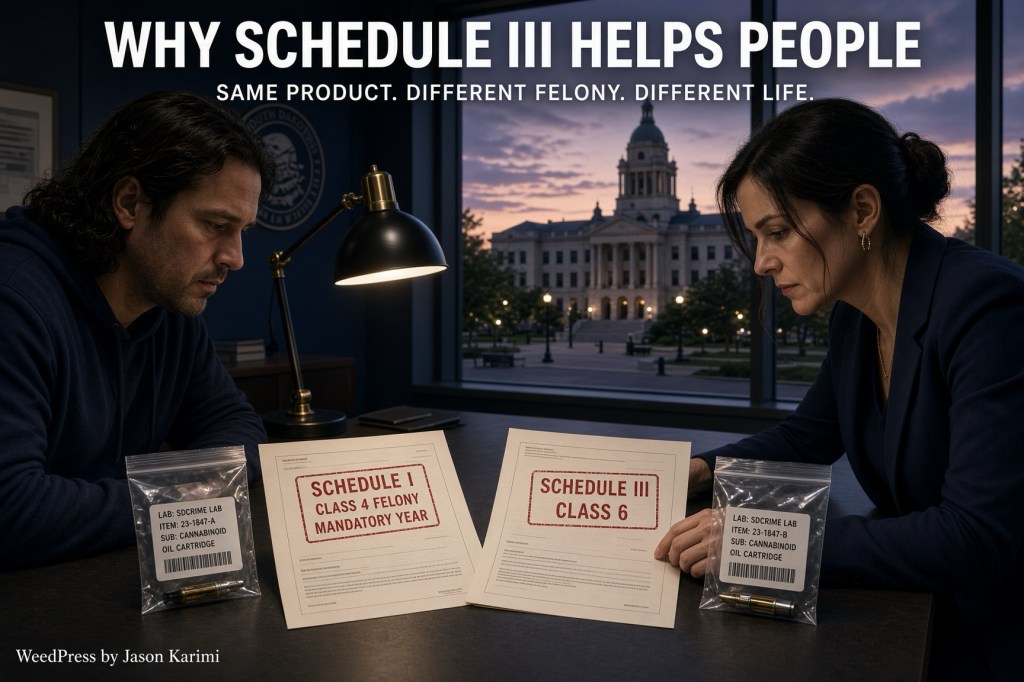
Unauthorized manufacture, distribution, or possession with intent to distribute a Schedule I or II substance is a Class 4 felony under SDCL 22-42-2. A first conviction carries a mandatory minimum term of imprisonment of one year.⁴ Unauthorized possession of a Schedule I or II substance is a Class 5 felony under SDCL 22-42-5. Unauthorized possession of a Schedule III or IV substance under the same section is a Class 6 felony.⁵
That is the mechanism. Flower is often a 22-42-6 case. A cartridge, wax, or oil can become a Schedule I controlled-substance case. The medical program can protect a cardholder who stays inside Title 34-20G. It does not erase the Schedule I hook when the lab report says THC or hash oil and the charging document follows the schedule list instead of the medical chapter.⁶
The Schedule I Findings Are the Policy Problem
Schedule I is not only a penalty trigger. It is also a set of official findings. To remain in Schedule I, a substance is supposed to have a high potential for abuse, no accepted medical use in the United States, and a lack of accepted safety for use under medical supervision.⁷
South Dakota cannot keep those findings and operate an honest medical program at the same time. The state licenses cultivation, manufacturing, and dispensing of cannabis products, including concentrated forms. It issues cards to patients with debilitating conditions. It then leaves the same cannabinoids on a list that says they have no accepted medical use. That contradiction is not academic. It shows up in charging language, institutional counsel memos, employer policies, and later litigation over whether cannabis is still an “illegal drug” for civil-rights purposes.⁸
Federal rescheduling of medical cannabis products to Schedule III did not rewrite South Dakota’s code. It did make the state findings harder to defend. The federal change is limited. It covers specified medical products under a state medical scheme and does not legalize adult-use flower. It is still a federal acknowledgment of accepted medical use for those products. South Dakota’s Schedule I findings have not caught up.⁹
Who the Current Listing Hits
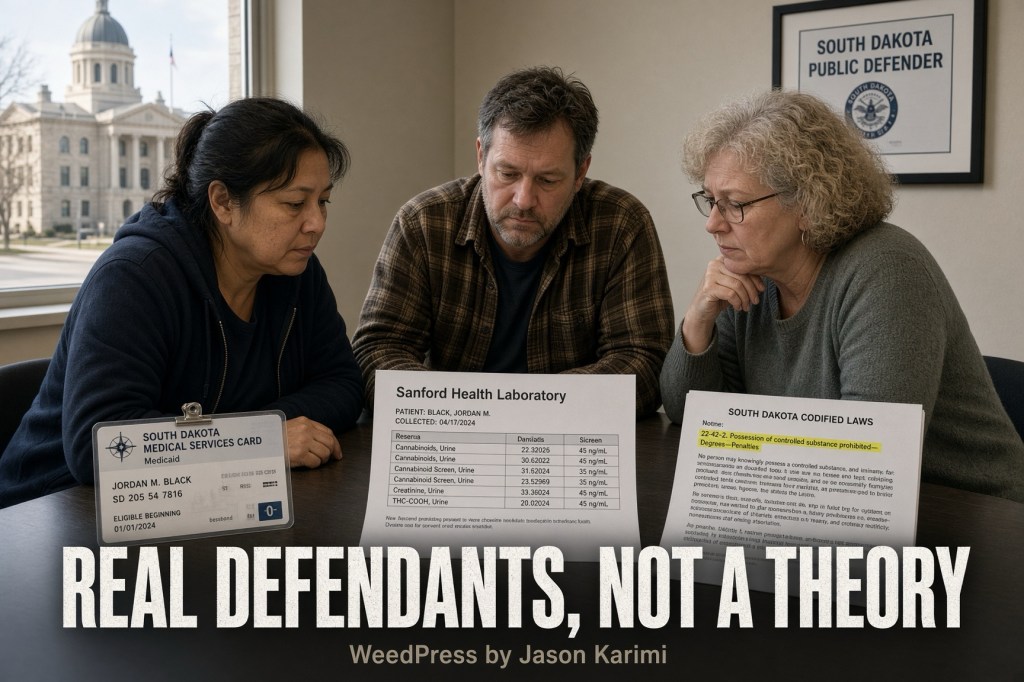
A qualifying patient with flower, inside possession limits, is the person Schedule I affects least on a good day. Title 34-20G already authorizes that possession. The remaining harm is stigma, institutional caution, and the risk of a stop that gets written up under the wrong statute.¹⁰
A qualifying patient with oil, a vape cartridge, or another concentrate is in a different position. That is the product most likely to be described as hashish, hash oil, or tetrahydrocannabinol on a lab report. If the case is charged under the Schedule I statutes instead of the medical chapter, the person is looking at a Class 5 possession theory or a Class 4 manufacture-or-distribute theory rather than the marijuana quantity ladder.¹¹
An uncarded person with flower is still exposed under 22-42-6 whether or not the Schedule I list moves. Rescheduling concentrates does not repeal the plant ban. An uncarded person with concentrate currently faces the harsher schedule-based path. Moving those items to Schedule III would not make that possession lawful. It would reduce the felony class available under 22-42-5 and remove the cleanest path into 22-42-2.¹²
Institutions feel the listing even when nobody is arrested. Nursing homes, hospitals, and employers still read “Schedule I” as “no accepted medical use.” That reading is what produces blanket bans, refusal to treat state-authorized use like other medicine, and the claim that accommodation is impossible because the substance is illegal in the relevant sense. The medical program already contradicts that claim. The Schedule I findings keep giving institutions a statute to hide behind.¹³
What Schedule III Would Change
A legislative move of hashish, hash oil, and tetrahydrocannabinols from Schedule I to Schedule III would do four concrete things.
First, it would change the default felony class for unauthorized concentrate possession under 22-42-5 from Class 5 to Class 6. That is still a felony. It is not the same felony. Prison exposure, collateral consequences, and plea leverage all move with the class.¹⁵
Second, it would take concentrates out of the Schedule I/II manufacture-and-distribution statute. SDCL 22-42-2 is built for Schedules I and II. A Schedule III listing forces the State to use a different charging theory or amend the criminal chapter. The one-year mandatory minimum attached to a first 22-42-2 conviction is the piece that makes a small amount of oil look like a major controlled-substance case.¹⁶
Third, it would retire the official finding that these substances have no accepted medical use in the United States. Schedule III is the schedule for substances with accepted medical use and a lower abuse potential than Schedule I or II. That is the classification that matches a functioning medical program. It is also the classification that makes it harder for an institution to say state-authorized medical cannabis is still an illegal drug in the old sense.¹⁷
Fourth, it would reduce the statutory contradiction that currently asks patients, licensees, and regulators to live in two titles at once. Title 34-20G says this product may be grown, processed, sold, and used as medicine. Title 34-20B still says the concentrated form of that product belongs with substances that have no accepted medical use. Aligning the schedule with the medical program does not expand the program. It stops the code from denying the program’s premise.¹⁸
What Schedule III Would Not Do
It would not create adult-use legalization. SDCL 22-42-6 would still prohibit unauthorized possession of marijuana by weight. Public use, impaired driving, and unlicensed sale would remain crimes. Federal law would still govern interstate movement, most banking questions, firearms under federal statutes, and immigration consequences.¹⁹
It would not automatically require employers, landlords, or nursing homes to accommodate every form of use. Those fights turn on the Americans with Disabilities Act, state disability law, facility rules, and the facts of each case. Schedule III removes a bad official finding. It does not write the accommodation order.²⁰
It would not, by itself, decide a religious-exemption case. The claimant would still have to prove a sincere religious exercise and a substantial burden. The State would still get to try to prove a compelling interest and least restrictive means. The schedule change would only take away the State’s cleanest talking point.²¹
It would not let the Department of Health invent a new market. Moving a substance between schedules is a legislative act under South Dakota’s structure. An agency letter is not a substitute for amending 34-20B-14 and the related criminal sections.²²
Why the Change Helps People Even If It Looks Technical
The people who need this change are not waiting for a theory of federalism. They are waiting for the charging document to stop treating a state-licensed medical product like a Schedule I narcotic.
A patient who uses oil because flower is impractical should not face a different felony universe than a patient who uses flower. A caregiver transporting a lawful concentrate should not be one lab label away from 22-42-2. A compliance officer at a facility should not be able to point at 34-20B-11 and pretend the state has not already accepted medical use. A prosecutor who wants a serious case will still have 22-42-6, distribution statutes, and the medical-program limits. What they should not have is a Schedule I finding that the Legislature no longer believes.²³
Schedule III is the modest version of honesty. It leaves adult use illegal. It leaves the medical program in charge of who may possess what. It simply stops classifying the concentrated form of that medicine as a substance with no accepted medical use and no accepted safety under medical supervision. That is a small amendment in the code book. It is not small in a courtroom.
Footnotes
¹ SDCL 34-20G-1 to -96 (medical cannabis program); SDCL 34-20B-14(10), (20) (hashish, hash oil, and tetrahydrocannabinols in Schedule I).
² SDCL 22-42-6.
³ SDCL 34-20B-14(10), (20); SDCL 34-20B-1 (definitions of marijuana and hashish).
⁴ SDCL 22-42-2.
⁵ SDCL 22-42-5.
⁶ See SDCL 34-20G-13, -51 (protections and medical-purpose defense within program limits).
⁷ SDCL 34-20B-11.
⁸ SDCL 34-20B-11; SDCL 34-20G-1 to -96.
⁹ C.J. Keene, How Federal Cannabis Scheduling Shakeup Impacts South Dakota Medical Marijuana Policy, SDPB (Aug. 18, 2026) (reporting NCSL briefing that federal Schedule III is limited to specified medical products and does not legalize adult-use cannabis).
¹⁰ SDCL 34-20G-1 to -96; SDCL 22-42-6.
¹¹ SDCL 34-20B-14(10), (20); SDCL 22-42-2; SDCL 22-42-5.
¹² SDCL 22-42-6; SDCL 22-42-5.
¹³ SDCL 34-20B-11; see also 42 U.S.C. §§ 12102, 12112, 12210 (ADA disability and illegal-drug-use provisions).
¹⁵ SDCL 22-42-5.
¹⁶ SDCL 22-42-2.
¹⁷ SDCL 34-20B-18 (Schedule III criteria and listing structure); SDCL 34-20B-11.
¹⁸ SDCL 34-20B-14(10), (20); SDCL 34-20G-1 to -96.
¹⁹ SDCL 22-42-6; SDCL 22-42-24 to -25; Keene, supra note 9.
²⁰ 42 U.S.C. §§ 12112, 12210.
²¹ SDCL 1-1A-4.
²² SDCL 34-20B-14; SDCL 34-20B-27.
²³ SDCL 22-42-2; SDCL 22-42-5; SDCL 22-42-6; SDCL 34-20B-11.
 WeedPress: The Paper Trail
Leave a comment