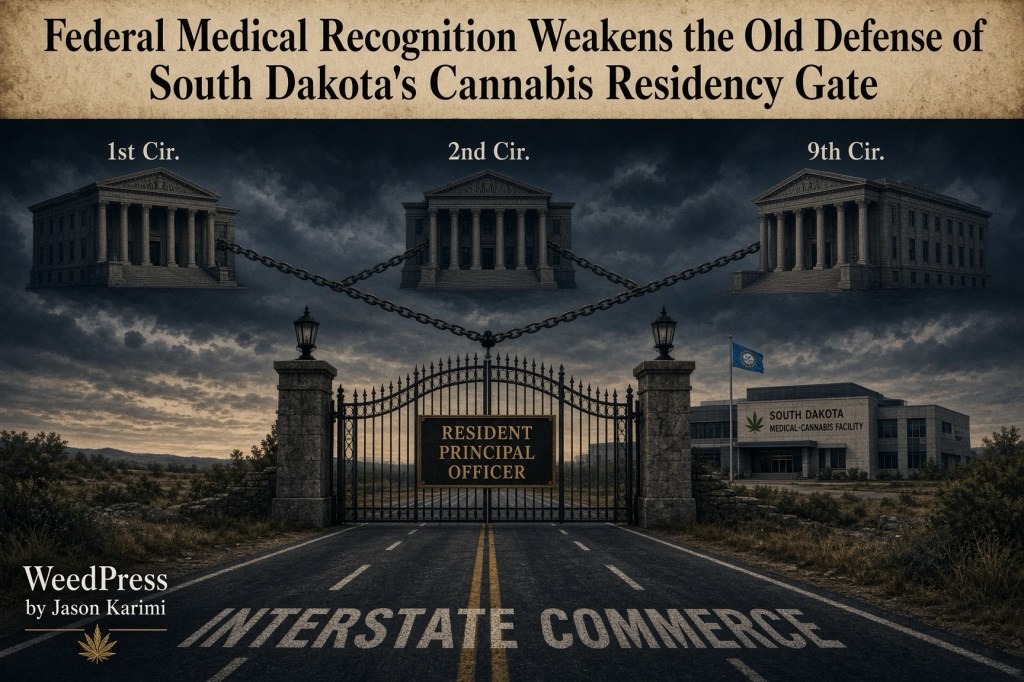
A federal shift in how medical marijuana is regulated is forcing states to confront an old constitutional question: can they still reserve cannabis licensing opportunities for residents when federal law no longer treats qualifying medical marijuana as entirely illicit?
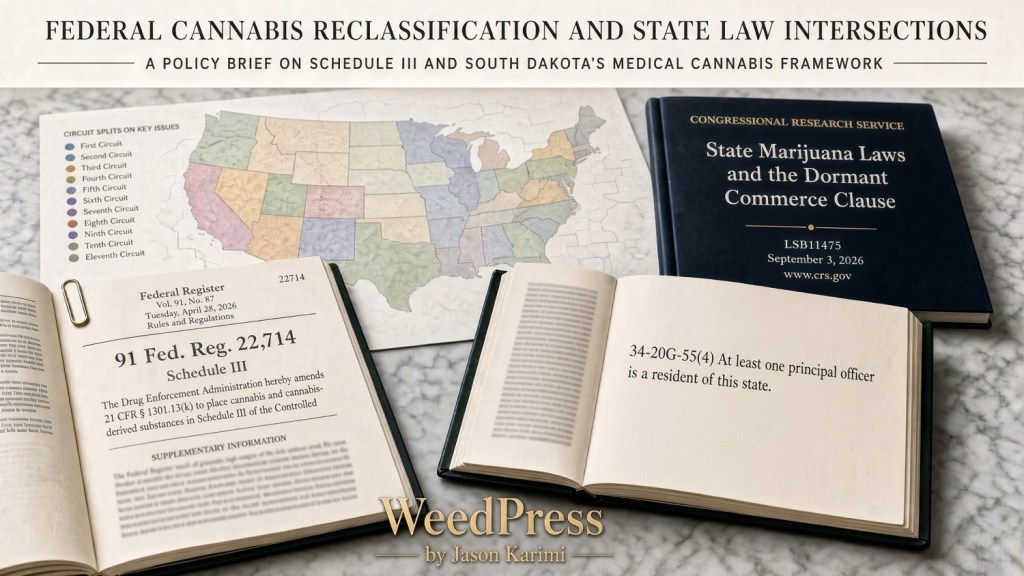
A Congressional Research Service legal sidebar issued September 3, 2026 maps a live circuit split over whether state cannabis licensing rules that favor residents violate the Dormant Commerce Clause.¹ That split now sits on top of the Department of Justice’s April 2026 order placing specified FDA-approved marijuana products and marijuana subject to a qualifying state medical license in Schedule III.² South Dakota’s medical program still requires that at least one principal officer of an establishment be a state resident.³ The statute is narrower than the Maine rule the First Circuit struck down. It is still a residency gate.⁴
The Dormant Commerce Clause is the judicial doctrine that states may not adopt protectionist commercial rules even when Congress has not passed a conflicting statute.⁵ Courts apply it to laws that discriminate against out-of-state people and capital, and to facially neutral rules that unduly burden interstate commerce.⁶ For years, states defending cannabis residency preferences argued that the doctrine does not apply because the Controlled Substances Act made the underlying market federally illegal.⁷ Some courts accepted that premise. Others did not.
That tension was visible before the April order. In 2022, Yale Law & Policy Review identified the Dormant Commerce Clause as a “sleeping giant” over cannabis markets and warned that residency restrictions and other geographically preferential licensing structures could become constitutionally vulnerable as federal law moved toward recognizing interstate cannabis commerce.⁸ WeedPress Policy Series No. 16 made a related structural point in April 2026: rescheduling would weaken the “no lawful interstate market” shield and reopen horizontal federalism constraints on protectionist licensing.⁹ CRS has now put that map in front of Congress.¹⁰
The First Circuit held that Maine’s requirement that dispensary officers and directors be state residents violated the Dormant Commerce Clause.¹¹ Federal prohibition, the court concluded, did not authorize the state to reserve the local medical market for residents.¹² The Second Circuit treated New York’s conviction-linked licensing preferences as discriminatory under the same doctrine.¹³ The Ninth Circuit went the other way. In January 2026 it held that the Dormant Commerce Clause does not protect interstate commerce in a cannabis market Congress declared illegal, and it upheld Washington and Sacramento residency rules.¹⁴ CRS told Congress the Supreme Court has not resolved the conflict and that the split makes review more likely.¹⁵ The Peridot Tree parties obtained an extension of their certiorari deadline to September 10, 2026.¹⁶
April 2026 materially changed the federal-law premise underlying the Ninth Circuit’s approach. The final order did not legalize adult-use marijuana and did not create a general right to ship product across state lines.¹⁷ It placed specified FDA-approved marijuana products and marijuana subject to a qualifying state medical license in Schedule III and created an expedited DEA registration path for holders of those state licenses.¹⁸ Qualifying medical marijuana is no longer treated as Schedule I marijuana. It is instead placed within a federally regulated Schedule III framework that expressly incorporates state medical-marijuana licensing into the federal registration system.¹⁹ That is not the same thing as a completed, generally lawful interstate cannabis market. CRS has noted that the order does not immediately bring the entire state-legal industry into compliance with federal law.²⁰
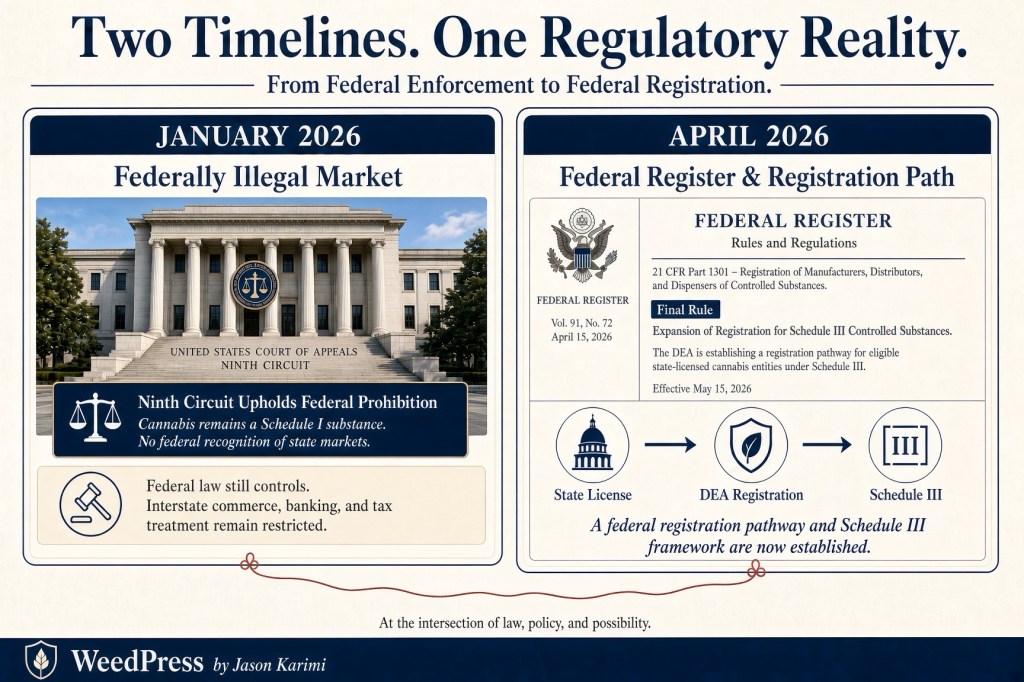
Policy Series No. 16 argued that once federal law acknowledges medical legitimacy, the categorical claim that marijuana is wholly illicit commerce weakens unless Congress speaks with unmistakable clarity.²¹ The Yale analysis made the same congressional-authorization point: Congress can displace the default Dormant Commerce Clause rule, but it must do so clearly.²² Nothing in the April 2026 order expressly authorizes states to discriminate against out-of-state participants in medical cannabis licensing.²³ Whether the new federal medical framework changes the constitutional analysis remains an unresolved question.²⁴
South Dakota is a medical-only market.²⁵ SDCL 34-20G-55(4) does not require every owner to live in the state. It requires at least one principal officer to be a resident before a registration certificate issues.²⁶ That is a structural condition: install an in-state officer or stay out. WeedPress flagged the provision in February 2026, before the April order and before the Ninth Circuit decision.²⁷
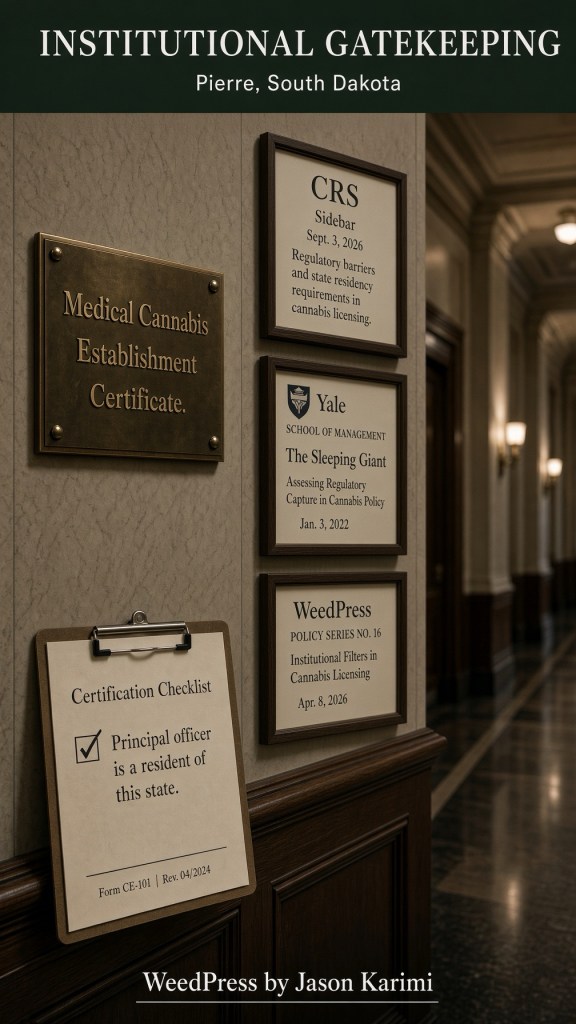
The Eighth Circuit has not decided whether a state medical-cannabis licensing residency condition survives the Dormant Commerce Clause. It does, however, have older precedent holding that marijuana constituting contraband under applicable law is not an article of interstate commerce protected by the Commerce Clause.²⁸ Whether that reasoning controls a state-licensed medical marijuana market operating under the April 2026 federal Schedule III framework is an unresolved question. Pierre therefore sits between circuits that would likely test the statute and a circuit that would not, with a regional precedent written for a different federal-law world.²⁹
Two further limits matter. First, a Dormant Commerce Clause challenge attacks who may hold the state license. It does not authorize domestic interstate shipment of marijuana. Covered marijuana remains subject to federal controlled-substance requirements, including applicable registration and other federal controls. International importation and exportation require permits under 21 C.F.R. § 1312.30.³⁰ Second, South Dakota’s rule is milder than Maine’s all-officer residency mandate. A court could still find a discriminatory purpose or effect. It could also treat the single-officer requirement as too thin to trigger the doctrine. That is a fact-specific question the Eighth Circuit has not answered.³¹

The honest conclusion is narrower than a prediction that the statute will fall. Federal medical recognition undercut the cleanest defense of residency locks. CRS has now told the Hill that the courts of appeals are split, that the April order may affect how later courts analyze the issue, and that Supreme Court review is more likely.³² The Peridot Tree petition is approaching a September 10 certiorari deadline.³³ South Dakota still conditions medical establishment certificates on an in-state principal officer. I have not identified a published South Dakota agency analysis addressing the constitutionality of that requirement after the April 2026 federal order.³⁴ States that leave residency gates unexamined are betting that the Ninth Circuit’s premise survives a federal framework that now expressly places qualifying state-licensed medical marijuana within a Schedule III regulatory and registration system.
That bet is no longer free.³⁵
Footnotes
¹ Cong. Rsch. Serv., LSB11475, State Marijuana Laws and the Dormant Commerce Clause (Sept. 3, 2026). https://www.congress.gov/crs-product/LSB11475
² Schedules of Controlled Substances: Rescheduling of Marijuana, 91 Fed. Reg. 22,714 (Apr. 28, 2026); Cong. Rsch. Serv., LSB11424, Department of Justice Eases Control of Medical Marijuana (Apr. 30, 2026).
³ S.D. Codified Laws § 34-20G-55(4).
⁴ Compare id. with Ne. Patients Grp. v. United Cannabis Patients & Caregivers of Me., 45 F.4th 542 (1st Cir. 2022).
⁵ U.S. Const. art. I, § 8, cl. 3; South Dakota v. Wayfair, Inc., 585 U.S. 162, 173 (2018).
⁶ Dep’t of Revenue of Ky. v. Davis, 553 U.S. 328, 337–38 (2008); Nat’l Pork Producers Council v. Ross, 598 U.S. 356, 369 (2023).
⁷ See Gonzales v. Raich, 545 U.S. 1 (2005); Peridot Tree WA, Inc. v. Wash. State Liquor & Cannabis Control Bd., No. 24-3481 (9th Cir. Jan. 2, 2026).
⁸ Tommy Tobin & Andrew Kline, A Sleeping Giant: How the Dormant Commerce Clause Looms Over the Cannabis Marketplace, Yale L. & Pol’y Rev. Inter Alia (Jan. 3, 2022), https://yalelawandpolicy.org/inter_alia/sleeping-giant-how-dormant-commerce-clause-looms-over-cannabis-marketplace.
⁹ Jason Karimi, No. 16 — The Dormant Commerce Clause After Cannabis Rescheduling: Interstate Market Protectionism and Constitutional Pressure, WeedPress Policy Series No. 16 (Apr. 8, 2026), https://weedpress.org/2026/04/06/no-16-the-dormant-commerce-clause-after-cannabis-rescheduling-interstate-market-protectionism-and-constitutional-pressure/.
¹⁰ Cong. Rsch. Serv., LSB11475, supra note 1.
¹¹ Ne. Patients Grp., 45 F.4th at 547–51.
¹² Id.
¹³ Variscite NY Four, LLC v. N.Y. State Cannabis Control Bd., 152 F.4th 47 (2d Cir. 2025).
¹⁴ Peridot Tree WA, slip op. at 3–4.
¹⁵ Cong. Rsch. Serv., LSB11475, supra note 1.
¹⁶ Application for Extension of Time, Peridot Tree WA, Inc. v. Wash. State Liquor & Cannabis Control Bd., No. 25A1344 (U.S. June 4, 2026) (certiorari deadline extended to Sept. 10, 2026).
¹⁷ 91 Fed. Reg. 22,714; Cong. Rsch. Serv., LSB11424, supra note 2.
¹⁸ 21 C.F.R. § 1301.13(k); 91 Fed. Reg. 22,714.
¹⁹ Id.
²⁰ Cong. Rsch. Serv., LSB11424, supra note 2; Cong. Rsch. Serv., LSB11475, supra note 1.
²¹ Karimi, supra note 9.
²² Tobin & Kline, supra note 8.
²³ 91 Fed. Reg. 22,714.
²⁴ Cong. Rsch. Serv., LSB11475, supra note 1.
²⁵ S.D. Codified Laws ch. 34-20G.
²⁶ S.D. Codified Laws § 34-20G-55(4).
²⁷ Jason Karimi, Why South Dakota’s Cannabis Licensing Framework Risks Being Ruled Unconstitutional, WeedPress (Feb. 6, 2026), https://weedpress.org/2026/02/06/why-south-dakotas-cannabis-licensing-framework-risks-being-ruled-unconstitutional/.
²⁸ Predka v. Iowa, 186 F.3d 1082, 1084–85 (8th Cir. 1999).
²⁹ Compare Ne. Patients Grp., 45 F.4th 542, and Variscite NY Four, 152 F.4th 47, with Peridot Tree WA, No. 24-3481, and Predka, 186 F.3d 1082.
³⁰ 21 U.S.C. §§ 841, 846; 21 C.F.R. § 1312.30.
³¹ See Ne. Patients Grp., 45 F.4th 542; Peridot Tree WA, No. 24-3481.
³² Cong. Rsch. Serv., LSB11475, supra note 1.
³³ Application for Extension of Time, supra note 16.
³⁴ S.D. Codified Laws § 34-20G-55(4). I have not identified a published South Dakota agency analysis addressing the constitutionality of the residency requirement after the April 2026 federal order.
³⁵ 91 Fed. Reg. 22,714; Cong. Rsch. Serv., LSB11475, supra note 1.
 WeedPress: The Paper Trail
Leave a comment