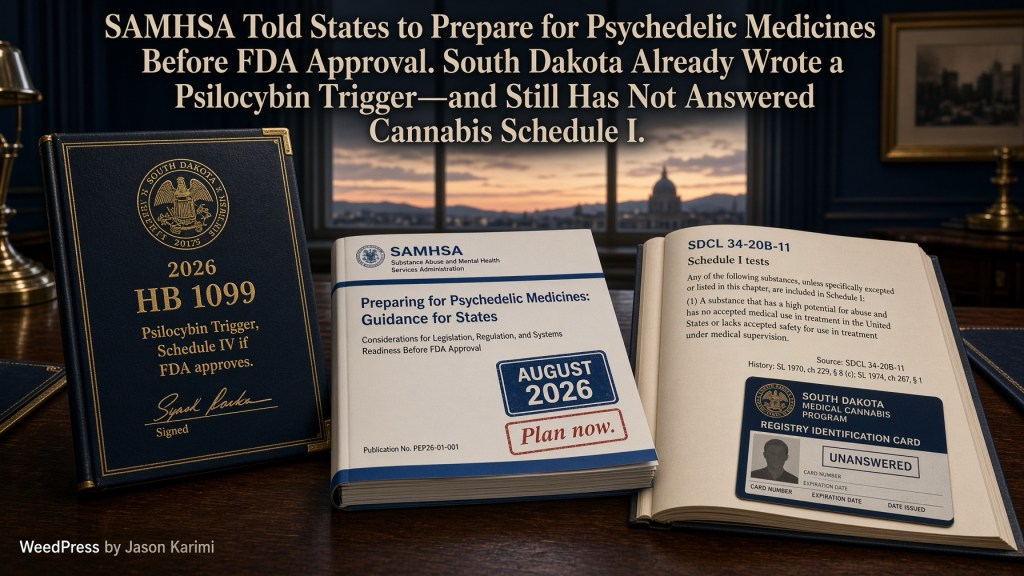
In August 2026, the Substance Abuse and Mental Health Services Administration published a policy paper telling state and territorial mental-health systems to start planning now for the fiscal, legal, and operational consequences of possible FDA-approved psychedelic therapies.¹ The paper is not a regulation. It does not approve psilocybin, MDMA, or LSD. It tells states to build the administrative box before the drug arrives: credentialing standards, safety protocols, informed-consent rules, complaint systems, and a hard look at Medicaid.²
That is the opposite of how South Dakota has handled cannabis.
The State built a medical program, left tetrahydrocannabinols in Schedule I under a statute that requires “no accepted medical use,” and has not issued a published ruling resolving the conflict.³ On psychedelics, the 2026 Legislature took a narrower and more careful step. HB 1099, signed March 10, 2026, is a trigger statute: if FDA approves a pharmaceutical composition of crystalline polymorph psilocybin, that approved product moves to Schedule IV.⁴ It does not legalize mushrooms. It does not create service centers. It does exactly what SAMHSA is now telling states to do in a different context—prepare the statute before the federal product lands.
The federal backdrop is no longer theoretical. On April 18, 2026, the President signed Executive Order 14,401, Accelerating Medical Treatments for Serious Mental Illness.⁵ The order directs FDA priority-review vouchers for qualifying Breakthrough Therapy psychedelic programs, a Right to Try pathway with DEA handling authorizations, at least $50 million through ARPA-H for federal-state collaboration, HHS/FDA work with the Department of Veterans Affairs, and Attorney General review aimed at timely rescheduling after successful Phase 3 work and FDA approval where appropriate.⁶ In July, HHS’s Health Resources and Services Administration issued a request for information on training and care-delivery models for possible FDA-approved psychedelic drugs in clinics, health centers, and rural settings.⁷ The VA and HHS signed a memorandum of understanding the same week on trial participation, training, data sharing, and patient education if approval comes.⁸
SAMHSA’s August paper sits on top of that stack. It notes that most clinical trials have not enrolled the people state systems actually treat—patients with serious mental illness, low income, co-occurring disorders, and complex trauma.⁹ It warns that covering a drug without the accompanying therapy is not what the evidence supports, and covering both is expensive.¹⁰ Those are budget and workforce problems, not slogan problems. NASCSA made the same point to state controlled-substance officials in May: prescription psychedelic medicines are coming into view, and states should understand the industry, the research, and the regulatory work before an approval forces the issue.¹¹
South Dakota should read the SAMHSA paper as a scheduling lesson, not as an invitation to copy Oregon’s service-center model. HB 1099 shows the Legislature knows how to write a federal-conformity trigger for one future pharmaceutical product.¹² SDCL 34-20B-11 still says a Schedule I substance must have no accepted medical use in the United States and a lack of accepted safety under medical supervision.¹³ SDCL 34-20B-27 still says the Department of Health “shall make recommendations to the Legislature” when it determines a substance has a different potential for abuse.¹⁴ WeedPress placed that cannabis question in the Department’s administrative record in 2026.¹⁵ The Department confirmed receipt.¹⁶ The MMOC’s first 2026 meeting then put federal rescheduling on the official committee record and left the statutory question sitting.¹⁷
The comparison here is simple. For a psilocybin based drug that is not yet FDA-approved, Pierre wrote a trigger law in 2026. For a drug the State already licenses as medicine for half a decade, marijuana, Pierre has not answered its own Schedule I definition, and is not out of alignment with federal schedule 3, defining marijuana as medicine federally. SAMHSA is telling states not to wait until the psychedelic federal products are on the loading dock.¹⁸ South Dakota waited on cannabis. The psychedelic paper is a reminder that the next fight will not be won by pretending federal medical recognition and reclassification is someone else’s problem.
States that treat SAMHSA’s list as optional will spend the next approval cycle arguing about clinics, Medicaid codes, and who is allowed in the room. States that treat it as an early warning will have a statute, a board, and a coverage theory before the first invoice arrives. South Dakota has now been told twice—once by its own psilocybin trigger, and once by SAMHSA—that scheduling work belongs upstream of the product, not after patients are already in the building.¹⁹
Footnotes
¹ Substance Abuse & Mental Health Servs. Admin., Current Research, Regulatory, and Policy Considerations Regarding Psychedelics as Medicine, Pub. No. PEP26-01-004 (Aug. 2026), https://library.samhsa.gov/product/current-research-regulatory-and-policy-considerations-psychedelics-medicine/pep26-01-004.
² Id.; see also Substance Abuse & Mental Health Servs. Admin., Current Research, Regulatory, and Policy Considerations Regarding Psychedelics as Medicine (PEP26-01-004) (PDF), https://library.samhsa.gov/sites/default/files/considerations-psychedelics-as-medicine-pep26-01-004.pdf.
³ S.D. Codified Laws § 34-20B-11; S.D. Codified Laws ch. 34-20G; Jason Karimi, Why South Dakota’s Own Statutes Now Make Schedule I Marijuana Unlawful to Maintain, WeedPress (Apr. 29, 2026), https://weedpress.org/2026/04/29/why-south-dakotas-own-statutes-now-make-schedule-i-marijuana-unlawful-to-maintain/.
⁴ H.B. 1099, 2026 Leg., Reg. Sess. (S.D. 2026) (signed Mar. 10, 2026) (rescheduling an FDA-approved pharmaceutical composition of crystalline polymorph psilocybin as a Schedule IV controlled substance); C.J. Keene, Bill Supporting Therapeutic Use of Psychedelic Compounds Clears Senate, SDPB (Mar. 2, 2026), https://www.sdpb.org/politics/2026-03-02/bill-supporting-therapeutic-use-of-psychedelic-compounds-clears-senate.
⁵ Exec. Order No. 14,401, Accelerating Medical Treatments for Serious Mental Illness, 91 Fed. Reg. 21,709 (Apr. 22, 2026).
⁶ Id. §§ 2–4; White House, Fact Sheet: President Donald J. Trump Is Accelerating Medical Treatments for Serious Mental Illness (Apr. 18, 2026), https://www.whitehouse.gov/fact-sheets/2026/04/fact-sheet-president-donald-j-trump-is-accelerating-medical-treatments-for-serious-mental-illness/.
⁷ Request for Information, Training and Care Delivery Models for Safe Administration of Potential FDA-Approved Psychedelic Therapies in Ambulatory Clinical Settings, 91 Fed. Reg. (July 14, 2026) (HRSA), https://www.federalregister.gov/documents/2026/07/14/2026-14146/request-for-information-training-and-care-delivery-models-for-safe-administration-of-potential.
⁸ U.S. Dep’t of Veterans Affs., VA, HHS Sign MOU to Improve Cooperation on Psychedelic Drug Trials (July 13, 2026), https://news.va.gov/press-room/va-hhs-sign-mou-to-improve-cooperation-on-psychedelic-drug-trials/.
⁹ SAMHSA, supra note 1.
¹⁰ Id.
¹¹ Nat’l Ass’n of State Controlled Substances Auths., Webinar: New Treatments Are Coming: Preparing States for Prescription Psychedelic Medicines (May 24, 2026), https://nascsa.org/event/webinar-new-treatments-are-coming-preparing-states-for-prescription-psychedelic-medicines/.
¹² H.B. 1099, supra note 4.
¹³ S.D. Codified Laws § 34-20B-11.
¹⁴ S.D. Codified Laws § 34-20B-27.
¹⁵ Jason Karimi, Petition: South Dakota Law Now Makes Schedule I Cannabis Classification Legally Impossible, WeedPress (Jan. 16, 2026), https://weedpress.org/2026/01/16/petition-filed-south-dakota-law-now-makes-schedule-i-cannabis-classification-legally-impossible/; Jason Karimi, Advance Notice to South Dakota Department of Health: Petition for Scheduling Review Will Follow Federal Rescheduling Hearings, WeedPress (May 14, 2026), https://weedpress.org/2026/05/14/advance-notice-to-south-dakota-department-of-health-petition-for-scheduling-review-will-follow-federal-rescheduling-hearings/.
¹⁶ Jason Karimi, DOH Confirms Receipt: South Dakota’s Schedule I Review Petition Is Officially in the Record, WeedPress (Mar. 5, 2026), https://weedpress.org/2026/03/05/doh-confirms-receipt-south-dakotas-schedule-i-review-petition-is-officially-in-the-record/. See also https://weedpress.org/2026/08/31/weedpress-asks-south-dakota-health-department-to-rule-whether-schedule-i-cannabis-still-fits-the-states-own-statute/
¹⁷ S.D. Legis. Rsch. Council, Medical Marijuana Oversight Committee, August 17, 2026 Meeting Materials, https://mylrc.sdlegislature.gov; Jason Karimi, MMOC’s First 2026 Meeting Put Federal Rescheduling on the Record, WeedPress (2026).
¹⁸ SAMHSA, supra note 1.
¹⁹ H.B. 1099, supra note 4; SAMHSA, supra note 1.
 WeedPress: The Paper Trail
Leave a comment