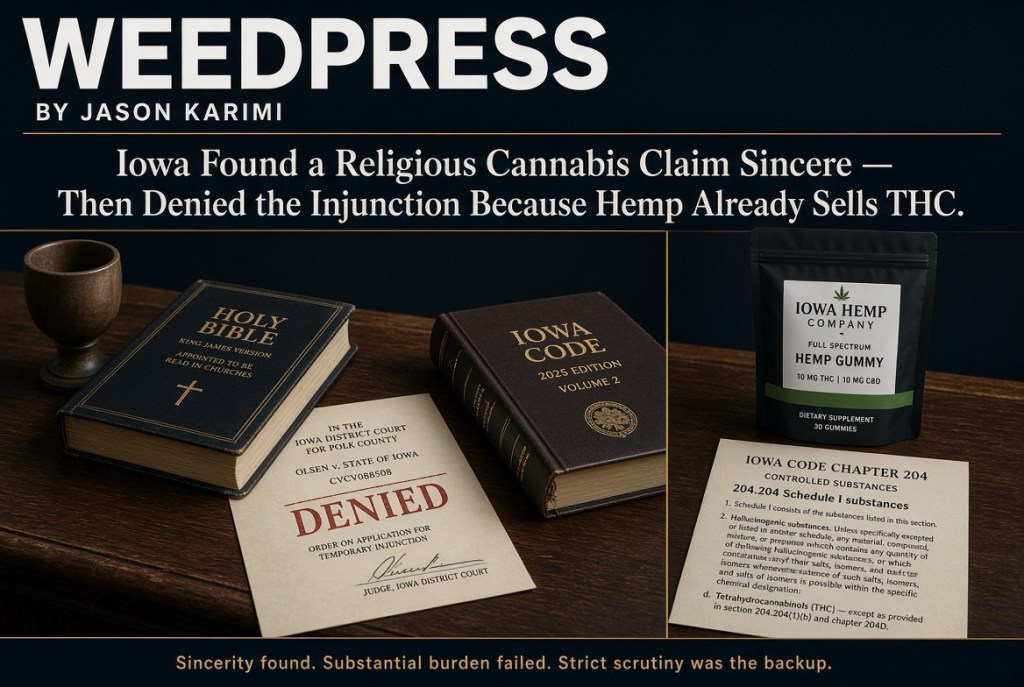
A Polk County judge found Carl Olsen’s religious cannabis claim sincere but held that Iowa’s legal hemp market meant he had not shown that marijuana enforcement substantially burdened the particular religious exercise he presented.¹
The September 10, 2026 order in Olsen v. State of Iowa is not a ruling that sacramental cannabis is unprotected. It is a ruling that, on this record, Iowa’s Religious Freedom Restoration Act did not require the court to authorize unlimited personal cultivation and possession.² Olsen sued under Iowa Code chapter 675 and asked the court to enjoin the State from interfering with religious cannabis use after an August 10, 2026 bench trial. He appeared pro se. The State appeared through the Attorney General’s office. Judge Celene Gogerty denied the petition and assessed costs to Olsen.³
The court did not reject the claim at the sincerity door. The case did not die because the judge decided cannabis cannot be religious. It died later in the statute.
What Olsen Asked For
The petition was broader than a narrow sacramental exemption. Olsen testified that cannabis could be smoked, vaporized, used in teas and extracts, eaten, and used for industrial materials; that the only limit should be self-imposed; that he should be allowed to buy seed and grow for personal use; and that there should be no quantity cap.⁴ He also argued that Iowa already authorizes limited religious use of a controlled substance in chapter 124, authorizes medical cannabis under chapter 124E, and authorizes delta-9 THC products under chapter 204, and that those statutes made continued enforcement against his religious practice unjustifiable.⁵
The Scope of the Requested Exemption Mattered
Olsen was not asking the court to authorize a tightly defined sacramental quantity. The requested injunction would have allowed personal cultivation and possession without a quantity cap, across multiple forms of consumption, with only a self-imposed limit. That matters because least-restrictive-means analysis concerns the actual relief sought, not an abstract religious exemption. An unlimited grow-and-possess order is a different case from a quantity-limited sacramental accommodation.⁶
Sincerity Was Found
Iowa’s RFRA protects “the practice or observance of religion,” including action “substantially motivated by one’s sincerely held religious belief, whether or not the exercise is compulsory or central to a larger system of religious belief.”⁷ A substantial burden includes criminal, civil, or administrative penalties that constrain that exercise.⁸ Once those showings are made, the State must prove a compelling governmental interest and least restrictive means.⁹
The Court Did Not Require Church Membership
The State argued sincerity failed because Olsen’s institutional story has changed. In State v. Olsen, he testified as a priest in the Ethiopian Zion Coptic Church and said smoking marijuana was the church’s only sacrament.¹⁰ In this trial he testified that the present claim is not based on that membership and is instead a Bible-based personal sacrament — daily communion, “the bottomless cup.”¹¹ The court noted the shift, then still found sincerity based on the long-standing sacrament claim and the trial testimony.¹² Iowa Code § 675.3(2) does not require the exercise to be compulsory or central to a named church. The court applied that definition. The sincerity finding is therefore evidence against the proposition that a cannabis religious claim must come from an established denomination. It is not a holding that every differently pleaded claim wins.¹³
The Holding That Ended the Case
The State argued Olsen could travel to a neighboring state or use legal THC products. The court rejected the State’s interstate-travel alternative as itself burdensome.¹⁴ It accepted the separate argument that Iowa’s chapter 204 hemp market meant Olsen had not established a substantial burden.
Iowa Code chapter 204 authorizes consumable hemp products that contain THC. The court found it undisputed that the statutory difference between hemp and marijuana is THC concentration, that Olsen’s beliefs permitted ingestion by multiple methods, and that he did not prove those beliefs require a particular THC concentration. On those facts, the court held chapter 204 already gives him access to cannabis products containing THC, and he therefore failed to prove that enforcement of chapter 124 substantially burdens the religious exercise.¹⁵
That is the judgment. Access to some legally available THC product is not automatically the same thing as access to the religious exercise claimed. The court treated them as sufficient on this record because Olsen did not establish that the sacrament required a particular THC concentration and because chapter 204 already sells THC-containing products. Whether that substantial-burden analysis survives appeal, and whether it would control a differently pleaded exemption, are separate questions.¹⁶
The court’s strict-scrutiny discussion was alternative analysis — not the basis of the judgment. Everything after the substantial-burden holding in the order is written “for the purpose of further review.”¹⁷
The Alternative Strict-Scrutiny Analysis
Olsen relied on Gonzales v. O Centro Espírita Beneficente União do Vegetal. O Centro rejects the government’s ability to carry its burden by a “mere invocation of the general characteristics of Schedule I substances,” particularly where the government has already created exceptions.¹⁸ The court agreed with the citation and distinguished the Iowa record. It did not treat Schedule I status itself as the compelling-interest evidence. It relied on Iowa-specific evidence introduced at trial: Medical Cannabidiol Board materials opposing raw or vaporized dried cannabis and citing respiratory-harm literature; Office of Drug Control Policy data on treatment admissions, youth use, potency, emergency-department visits, and impaired driving; and narcotics-enforcement testimony that an unregulated religious exception would be impractical to monitor and easy to divert.¹⁹
On that record the court found three compelling interests: citizen health, including children; citizen welfare, including the correlation the State’s witnesses drew between substance abuse and child-welfare cases; and public safety, including cannabis-impaired driving.²⁰ It cited Iowa authority that protecting children from harm and preventing death or physical injury, including drug-impaired driving, can be compelling interests.²¹
On least-restrictive-means, the court accepted the State’s position that there is no practical way to distinguish religious use from non-religious use, rejected an individualized injunction for unlimited grow-and-possess as the required alternative, and treated chapter 204 hemp as an already-existing narrower channel that keeps higher-THC product out of an unregulated carve-out.²² That analysis is the backup reasoning. It is not the holding that denied the injunction.
What the Order Does Not Decide
The order does not hold that Iowa RFRA is a dead letter. It does not hold that a narrower, quantity-limited sacramental claim would fail on the same facts. It does not decide a federal RFRA application. It does not rewrite chapter 124E or chapter 204. It does not treat federal rescheduling as having already repealed Iowa’s marijuana schedule. Those issues were not the judgment.
It also does not establish that every religious cannabis claimant can be denied relief whenever some THC-containing hemp product is commercially available. The decision turned on the particular record before the court — including the breadth of Olsen’s requested relief and his failure to establish that his religious exercise required a particular THC concentration.²³
Why the Case Matters
Neighboring-state RFRA cannabis litigation is producing records in 2026. This one found the religious claim sincere and still denied open-ended cultivation and possession because the court concluded legal hemp THC already occupied the field of “access to a THC product.” That is a fact-dependent substantial-burden holding, not a universal rule that hemp defeats every cannabis sacrament claim.
Olsen lost the injunction. He did not lose on sincerity.
The court accepted that his religious claim was sincere, rejected interstate travel as an adequate answer to the burden, and then stopped the case at the substantial-burden stage because Iowa’s chapter 204 hemp market gave him lawful access to THC-containing products on the record presented. The court nevertheless went further and explained why it believed the State would prevail under strict scrutiny if that threshold ruling were wrong.
That makes the case narrower — and more interesting — than a simple rejection of religious cannabis use. The unresolved question is whether access to some legally available THC product is enough to defeat a RFRA substantial-burden claim when the claimant’s religious exercise concerns cannabis itself, and whether a more narrowly tailored sacramental exemption would produce the same result.
For now, the answer in Polk County is no injunction. The record on sincerity is a different story.
Footnotes
¹ Findings of Fact, Conclusions of Law, and Order, Olsen v. State, No. CVCV068508 (Iowa Dist. Ct. Polk Cnty. Sept. 10, 2026).
² Id. at 1, 15.
³ Id. at 1, 15.
⁴ Id. at 3–4.
⁵ Id. at 1; see Iowa Code chs. 124, 124E, 204.
⁶ Order, supra note 1, at 4, 14–15.
⁷ Iowa Code § 675.3(2).
⁸ Iowa Code § 675.3(5).
⁹ Iowa Code §§ 675.2, 675.4.
¹⁰ State v. Olsen, 315 N.W.2d 1, 7–8 (Iowa 1982); Order, supra note 1, at 2.
¹¹ Order, supra note 1, at 3, 10–11.
¹² Id. at 11.
¹³ Iowa Code § 675.3(2); Order, supra note 1, at 11.
¹⁴ Order, supra note 1, at 11.
¹⁵ Id. at 11–12; Iowa Code ch. 204.
¹⁶ Order, supra note 1, at 11–12.
¹⁷ Id. at 12.
¹⁸ Gonzales v. O Centro Espírita Beneficente União do Vegetal, 546 U.S. 418, 432 (2006).
¹⁹ Order, supra note 1, at 4–9, 12.
²⁰ Id. at 12–14.
²¹ In re D.J.R., 454 N.W.2d 838, 845 (Iowa 1990); State v. Mahana, 36 N.W.3d 706, 722 (Iowa 2026); State v. Newton, 929 N.W.2d 250, 258 (Iowa 2019).
²² Order, supra note 1, at 14–15.
²³ Id. at 4, 11–12, 15.
 WeedPress: The Paper Trail
Leave a comment