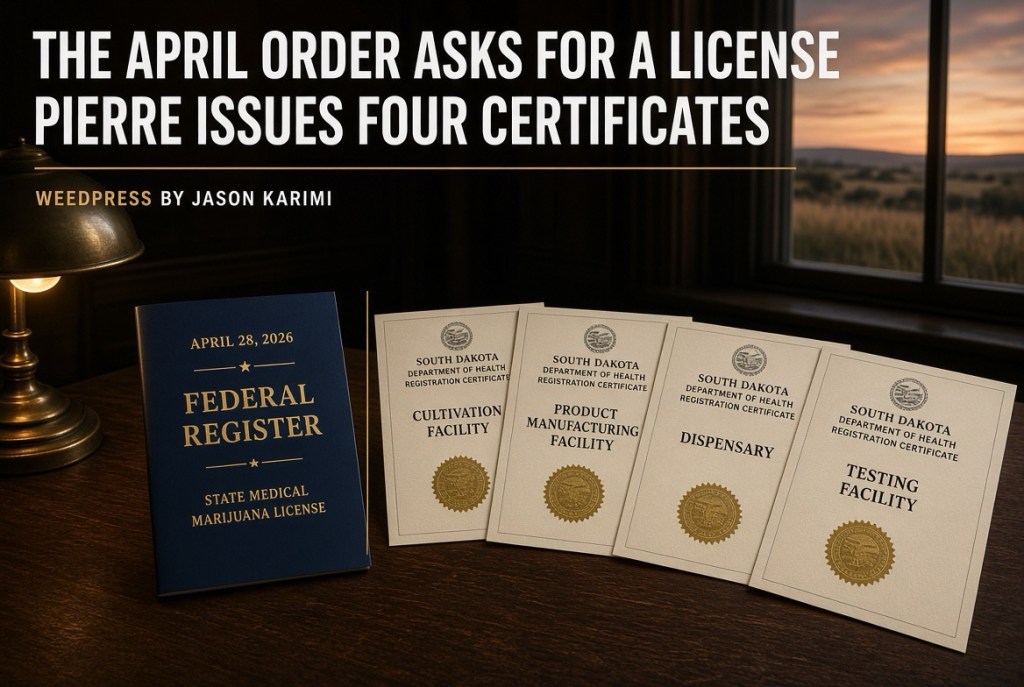
“Qualifying state medical license” is a federal noun. South Dakota’s operator credential is a registration certificate, in four types. The unpublished work is the crosswalk.
The first page in this series separated the patient credential from the shop credential.¹ A registry identification card is not the license the April 28, 2026 order uses to put state-program marijuana in Schedule III.² That license is an operator document: “a license issued by a state entity … authorizing the licensee to manufacture, distribute, and/or dispense marijuana or products that contain marijuana for medical purposes.”³
This page stays on that operator document. It does not announce that any South Dakota class is “not qualifying.” It sets the federal text next to the papers Pierre actually issues and marks what has not been published.
What the federal text uses
The order does three things with a qualifying state medical marijuana license.
First, marijuana subject to that license is the second covered Schedule III category.⁴
Second, an entity holding that license may use the expedited DEA path at 21 C.F.R. § 1301.13(k) as a marijuana manufacturer, distributor, or dispenser.⁵
Third, for the public-interest inquiry, “a state license shall constitute conclusive evidence that the applicant is authorized under state law to engage in the activity for which registration is sought.”⁶ The federal registration “shall not exceed the scope of the holder’s state medical marijuana license.”⁷ If the state credential is suspended, revoked, or expires, the DEA registration suspends with it.⁸
Those are activity nouns: manufacture, distribute, dispense. The qualifying question in Pierre is which South Dakota paper authorizes which of those activities.
What Pierre issues
South Dakota does not title the operator credential a “state medical marijuana license.” SDCL § 34-20G-55 directs the Department of Health, if the statutory conditions are met, to “register the prospective medical cannabis establishment and issue a registration certificate.”⁹ ARSD 44:90:03:01 is the initial-application rule for that certificate.¹⁰
Chapter 34-20G names four establishment types, and only four:¹¹
Pierre certificate — What the statute authorizes — Closest federal activity noun
Cultivation facility — Acquire, possess, cultivate, deliver, transfer, transport, supply, or sell cannabis to a medical cannabis establishment.¹² — Manufacture / distribute
Cannabis product manufacturing facility — Acquire, possess, manufacture, deliver, transfer, transport, supply, or sell cannabis products to a dispensary.¹³ — Manufacture / distribute
Dispensary — Acquire, possess, store, deliver, transfer, transport, sell, supply, or dispense to cardholders.¹⁴ — Dispense / distribute
Testing facility — Analyze the safety and potency of cannabis.¹⁵ — Not named in the license definition
The Department’s own establishment page uses the same four types.¹⁶ The annual fee is attached to the registration certificate, not to a separately titled “license.”¹⁷ A local Form E zoning certification and any local registration, license, or permit are application conditions under § 34-20G-55. They are not the federal noun.¹⁸
The unpublished crosswalk
Three questions follow from that table. None of them is answered in chapter 34-20G or Article 44:90.
1. Is the registration certificate the “license” the order names?
Pierre’s operator paper is a registration certificate. The order’s operator paper is a license. Functionally they may be the same desk. The texts do not say so. A search of SDCL chapter 34-20G and S.D. Admin. R. art. 44:90 as of September 11, 2026, did not locate a published South Dakota crosswalk stating that a § 34-20G-55 certificate is the April order’s state medical marijuana license.¹⁹
2. Which certificate maps to which DEA registration?
The order registers manufacturers, distributors, and dispensers.²⁰ South Dakota splits the market into cultivator, manufacturer, dispensary, and testing facility. A dispensary’s statutory work includes dispensing to cardholders. That is the cleanest line on the chart. Cultivation and product manufacturing sit on the manufacture/distribute side. The state file does not publish which DEA form a cultivator files, or whether one South Dakota certificate supports more than one federal registration type. The order allows a single entity to hold multiple federal registrations.²¹ It also caps each registration at the scope of the state credential.²² Those two sentences cannot be applied in Pierre until someone identifies the matching pair.
3. Where does the testing certificate sit?
A testing facility is a medical cannabis establishment.²³ It is registered under the same § 34-20G-55 process. The federal license definition, however, is written in manufacture / distribute / dispense. A testing facility is defined to analyze safety and potency.²⁴ That is a real drafting gap. It is not a finding that the testing certificate is “not qualifying.” It is the question the next lab piece will have to source. Do not treat silence as a ban.
What this page does not decide
It does not decide whether DEA will accept a South Dakota registration certificate as conclusive evidence under § 1301.13(k)(2). That is DEA’s application of its own rule to Pierre’s paper.
It does not decide tax treatment, pharmacy jurisdiction, written-certification-versus-prescription, or safety-sensitive employment. Those are later files.
It does not treat a patient registry card as the qualifying license. That stacking error is the first page.²⁵
The checklist
If the question is the federal noun, start here:
1. The order requires a state license to manufacture, distribute, and/or dispense for medical purposes.²⁶
2. South Dakota’s operator credential is a registration certificate issued under SDCL § 34-20G-55.²⁷
3. That certificate comes in four types. Only three of those types have statutory functions that correspond directly to the federal manufacture, distribution, or dispensing nouns.²⁸
4. The federal registration cannot exceed the scope of the state credential, while the state license serves as conclusive evidence that the applicant is authorized under state law to engage in the activity for which federal registration is sought.²⁹
5. Pierre has not published the pair-by-pair map.
The gap is the story. The certificate is the document to take to the next question. The card is not.
Footnotes
¹ Jason Karimi, A Patient Card Is Not a Shop License, WeedPress (Sept. 11, 2026).
² Schedules of Controlled Substances: Rescheduling of Food and Drug Administration Approved Products Containing Marijuana From Schedule I to Schedule III; Corresponding Change to Permit Requirements, 91 Fed. Reg. 22,714 (Apr. 28, 2026) [hereinafter April Order]; Karimi, supra note 1.
³ April Order, 91 Fed. Reg. at 22,714 (definition of “state medical marijuana license”).
⁴ Id.
⁵ Id.; 21 C.F.R. § 1301.13(k) (2026).
⁶ 21 C.F.R. § 1301.13(k)(2).
⁷ Id. § 1301.13(k)(3).
⁸ Id.
⁹ S.D. Codified Laws § 34-20G-55.
¹⁰ S.D. Admin. R. 44:90:03:01.
¹¹ S.D. Codified Laws § 34-20G-1(17); S.D. Dep’t of Health, Med Cannabis Establishments, https://doh.sd.gov/programs/medical-cannabis/med-cannabis-establishments/ (four registration types: cultivator, manufacturer, dispensary, and testing).
¹² S.D. Codified Laws § 34-20G-1(7).
¹³ Id. § 34-20G-1(4).
¹⁴ Id. § 34-20G-1 (definition of dispensary).
¹⁵ Id. § 34-20G-1(5).
¹⁶ S.D. Dep’t of Health, supra note 11.
¹⁷ Id. (annual registration fee).
¹⁸ S.D. Codified Laws § 34-20G-55(1)(d)–(e); S.D. Admin. R. 44:90:03:01(4)–(5).
¹⁹ Search of SDCL ch. 34-20G and S.D. Admin. R. art. 44:90 as of Sept. 11, 2026.
²⁰ 21 C.F.R. § 1301.13(k).
²¹ April Order / 21 C.F.R. § 1301.13(k) (single entity may be granted multiple types of registrations).
²² 21 C.F.R. § 1301.13(k)(3).
²³ S.D. Codified Laws § 34-20G-1(17).
²⁴ Id. § 34-20G-1(5).
²⁵ Karimi, supra note 1.
²⁶ April Order, 91 Fed. Reg. at 22,714.
²⁷ S.D. Codified Laws § 34-20G-55.
²⁸ Id. § 34-20G-1(4), (5), (7), (17).
²⁹ 21 C.F.R. § 1301.13(k)(2)–(3).
 WeedPress: The Paper Trail
Leave a comment