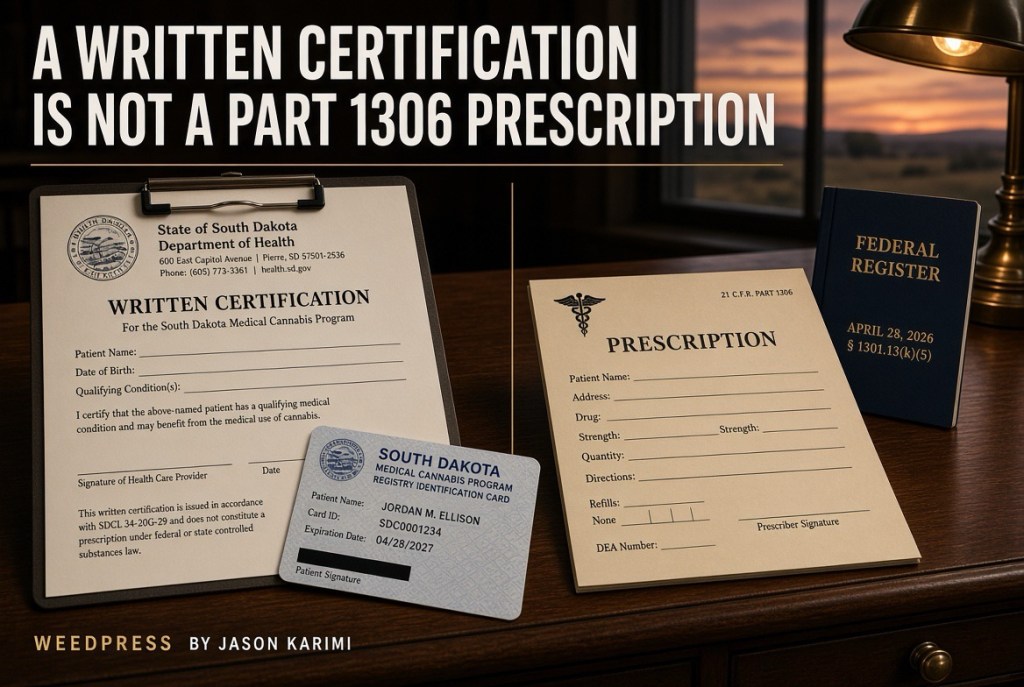
The April order says a state certification can be enough to dispense. It does not convert chapter 34-20G into the federal prescription rule.
The first two pages in this series separated the patient credential from the shop credential, then asked which South Dakota establishment paper is the federal “license.”¹ This page is the clinic noun.
South Dakota lets a patient into the program with a practitioner’s written certification.² Federal Schedule III drugs that are prescription drugs are dispensed under 21 C.F.R. part 1306.³ Those are not the same instrument. The April 28, 2026 order does not say South Dakota certifications are invalid. It also does not say they are part 1306 prescriptions.⁴ The unpublished work is the space between those two sentences.
State medical-cannabis programs historically developed around recommendations, certifications, and state registry systems—not conventional prescriptions under 21 C.F.R. part 1306.⁵ A Schedule I substance could not be prescribed under federal law. States built a different paper: an opinion that a patient may benefit, which then opened a state registry or a state-law defense. South Dakota copied that architecture. It named the paper a written certification.⁶ Treating that paper as if it had always been a part 1306 script is a category error.
Before April, the chain was state certification, then state authorization, then dispensary. After April, federal law creates a limited recognition mechanism for that existing architecture. It is the federal text catching up, in a limited way, to the recommendation-and-certification system the states actually built.
What Pierre issues
A written certification is the practitioner document that starts the registry file. SDCL § 34-20G-29 requires a qualifying-patient application to include “[a] written certification issued by a practitioner within ninety days immediately preceding the date of an application.”⁷ ARSD 44:90:02:01 requires that certification on a department form.⁸ SDCL § 34-20G-5 protects a practitioner who provides a written certification, or who states that a patient is likely to receive therapeutic or palliative benefit, so long as the practitioner has a bona fide relationship and evaluates the condition.⁹
What the certification does in Pierre is limited. It is an input. The department then issues a registry identification card.¹⁰ At the point of sale, the dispensary verifies the registry card, not the practitioner’s certification form.¹¹ The certification serves a different statutory function from a part 1306 prescription. Chapter 34-20G requires it to document the practitioner’s certification of the patient’s qualifying condition and related statutory requirements; it is not drafted as a prescription for a particular drug, strength, dosage form, quantity, or directions for use.
The South Dakota chain is four steps: certification, registry application, registry card, dispensary transaction. The federal question is where § 1301.13(k)(5) attaches to that chain.
What part 1306 requires
Part 1306 is the federal prescription rule for controlled substances. A Schedule III prescription drug may be dispensed by a pharmacist only pursuant to a paper, facsimile, electronic, or oral prescription that meets § 1306.05.¹² That section requires the prescription to be dated and signed on the day issued and to bear the patient’s full name and address, the drug name, strength, dosage form, quantity prescribed, directions for use, and the practitioner’s name, address, and registration number.¹³ The practitioner must be authorized to prescribe in the jurisdiction and registered with DEA, or exempt.¹⁴ Refill limits and labeling rules follow in §§ 1306.22 and 1306.24.¹⁵
A written certification under chapter 34-20G is not built to that list. Treating the two documents as interchangeable is the stacking error this page is written to stop.
What the April order actually says about certifications
The order does not rewrite part 1306. Section 1301.13(k)(5) operates “[n]otwithstanding part 1306” and recognizes a state “certification or other document” as sufficient for dispensing if the federal conditions are satisfied.¹⁶ Those conditions are that the document be dated and signed on the day issued, bear the full name and address of the user, and contain the name, address, and state license number of the practitioner who signed it.¹⁷
Read that sentence for what it is. It is a sufficiency rule for dispensing. It is not a declaration that the certification is a § 1306.05 prescription. It is not a declaration that South Dakota’s department form already contains every element the rule lists. It is not a ban on the existing 34-20G process.
Three questions follow. None of them is answered in chapter 34-20G or Article 44:90.
1. Does South Dakota’s certification-plus-card system satisfy § 1301.13(k)(5)?
The practitioner form is expressly titled a written certification. The patient then receives a registry identification card. South Dakota’s rules use the certification to establish the medical qualification and the registry card to establish the patient’s authorization at the point of sale.¹⁸
Federal § 1301.13(k)(5), however, speaks in the singular of “a certification or other document” and requires that document to contain the user’s full name and address as well as the practitioner’s name, address, and state license number.¹⁹ South Dakota’s published certification rule supplies the practitioner-side information, while SDCL § 34-20G-29 separately supplies the patient’s identifying information through the registry application.²⁰
That creates a narrower and more concrete question than whether South Dakota has a “medical marijuana prescription.” Does the federal rule permit the required information to exist across the certification-and-registry process, or must the certification or other document itself contain every § 1301.13(k)(5) element?
2. Does the department’s certification form itself carry every federal condition?
The federal rule requires the user’s full name and address, plus the practitioner’s name, address, and state license number.²¹ South Dakota’s certification rule expressly requires the practitioner’s name and address and South Dakota license number, but the patient’s identifying information appears separately in the registry-card application requirements.²²
That does not establish a federal violation. It identifies a drafting question. If § 1301.13(k)(5) requires the “certification or other document” itself to contain all of those elements, where does South Dakota’s existing system place the missing information?
3. Who is the federal dispenser?
Part 1306 assumes a pharmacist filling a prescription.²³ Chapter 34-20G assumes a registered dispensary selling to a cardholder.²⁴ Article 2 asked which establishment certificate maps to a DEA dispenser registration.²⁵ This page does not repeat that map. It only notes that the dispense noun and the prescription noun are being asked to do work in two different shops.
What this page does not decide
It does not announce that South Dakota certifications are invalid.
It does not announce that they are part 1306 prescriptions.
It does not decide home-cultivation status. Personal grows sit outside the April order’s two covered categories. That is a different file.²⁶
It does not decide pharmacy-board jurisdiction, tax treatment, or safety-sensitive employment. Those remain later pages.
It does not treat a registry card as a shop license. That stacking error was page one.²⁷
The checklist
1. State medical-cannabis programs historically developed around recommendations and certifications rather than conventional part 1306 prescriptions. South Dakota’s system uses a written certification.²⁸
2. Pierre’s clinic document is a written certification on a department form, used to obtain a registry identification card. At the point of sale, the dispensary verifies the card.²⁹
3. Federal part 1306 prescriptions require a different and longer set of elements, issued by a DEA-registered practitioner and filled by a person entitled to fill them. Section 1301.13(k)(5) operates notwithstanding part 1306.³⁰
4. Section 1301.13(k)(5) treats a state certification or other document as sufficient to permit dispensing if named elements are present. It does not rename that document a part 1306 prescription.³¹
5. South Dakota’s published rules divide the relevant information between the practitioner certification and the registry-card/application process; South Dakota has not published a crosswalk explaining how that existing system satisfies § 1301.13(k)(5).
6. Silence is not a ban. It is the gap.
The certification starts the file. The card is what the counter sees. Neither is transformed into a part 1306 prescription merely because the April order recognizes a state certification pathway. The federal question is narrower: whether Pierre’s existing certification paperwork satisfies § 1301.13(k)(5), and what role—if any—the registry card plays alongside it. Ask that question before anyone announces a new rule.
Footnotes
¹ Jason Karimi, A Patient Card Is Not a Shop License, WeedPress (Sept. 11, 2026); Jason Karimi, The April Order Asks for a License. Pierre Issues Four Certificates., WeedPress (Sept. 11, 2026).
² S.D. Codified Laws § 34-20G-29(1); S.D. Admin. R. 44:90:02:01.
³ 21 C.F.R. pt. 1306; id. § 1306.21.
⁴ Schedules of Controlled Substances: Rescheduling of Food and Drug Administration Approved Products Containing Marijuana From Schedule I to Schedule III; Corresponding Change to Permit Requirements, 91 Fed. Reg. 22,714 (Apr. 28, 2026) [hereinafter April Order].
⁵ See, e.g., Cal. Health & Safety Code § 11362.5 (Compassionate Use Act of 1996) (physician recommendation); S.D. Codified Laws § 34-20G-5 (written certification). Schedule I status under 21 U.S.C. § 812 barred conventional CSA prescribing.
⁶ S.D. Codified Laws §§ 34-20G-5, 34-20G-29(1).
⁷ Id. § 34-20G-29(1).
⁸ S.D. Admin. R. 44:90:02:01.
⁹ S.D. Codified Laws § 34-20G-5.
¹⁰ Id. §§ 34-20G-1(6), (23), 34-20G-29.
¹¹ Id. § 34-20G-1 (definition of dispensary); S.D. Admin. R. ch. 44:90:08 (dispensary verification of registry identification card).
¹² 21 C.F.R. § 1306.21(a).
¹³ Id. § 1306.05(a).
¹⁴ Id. § 1306.03(a).
¹⁵ Id. §§ 1306.22, 1306.24.
¹⁶ 21 C.F.R. § 1301.13(k)(5) (2026); April Order, 91 Fed. Reg. at 22,714.
¹⁷ 21 C.F.R. § 1301.13(k)(5).
¹⁸ S.D. Codified Laws §§ 34-20G-29, 34-20G-1; S.D. Admin. R. 44:90:02:01, ch. 44:90:08.
¹⁹ 21 C.F.R. § 1301.13(k)(5).
²⁰ S.D. Admin. R. 44:90:02:01; S.D. Codified Laws § 34-20G-29.
²¹ 21 C.F.R. § 1301.13(k)(5).
²² S.D. Admin. R. 44:90:02:01; S.D. Codified Laws § 34-20G-29.
²³ 21 C.F.R. §§ 1306.06, 1306.21.
²⁴ S.D. Codified Laws § 34-20G-1 (dispensary).
²⁵ Karimi, The April Order Asks for a License, supra note 1.
²⁶ April Order, 91 Fed. Reg. at 22,714; Jason Karimi, ILLEGAL: Homegrown Cannabis Remains Outside Federal Schedule III Protections, WeedPress.
²⁷ Karimi, A Patient Card Is Not a Shop License, supra note 1.
²⁸ See sources cited supra note 5.
²⁹ S.D. Codified Laws § 34-20G-29(1); S.D. Admin. R. 44:90:02:01, ch. 44:90:08.
³⁰ 21 C.F.R. §§ 1306.03, 1306.05, 1306.21, 1301.13(k)(5).
³¹ Id. § 1301.13(k)(5); April Order, 91 Fed. Reg. at 22,714.
 WeedPress: The Paper Trail
Leave a comment