September 14, 2026
Whitney Brunner
Medical Cannabis Program Administrator
South Dakota Department of Health
600 East Capitol Avenue
Pierre, SD 57501
Re: Supplemental written comments on proposed amendments to S.D. Admin. R. art. 44:90
Public hearing September 23, 2026; written comments due October 3, 2026
Subject: Proposed 44:90:12:03 and 44:90:12:11; Form 14 items 8, 9, and 13
Dear Ms. Brunner:
Please place this letter in the official written-comment record under SDCL chapter 1-26 for the Department’s August 21, 2026 filing of proposed amendments to Article 44:90.
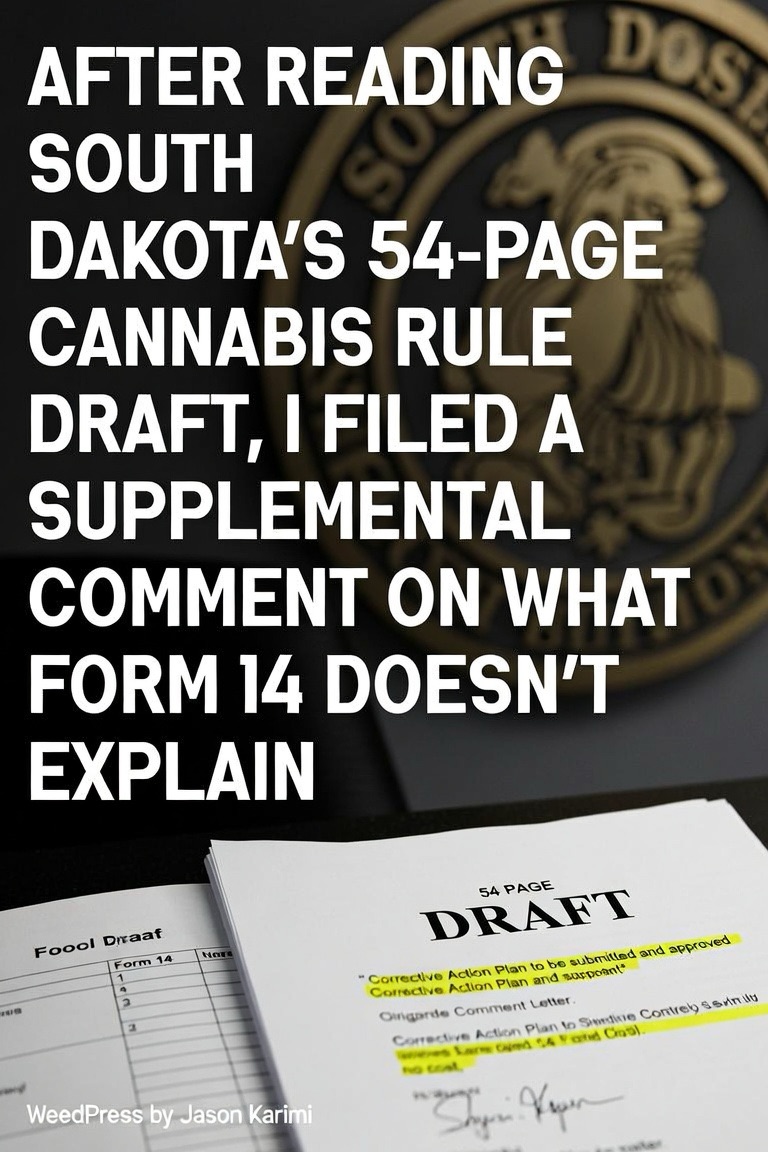
I submitted written comments on September 10, 2026. After completing a line-by-line review of the Department’s 54-page proposed-rule draft and accompanying Form 14, I submit this supplemental comment concerning specific enforcement provisions, documentation requirements, and the regulatory-impact analysis.
This supplemental comment does not object to the fact that the Department opened 38 sections. South Dakota has opened more. The June 2022 package listed 47 discrete sections. The useful questions here are what proposed 44:90:12:11 and 44:90:12:03 change, how those two provisions operate together, and whether Form 14 explains those changes.
I. What proposed 44:90:12:11 changes
Current 44:90:12:11, adopted in 52 SDR 10 and effective August 4, 2025, sets first-offense Category 4 at $1,000 and Category 5 at $500, with a five-year lookback.
The June 26, 2026 draft leaves Categories 1 through 3 substantially unchanged. It divides Categories 4 and 5 between first and subsequent offenses. A first offense becomes “Corrective Action Plan to be submitted and approved.” A second or subsequent Category 4 violation remains $1,000. A second or subsequent Category 5 violation remains $500. The five-year lookback remains.
The Department is therefore revising an enforcement schedule adopted approximately one year ago. It is not creating a new fine schedule.
II. Corrective-action plans under 44:90:12:03 are not new
Current 44:90:12:03 already exists. Its source line is 48 SDR 40, effective October 5, 2021, and 52 SDR 10, effective August 4, 2025. The current text already authorizes the Department, upon discovery of a suspected violation, to order an establishment to comply with a corrective-action plan that may include:
(1) modifying operating procedures;
(2) halting transfer of mislabeled product or product that otherwise poses a threat to public health; and
(3) destroying or remediating product that poses a threat to public health.
The current section also contains the destroy-order provisions, the sentence addressing fault for contamination or unsafe conditions, chapter 1-26 judicial-review language, the ten-business-day destruction period, and the provision preserving voluntary corrective action and recall.
The June 26 draft does not create corrective-action plans. It changes the process by which a plan is created, approved, and enforced.
Under the proposal:
• the Department may order an establishment to submit a corrective-action plan for Department review and approval;
• the establishment must comply with the plan as approved by the Department;
• the Department may inspect, review records, or otherwise verify implementation;
• failure to submit, implement, or comply with an approved plan may result in a monetary penalty or other authorized enforcement action; and
• the proposal expressly states that nothing in the section prevents imposition of a fine under 44:90:12:10 and 44:90:12:11 in addition to requiring a corrective-action plan.
The three numbered substantive contents of a plan, the destroy-order provisions, and the voluntary-corrective-action provision remain.
A separate rule, 44:90:04:02, already requires establishments to maintain internal corrective-and-preventive-action procedures. That chapter 4 requirement is not the same regulatory instrument as a Department-ordered corrective-action plan under chapter 12. This comment addresses the latter.
III. Questions the Department should answer in the rulemaking record
1. First-offense corrective-action plans and monetary penalties.
Is a corrective-action plan under proposed 44:90:12:11 the exclusive scheduled response to a first Category 4 or Category 5 violation, or may the Department also impose a monetary fine for that same first violation?
If a monetary fine may accompany the first-offense corrective-action plan, please identify the provision establishing the amount of that fine after proposed 44:90:12:11 replaces the first-offense Category 4 and Category 5 dollar amounts with corrective-action plans.
The proposed sentence in 44:90:12:03 preserving a fine “in addition to” a corrective-action plan makes this question material to the operation of the proposed rules.
2. Submission, approval, implementation, and verification.
How will a first-offense corrective-action plan be submitted, approved, timed, and verified?
What deadline will apply to submission? What occurs if the Department does not approve, reject, or request modification of a submitted plan within a specified period? What records or other evidence may the Department require to verify implementation? Are those matters governed by written standards outside the proposed rule?
3. Regulatory-impact analysis and the zero-cost determination.
How did the Department determine in Form 14, dated August 19, 2026, that the proposed submit-review-approve-implement-and-verify process in 44:90:12:03 creates no implementation cost, compliance cost, administrative cost, opportunity cost, or new reporting or recordkeeping requirement?
Form 14 item 8 identifies a savings from replacing first-offense Category 4 and Category 5 fines with corrective-action plans. Item 9 states there is no cost associated with the rule changes. Those conclusions should be explained together.
A first-offense monetary fine may be more or less costly than preparing, submitting, obtaining approval of, implementing, documenting, and permitting verification of a corrective-action plan. Form 14 does not disclose which analysis was used.
If the Department’s zero-cost conclusion depends on excluding costs incurred only by establishments subject to enforcement, please identify that assumption and its basis as part of the key assumptions and sources of uncertainty addressed by SDCL 1-26-4.11.
The same Form 14 representation should also address other new documentation duties in the June 26 draft. The draft’s waste-management operating-procedure language requires cannabis waste to be documented immediately in the inventory-tracking system, held in a designated secure waste-rendering area, and, if unrendered waste is transferred, moved only with Department approval, inventory-tracking documentation, a secure container, and a documented chain of custody. That text appears to impose recordkeeping requirements independent of the corrective-action-plan provisions and, in the transfer option, a Department-approval requirement. Form 14’s statement that the amendments create no new reporting or recordkeeping requirement should explain that language as well as proposed 44:90:12:03 and 44:90:12:11.
4. Small-business population.
Form 14 item 13 selects a range of 100–499 affected small businesses and states that there is no unique small-business impact because medical-cannabis businesses are already complying.
Please identify the factual basis for selecting the 100–499 range and state whether the population being counted consists of licensed establishments, unique legal entities, applicants, or another universe.
The Department’s August 27, 2026 public establishment list contained 108 licensed establishments. If licenses and businesses are not the same unit for purposes of Form 14, identifying the denominator would make the analysis reproducible.
5. Alternatives considered.
Form 14 states: “No alternative exists.”
Please identify what alternatives the Department considered before reaching that conclusion, including whether it considered:
(a) retaining the existing first-offense Category 4 and Category 5 dollar amounts;
(b) retaining existing 44:90:12:03 as an order-to-comply mechanism;
(c) amending 44:90:12:11 without rewriting the corrective-action-plan process;
(d) amending 44:90:12:03 without changing the first-offense fine schedule; or
(e) expressly stating whether a first-offense Category 4 or Category 5 corrective-action plan may be accompanied by a monetary fine.
This question does not assume that any of those alternatives is preferable. It asks what the Department considered before concluding that no alternative exists.
6. October 2025 stakeholder process.
Please place in the rulemaking file any written materials, presentations, agendas, minutes, summaries, recommendations, enforcement data, or other written materials from the October 2025 industry stakeholder meeting identified in Form 14 as part of the basis for this package.
If no such written materials exist, please state that in the record.
IV. What this supplemental comment is not
This supplemental comment does not ask the Department to restore the $500 and $1,000 first-offense fines as a policy preference. Converting a specified first-offense monetary penalty into a corrective-action process can constitute regulatory relief, additional compliance process, or both. The rulemaking record should identify which result the Department intends and whether the corrective-action plan may be stacked with a monetary fine for the underlying first offense.
This supplemental comment does not treat the Article 44:90 rulemaking as the determination contemplated by SDCL 34-20B-27. They are separate proceedings.
This supplemental comment does not object to “38” as a headline. The number of amended sections is not the issue presented here. The issue is leaving the interaction between proposed 44:90:12:03 and 44:90:12:11 unexplained, and leaving the draft’s new waste-documentation duties unaddressed in the cost analysis, while Form 14 states that there is no cost and no new reporting or recordkeeping associated with the rule changes.
V. Request
Please include this letter in the complete record of written comments required by SDCL 1-26-4.
Please address the six matters identified above in the Department’s rulemaking record and, where appropriate, in an updated regulatory-impact analysis under SDCL 1-26-4.11 before the Department presents the proposed rules to the Interim Rules Review Committee.
In addition, pursuant to SDCL 1-26-7.1, I hereby request the Department’s written, concise statement of the principal reasons for and against adoption of the proposed amendments addressed in this comment and, if the Department adopts those amendments without resolving the considerations raised above, its reasons for overruling those considerations.
Please serve that statement as required by SDCL 1-26-7.1.
Respectfully submitted,
Jason Karimi
WeedPress
Sioux Falls, South Dakota
*********************
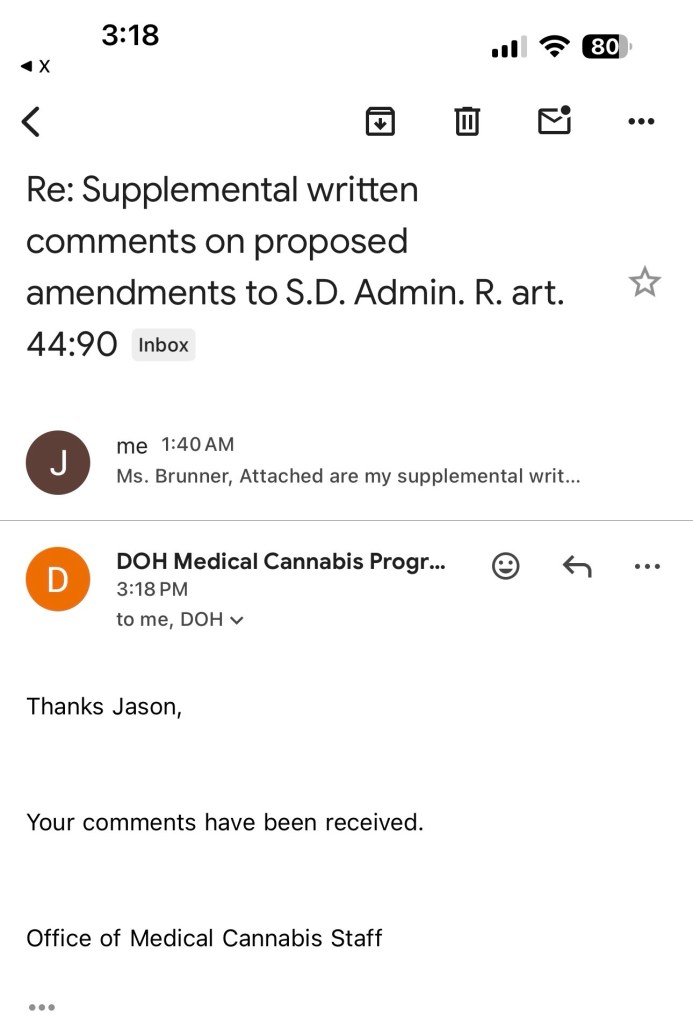
Update #1 9-14: DOH confirmed receipt same day:
Words cannot express how important this timing of this issue is to me personally, nor how grateful I am for everyone who voted turned out spent funds and risked life savings to actually help medical patients in an industry that rarely turns profit. Actions and conduct might be able to express the importance, though. This is the first year business and patient interests coexist in South Dakota’s discussions. It’s also the first year what I advocated for in South Dakota for five years came true – medical cannabis patients have been granted federal exemption. It was my sole ask, and it’s been now granted.
Prior to this year the nascent industry needed to focus on establishing itself and surviving. Patient rights, the foundation of the industry being patient consumers, are back in focus again. And with a willingness to be wrong or foolish, or make good faith errors learning complex legal procedures, any citizen can speak up and take part, if they’re willing to read the documents and follow the political season year after year.
Most people waste it watching the NFL.
I never have understood why that is.
I always learned law like some learn sports stats. I’m still not as good as a lawyer in many respects. But while most may not file communications as in depth, I’m doing this because I’m not a political ass kisser trying to jockey for inside positions with a cannabis business relying on my abilities to beg politicians for favoritism; I am a patient, with close ones who are also patients; and I’ve been studying law on this sole topic that every lawyer who ever talks to me says I know more than any lawyer they know on cannabis laws.
If you can steal insights or use ideas from me, please feel free to do so without need for credit. But do be advised if you file in any court anywhere and hurt my issue I reserve the right to file to intervene in the case, so do please come correct when appearing in courts.
If your lawyer would like to speak, I’m willing and able.
 WeedPress: The Paper Trail
Leave a comment