Previously in this series…
SDCL 1-26-5 lists three reasons an agency may use the emergency procedure. Convenience and a closed legislative calendar are not among them.
The first four pages in this series mapped nouns and desks: cardholder and establishment, four certificates and one federal license, certification and part 1306, Health and Pharmacy.¹ This page is the calendar.
The 2026 legislative session adjourned March 30.² The next regular session convenes on the second Tuesday of January 2027.³ Between those dates, an agency that wants a new permanent rule still uses SDCL chapter 1-26. It does not acquire a fourth path labeled “we will fix it in December.” The emergency-rule statute is already on the books. It is narrow. It expires. It cannot repeal a permanent rule.⁴
This page does not predict that the Department of Health will file an emergency cannabis rule. It sets the statute next to that temptation.
What the permanent path already is
A permanent rule follows SDCL § 1-26-4 and the related provisions of chapter 1-26. The agency publishes notice, receives public comments, appears before the Interim Rules Review Committee, and completes the filing process.⁵ The Department’s current Article 44:90 package is on that path: hearing September 23, 2026; written comments October 3; Interim Rules Review Committee October 14.⁶ That package is thirty-eight proposed amendments. It is not an emergency filing.⁷
The existence of that package matters. An agency may not use the emergency procedure “for the convenience of the agency merely to avoid the consequences for failing to timely promulgate rules.”⁸ A winter gap between sessions is a calendar fact. It is not, standing alone, an emergency listed in § 1-26-5.
What § 1-26-5 actually permits
Before adopting an emergency rule, the agency must publish the text, publish notice of intent, and serve the proposed rule and a statement of reasons on the designated person, each member of the Interim Rules Review Committee, and code counsel.⁹ The statement must show that the emergency procedure is necessary because of one or more of three circumstances:
(a) imminent peril to the public health, safety, or welfare;
(b) prevention of substantial unforeseen financial loss to state government; or
(c) an unforeseen event, at a time when an emergency rule is required to secure or protect the best interest of the state or its residents.¹⁰
Those are the listed doors. The April 28, 2026 federal order is not a secret.¹¹ It has been public since April. An event that has been on the calendar for five months is a poor candidate for “unforeseen” in December. This page does not decide that no cannabis-related fact could ever meet subsection (a), (b), or (c). It marks that the agency has to pick one of those three and put the reasons in writing.
What an emergency rule cannot do
Three limits sit on top of the three doors.
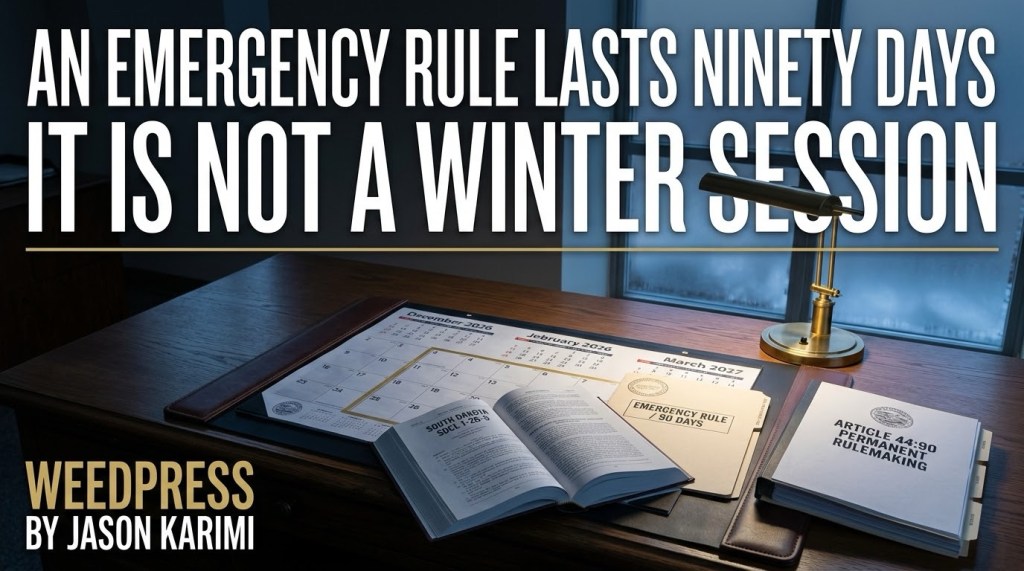
First, duration. “No emergency rule may remain in effect for a period of longer than ninety days.”¹² An emergency rule filed in December 2026 expires, at latest, in March 2027—during the next regular session, not as a substitute for it.
Second, effect on existing rules. An emergency rule “may temporarily suspend, but not repeal, a permanent rule.”¹³ A permanent rule amended by an emergency rule reverts to its original form ninety days after the emergency amendment has been in effect, unless further amended in that period.¹⁴ Article 44:90 is a body of permanent rules. An emergency overlay does not erase it.
Third, process. An emergency rule is provisionally effective immediately after filing.¹⁵ It remains subject to Interim Rules Review Committee suspension under § 1-26-38 until July 1 of the following year.¹⁶ Code counsel reviews the statement of reasons.¹⁷ The emergency number on the draft is there to distinguish it from a permanent rule.¹⁸ It is not a quieter copy of § 1-26-4.
Three questions the calendar does not answer by itself
1. Does a federal scheduling order, standing alone, satisfy § 1-26-5?
The April order is a published federal action.¹⁹ The three emergency doors require imminent peril, unforeseen financial loss to state government, or an unforeseen event requiring an emergency response. A five-month-old Federal Register notice is a fact in the record. Whether any later cannabis-specific development meets one of the three doors is a filing-by-filing question. The statute does not contain a fourth door labeled “federal law changed.”
2. Can an emergency rule supply the unpublished crosswalks in Articles 1 through 4?
Those pages asked which certificate is the federal license, whether the certification-plus-card file satisfies § 1301.13(k)(5), and which state desk receives a DEA registration.²⁰ An emergency rule that lasts ninety days and cannot repeal a permanent rule is a thin instrument for that map. If the Department intends to publish the crosswalk, the permanent path already open in the September 23 package is the file that lasts.
3. What happens when the ninety days end?
The emergency rule expires.²¹ The amended permanent rule, if only overlaid, reverts.²² The Legislature is then in, or about to be in, regular session.²³ Statute change still belongs to the Legislature. Scheduling change under § 34-20B-27 still belongs to a Department determination plus legislation.²⁴ An expired emergency rule does not write either of those.
What this page does not decide
It does not decide that the Department will file an emergency cannabis rule.
It does not decide that no set of facts could ever meet § 1-26-5(a), (b), or (c).
It does not decide the September 23 Article 44:90 package.
It does not decide tax treatment, dual DEA registration, or labs. Those remain later pages.
It does not treat a patient card as a shop license, a certification as a prescription, or Pharmacy as the medical-cannabis desk. Those were pages one, three, and four.²⁵
The checklist
1. Permanent rules travel under SDCL § 1-26-4. Emergency rules travel under § 1-26-5. They are not the same procedure.²⁶
2. An agency may use the emergency procedure only for one of three listed circumstances. It may not use it merely to avoid a missed permanent-rule calendar.²⁷
3. No emergency rule may remain in effect longer than ninety days.²⁸
4. An emergency rule may suspend a permanent rule. It may not repeal one. An overlay reverts in ninety days unless further amended.²⁹
5. The current Article 44:90 rewrite is already on the permanent path.³⁰
6. Silence about a December emergency filing is not authority for one. It is the gap.
The Legislature left town in March. It comes back in January. Chapter 1-26 already says what an agency may do in the months between. Ninety days is the outer wall. Three listed circumstances are the door. Convenience is not on the list. That is the statute. It does not need a new label.
Footnotes
¹ Jason Karimi, A Patient Card Is Not a Shop License, WeedPress (Sept. 11, 2026); Jason Karimi, The April Order Asks for a License. Pierre Issues Four Certificates., WeedPress (Sept. 11, 2026); Jason Karimi, A Written Certification Is Not a Part 1306 Prescription, WeedPress (Sept. 11, 2026); Jason Karimi, The Medical Cannabis Desk Is at Health. The Prescription Desk Is at Pharmacy., WeedPress (Sept. 11, 2026).
² S.D. Legislature, Index to the One Hundred First Legislative Session (session begun Jan. 13, 2026; concluded Mar. 30, 2026).
³ S.D. Const. art. III, § 7; 102d S.D. Legislative Session Calendar (2027 session opens second Tuesday of January).
⁴ S.D. Codified Laws §§ 1-26-5, 1-26-5.1, 1-26-8.
⁵ Id. §§ 1-26-4, 1-26-6.
⁶ S.D. Dep’t of Health, Notice of Public Hearing to Adopt Rules, Form 6 (filed Aug. 21, 2026); S.D. Legislative Research Council, South Dakota Register, Vol. 53 (Aug. 31, 2026).
⁷ Id.; Jason Karimi, 38 Rules, 19,821 Patients, 108 Licensed Establishments, WeedPress (Sept. 9, 2026).
⁸ S.D. Codified Laws § 1-26-5.
⁹ Id.
¹⁰ Id. § 1-26-5(2)(a)–(c).
¹¹ Schedules of Controlled Substances: Rescheduling of Food and Drug Administration Approved Products Containing Marijuana From Schedule I to Schedule III; Corresponding Change to Permit Requirements, 91 Fed. Reg. 22,714 (Apr. 28, 2026).
¹² S.D. Codified Laws § 1-26-8(2).
¹³ Id. § 1-26-5.1.
¹⁴ Id.
¹⁵ Id. §§ 1-26-6, 1-26-8(2).
¹⁶ Id. §§ 1-26-6, 1-26-38.
¹⁷ Id. § 1-26-6.5.
¹⁸ Id. § 1-26-5(1).
¹⁹ 91 Fed. Reg. 22,714.
²⁰ See articles cited supra note 1.
²¹ S.D. Codified Laws § 1-26-8(2).
²² Id. § 1-26-5.1.
²³ See sources cited supra notes 2–3.
²⁴ S.D. Codified Laws § 34-20B-27; Jason Karimi, South Dakota’s Schedule I Statute Requires a Department Determination Before the Legislature Gets a Rescheduling Recommendation, WeedPress (Sept. 5, 2026).
²⁵ See articles cited supra note 1.
²⁶ S.D. Codified Laws §§ 1-26-4, 1-26-5.
²⁷ Id. § 1-26-5.
²⁸ Id. § 1-26-8(2).
²⁹ Id. § 1-26-5.1.
³⁰ See sources cited supra notes 6–7.
 WeedPress: The Paper Trail
Leave a comment