A July 2026 working paper by Anthony M. Bertelli treats lay participation in administration as more than a courtesy window on a proposed rule.¹ The claim is institutional, not sentimental. Carefully designed participation, he argues, can function as an “authorized partnership”: a legally structured encounter in which ordinary people help keep public administration tied to democratically sanctioned principles, rather than to the nearest organized interest or the nearest partisan weather.²
That is not a simplistic abstraction dropped onto Pierre. South Dakota already wrote participation rights into statute. An interested person may petition an agency to promulgate, amend, or repeal a rule.³ The agency must, within thirty days, deny the petition in writing with reasons or open rulemaking.⁴ Upon adoption of a rule or rejection of such a petition, and upon a timely written request, the agency must issue a concise statement of the principal reasons for and against the rule and of why it overruled the considerations urged against adoption or rejection.⁵ The Medical Marijuana Oversight Committee is a statutory body with membership, leadership, and evaluation duties over the medical cannabis program.⁶
Those are not blog features. They are desks.
Walter J. West
Whether those desks operate as authorized partnerships is the application this piece makes of Bertelli’s framework. It is not a finding the paper itself reaches about South Dakota. The medical cannabis file—petitions on scheduling after federal rescheduling, comments on the ARSD 44:90 package, Form 14 corrective-action language, testing-lab registration, dual-registration consequences, safety-sensitive employment, and the LRC legality review of a homegrow restriction—is a working test of that distinction.⁷
As we express our gratitude, we must never forget that the highest appreciation is not to utter words, but to live by them. Kennedy, John F. (1964). “Public Papers of the Presidents of the United States: John F. Kennedy, 1963”, p.836
What the paper actually argues
Bertelli’s paper is titled Authorized Partnerships: Lay Participation and the Defense of Democratic Public Administration.⁸ It advances four claims.
First, European hard and soft law supplies a workable frame of “authorized discretion”: bureaucratic choice is not free-floating expertise. It is discretion that law has already tied to democratically sanctioned principles.⁹ That frame is developed at length in his 2025 Governance article with Valentina Falletti and Silvia Cannas, which treats authorized discretion as the democratic essential of public administration: legal principles, grounded in democratic values, authorize the forms of governance that comport with those values.¹⁰
Second, those principles are not elite ornaments. They occupy a coherent and resilient place in mass political belief systems.¹¹ People already carry workable ideas about what officials may do, what they must answer for, and when a process has been captured.
Third, authorized discretion is a publicly intelligible standard of administrative responsibility. Concrete encounters—comments, hearings, petitions, oversight meetings—sharpen citizens’ reasoning about that standard.¹² Participation is not valuable because it is loud. It is valuable because it trains the public to recognize when an agency is still inside its authorization and when it has slipped into private government.
Fourth, a “structural integrity” principle inside authorized discretion is a defense against destabilizing politics, including populist capture of the administrative apparatus.¹³ Institutional design that lets citizens help police that integrity is, on this account, a defense of democratic administration, not an attack on competence.
The normative payoff is blunt. Designs that empower lay participants to help defend governance against partisan capture are not optional décor. They are part of how an administrative state remains a public one.¹⁴
Bertelli’s empirical laboratory is European. South Dakota’s laboratory is chapter 1-26, chapter 34-20G, and the Department of Health’s cannabis docket. The translation is an application, not a quotation. Notice-and-comment, the petition right, and reason-giving are the American versions of the same architecture. Kamaile Turcan has made a related point from the other direction: notice-and-comment, the petition right, and arbitrary-and-capricious review are democracy-enhancing mechanisms unique to agency rulemaking.¹⁵ Bertelli supplies a way to judge whether those mechanisms are doing democratic work. They defend administration only if they are used as partnerships with a public standard of responsibility—not as comment boxes that can be closed or drowned.
South Dakota already built the partnership. It did not staff it.
That heading is the thesis of this article, not a conclusion Bertelli draws. The statutes below are the raw material for the claim.
Start with the petition statute. SDCL § 1-26-13 gives “an interested person” the right to petition.¹⁶ It is not limited to licensees, trade associations, or people with a lawyer on retainer. The petition must contain the text or substance of the rule sought, identification of any rule to be repealed, reasons, and the petitioner’s name and address.¹⁷ The agency then has a binary duty: deny in writing with reasons, or initiate proceedings under § 1-26-4.¹⁸ A copy of the petition and any denial goes to the Interim Rules Review Committee and to code counsel.¹⁹ That last sentence is the partnership’s second desk. The Department does not get to eat the filing.

Alfred North Whitehead
SDCL § 1-26-7.1 is the reason-giving desk, and its trigger is narrower than comment culture often assumes. The duty arises upon adoption of a rule or upon rejection of a § 1-26-13 petition, and only if an interested person requests the statement in writing either before that action or within thirty days after it.²⁰ The resulting statement must give the principal reasons for and against the rule and the agency’s reasons for overruling the considerations urged against adoption or rejection.²¹ The agency must then serve a copy on the members of the Interim Rules Review Committee and on code counsel.²² That service clause is current law, not a drafting preference. The 2025 amendment moved the second copy from the LRC director to code counsel; the 1966 origin of the reason-giving requirement, as later amended in 1975 and again in 2025, is the official source line.²³
When § 1-26-7.1 applies and an interested person timely requests the statement, the agency must explain the principal reasons for and against the rule and why it overruled considerations urged against adoption or rejection. Bertelli supplies a useful way to understand why that statutory reason-giving matters: discretion remains publicly intelligible because the agency must connect its decision to reasons that outsiders can inspect.²⁴ The statute does not create a free-standing remedy merely because someone submitted a testing-lab comment or a Form 14 objection. Those filings become “considerations urged against the rule” if they are in the adoption record, or they become the subject of a § 1-26-7.1 statement if they were presented in a petition that the agency rejected. They do not, by themselves, convert agency silence into a § 1-26-7.1 violation.
Rulemaking itself is the third desk. SDCL § 1-26-4 is the notice, comment, hearing, and fiscal-note machinery.²⁵ ARSD article 44:90 is the cannabis rules package that machinery is supposed to discipline.²⁶ When the Department circulates a fifty-four-page draft, or revises Form 14 corrective-action plans, or writes laboratory and dual-registration requirements that sit next to DEA Part 1301, the comment file is not a suggestion box. It becomes part of the administrative record that can matter to later reason-giving, LRC review, and, where applicable, administrative or judicial review.²⁷
The Medical Marijuana Oversight Committee is the fourth desk. Current law is § 34-20G-92 (membership), § 34-20G-92.1 (leadership), and § 34-20G-93 (duties and input).²⁸ Section 34-20G-94 is repealed.²⁹ Section 93 requires the Committee to meet at least twice a year to evaluate the program and make recommendations to the Legislature and the Department, including on patient access, the performance of dispensaries and cultivation facilities, and regulatory safeguards.³⁰ Open-meeting notice for state bodies is a separate duty under chapter 1-25.³¹ Recording is a different statute again. SDCL § 1-25-11 does not require the Committee to publish a recording or to maintain a “recording path.” It forbids a public body from preventing a person from making a reasonable, obvious, and nondisruptive audio or video recording of an open official meeting.³² A lay participant who records, and then cites the recording in a later petition or comment, is using that right. Treating the absence of an official posted video as a statutory breach of § 1-25-11 overstates the section. Treating an unposted, unrecorded, un-citable meeting as a weak partnership is a Bertelli-derived argument about design, not a citation to § 1-25-11.
None of this requires South Dakota to import EU soft law. It requires the Department, the Committee, and the LRC to treat the statutes they already have as authorization—not as optional courtesy.
What an authorized partnership looks like in a cannabis file
Bertelli’s third claim is the operational one for this docket. Concrete encounters sharpen reasoning about administrative responsibility.³³ That only happens if the encounter leaves a noun on a desk.
A scheduling petition after federal rescheduling is that kind of encounter. SDCL §§ 34-20B-11 and 34-20B-27 still speak in Schedule I terms. Federal placement of marijuana in Schedule III does not automatically rewrite those sections, but it does change the factual predicate on which the Department and the Legislature have been operating.³⁴ A petition that puts the 1970 and 1976 session-law history, the current text, and the federal action on the same page is not “activism.” It is the interested-person mechanism § 1-26-13 was written to trigger.³⁵ The Department’s duty is not to agree. It is to deny with reasons or open a proceeding, and to serve the Interim Rules Review Committee and code counsel.³⁶ Failure within thirty days either to deny the petition in writing with reasons or to initiate proceedings fails to satisfy the binary response § 1-26-13 requires.
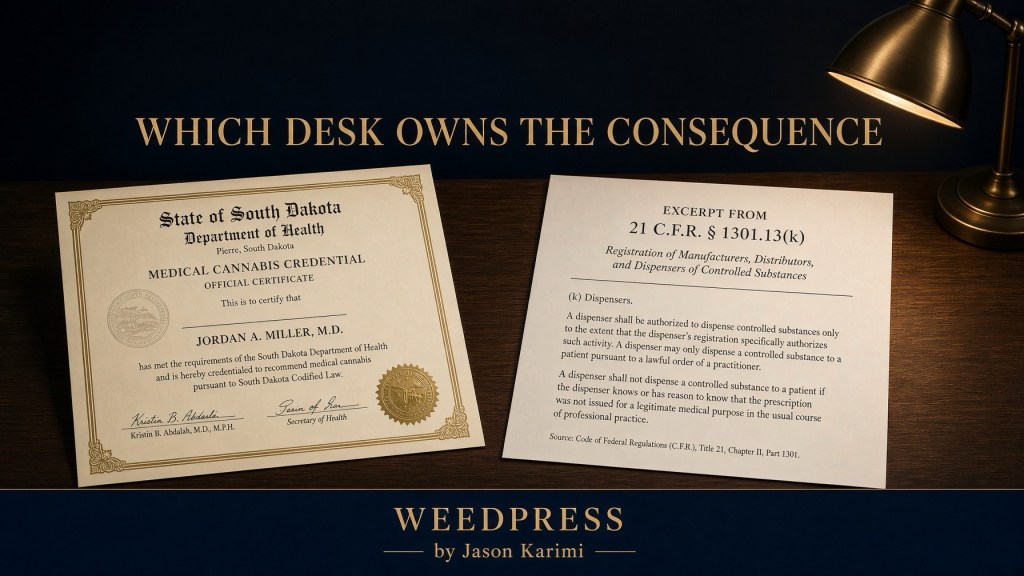
A comment on ARSD 44:90 that maps a state certificate to 21 C.F.R. § 1301.13(k) is the same mechanism in a different chair.³⁷ Federal expedited registration for state-licensed medical marijuana manufacturers, distributors, and dispensers treats the state license as the predicate for an expedited DEA path and, in the current text, as conclusive evidence of state-law authorization for the activity.³⁸ When the state credential is suspended, the federal tether has a consequence. A comment that writes that crosswalk into the Department’s record does two Bertelli jobs at once. It gives the agency the information only a user of the program is likely to put in one place. And it gives later readers—LRC, a court, a future board—a publicly intelligible standard: the Department was told what the federal desk would do with its state paper.
Testing-lab registration is the same structure. South Dakota already requires laboratories in the medical program to meet standards that sit next to DEA registration.³⁹ A lay comment that names the dual desk is not an amateur trespass on science. It is the public explaining the authorization the agency is about to implement.
Safety-sensitive employment is the same structure on a different statute. Two desks—program eligibility and employer or licensing boards—do not disappear because a commenter lacks a trade-association letterhead.⁴⁰ The partnership Bertelli describes is not “the public gets a feeling.” It is that the public is given procedures for putting the question of which desk owns which consequence into an official administrative record.
LRC legality review of a homegrow restriction is an integrity check, not a final adjudication. When Legislative Research Council staff mark a proposal and describe the statutory support for an under-21 cultivation restriction as weak, that markup is not a press release.⁴¹ It is a second institution telling the first that the proposed rule’s authority is in question. Publishing that letter, citing it, and putting it back into the comment file is how a lay participant keeps the authority question visible.⁴² Bertelli’s fourth claim is that this kind of visibility is a defense against capture.⁴³ The letter does not, by itself, establish that the restriction “cannot survive.” It establishes that the authority question was raised in the official review path and belongs in the public file.
Capture risks, populism, and the cannabis version of both
Bertelli writes against partisan and populist capture of administration.⁴⁴ The South Dakota cannabis process presents risks corresponding to both versions. They do not look like European party systems. The paragraphs that follow describe mechanisms. They do not purport to prove that the Department of Health has been captured.
One risk is industry capture dressed as expertise. Licensees, laboratories, and counsel who live inside the program will always have more hours and more paper than a patient or a pro se petitioner. That is not illegitimate. It becomes a capture risk when process treats that paper as the only paper that counts, or when a comment that cites the session laws and the C.F.R. is filed under “public input” while a trade letter is filed under “technical correction.” Bertelli’s design claim is that the process has to make the lay filing consequential enough that the agency cannot launder it.⁴⁵ SDCL §§ 1-26-13 and 1-26-7.1 are already that design—if they are used when their triggers are met.
The other risk is political capture dressed as moral emergency. Repeal-trigger bills, potency caps, and “send it back to the people” rhetoric treat the medical program as a temporary mistake rather than as an administered statute.⁴⁶ A populist move against an agency is not the same thing as lay participation inside an agency. Bertelli’s structural-integrity principle is useful here precisely because it refuses that collapse.⁴⁷ The defense of democratic administration is not “the crowd should run the laboratory.” It is “the laboratory should remain answerable to the authorization the crowd already enacted, and lay participants should be able to say so on the record.”
MMOC is where those two risks meet. Section 93 already requires twice-yearly evaluation and a channel for input.⁴⁸ Chapter 1-25 already requires notice of official meetings.⁴⁹ Section 1-25-11 already protects a person who records an open meeting.⁵⁰ If the Committee does not meet as required, does not give the notice the open-meeting statutes require, or treats testimony as something that cannot later be cited, the statutory partnership has been hollowed out. Using those tools is not theater. Leaving them unused is a design failure this article attributes to practice, not a new duty invented out of § 1-25-11.
And so while the great ones depart to their dinner, the secretary stays, growing thinner and thinner, racking his brain to record and report what he thinks that they think that they ought to have thought. Arthur Bryant Sir Arthur Bryant, Alan Brooke Alanbrooke (Viscount) (1957). “The Turn of the Tide: A History of the War Years Based on the Diares of Field-Marshal Lord Alanbrooke, Chief of the Imperial General Staff”
The file is the participation
A recurring mistake in comment culture is to treat volume as voice. Form letters, identical patient stories, and last-day dumps can demonstrate participation. Volume alone does not establish that a filing has identified the agency’s governing authorization. Bertelli is not asking for more noise. He is asking for encounters that train the public to apply a standard of responsibility.⁵¹
That is why a cannabis administrative file has to be built as nouns, desks, and crosswalks.
• Noun: the text of SDCL §§ 34-20B-11 and 34-20B-27; the text of a Form 14; the text of an LRC letter; the clause in 21 C.F.R. § 1301.13(k) that builds the federal registration path on a state medical-marijuana license.
• Desk: Department of Health rulemaking; Interim Rules Review Committee and code counsel; LRC legality review; MMOC under §§ 34-20G-92, 34-20G-92.1, and 34-20G-93; DEA registration.
• Crosswalk: what happens to the federal registration when the state certificate moves; what happens to a safety-sensitive job when the program card and the employer policy disagree; what happens to a scheduling statute when the federal schedule changes and the state text does not.
A petition that does that work is lay participation in Bertelli’s sense even if only one person signs it. A thousand comments may demonstrate participation; volume alone does not perform the authorization work this file requires.
The practical implication for patients, caregivers, local governments, and anyone else who uses this program is unromantic. Read the draft. Quote the statute. Ask the Department to say which authorization it is using. If the Department adopts a rule or rejects a § 1-26-13 petition, request the § 1-26-7.1 statement in writing before that action or within thirty days after it. Serve the record as if a later hearing will need it, because that is the only way a later hearing can use it. Attend the noticed meeting. Record it if the recording is reasonable, obvious, and nondisruptive. Put the resulting file in the next comment. That is the partnership. Everything else is atmosphere.
What the Department owes in return
Authorized discretion is a two-sided design. The public has to show up with a standard. The agency has to answer in a form the public can use.
That means written denials with reasons on a § 1-26-13 petition, not oral brush-offs. It means serving the Interim Rules Review Committee and code counsel when § 1-26-13 says so.⁵² It means a concise statement under § 1-26-7.1, when that section’s triggers are met, that actually engages the considerations urged against the rule—including a federal-state crosswalk that made it into the adoption or petition record—and that is served on the Interim Rules Review Committee and code counsel.⁵³ It means meeting notices for MMOC that chapter 1-25 already requires.⁵⁴ It means not interfering with a lawful recording of an open meeting.⁵⁵ And, as a matter of the authorized-partnership framework developed here, it means treating an LRC authority mark as a constraint that has to be answered rather than as a suggestion to be negotiated after the stakeholder room has already closed.
It also means not confusing expertise with insulation. Laboratories, physicians, and compliance counsel belong in the file. So do the people who have to live under the form the Department is about to freeze. Bertelli’s mass-belief claim is that the public already knows the difference between a responsible official and a captured one.⁵⁶ Concrete encounters either confirm that belief or corrode it. A cannabis program that will not answer a scheduling petition after a federal schedule change is teaching the public a lesson about responsibility. It should not be surprised by the lesson it teaches.
The defense is the record
Bertelli’s last move is the one this publication exists to test. Lay participation, designed as an authorized partnership, is a defense of democratic public administration against partisan capture.⁵⁷ South Dakota does not need a new theory to try that defense. It needs to use the petition statute, the reason-giving statute when its triggers are met, the comment docket, the oversight committee that current law still maintains, and the LRC letter as if they were real.
The medical cannabis file is not a side issue on which those tools can be treated as optional. It is a program in which federal law, state scheduling text, program rules, laboratory credentials, employment consequences, and political repeal pressure sit on the same desks at the same time. If authorized discretion means anything in Pierre, it means the Department has to say—on paper, with reasons, in time, and in the form the statute actually wrote—which of those desks it is using and why the considerations urged against it do not control.
Until that answer is in the file, the partnership is only authorized. It is not yet performed.
Footnotes
¹ Anthony M. Bertelli, Authorized Partnerships: Lay Participation and the Defense of Democratic Public Administration (July 16, 2026) (unpublished manuscript), https://ssrn.com/abstract=7128880.
² Id.
³ S.D. Codified Laws § 1-26-13 (2025).
⁴ Id.
⁵ Id. § 1-26-7.1.
⁶ Id. §§ 34-20G-92, 34-20G-92.1, 34-20G-93.
⁷ See S.D. Admin. R. 44:90 (medical cannabis); 21 C.F.R. § 1301.13(k) (2026); S.D. Legis. Rsch. Council, Letter of Approval / Legality Review, No. 970, https://rules.sd.gov/Uploads/970_LetterLRCApproval.pdf.
⁸ Bertelli, supra note 1.
⁹ Id.
¹⁰ Anthony M. Bertelli, Vincenza Falletti & Silvia Cannas, Authorized Discretion: The Democratic Essentials of Governance in the European Union, 38 Governance e70029 (2025), https://doi.org/10.1111/gove.70029.
¹¹ Bertelli, supra note 1.
¹² Id.
¹³ Id.; see also Anthony M. Bertelli & Vincenza Falletti, Bureaucracy Under Pressure: Structural Integrity and the Ethics of Democratic Administration, 92 Int’l Rev. Admin. Sci. (forthcoming 2026), https://doi.org/10.1177/00208523251406200 (first published online Dec. 24, 2025).
¹⁴ Bertelli, supra note 1.
¹⁵ Kamaile Turcan, Shaping Administrative Law for a Participatory Democracy (Sept. 2, 2025) (unpublished manuscript), https://ssrn.com/abstract=5433454.
¹⁶ S.D. Codified Laws § 1-26-13.
¹⁷ Id.
¹⁸ Id.; see also id. § 1-26-4.
¹⁹ Id. § 1-26-13.
²⁰ Id. § 1-26-7.1.
²¹ Id.
²² Id. (“The agency must serve a copy of the statement on the members of the Interim Rules Review Committee and code counsel.”).
²³ Id. (Source: SL 1966, ch. 159, § 3; SDCL, § 1-26-4(2); SL 1972, ch. 8, § 5; SL 1975, ch. 16, § 17; SL 1983, ch. 5, § 2; SL 1997, ch. 12, § 1; SL 2025, ch. 9, § 19). The 1975 amendment associated with § 1-26-7.1 is § 17 of chapter 16, not § 20. Section 20 of that chapter appears in the source line for § 1-26-7. See id. § 1-26-7 (Source: … SL 1975, ch. 16, § 20 …). The 2025 amendment also shifted service of the statement from the LRC director to code counsel. See 2025 S.D. Sess. Laws ch. 9, § 19; S.D. Legis. Rsch. Council, 2025 Title Summaries, Title 1 (HB 1051 reverting rules-oversight staffing to code counsel).
²⁴ Bertelli, supra note 1.
²⁵ S.D. Codified Laws § 1-26-4.
²⁶ S.D. Admin. R. 44:90.
²⁷ See S.D. Codified Laws §§ 1-26-6, 1-26-7.1, 1-26-30 to 1-26-37; S.D. Legis. Rsch. Council, supra note 7.
²⁸ S.D. Codified Laws §§ 34-20G-92, 34-20G-92.1, 34-20G-93.
²⁹ Id. § 34-20G-94 (repealed).
³⁰ Id. § 34-20G-93.
³¹ See id. §§ 1-25-1, 1-25-1.3, 1-25-1.4.
³² Id. § 1-25-11.
³³ Bertelli, supra note 1.
³⁴ Compare S.D. Codified Laws §§ 34-20B-11, 34-20B-27, with the federal placement of marijuana in Schedule III and the implementing registration text at 21 C.F.R. § 1301.13(k).
³⁵ S.D. Codified Laws § 1-26-13; see SL 1970, ch. 229; SL 1976, ch. 158 (legislative history of the state scheduling scheme).
³⁶ S.D. Codified Laws § 1-26-13.
³⁷ 21 C.F.R. § 1301.13(k) (2026).
³⁸ Id. § 1301.13(k), (k)(2) (state license as evidence of state authorization).
³⁹ See S.D. Admin. R. 44:90 (testing facilities); 21 C.F.R. pts. 1301, 1318.
⁴⁰ See S.D. Codified Laws ch. 34-20G; applicable professional and employer policies sitting outside the Department’s card.
⁴¹ S.D. Legis. Rsch. Council, supra note 7.
⁴² See S.D. Codified Laws §§ 1-26-1.1, 1-26-4 (LRC and Interim Rules Review Committee roles in the rulemaking path).
⁴³ Bertelli, supra note 1.
⁴⁴ Id.
⁴⁵ Id.
⁴⁶ See S.D. S. Health & Hum. Servs. Comm. hearings on medical cannabis repeal-trigger and potency-cap proposals (2025–2026).
⁴⁷ Bertelli, supra note 1; Bertelli & Falletti, supra note 13.
⁴⁸ S.D. Codified Laws § 34-20G-93.
⁴⁹ Id. §§ 1-25-1, 1-25-1.3.
⁵⁰ Id. § 1-25-11.
⁵¹ Bertelli, supra note 1.
⁵² S.D. Codified Laws § 1-26-13.
⁵³ Id. § 1-26-7.1.
⁵⁴ Id. §§ 1-25-1, 1-25-1.3.
⁵⁵ Id. § 1-25-11.
⁵⁶ Bertelli, supra note 1.
⁵⁷ Id.


Leave a comment