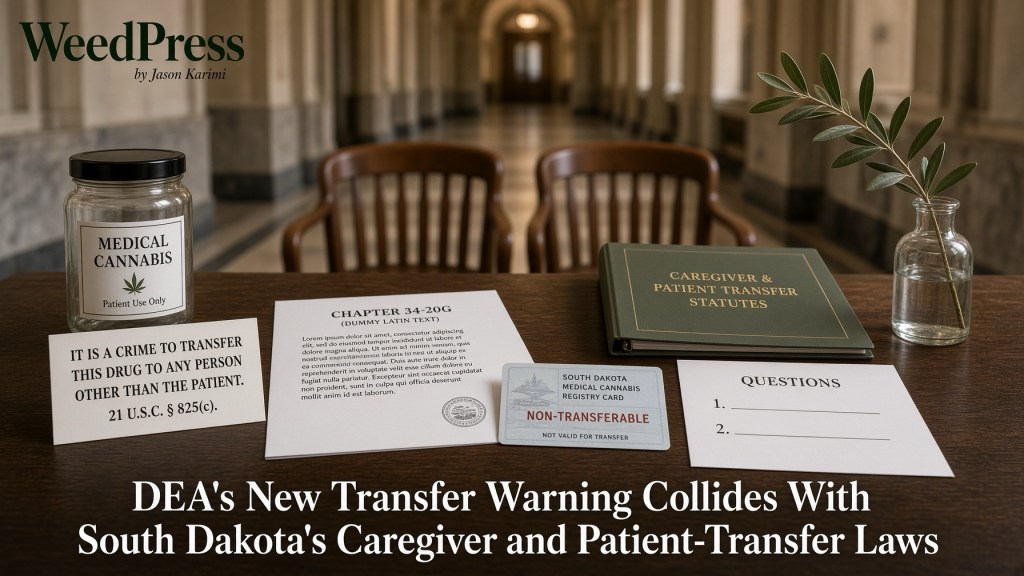
South Dakota still lets a designated caregiver buy and carry medical cannabis for a patient. It still protects specified no-value transfers from one cardholder to another under § 34-20G-2(6).¹ Federal Schedule III rules now put a different sentence on the jar: it is a crime to transfer the drug to anyone other than “the patient.”²
The April 2026 order did not repeal IM26.³ It created a labeling problem Pierre has not answered. That problem belongs on the October 13 Medical Marijuana Oversight Committee record.⁴
The federal side, in plain terms
Once state-licensed medical marijuana is treated as a Schedule III drug, a container dispensed to or for a patient must carry a clear warning that transfer to any person other than the patient is a crime. That is 21 U.S.C. § 825(c).⁵ It is a label rule, not a new standalone crime statute. The crime it points to is still unauthorized transfer under the Controlled Substances Act.⁶
DEA’s own regulation makes the packaging deal explicit. A covered registrant may use state labeling only if the label includes that § 825(c) warning, “where applicable.” That is 21 C.F.R. § 1301.13(k)(8).⁷
DEA also wrote a second instruction. A registered dispenser may dispense to “individuals authorized by state law to possess marijuana … for medical purposes,” within the state license. That is § 1301.13(k)(1)(iii).⁸ That language matters to South Dakota’s caregiver structure.
The South Dakota side, in plain terms
A designated caregiver is an adult who helps a qualifying patient, has no disqualifying felony, and generally helps no more than five patients.⁹ A cardholder is the patient or that caregiver.¹⁰
Section 34-20G-70 limits how much a dispensary may dispense “to a registered qualifying patient or a nonresident cardholder, directly or via a designated caregiver,” in any fourteen-day period. Before the product may be dispensed to a cardholder or nonresident cardholder, the agent must verify the card and identity.¹¹ ARSD 44:90:08:03 then requires dispensary staff to track amounts dispensed for a patient’s use and to consolidate sales to the patient and the patient’s designated caregiver.¹²
Separately, SDCL § 34-20G-2(6) protects a no-value gift of cannabis to another cardholder, a nonresident cardholder, or a dispensary, so long as the giver does not knowingly push the recipient over the allowable amount.¹³ State law still felonizes transfer to an unauthorized person.¹⁴ It still authorizes those two authorized paths.
ARSD 44:90 still treats caregivers as part of how patients get and, in some cases, grow medicine.¹⁵
Three sentences that do not match
1. DEA: you may dispense to a person state law authorizes to possess medical marijuana.
2. DEA: the label must warn that transfer to anyone but “the patient” is a crime.
3. South Dakota: caregivers remain in the program, and § 34-20G-2(6) still protects specified cardholder gifts.
That is the article. It is not a court decision that IM26 is void. It is an unresolved implementation question.
Two questions for MMOC (October 13)
The Legislature’s public schedule lists the Medical Marijuana Oversight Committee for Tuesday, October 13, 2026, at 11:00 a.m. in Room 362 at the State Capitol.¹⁶ Do not treat caregiver pickup and cardholder-to-cardholder gifting as one issue. They are two desks. South Dakota’s dispensing statute expressly contemplates dispensing directly to the patient or via the designated caregiver; the dispensary rule requires those sales to be tracked together for the patient’s cap.¹⁷
Question 1 — caregivers.
Who is “the patient” for the § 825(c) warning when § 1301.13(k)(1)(iii) lets a registered dispenser dispense to someone South Dakota law authorizes to possess marijuana for another patient’s medical use?
Question 2 — sharing after the sale.
What happens to § 34-20G-2(6)’s no-value cardholder transfer after the original dispensing has occurred?
Question 1 is complicated by DEA’s own text, because the dispenser rule expressly reaches individuals whom state law authorizes to possess medical marijuana, while § 825(c) uses the narrower noun “the patient.” Question 2 is the sharper collision: the state statute describes a later gift; the federal warning describes a crime if the recipient is not “the patient.”
MMOC does not have to repeal chapter 34-20G to put an answer in the file. It does have to say how those two paths work once the jar carries the federal sentence.
What this is not
This is not a prediction of raids. It is not a claim that § 825(c) charges every gift by itself. It is not a claim that federal law has already ordered Pierre to amend both statutes.
It is a claim that the warning is now part of the federal packaging path, South Dakota has not reconciled that warning with the transfers its own law still authorizes, and the October 13 meeting is a place to put the two questions on the record.¹⁸ Until someone answers them, the label is printed. The statute is not reconciled.
Notes
¹ S.D. Codified Laws §§ 34-20G-1(10), 34-20G-2(6).
² 21 U.S.C. § 825(c); 21 C.F.R. § 1301.13(k)(8).
³ Schedules of Controlled Substances: Rescheduling of Food and Drug Administration Approved Products Containing Marijuana From Schedule I to Schedule III; Corresponding Change to Permit Requirements, 91 Fed. Reg. 22,714 (Apr. 28, 2026).
⁴ S.D. Legislature, Schedule (listing Medical Marijuana Oversight Committee, Oct. 13, 2026, 11:00 a.m., Room 362), https://sdlegislature.gov/session/schedule.
⁵ 21 U.S.C. § 825(c).
⁶ See 21 U.S.C. §§ 802(10)–(11), 841(a).
⁷ 21 C.F.R. § 1301.13(k)(8); 91 Fed. Reg. 22,714.
⁸ 21 C.F.R. § 1301.13(k)(1)(iii).
⁹ S.D. Codified Laws § 34-20G-1(10).
¹⁰ Id. § 34-20G-1(6).
¹¹ Id. § 34-20G-70.
¹² ARSD 44:90:08:03.
¹³ S.D. Codified Laws § 34-20G-2(6).
¹⁴ Id. §§ 34-20G-74, 34-20G-75.
¹⁵ ARSD art. 44:90.
¹⁶ S.D. Legislature, Schedule, supra note 4.
¹⁷ S.D. Codified Laws § 34-20G-70; ARSD 44:90:08:03.
¹⁸ 21 U.S.C. § 825(c); 21 C.F.R. § 1301.13(k)(1)(iii), (k)(8); S.D. Codified Laws §§ 34-20G-1(10), 34-20G-2(6), 34-20G-70.


Leave a comment