April 23, 2026
Marijuana’s federal Schedule I status was never just a scientific judgment. It was born at the intersection of bureaucracy, racial politics, antiwar backlash, and executive power. The Controlled Substances Act placed marijuana in Schedule I in 1970, the most restrictive category in federal drug law, reserved for substances deemed to have a high potential for abuse, no currently accepted medical use, and no accepted safety for use under medical supervision.¹
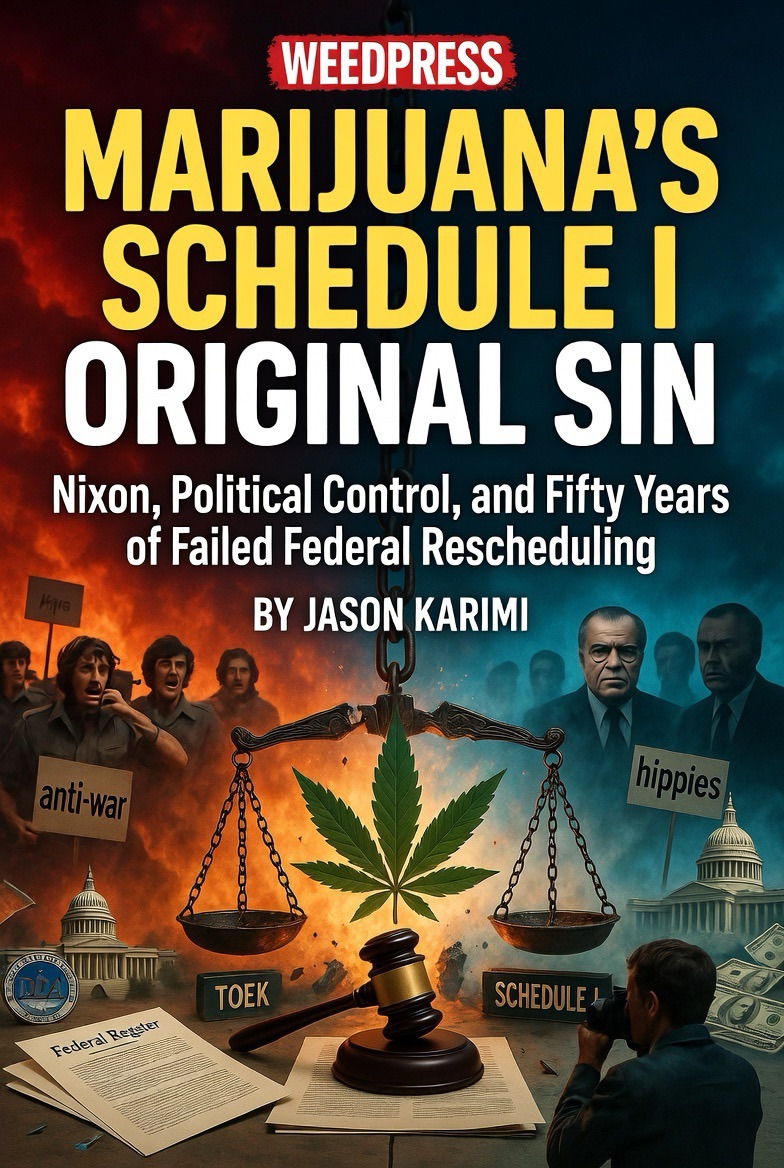
President Richard Nixon’s administration did not merely enforce drug law. It weaponized drug law as political architecture. Nixon’s domestic-policy adviser John Ehrlichman later described the drug war as a tool for associating “hippies” with marijuana and Black communities with heroin, then criminalizing both heavily to disrupt political enemies.² The quote has been disputed by some Nixon-era defenders, but it fits the broader historical record: Nixon escalated drug control during the Vietnam-era backlash, targeted antiwar and countercultural constituencies, and rejected the very commission he appointed when it recommended marijuana decriminalization.³
That is the central point lawyers, legislators, and policy researchers must confront: marijuana’s Schedule I status was not a neutral evidence-based endpoint. It was a political starting point that later agencies, courts, and litigants were forced to rationalize after the fact.
Congress placed marijuana in Schedule I as part of the CSA, but the placement was supposed to be provisional while the National Commission on Marihuana and Drug Abuse studied the issue.⁴ In 1972, the Shafer Commission concluded that possession of marijuana for personal use should not be treated as a criminal offense.⁵ Nixon ignored that recommendation.⁶ The result was a federal classification that survived not because it was medically coherent, but because administrative law allowed DEA to transform old political assumptions into binding regulatory doctrine.
The national rescheduling history begins almost immediately after the CSA. NORML filed the first major marijuana rescheduling petition in 1972, seeking removal from Schedule I.⁷ In NORML v. Ingersoll, the D.C. Circuit rejected DEA’s procedural avoidance and forced the agency to process the petition.⁸ In NORML v. DEA, the court again confronted DEA’s handling of marijuana scheduling and rejected simplistic arguments that treaty obligations automatically required Schedule I treatment.⁹
The most important administrative breakthrough came in 1988, when DEA Administrative Law Judge Francis Young concluded, after extensive hearings, that marijuana was “one of the safest therapeutically active substances known to man” and should be transferred out of Schedule I.¹⁰ That finding should have been a turning point. Instead, DEA Administrator John Lawn rejected it and kept marijuana in Schedule I.¹¹
The D.C. Circuit largely allowed DEA to do so. In Alliance for Cannabis Therapeutics v. DEA, the court upheld DEA’s power to define “currently accepted medical use” through restrictive criteria.¹² After remand, DEA refined its test, and in the 1994 ACT decision the D.C. Circuit accepted DEA’s five-part standard requiring, among other things, adequate studies, known chemistry, and general acceptance by qualified experts.¹³
The trap was obvious. Schedule I status made research harder; lack of research was then used to justify Schedule I status.¹⁴ Federal law created a closed evidentiary loop: marijuana could not escape Schedule I without the kind of FDA-style evidence that Schedule I itself helped prevent.

The modern rescheduling era repeated the same cycle. In 2002, the Coalition to Reschedule Cannabis filed a petition seeking transfer of marijuana to Schedule III, IV, or V.¹⁵ DEA did not deny that petition until 2011.¹⁶ WeedPress covered that moment in connection with Carl Olsen and the 2011 DEA ruling; that history remains relevant because it shows how coalition-based rescheduling litigation was forced to fight both science and agency delay. See WeedPress, “Tonight: Carl’s Cannabis Corner — July 10, 2011.”¹⁷
In Americans for Safe Access v. DEA, the D.C. Circuit upheld DEA’s 2011 denial, even though the petitioners cited peer-reviewed studies and state medical-cannabis laws.¹⁸ The court found standing through veteran Michael Krawitz but deferred to DEA’s conclusion that marijuana lacked “currently accepted medical use” under the agency’s framework.¹⁹
DEA denied later petitions again in 2016, maintaining Schedule I despite expanding state medical legalization and growing scientific evidence.²⁰ The agency continued to treat FDA approval, controlled studies, and federal acceptance as decisive markers, even as state medical systems became the real-world site of patient access.²¹
The Supreme Court’s cannabis cases deepened the problem. In United States v. Oakland Cannabis Buyers’ Cooperative, the Court rejected a medical-necessity defense under the CSA, emphasizing that Congress had already placed marijuana in Schedule I.²² In Gonzales v. Raich, the Court then held that Congress could reach even intrastate, noncommercial medical cannabis activity under the Commerce Clause.²³ Together, those cases made Schedule I classification more than symbolic. It became the legal engine through which federal power displaced state medical judgment, patient reliance, and local democratic reform.²⁴
That federalism backdrop matters because the CSA does not leave scheduling to intuition. It sets out a formal rescheduling process through the Attorney General, DEA, and HHS.²⁵ The statute requires consideration of scientific evidence, pharmacological effect, abuse potential, public-health risk, dependence liability, and whether a substance is an immediate precursor.²⁶ But in practice, marijuana rescheduling became less a fresh statutory inquiry than a defense of old assumptions.²⁷
International treaty arguments also became part of the government’s defense. Federal agencies repeatedly invoked the Single Convention on Narcotic Drugs as a constraint on marijuana scheduling, even though the D.C. Circuit had already rejected the idea that treaty obligations mechanically required Schedule I status.²⁸ The treaty point mattered politically because it gave federal officials another way to portray prohibition as legal necessity rather than discretionary policy choice.²⁹
Other litigation reinforced the same administrative pattern. In Gettman v. DEA, the D.C. Circuit held that petitioners challenging marijuana’s Schedule I status lacked standing, avoiding the merits of the scientific classification fight.³⁰ In Grinspoon v. DEA, the First Circuit’s treatment of medical use in the context of synthetic THC showed that federal drug scheduling could recognize accepted medical use when agencies wanted to draw that line narrowly and product-specifically.³¹ That contrast remains important: the system could accommodate cannabinoid medicine while continuing to condemn the plant.
By 1992, DEA had formally rejected ALJ Young’s recommendation and reaffirmed marijuana’s Schedule I status.³² By 2001, DEA had denied another marijuana scheduling petition.³³ By 2011 and 2016, the agency had done it again.³⁴ The result was not merely policy inertia. It was institutional entrenchment.
This is why marijuana rescheduling is not merely a drug-policy issue. It is an institutional-design issue. The CSA gives scheduling power to federal agencies, but the historical record shows that the initial classification was politically contaminated; the administrative record shows that DEA preserved that classification through restrictive evidentiary rules; and the case law shows that courts repeatedly deferred to the agency’s frame.³⁵
That deference is now itself in transition. After Loper Bright Enterprises v. Raimondo, courts may be less willing to reflexively defer to agency interpretations of ambiguous statutes.³⁶ Cannabis rescheduling lawyers should not overread that case as a silver bullet. But they should recognize the opportunity: if agency deference weakens, DEA’s old definitional control over “currently accepted medical use” may become more vulnerable to challenge.³⁷
For lawyers, the lesson is procedural. Winning marijuana reform requires building records that attack the evidentiary loop directly. For legislators, the lesson is structural. If Congress leaves cannabis reform entirely to agency scheduling, agencies can narrow the question to technical medical-use criteria while ignoring federalism, reliance interests, racial impact, religious liberty, and democratic legitimacy. For policy researchers, the lesson is historical. Schedule I status is not a fact about marijuana. It is a record of how political decisions harden into legal categories.³⁸
The Nixon-era origin matters because law carries memory. A classification created during a political war on antiwar protestors, counterculture, and marginalized communities should not receive endless legitimacy simply because agencies later learned how to defend it in Federal Register prose.
That is also why the coalition history matters. Cannabis rescheduling was never only a bureaucratic paper fight. It was a long-form legal campaign by patients, scientists, lawyers, veterans, activists, and reform organizations trying to force federal law to confront reality.³⁹ WeedPress has covered that history through the work around Carl Olsen and the rescheduling coalition, and that record should be understood as part of the national litigation arc—not merely local reform lore.⁴⁰
Marijuana’s Schedule I status began as a political weapon. The national litigation history shows how that weapon became an administrative habit. The next phase of reform should not merely ask whether cannabis belongs in Schedule III. It should ask why a classification born from political discrimination was allowed to govern medicine, federalism, criminal law, research, and constitutional liberty for more than fifty years.
Footnotes
¹ 21 U.S.C. § 812(b)(1).
² Dan Baum, Legalize It All, Harper’s Mag. (Apr. 2016).
³ Nat’l Comm’n on Marihuana & Drug Abuse, Marihuana: A Signal of Misunderstanding (1972).
⁴ Controlled Substances Act, Pub. L. No. 91-513, 84 Stat. 1236 (1970).
⁵ Nat’l Comm’n on Marihuana & Drug Abuse, supra note 3.
⁶ Id.
⁷ Nat’l Org. for Reform of Marijuana Laws v. Ingersoll, 497 F.2d 654, 655 (D.C. Cir. 1974).
⁸ Id.
⁹ Nat’l Org. for Reform of Marijuana Laws v. DEA, 559 F.2d 735, 751–57 (D.C. Cir. 1977).
¹⁰ In re Marijuana Rescheduling Petition, DEA No. 86-22, Op. & Recommended Ruling, Findings of Fact, Conclusions of Law & Decision of Admin. L.J. Francis L. Young (Sept. 6, 1988).
¹¹ Marijuana Scheduling Petition; Denial of Petition, 54 Fed. Reg. 53,767 (Dec. 29, 1989).
¹² All. for Cannabis Therapeutics v. DEA, 930 F.2d 936, 939–41 (D.C. Cir. 1991).
¹³ All. for Cannabis Therapeutics v. DEA, 15 F.3d 1131, 1135–37 (D.C. Cir. 1994).
¹⁴ See 21 U.S.C. §§ 823, 841; 21 C.F.R. pt. 1301.
¹⁵ Ams. for Safe Access v. DEA, 706 F.3d 438, 439–40 (D.C. Cir. 2013).
¹⁶ Denial of Petition to Initiate Proceedings to Reschedule Marijuana, 76 Fed. Reg. 40,552 (July 8, 2011).
¹⁷ Jason Karimi, Tonight: Carl’s Cannabis Corner — July 10, 2011, WeedPress (July 10, 2011).
¹⁸ Ams. for Safe Access, 706 F.3d at 440–42.
¹⁹ Id. at 443–50.
²⁰ Denial of Petition to Initiate Proceedings to Reschedule Marijuana, 81 Fed. Reg. 53,688 (Aug. 12, 2016).
²¹ Id.
²² United States v. Oakland Cannabis Buyers’ Coop., 532 U.S. 483 (2001).
²³ Gonzales v. Raich, 545 U.S. 1 (2005).
²⁴ See id.; Oakland Cannabis Buyers’ Coop., 532 U.S. 483.
²⁵ 21 U.S.C. § 811(a)–(b).
²⁶ 21 U.S.C. § 811(c).
²⁷ 21 U.S.C. § 812(c), sched. I(c)(10).
²⁸ Single Convention on Narcotic Drugs, Mar. 30, 1961, 18 U.S.T. 1407; NORML v. DEA, 559 F.2d at 751.
²⁹ NORML v. DEA, 559 F.2d at 751–57.
³⁰ Gettman v. DEA, 290 F.3d 430, 432–35 (D.C. Cir. 2002).
³¹ Grinspoon v. DEA, 828 F.2d 881 (1st Cir. 1987).
³² Cannabis Rescheduling, 57 Fed. Reg. 10,499 (Mar. 26, 1992).
³³ Marijuana Scheduling Petition; Denial of Petition, 66 Fed. Reg. 20,038 (Apr. 18, 2001).
³⁴ Denial of Petition, 76 Fed. Reg. 40,552; Denial of Petition, 81 Fed. Reg. 53,688.
³⁵ See All. for Cannabis Therapeutics, 15 F.3d at 1135–37; Ams. for Safe Access, 706 F.3d at 449–50.
³⁶ Loper Bright Enters. v. Raimondo, 603 U.S. ___ (2024).
³⁷ See id.; All. for Cannabis Therapeutics, 15 F.3d at 1135–37.
³⁸ See 21 U.S.C. §§ 811–812; Ams. for Safe Access, 706 F.3d 438.
³⁹ See Ams. for Safe Access, 706 F.3d at 439–40.
⁴⁰ Jason Karimi, Tonight: Carl’s Cannabis Corner — July 10, 2011, WeedPress (July 10, 2011).
 WeedPress: The Paper Trail
Leave a comment