
South Dakota’s medical cannabis program stands at a critical juncture following the federal partial rescheduling of certain marijuana products to Schedule III.¹ After the DEA’s June 29, 2026 rescheduling hearing concludes, the undersigned will formally petition the South Dakota Department of Health (DOH) to review and align the state’s Schedule I classification of marijuana with current federal reality.²
This is not an activist stunt for attention. It is a sincere pursuit of legal truth and regulatory clarity in the interest of patients.³ The undersigned’s fiancée is a patient with severe medical issues for which medical cannabis provides substantial relief. South Dakota is fortunate to have some of the best quality and most affordable medical cannabis in the country. Genesis Farms dispensaries, for example, routinely offer $50 ounces and maintain highly competitive pricing.⁴
The thrust of the petition is straightforward. Absent agency action to review scheduling, certain marijuana prosecutions and scheduling classifications may become increasingly vulnerable to conformity-based challenges following the federal shift.⁵ Advance notice is therefore being provided now: in the absence of timely DOH review and alignment, defense cases will be pursued to seek dismissal of marijuana charges on the grounds that current state scheduling no longer satisfies the statutory criteria set forth in South Dakota law.⁶
Such litigation would not serve patient interests or public safety. It would instead create unnecessary uncertainty, drain public resources, and delay the clarity that patients, caregivers, operators, and law enforcement all deserve following the federal rescheduling determination.⁷ A proactive DOH review will help clarify the interaction between federal Schedule III changes and South Dakota’s medical cannabis framework under SDCL ch. 34-20G.⁸ It will also reduce regulatory risk for small operators and ensure continued patient access to safe, tested, affordable medicine.⁹
The federal rescheduling order of April 28, 2026 created a Schedule III pathway affecting certain FDA-approved marijuana products and marijuana operating within qualifying state-licensed frameworks, subject to federal registration and compliance requirements.¹⁰ South Dakota’s statutes contain conformity mechanisms that are now implicated.¹¹ Other jurisdictions are already confronting conformity and implementation disputes following federal rescheduling actions.¹²
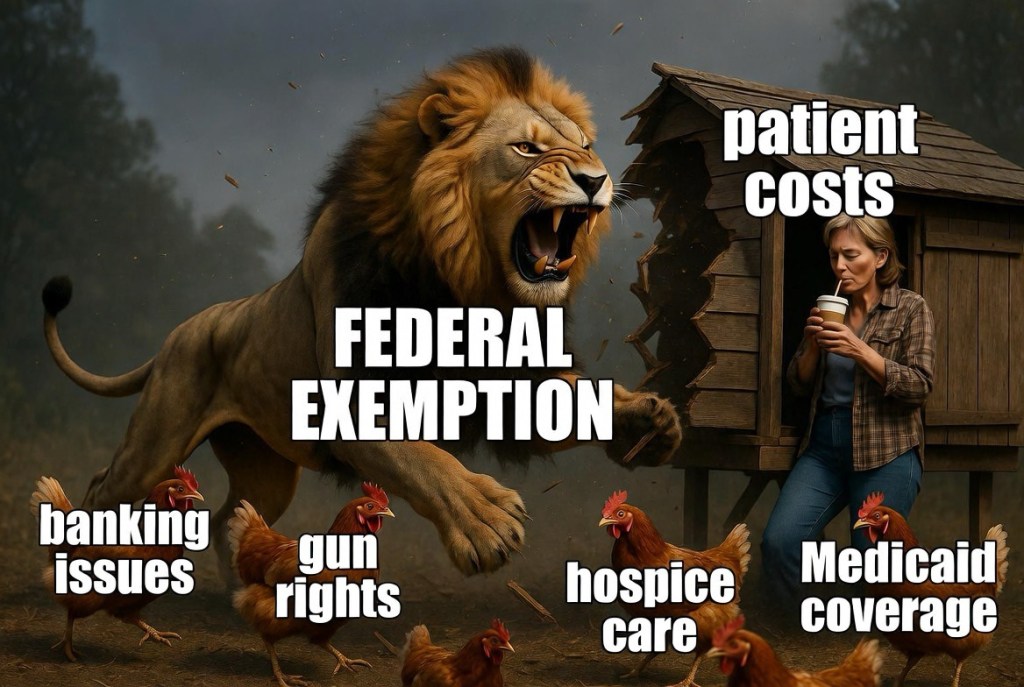
WeedPress has mapped these dynamics for nearly two decades through its ongoing series on the Controlled Substances Act as an architecture of exemptions.¹³ The federal government’s recent actions appear to validate aspects of the exemption-framework analysis long discussed by WeedPress.¹⁴ The resulting shockwave is already hitting states with conformity language, forcing legislatures, regulators, and courts to confront the new reality.¹⁵ South Dakota should not wait to be forced into alignment through litigation.¹⁶
This petition will be filed after the federal hearings conclude so that the fullest possible administrative record is available.¹⁷ It is offered in good faith as advance notice to the Department of Health and to all stakeholders. Patients deserve stable, enforceable laws that reflect current federal and scientific understanding.¹⁸ Small operators deserve regulatory certainty rather than exposure to future challenges.¹⁹ Law enforcement and the courts deserve clear, consistent guidance rather than protracted litigation over scheduling validity.²⁰
WeedPress will continue tracking the rescheduling mechanics, state conformity issues, and program impacts so that patients and operators have the information they need during this transition.²¹ The public record must remain open and accessible.²²
This work builds directly on the undersigned’s formal participation in the federal process.²³ It rests on long-standing statutory authority under the CSA, including DEA registration authority and treaty-based scheduling provisions.²⁴ ³⁰ It also reflects the citizen-driven origins of South Dakota’s medical cannabis program.²⁵ Genesis Farms patient pricing data illustrates the practical stakes for patients and operators.²⁶ The broader federal legitimacy argument advanced by WeedPress for seventeen years is now being tested in real time.²⁸ The litigation exposure analysis above is grounded in conformity concerns that have already surfaced in multiple jurisdictions.²⁹
Footnotes
¹ Schedules of Controlled Substances: Rescheduling of Food and Drug Administration Approved Products Containing Marijuana From Schedule I to Schedule III; Corresponding Change to Permit Requirements, 91 Fed. Reg. 22714 (Apr. 28, 2026) (2026-08176), https://www.federalregister.gov/documents/2026/04/28/2026-08176.
² See SDCL ch. 34-20G (state medical cannabis framework and conformity provisions).
³ This petition is framed as a good-faith request for agency review under applicable administrative procedures.
⁴ Genesis Farms Cannabis Company, https://www.genesisfarmscannabis.com/ (routinely offering $50 ounces and highly competitive pricing documented on site); see also Genesis Farms “What’s New” page confirming extended low-price promotions, https://www.genesisfarmscannabis.com/whats-new.
⁵ Certain marijuana prosecutions and scheduling classifications may become increasingly vulnerable to conformity-based challenges following the federal shift.
⁶ Advance notice of potential defense strategies is provided in the interest of regulatory clarity.
⁷ Patient access and program stability are core interests served by timely agency review.
⁸ SDCL ch. 34-20G (conformity language).
⁹ Small operators face compliance and market pressures from federal alignment.
¹⁰ 91 Fed. Reg. 22714 (Apr. 28, 2026).
¹¹ See supra note 2.
¹² Other jurisdictions are already confronting conformity and implementation disputes following federal rescheduling actions.
¹³ Jason Karimi, The Controlled Substances Act as Architecture of Exemptions: A Two-Decade Policy Series, WeedPress (ongoing series, 2008–2026), https://weedpress.org/policy-series/csa-architecture-of-exemptions.
¹⁴ The federal government’s recent actions appear to validate aspects of the exemption-framework analysis long discussed by WeedPress.
¹⁵ Jason Karimi, The Federal Rescheduling Shockwave Hits South Carolina and 26 Other States Appear to Have Automatic or Mandatory Conformity Mechanisms, WeedPress (May 5, 2026), https://weedpress.org/2026/05/05/the-federal-rescheduling-shockwave-hits-south-carolina-and-26-other-states.
¹⁶ Proactive review reduces litigation risk and promotes regulatory certainty.
¹⁷ DEA Docket No. DEA-1362, Schedules of Controlled Substances: Rescheduling of Marijuana, 91 Fed. Reg. 22777 (Apr. 28, 2026) (hearing begins June 29, 2026).
¹⁸ Patient interests are paramount in medical cannabis program administration.
¹⁹ Small operators require clear regulatory guidance post-federal change.
²⁰ Law enforcement and courts benefit from enforceable, consistent scheduling.
²¹ Jason Karimi, The Policy Vacuum: What Happens When Leadership Steps Back During Federal Cannabis Rescheduling, WeedPress (May 13, 2026), https://weedpress.org/2026/05/13/the-policy-vacuum.
²² See supra notes 1, 10, 17.
²³ Jason Karimi, I Have Filed Notice to Participate in the DEA’s June 29 Rescheduling Hearing, WeedPress (May 10, 2026), https://weedpress.org/2026/05/10/i-have-filed-notice-to-participate-in-the-deas-june-29-rescheduling-hearing.
²⁴ 21 U.S.C. § 823 (DEA registration authority).
²⁵ South Dakota Initiated Measure 26 (2020).
²⁶ Genesis Farms patient pricing data (supra note 4).
²⁷ Smaller operators’ reported complaints regarding Genesis Farms pricing (reported to WeedPress).
²⁸ Jason Karimi, I Spent 17 Years Arguing for Federal Cannabis Legitimacy — Now Small Operators Are About to Learn What That Means, WeedPress (May 9, 2026), https://weedpress.org/2026/05/09/i-spent-17-years-arguing-for-federal-cannabis-legitimacy-now-small-operators-are-about-to-learn-what-that-means.
²⁹ See supra notes 5–7 (litigation exposure analysis).
See also 21 U.S.C. § 811(d)(1) (treaty obligations and scheduling authority).
Update: here’s a draft of the petition and prayer for relief.
Petition for Scheduling Review – Federal Rescheduling Triggers Mandatory Agency Action Under South Dakota Law
On April 28, 2026, the United States Drug Enforcement Administration issued a final order placing certain FDA-approved marijuana products and marijuana subject to qualifying state-issued medical licenses into Schedule III of the federal Controlled Substances Act.¹ This federal action constitutes a formal determination that the covered categories no longer fit Schedule I and belong in Schedule III.
This federal rescheduling creates an irreconcilable conflict with South Dakota’s continued classification of marijuana as a Schedule I substance. Under SDCL 34-20B-11, a substance may be placed in Schedule I only if it has “no currently accepted medical use in treatment in the United States.” Yet South Dakota’s own medical cannabis program, enacted by Initiated Measure 26 (2020) and codified at SDCL ch. 34-20G, expressly recognizes and regulates accepted medical use for qualifying patients.² The federal order now formally acknowledges what the state program already implements, rendering the continued Schedule I classification inconsistent with both federal reality and South Dakota’s own statutory framework.
South Dakota law imposes a mandatory duty on the Department of Health in response to such changes. SDCL 34-20B-27 states, in relevant part:
“The department shall make recommendations to the Legislature that a substance be added, deleted, or rescheduled when the department determines that such substance has a different potential for abuse.”³
The word “shall” is mandatory and creates a non-discretionary duty. By express legislative decree and long-standing rules of statutory construction, the word “shall” manifests a mandatory directive and does not confer discretion.⁴ When a statute dictates that an official “shall” perform an action, a writ of mandamus may issue to compel fulfillment of that clear legal duty.⁵
In making any scheduling determination, the Department must apply South Dakota’s own schedule criteria, including abuse potential, accepted medical use in the United States, accepted safety for use under medical supervision, and dependence liability.⁶ The federal government’s determination that covered categories of marijuana belong in Schedule III directly implicates those public-health and safety criteria and requires meaningful departmental review rather than administrative inaction.
The April 28, 2026 federal order supplies compelling evidence requiring the Department to determine whether marijuana now has a different potential for abuse under SDCL 34-20B-27. The Department is therefore required to review the scheduling of marijuana and make appropriate recommendations to the Legislature.
Absent timely action, the State’s continued enforcement of Schedule I marijuana laws faces increasing legal vulnerability. Defendants in criminal prosecutions can (and will) raise conformity-based challenges, arguing that the Department’s inaction violates the mandatory “shall” language of SDCL 34-20B-27 and renders the state’s Schedule I classification inconsistent with federal law and South Dakota’s own medical cannabis program.⁷ Such litigation would drain public resources, create uncertainty for patients and operators, and undermine the rule of law.
This petition is submitted in good faith as advance notice and a collaborative request that the Department fulfill its mandatory statutory duty under SDCL 34-20B-27 promptly after the federal June 29, 2026 rescheduling hearing concludes. The undersigned respectfully requests that DOH conduct the required review and make appropriate recommendations to align state law with federal reality and with South Dakota’s own medical cannabis program.
Should the Department decline or fail to act, the undersigned will seek judicial enforcement through declaratory judgment and/or a writ of mandamus to compel compliance with the mandatory “shall” language of SDCL 34-20B-27.
Prayer for Relief
WHEREFORE, Petitioner respectfully requests that the South Dakota Department of Health fulfill its mandatory statutory duties under SDCL 34-20B-27 and grant the following administrative relief:
1. Initiate Administrative Review. Formally open an administrative review of South Dakota’s continued classification of marijuana as a Schedule I substance promptly following the conclusion of the federal June 29, 2026 rescheduling hearing.
2. Apply South Dakota’s Scheduling Criteria. Evaluate whether marijuana remains properly classified under South Dakota law by applying the statutory criteria reflected in SDCL 34-20B-11 and SDCL 34-20B-18, including abuse potential, accepted medical use in the United States, accepted safety for use under medical supervision, and dependence liability.
3. Make Written Findings. Issue written findings addressing whether the April 28, 2026 federal rescheduling order supplies compelling evidence that marijuana now has a different potential for abuse and no longer satisfies South Dakota’s Schedule I criteria.
4. Submit Legislative Recommendations. Make appropriate recommendations to the South Dakota Legislature under SDCL 34-20B-27, including a recommendation that marijuana be removed from Schedule I and rescheduled or otherwise reclassified in a manner consistent with federal law and South Dakota’s medical cannabis program, SDCL ch. 34-20G.
5. Acknowledge the State-Federal Conflict. Provide an administrative declaration or written determination acknowledging that continued Schedule I treatment creates substantial conflict with the federal reclassification reflected in 91 Fed. Reg. 22714 and with South Dakota’s own recognition of medical cannabis under SDCL ch. 34-20G.
Dated this _____ day of ________________, 2026.
Respectfully submitted,
Jason Karimi
Citizen
[Address]
[City, State ZIP]
[Phone Number]
[Email Address]
State of ____________________ )
: ss.
County of __________________ )
Subscribed and sworn to before me this _____ day of ________________, 2026, by Jason Karimi.
Notary Public
My Commission Expires: ____________________
Footnotes
¹ Schedules of Controlled Substances: Rescheduling of Food and Drug Administration Approved Products Containing Marijuana From Schedule I to Schedule III; Corresponding Change to Permit Requirements, 91 Fed. Reg. 22714 (Apr. 28, 2026) (2026-08176), https://www.federalregister.gov/documents/2026/04/28/2026-08176.
² SDCL ch. 34-20G (medical cannabis program enacted by Initiated Measure 26 (2020)).
³ SDCL 34-20B-27.
⁴ SDCL 2-14-2.1 (explicitly declaring that “shall” manifests a mandatory directive and does not confer discretion); see also In re Bohn v. Bueno, 2024 S.D. 6, ¶ 12, 3 N.W.3d 441, 447–48.
⁵ In re Bohn v. Bueno, 2024 S.D. 6, ¶ 13, 3 N.W.3d 441, 447–48; SDCL 21-29-2 (recognizing mandamus as the remedy to compel performance of a clear legal duty where there is no plain, speedy, and adequate remedy in the ordinary course of law).
⁶ See SDCL 34-20B-11; SDCL 34-20B-18 (requiring scheduling classifications to turn on abuse potential, accepted medical use in the United States, accepted safety for use under medical supervision, and dependence liability; together, these criteria require the Department to evaluate public-health and safety consequences when determining whether marijuana remains properly classified in Schedule I or should be recommended for rescheduling).
⁷ See SDCL 34-20B-11 (Schedule I criteria requiring “no accepted medical use in the United States” and a high potential for abuse).
 WeedPress: The Paper Trail
Leave a comment