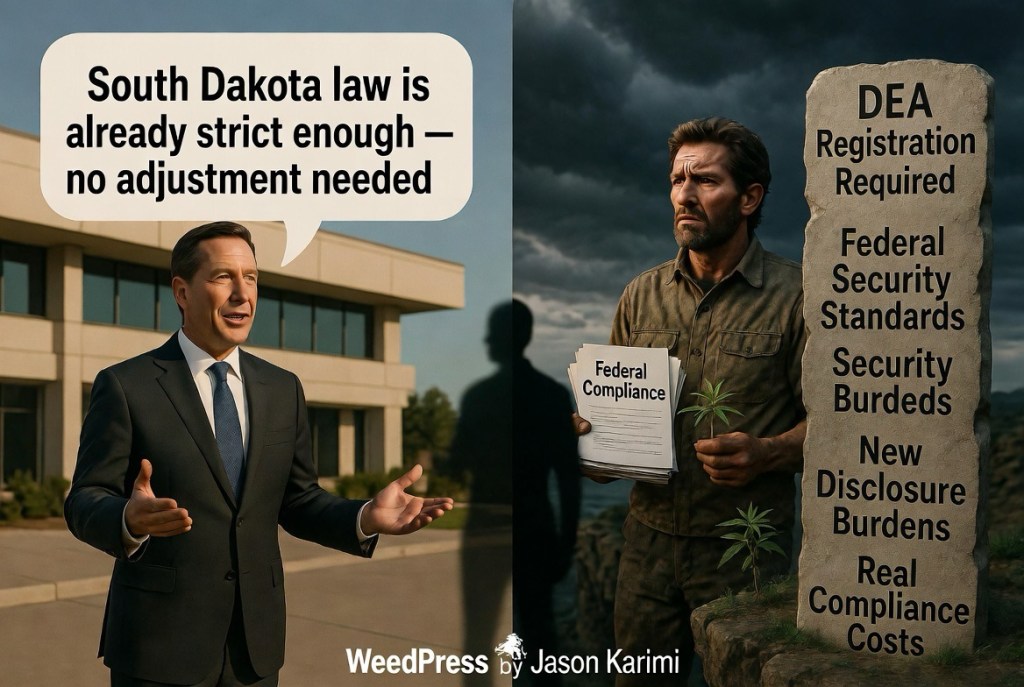
New analysis shows that South Dakota’s current licensing rules do not fully satisfy the new federal Schedule III requirements. DEA registration, security upgrades, and disclosure obligations represent real adjustments that many operators will need to make. Blanket claims that “everyone will be fine with little change” overlook these gaps.
Some voices in South Dakota are claiming that existing state medical cannabis rules are already strict enough that operators will need little or no adjustment to comply with the new federal Schedule III framework. This claim is incorrect.
On April 28, 2026, the Department of Justice placed certain FDA-approved marijuana products and marijuana subject to qualifying state medical marijuana licenses into Schedule III.¹ This created new federal obligations for state-licensed operators. South Dakota’s current medical cannabis licensing system was never designed to meet federal controlled substance standards. Operators will need to make concrete adjustments in several key areas.
DEA Registration Is a New Federal Requirement
Federal law now requires any person handling covered marijuana products to obtain DEA registration.² This is a federal licensing layer that did not previously apply to South Dakota’s state medical cannabis program. Operators must submit applications, pay fees, and go through federal review.
South Dakota only requires a state license from the Department of Health. There is no existing DEA registration for medical cannabis operators. Every operator who wants to legally operate under the new federal framework must apply for and obtain this registration. This is not something they already have.
Security and Diversion Prevention Standards Are Higher
Federal controlled substance regulations (21 CFR Part 1300 series) impose specific physical security, surveillance, access control, and diversion prevention requirements designed for Schedule I–III substances.³ These standards are generally more rigorous than typical state medical cannabis security rules.
South Dakota requires a security plan as part of state licensing, but these plans were calibrated to state medical cannabis standards, not federal controlled substance standards. Many legacy facilities were built to meet state requirements, not federal ones. Operators will need to evaluate and, in many cases, upgrade their physical security and diversion prevention systems to satisfy federal rules.
Recordkeeping and Reporting Now Have a Federal Layer
Federal Schedule III status brings strict DEA recordkeeping, inventory tracking, and reporting obligations.⁴ Operators must maintain detailed federal-compliant records and be prepared for federal audits and inspections.
South Dakota already requires inventory tracking through its state system. However, these state-level requirements were not designed to satisfy federal controlled substance recordkeeping and reporting standards. Operators will need to adjust processes and systems to meet the federal layer on top of existing state obligations.
Disclosure of Prior Activity Creates New Burdens
During the June 3, 2026 Beard Bros webinar “Schedule 3: Harm or Help?,” attorney Amber Lengacher stated that disclosing prior handling of cannabis without a federal license is “super sketch” and that she does not know anyone who is “super comfortable with doing that.”⁵ She also emphasized that “businesses really do need to be consulting with legal counsel… there’s a lot of risk there for sure.”⁶
South Dakota licensing requires background checks and ownership disclosures, but it does not include the specific federal-style disclosure of prior unlicensed handling of what is now a federally controlled substance. This is a new requirement that creates real legal and practical exposure for many operators.
Small and Tribal Operators Face Disproportionate Impact
Industry analyses have concluded that “the increased DEA compliance costs will partially offset the tax savings achieved by 280E’s nullification. This will increase capital and administrative expenditures, which could put smaller operators at a long-term disadvantage.”⁷ Law firms advising the industry have warned of the need for “substantial capital investment and operational overhauls” to meet federal standards.⁸
Blanket claims that “every single operator in South Dakota is safe and going to be in compliance” ignore these documented realities. Larger, well-capitalized operators are better positioned to absorb the costs of DEA registration, security upgrades, legal counsel, and system changes. Smaller and tribal operators face a steeper compliance cliff.
South Dakota Law Is Not Enough on Its Own
South Dakota’s medical cannabis rules created a functional state program. They were never designed to fully satisfy federal controlled substance requirements for security, recordkeeping, registration, and disclosure. Operators will need to make real adjustments to operate lawfully under the new federal Schedule III framework.
Claims that state law is already “stricter” than federal requirements across the board do not hold up when the actual obligations are compared side by side. Federal DEA registration, federal controlled substance security standards, federal recordkeeping and reporting, and new disclosure requirements are all new layers that South Dakota operators did not previously face.
WeedPress Position
WeedPress is the only independent South Dakota analyst of these federal-state compliance issues with no industry ties, no consulting contracts, and no financial stake in any cannabis business. Other voices in the state have direct business or organizational interests that create incentive to downplay the real adjustments operators will need to make.
Small and tribal operators deserve accurate information about what federal Schedule III compliance actually requires — not reassuring claims that everything is already fine. The operators who understand the real gaps between state and federal requirements will be in the strongest position to make deliberate decisions about their future.
Footnotes
¹ Schedules of Controlled Substances: Rescheduling of Food and Drug Administration Approved Products Containing Marijuana From Schedule I to Schedule III; Corresponding Change to Permit Requirements, 91 Fed. Reg. 22714 (Apr. 28, 2026) (2026-08176).
² Id. at 22719 (establishing DEA registration requirement for persons handling covered marijuana products under the new Schedule III framework).
³ Id. (detailing federal security and diversion prevention obligations under controlled substance regulations).
⁴ Id. (imposing federal recordkeeping, inventory, and reporting requirements on registered handlers of Schedule III marijuana products).
⁵ Beard Bros Media Network, “Schedule 3: Harm or Help?” (June 3, 2026), https://www.youtube.com/watch?v=gy7dtRNpB4Q (Amber Lengacher discussing disclosure risks for operators who previously handled cannabis without a federal license).
⁶ Id. (Amber Lengacher emphasizing the need for legal counsel and highlighting compliance risks).
⁷ Abraham Finberg & Simon Menkes, “Cannabis Rescheduling’s Compliance Costs Will Dent Tax Savings,” Bloomberg Tax, Apr. 28, 2026, https://news.bloombergtax.com/tax-insights-and-commentary/cannabis-reschedulings-compliance-costs-will-dent-tax-savings.
⁸ Foley & Lardner LLP, “Marijuana – Some Products Reclassified to Schedule III: What It Means, What It Doesn’t, and What Comes Next” (Apr. 23, 2026) (discussing substantial capital investment and operational overhauls required to meet federal standards).
⁹ KVK Lawyers, “The DOJ’s Cannabis Rescheduling Order: Understanding the Next Steps for Operators” (May 1, 2026), https://www.kvklawyers.com/2026/05/01/the-dojs-cannabis-rescheduling-order-understanding-the-next-steps-for-operators/ (noting application requirements, fees, and compliance protocols for state-licensed operators).
¹⁰ Industry analyses have repeatedly documented that rescheduling creates disproportionate burdens on smaller and less-capitalized operators. See, e.g., reports from Headset and Vangst on post-rescheduling operator impact modeling (widely cited in 2026 transition commentary).


Leave a Reply