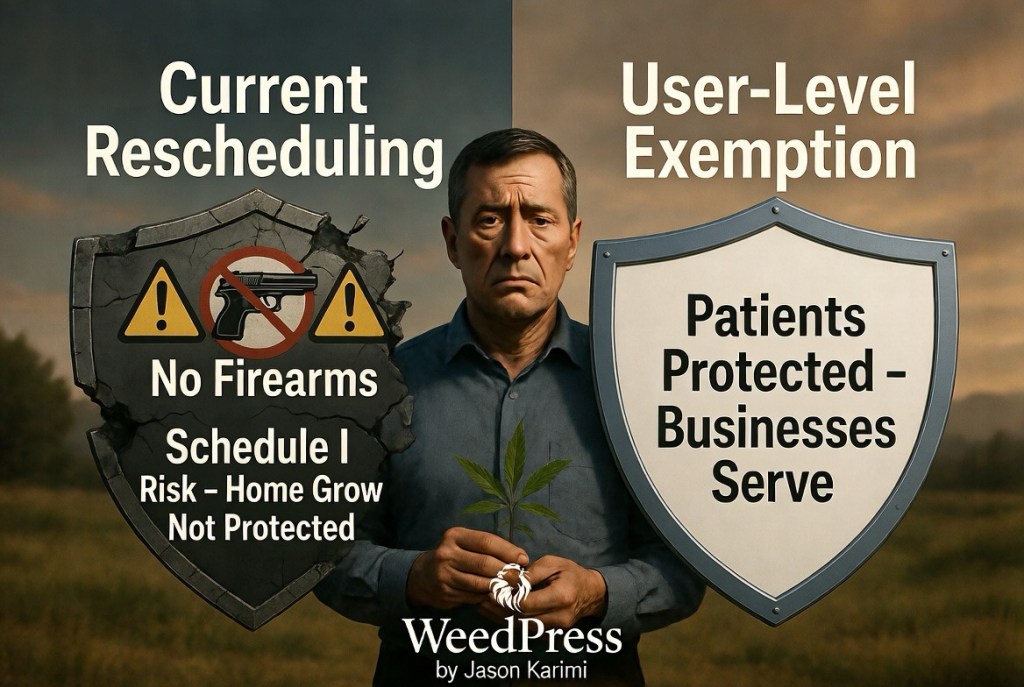
The April 28, 2026 federal partial rescheduling order left a significant gap: personal home cultivation was not included in the narrow categories moved to Schedule III. Colorado attorneys Brian Vicente and Rachel Gillette have been direct about the practical consequences. Vicente noted that home grows do not qualify for the new federal registration pathway because they are not produced under a state-issued license for commercial or medical marijuana.¹ Gillette highlighted the resulting uncertainty, asking whether giving homegrown cannabis to a friend could now be treated as trafficking a Schedule I substance.²
These concerns are not theoretical. Patients and caregivers who grow at home under state law now operate in a federal gray area. The current framework forces a choice between a complex DEA registration process designed for commercial operators or remaining outside federal protections entirely.
Carl Olsen’s Proposed Solution
Longtime cannabis and advocate Carl Olsen has outlined a more targeted approach. Rather than requiring every individual user or small grower to navigate the full commercial DEA registration process under 21 U.S.C. § 822(d)(1), Olsen proposes creating a user-level exemption modeled on the existing peyote regulation.
In private discussions following the Beard Bros webinar, Olsen explained his thinking:
“Instead of some clunky process under 21 USC 822(d)(1) and every article in the Single Convention except 36 that only covers people willing to register and has no user rights whatsoever, I would use 21 USC 822(d) and Article 36 of the Single Convention. You would end up with something that looks similar to 21 CFR 1307.31 where users are exempt and people supplying them register to supply them.”³
Under this model, registered medical cannabis patients would be exempt from the full commercial registration requirements. They would prove their status through existing state medical cannabis registration combined with certification from a practitioner. Suppliers or caregivers serving these exempted users would register, but individual patients and home growers operating within the exemption would not face the same burdens.
Why This Approach Addresses the Gaps Identified by Vicente and Gillette
The current rescheduling ties Schedule III status to marijuana produced under a qualifying state-issued medical marijuana license. Personal home cultivation falls outside that definition. Olsen’s proposal sidesteps this problem by creating a parallel user exemption track rather than trying to force every home grower into the commercial licensing system.
This mirrors the peyote exemption in 21 C.F.R. § 1307.31, which allows members of the Native American Church to possess and use peyote for religious purposes without it being treated as illegal trafficking.⁴ The peyote model has operated for decades without collapsing into widespread diversion. Olsen argues a similar structure could work for medical cannabis users under Schedule III.
He further noted that the scheduling process is not complete, stating that “we can’t be 100% sure home grown won’t be covered” under the current order, but that now is the time to advocate for a clean exemption rather than waiting for the existing framework to somehow expand.⁵
Under this model, registered medical cannabis patients would be exempt from the full commercial DEA registration requirements. To qualify, patients would only need to provide proof of their status through their existing state medical cannabis registration combined with certification from a licensed practitioner.
Suppliers, caregivers, or dispensaries serving these exempted patients would still register with the DEA, but they would operate under a lighter framework than full commercial producers. Individual patients and home growers operating within the exemption would not be required to meet the complex security, recordkeeping, and operational obligations designed for large-scale commercial businesses.
This creates two parallel tracks: one for commercial operators that choose full registration, and a simpler exemption track for verified patients and those who serve them directly.
Feasibility and Timing
Amending Schedule III through a new regulation to create a user exemption would not require new legislation. It could be accomplished through the administrative process under the Controlled Substances Act, similar to how the peyote exemption was established. Because the current scheduling process remains open, advocates still have a window to shape the final framework before it hardens into permanent rules.
Why This Matters for South Dakota Patients
South Dakota’s medical cannabis program permits limited home cultivation for registered patients. However, those home grows do not qualify as marijuana produced under a state-issued commercial medical marijuana license. Under the current federal order, homegrown likely remains Schedule I.
A user-level exemption modeled on Olsen’s proposal would directly protect South Dakota patients who grow at home. It would also reduce the compliance burden on small caregivers and suppliers serving those patients, without forcing every individual into the full DEA registration system designed for larger operators.
WeedPress Position
WeedPress is the only independent South Dakota analyst consistently documenting both the gaps in the current rescheduling and practical solutions proposed by experienced advocates. Other voices in the state have direct business or organizational interests that create incentive to downplay remaining federal risks or to treat the April 28 order as a complete solution.
Patients and small operators deserve more than reassurance that “everything will work out.” They deserve concrete policy proposals that actually close the gaps left by the current framework. Carl Olsen’s user-exemption model, built on the proven peyote precedent, is one such proposal worth serious consideration.
Footnotes
¹ Brian Vicente, Colorado cannabis attorney and co-founder of Vicente LLP, comments following the April 28, 2026 federal rescheduling order, stating that personal home cultivation does not qualify for the new Schedule III registration pathway because it is not produced under a state-issued license for commercial or medical marijuana. These comments were widely circulated in Colorado cannabis industry discussions in late April and May 2026.
² Rachel Gillette, Colorado cannabis attorney, comments on home cultivation following federal rescheduling, Denver Post, Apr. 24, 2026, https://www.denverpost.com/2026/04/24/medical-marijuana-rescheduling-colorado-cannabis-business/ (quoting Gillette on the uncertainty for homegrowers who lack a state license and therefore cannot use the new federal DEA registration pathway).
³ Carl Olsen, cannabis and religious freedom advocate, private discussion following the Beard Bros Media Network webinar “Schedule 3: Harm or Help?” (June 3, 2026) (on file with author; describing a user-level exemption modeled on 21 C.F.R. § 1307.31).
⁴ 21 C.F.R. § 1307.31 (2026) (exemption for the use of peyote in religious ceremonies by members of the Native American Church).
⁵ Carl Olsen, text message discussion, June 2026 (noting that the scheduling process is not complete and that home grown coverage remains uncertain under the current order).
⁷ 21 U.S.C. § 822(d) (2026) (providing authority for the Attorney General to exempt certain persons or classes of persons from registration requirements).
⁸ Single Convention on Narcotic Drugs, Mar. 30, 1961, 520 U.N.T.S. 151, art. 36 (addressing penal provisions and allowing for limited exemptions consistent with the treaty).
⁹ Schedules of Controlled Substances: Rescheduling of Food and Drug Administration Approved Products Containing Marijuana From Schedule I to Schedule III; Corresponding Change to Permit Requirements, 91 Fed. Reg. 22714 (Apr. 28, 2026) (2026-08176) (limiting Schedule III treatment to FDA-approved products and marijuana subject to qualifying state-issued medical marijuana licenses).
¹⁰ The current federal framework leaves personal home cultivation in a continued state of uncertainty in every state that authorizes it outside of licensed commercial production.
 WeedPress: The Paper Trail
Leave a comment