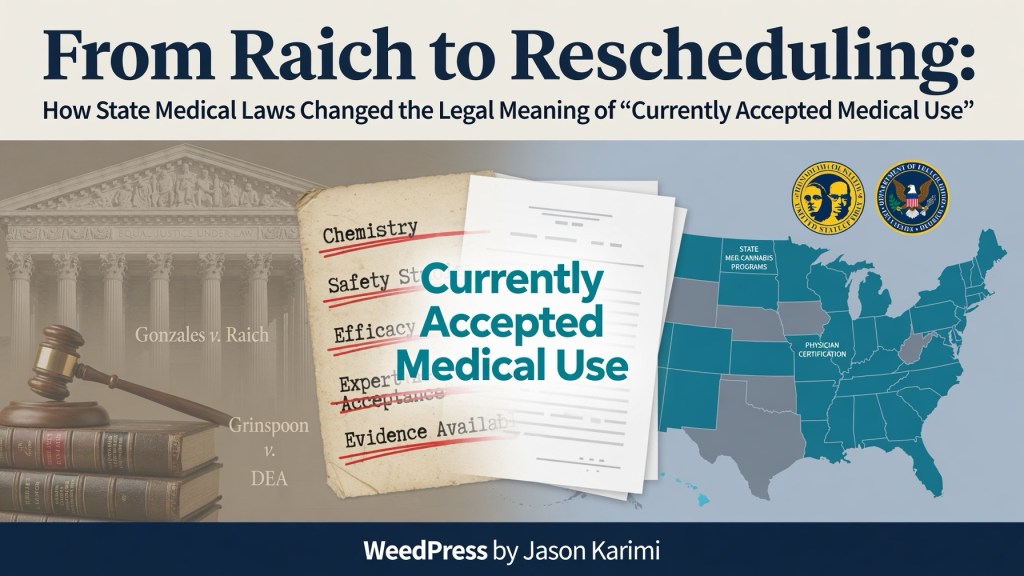
In Gonzales v. Raich, the Supreme Court upheld federal power to prohibit intrastate medical cannabis even where state law authorized it.¹ Although Raich did not prescribe a particular avenue for reform, its decision left intact Congress’s administrative scheduling framework under the Controlled Substances Act. As a practical matter, the ruling shifted reform efforts toward Congress and the CSA’s rescheduling procedures rather than constitutional challenges to federal prohibition.² That ruling set the long-term strategic problem. The question became how to move the administrative and political process effectively.
The Early Assumption: Science Would Force the Change
For years, many advocates treated rescheduling primarily as a scientific project. The theory was that sufficiently strong evidence of medical efficacy and safety, presented in court or before the DEA, would compel recognition of “currently accepted medical use.”³ Courts, however, are institutionally better at statutory interpretation than at resolving competing scientific claims. Pure science-based challenges repeatedly encountered deference to existing Schedule I findings. The decisive terrain was always going to be legal, not purely scientific.
Grinspoon and the Rejection of FDA-Approval-Only
An important early correction came in Grinspoon v. DEA.⁴ The First Circuit held that the DEA Administrator could not treat the absence of FDA interstate-marketing approval as conclusive evidence that a substance lacked “currently accepted medical use in treatment in the United States” or lacked accepted safety under medical supervision.⁵ The court rejected the equation of the CSA standard with FDA approval and noted that the statutory phrase “in the United States” does not require recognition in every state or FDA marketing approval.⁶
Grinspoon opened the door to arguments that accepted medical use could be shown by evidence other than FDA approval.
The ACT Litigation and the 8-Part / 5-Part Tests
The Alliance for Cannabis Therapeutics litigation produced the multi-factor tests that dominated DEA analysis for decades.⁷ DEA initially applied an eight-part test for currently accepted medical use. After judicial review it adopted a five-part test:
1. The drug’s chemistry must be known and reproducible;
2. There must be adequate safety studies;
3. There must be adequate and well-controlled studies proving efficacy;
4. The drug must be accepted by qualified experts; and
5. The scientific evidence must be widely available.⁸
These criteria, refined in the ACT cases, effectively imported FDA-style pharmaceutical requirements into CSA scheduling. Botanical cannabis repeatedly failed standards designed around single-molecule drugs. The tests kept the fight trapped inside a science-heavy framework that agencies and courts could continually defer to.
The five-part framework was never written into the Controlled Substances Act itself. It was an administrative interpretation adopted by DEA. Because Congress never codified DEA’s five-part formulation, the central legal question eventually became not whether the agency could depart from its own test, but whether its interpretation remained faithful to the statutory language enacted by Congress.⁹ Because the statute merely requires “currently accepted medical use,” later administrations retained authority to interpret that phrase differently so long as the interpretation remained reasonable under the statute.
As more states enacted comprehensive medical cannabis laws, however, the factual landscape underlying the statutory inquiry continued to evolve while the five-part framework remained largely unchanged.
State Medical Laws Changed the Legal Predicate
Once a critical mass of states enacted medical cannabis programs, the statutory criterion itself came under pressure. Schedule I requires a finding of “no currently accepted medical use in treatment in the United States.”¹⁰ Widespread state-authorized, physician-supervised medical use can fundamentally change the factual predicate on which that statutory finding rests.¹¹ The stronger argument became legal and structural: a substance cannot coherently remain in Schedule I when dozens of states have established detailed medical programs regulating it as medicine.
Science remained relevant, but it was no longer the sole or even the primary lever. The debate increasingly shifted from whether cannabis could satisfy an agency-created scientific framework to how Congress’s statutory language should be interpreted in light of decades of lawful state medical practice.
Parallel Shift in Political Messaging (2018)
A similar strategic pivot occurred in the broader political campaign for adult-use legalization. By 2018, major advocacy organizations such as the Marijuana Policy Project and the Drug Policy Alliance recognized that the public battle over medical use was largely won. Polling consistently showed that 75 to 85 percent of voters already accepted that cannabis had legitimate medical value.¹²
Campaign strategists concluded that further emphasis on science or health data was no longer the most effective way to expand support for full legalization. Instead, messaging shifted toward moral and fiscal arguments against continued criminalization—specifically framing the question as whether arresting people for cannabis was a good use of police resources. That framing proved more effective at converting moderate and conservative swing voters than continued debate over medical efficacy.¹³
The political messaging shift broadly paralleled the legal evolution: as medical cannabis became more widely accepted in public opinion and state law, both legal and political strategies increasingly moved beyond debating medical efficacy alone.
The New Two-Part Test
That shift is reflected in the more recent two-part inquiry developed and applied by HHS:
1. Whether there exists widespread current medical use by licensed health-care providers operating in accordance with jurisdiction-authorized programs; and
2. Whether there exists credible scientific support for at least one of the medical conditions for which that use is established.¹⁴
The institutional sequence matters. DEA created the five-part test. HHS later interpreted “currently accepted medical use” differently through its two-part inquiry. The Department of Justice’s Office of Legal Counsel concluded that HHS’s interpretation, including its two-part inquiry, was a permissible reading of the Controlled Substances Act.¹⁵ DEA ultimately relied on that interpretation in the rescheduling proceeding.
This framework is not limited to cannabis. It emerged as a broader method for evaluating currently accepted medical use when FDA approval is absent. WeedPress has previously explained the development and significance of this two-part standard.¹⁶ By incorporating real-world state-authorized medical practice, the test directly reflects the legal change that state medical laws produced.
Coalition Litigation and the Modern Strategy
Modern coalition litigation and administrative advocacy increasingly incorporate this legal theory—using the statutory criteria of the CSA together with the fact of widespread state medical programs—rather than relying solely on the old five-part scientific gauntlet. That approach is the practical fulfillment of the route left open after Raich, updated by Grinspoon’s rejection of FDA-approval-only and by the later proliferation of state medical laws.¹⁷
Conclusion
Raich left intact the CSA’s administrative scheduling framework and, as a practical matter, shifted reform efforts toward Congress and the CSA’s rescheduling procedures. Grinspoon established that FDA approval is not the sole gateway to “accepted medical use.” The eight-part and five-part tests kept the fight inside a restrictive scientific frame for decades.
Once dozens of states enacted comprehensive medical cannabis laws, the legal question ceased to be whether scientists could someday prove medical use. The more fundamental question became whether the federal government could continue to maintain the statutory finding that marijuana had “no currently accepted medical use in treatment in the United States” despite widespread, regulated medical practice occurring throughout the country. The HHS two-part inquiry provided an interpretation of the Controlled Substances Act under which widespread state-authorized medical practice became legally relevant evidence of “currently accepted medical use,” rather than treating FDA approval as the exclusive benchmark.
In that sense, the path from Raich to rescheduling was not a story of science replacing law. It was a story of changing legal facts transforming the meaning of a statutory standard.
Footnotes
¹ Gonzales v. Raich, 545 U.S. 1 (2005).
² Id.
³ See early rescheduling petitions and related advocacy emphasizing scientific evidence of medical efficacy.
⁴ Grinspoon v. DEA, 828 F.2d 881 (1st Cir. 1987).
⁵ Id. at 884–91.
⁶ Id. at 886–88.
⁷ See Alliance for Cannabis Therapeutics v. DEA, 15 F.3d 1131 (D.C. Cir. 1994), and related proceedings.
⁸ 57 Fed. Reg. 10,499, 10,506 (Mar. 26, 1992); see also Alliance for Cannabis Therapeutics, 15 F.3d at 1135.
⁹ 21 U.S.C. § 812(b); the five-part test was an agency interpretation, not a statutory command.
¹⁰ 21 U.S.C. § 812(b)(1).
¹¹ See the proliferation of state medical cannabis programs after 1996 and their cumulative effect on the factual predicate of the “accepted medical use” criterion.
¹² Contemporary polling data from 2018 showing consistent majority public acceptance of medical cannabis (approximately 75–85 percent).
¹³ Reporting and campaign analysis from 2018 describing the strategic pivot by major advocacy organizations, including the Marijuana Policy Project and the Drug Policy Alliance, toward criminal-justice and resource-allocation messaging for adult-use legalization.
¹⁴ HHS recommendation and accompanying two-part analysis for currently accepted medical use.
¹⁵ See Department of Justice, Office of Legal Counsel, opinion concluding that HHS’s interpretation of “currently accepted medical use,” including its two-part inquiry, was a permissible interpretation of the Controlled Substances Act.
¹⁶ Jason Karimi, A New Legal Standard Emerges: How HHS’s Two-Part Test Is Reshaping DEA Drug Scheduling, WeedPress (Jan. 18, 2026), https://weedpress.org/2026/01/18/a-new-legal-standard-emerges-how-hhss-two-part-test-is-reshaping-dea-drug-scheduling/.
¹⁷ This observation synthesizes the historical evolution described throughout this article; for earlier coalition advocacy, see Jason Karimi, Cannabis Rescheduling Coalition Petition: Federal Brief Filed Today Demands DEA Update Their Science, WeedPress (July 23, 2011), https://weedpress.org/2011/07/23/cannabis-rescheduling-coalition-petition-federal-brief-filed-today-demands-dea-update-their-science/.
 WeedPress: The Paper Trail
Leave a comment