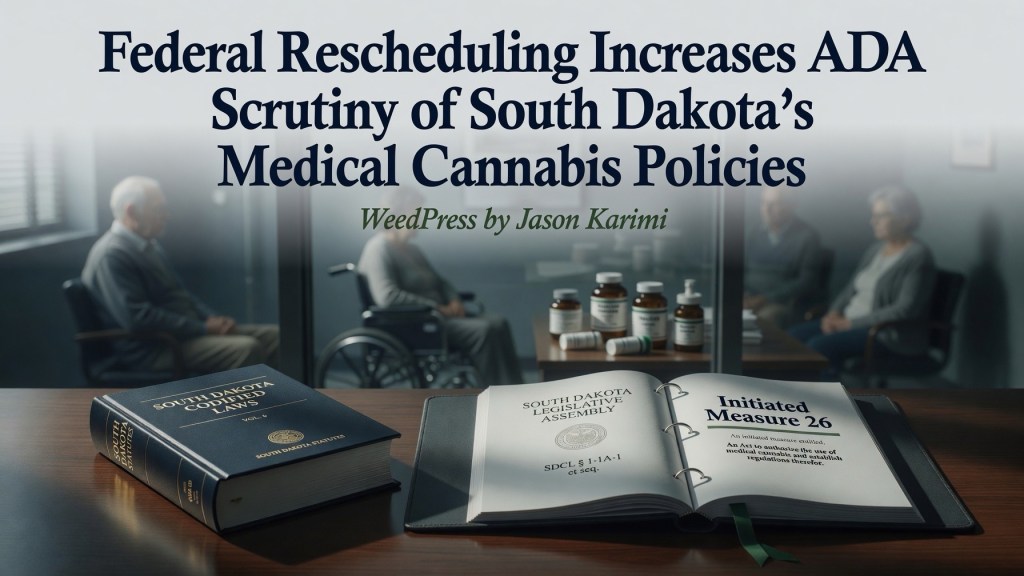
Federal rescheduling creates substantial new ADA questions for South Dakota policies that restrict medical cannabis use in nursing facilities and publicly supported recovery housing.
Federal rescheduling of marijuana to Schedule III has changed the legal landscape. South Dakota officials and publicly funded providers should update their policies accordingly instead of continuing to treat state-registered medical cannabis patients as if they are engaged in illegal drug use.¹
The Core Problem
Across the country, recovery and sober-living settings have long used blanket rules that prohibit all cannabis use. Those rules were easier to justify when cannabis was strictly Schedule I under federal law. That justification is now weaker.²
South Dakota already runs a regulated medical cannabis program. Registered patients use cannabis under state law with practitioner involvement. When recovery housing providers or referral agencies force those patients to choose between their medicine and a place to live, the system creates an unnecessary conflict. Patients in recovery are told their state-authorized medicine is incompatible with stability and sobriety support.³
The same outdated logic has affected nursing home residents. The original medical cannabis measure passed by voters contained restrictions that effectively discriminated against patients in nursing facilities. Those limitations were driven in significant part by the then-prevailing federal Schedule I status and were drafted without the benefit of professional legislative drafting that fully accounted for disability-rights obligations.⁴ As a result, some of the state’s most vulnerable patients—elderly and disabled residents of long-term care facilities—were left with fewer practical protections for access to their medicine than other qualifying patients.⁵
ADA Obligations and Heightened Scrutiny After Federal Rescheduling
The Americans with Disabilities Act prohibits discrimination against qualified individuals with disabilities in the provision of services, programs, and activities.⁶ Nursing homes and similar long-term-care settings that receive federal funds or qualify as places of public accommodation may be required to consider reasonable-accommodation requests and conduct individualized assessments. Those duties do not necessarily require approval of every requested cannabis accommodation, particularly where the facility establishes a legitimate clinical, regulatory, safety, or fundamental-alteration concern.⁷
Following federal administrative action placing qualifying marijuana products into Schedule III, reflecting a federal determination of accepted medical use for purposes of the Controlled Substances Act, the legal assumptions that previously underlay many disability-accommodation disputes have substantially changed.⁸ Federal rescheduling materially strengthens the argument that state-authorized medical cannabis use should no longer be treated categorically as illegal drug use under the ADA, although courts have not yet definitively resolved the issue.⁹
Policies that force nursing home residents to forgo state-authorized medical cannabis or leave their care setting should be reexamined under current federal disability-rights standards.¹⁰ Continuing to treat registered medical cannabis use as automatically disqualifying is increasingly difficult to reconcile with the ADA’s requirements of individualized assessment and reasonable accommodation.¹¹
The ADA often requires individualized assessment rather than categorical exclusion where reasonable accommodation is at issue and no direct threat has been established.¹² A registered medical cannabis patient who lawfully uses non-smoked medication under a valid practitioner certification and through the state-regulated medical cannabis system should not automatically be treated the same as someone actively abusing intoxicating substances. The relevant question becomes whether the individual can safely participate in the program or reside in the facility—not whether cannabis appears on a medication list.¹³ Supreme Court precedent has long emphasized that disability-related decisions should rest on individualized inquiry rather than stereotypes or generalized assumptions.¹⁴
Because many nursing facilities participate in Medicare and Medicaid, evolving federal disability-law interpretations may have significant implications for CMS-regulated facilities. As disability law develops following federal rescheduling, categorical policies may become increasingly difficult to defend where individualized assessment is required.¹⁵
WeedPress has previously documented both the original structural exclusion of nursing-home patients under the state program and the strengthened ADA arguments that follow from federal rescheduling.¹⁶ Those analyses remain directly relevant: the law as implemented still leaves the sickest patients with fewer practical rights, and the federal scheduling change has only sharpened the legal tension.¹⁷
Read a couple books and challenge the clergy
Read a couple psalms up inna the morning early https://youtu.be/VIY8-SF7M_8?is=i2e7VSJ_joAbcpTg
Recovery Housing and Disability-Law Principles
Recovery residences may impose reasonable rules necessary to maintain a safe therapeutic environment. However, whether a particular residence is subject to federal disability statutes depends upon its legal status, funding, contractual relationships, and other applicable law. Where those statutes apply, categorical exclusion based solely on lawful patient status becomes increasingly difficult to justify following federal rescheduling.¹⁸
What South Dakota Law Already Says
Three provisions of the state medical cannabis statutes remain relevant.
SDCL 34-20G-22 directs that registered qualifying patients must be afforded the same rights under state and local law as a person solely prescribed a pharmaceutical medication in the employment and drug-testing context (with limited safety-sensitive exceptions).¹⁹ The statute shows the Legislature already recognized that medical cannabis should not be treated as equivalent to illicit drug use in at least one major area.
SDCL 34-20G-27 makes clear that nothing in the medical cannabis chapter requires a property owner to allow smoking or vaping on the premises.²⁰ That protection for property owners is real and should be respected. It does not, however, require or justify categorical exclusion of registered patients from recovery-oriented housing or long-term care settings solely because of their patient status or non-smoked medicine.
SDCL 34-20G-25.1 also specifically protects certain health-care and accredited prevention or treatment facilities from being required by state medical-cannabis law to permit cannabis consumption on facility grounds. That statute is a substantial limitation on rights created by Chapter 34-20G. It does not necessarily resolve separate obligations under the ADA, Section 504, or federal nursing-facility regulations, but any complete analysis must acknowledge it.
The Federal Shift Matters
To the extent marijuana products are covered by the federal Schedule III rule—because they are contained in FDA-approved products or are manufactured, distributed, or dispensed pursuant to qualifying state medical-marijuana licenses—the old automatic equation of “cannabis use = illegal drug use” loses substantial force. Agencies and providers that receive public funds or operate under state oversight should revisit policies that still rely on that equation.²¹
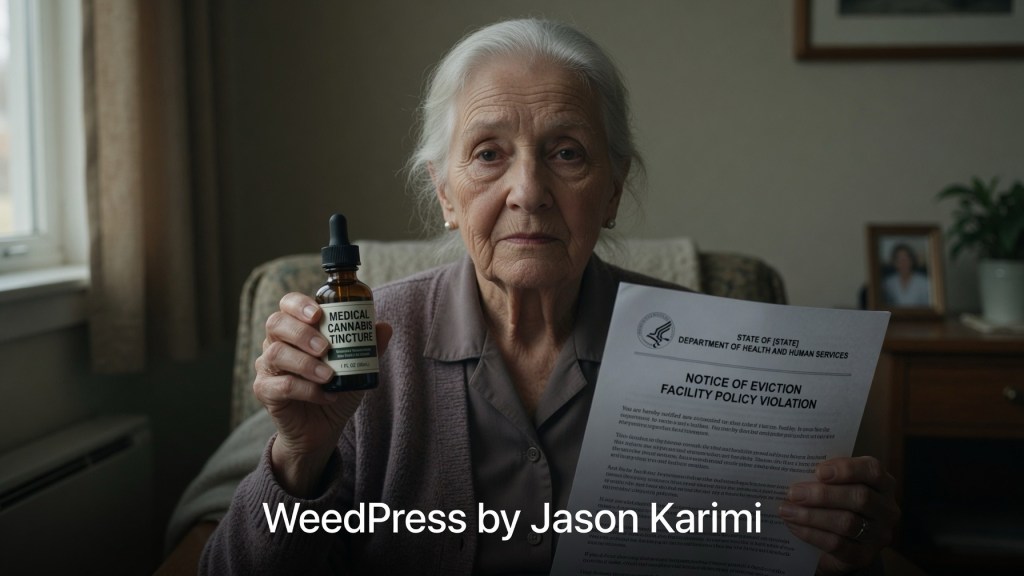
Blanket exclusion of registered medical cannabis patients from recovery housing or nursing facilities, without individualized assessment, is increasingly difficult to defend. It undermines both the medical cannabis program and the stated goals of recovery and long-term care: stability, continuity of care, and support for people trying to maintain their health and dignity.²²
What Officials Should Do
South Dakota does not have a single statewide recovery-residence certification regime. Responsibility is therefore more diffuse, but it is not eliminated.
Relevant officials and entities should:
1. Review existing policies and contracts that govern referral into recovery or supportive housing, and rules applied inside nursing facilities, to identify categorical cannabis bans that sweep in registered medical patients.
2. Direct publicly funded providers to replace automatic exclusion with individualized assessment that distinguishes impairment, smoked use on premises, and legitimate medical use under state law.
3. Issue clear guidance that registered medical cannabis patient status alone is not grounds for denial or removal from recovery-oriented housing or nursing care when the patient is otherwise compliant.
4. Align administrative practice with the reality that South Dakota has chosen to operate a medical cannabis program and that federal scheduling no longer treats that medicine as Schedule I.
5. Specifically address the residual discrimination against nursing home patients that originated in the early drafting of the medical cannabis law under prior Schedule I assumptions.²³
The Stakes
Recovery housing and nursing facilities are supposed to reduce chaos and protect vulnerable people, not create new forms of exclusion. Forcing medical cannabis patients—especially elderly and disabled residents of long-term care—to abandon a medicine their own state has authorized in order to keep a roof over their heads or remain in care is a policy failure. It is also increasingly out of step with the federal scheduling change, with evolving ADA interpretations, and with South Dakota’s own decision to regulate medical cannabis.²⁴
Federal rescheduling did not automatically rewrite South Dakota’s medical cannabis statutes. It did, however, remove one of the principal legal assumptions on which many exclusionary policies were built. Continuing to treat every registered medical cannabis patient as though they are engaged in illegal drug use is becoming increasingly difficult to justify under modern disability law. South Dakota officials now have an opportunity to align administrative practice with both state medical cannabis policy and evolving federal law. Whether they do so voluntarily—or through future litigation—remains to be seen.²⁵
Footnotes
¹ See Controlled Substances Act, 21 U.S.C. § 812; federal administrative action placing certain marijuana in Schedule III (2026).
² See generally Gonzales v. Raich, 545 U.S. 1 (2005) (pre-rescheduling federal prohibition framework).
³ South Dakota Medical Cannabis Program, SDCL ch. 34-20G.
⁴ Initiated Measure 26 (2020); see also contemporary drafting limitations reflecting then-existing Schedule I status.
⁵ Jason Karimi, The Patients Left Behind: How South Dakota’s Medical Cannabis Law Still Punishes the Sickest Among Us, WeedPress (June 26, 2026), https://weedpress.org/2026/06/26/the-patients-left-behind-how-south-dakotas-medical-cannabis-law-still-punishes-the-sickest-among-us/.
⁶ Americans with Disabilities Act, 42 U.S.C. § 12101 et seq.
⁷ 42 U.S.C. §§ 12132 (Title II), 12182 (Title III); see also Section 504 of the Rehabilitation Act, 29 U.S.C. § 794.
⁸ Federal administrative action placing qualifying marijuana products into Schedule III, reflecting a federal determination of accepted medical use for purposes of the Controlled Substances Act.
⁹ 42 U.S.C. § 12210 (illegal drug use exclusion); the continued application of this exclusion to state-authorized medical cannabis patients is likely to require renewed judicial analysis following federal Schedule III placement. 42 U.S.C. § 12210(c) protects access to otherwise available health and rehabilitation services in specified circumstances, while implementing regulations preserve a treatment program’s authority to address current illegal drug use within the program. Federal rescheduling therefore raises new questions regarding how the ADA’s “illegal use of drugs” provisions apply to state-authorized medical cannabis, an issue that has not yet been definitively resolved by the courts.
¹⁰ See Nursing home takes regulators to court over resident’s eviction, Iowa Capital Dispatch (June 4, 2026), https://iowacapitaldispatch.com/2026/06/04/nursing-home-takes-regulators-to-court-over-residents-eviction/.
¹¹ See Jones Walker LLP, ADA Implications of Potential Marijuana Rescheduling (2026 analysis); compare pre-rescheduling cases such as James v. City of Costa Mesa, 700 F.3d 1118 (9th Cir. 2012).
¹² 28 C.F.R. § 35.130 (Title II); 28 C.F.R. § 36.201 et seq. (Title III); see also PGA Tour, Inc. v. Martin, 532 U.S. 661 (2001) (individualized inquiry under the ADA).
¹³ Id.
¹⁴ School Board of Nassau County v. Arline, 480 U.S. 273 (1987) (emphasizing individualized inquiry rather than stereotypes or generalized assumptions in disability determinations).
¹⁵ See 42 C.F.R. Part 483 (CMS requirements for states and long-term care facilities); evolving federal disability-law interpretations following rescheduling.
¹⁶ Jason Karimi, The Patients Left Behind: How South Dakota’s Medical Cannabis Law Still Punishes the Sickest Among Us, WeedPress (June 26, 2026); Jason Karimi, South Dakota’s Medical Cannabis Law Now Violates the ADA: Nursing Home Residents Are Being Forced to Choose Between Their Medicine and Their Dignity, WeedPress (July 13, 2026) (arguing that federal rescheduling significantly strengthens ADA challenges to South Dakota’s policies), https://weedpress.org/2026/07/13/south-dakotas-medical-cannabis-law-now-violates-the-ada-nursing-home-residents-are-being-forced-to-choose-between-their-medicine-and-their-dignity/.
¹⁷ Id.
¹⁸ Recovery residences’ coverage under federal disability statutes depends on legal status, funding, contractual relationships, and other applicable law.
¹⁹ SDCL 34-20G-22.
²⁰ SDCL 34-20G-27.
²¹ Federal Schedule III placement and related administrative recognition of accepted medical use.
²² See 42 U.S.C. §§ 12131–12189 (Title II); 42 U.S.C. §§ 12181–12189 (Title III); 28 C.F.R. pts. 35 & 36. These provisions generally require individualized consideration of disability-accommodation requests where applicable, rather than categorical exclusion based solely on disability-related status.
²³ Residual effects of original IM 26 drafting choices made under Schedule I assumptions; see Karimi, The Patients Left Behind, supra note 5; Karimi, South Dakota’s Medical Cannabis Law Now Violates the ADA, supra note 16.
²⁴ Americans with Disabilities Act; SDCL ch. 34-20G; federal rescheduling action.
²⁵ Policy continuity and administrative updating obligations following federal scheduling change.
 WeedPress: The Paper Trail
Leave a comment