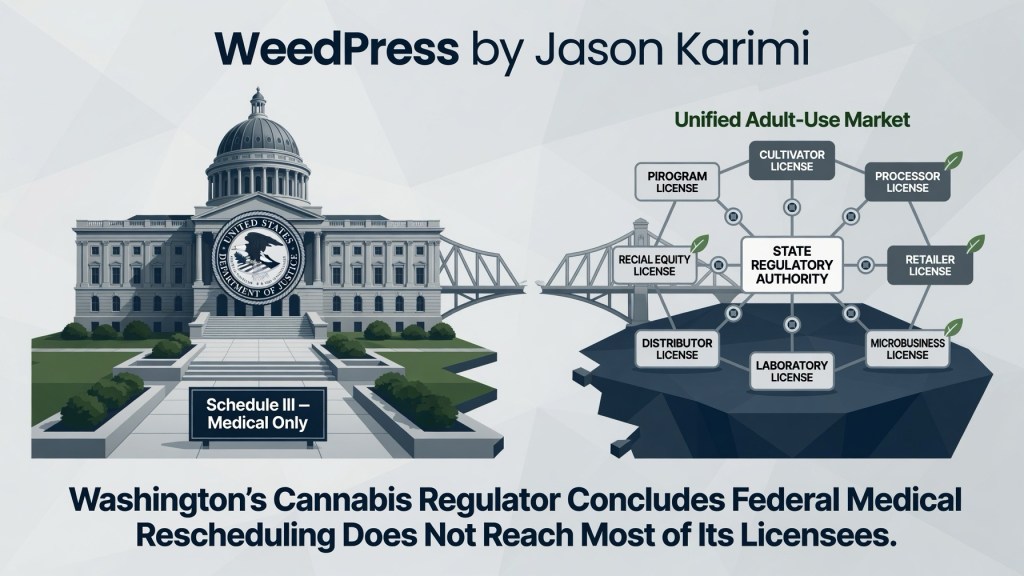
Washington’s cannabis regulator became one of the first state agencies to publicly conclude that the federal medical marijuana rescheduling order does not appear to extend to most of its licensed cannabis businesses.¹ In a June 2026 bulletin, the Washington State Liquor and Cannabis Board stated that federal rescheduling “does not appear to apply” to the state’s licensees because of its predominantly recreational regulatory structure.²
This is more than a state-specific interpretive dispute. It is an early signal of a structural problem that other dual-license and unified-market states confront as the federal Schedule III framework settles. California, by contrast, has already begun creating practical pathways to help its licensees align with the federal medical order.
The Federal Order’s Limited Scope
In April 2026, the Department of Justice issued a final order placing two categories of marijuana into Schedule III of the Controlled Substances Act: (1) FDA-approved drug products containing marijuana, and (2) marijuana subject to a qualifying state-issued medical marijuana license.³ Adult-use or recreational marijuana remained in Schedule I.⁴
Eligibility therefore depends not simply on whether marijuana is used medically, but on whether the product or business falls within one of the categories specifically described in the federal order. The practical benefits of Schedule III status—most notably relief from Internal Revenue Code § 280E and access to an expedited DEA registration pathway—are tied to those defined categories.⁵
Washington’s Unified Market Structure
Washington does not operate a separate medical cannabis licensing system for producers, processors, or retailers.⁶ Instead, the state maintains a single recreational market. Within that market, certain producers and processors may manufacture Department of Health-compliant products, and certain retailers may sell those products to patients and designated providers.⁷ Medical access exists, but it is embedded inside the adult-use regulatory framework rather than operating as a distinct licensing category.
Because the federal order keys eligibility to “state medical marijuana licensees,” Washington regulators concluded that most of the state’s licensees do not appear to qualify under the current federal language.⁸ As a result, the Board stated that federal rescheduling in its present form does not appear to extend the associated benefits to Washington’s cannabis businesses.⁹
Other contemporaneous reporting reached similar conclusions. Marijuana Moment reported that Washington officials concluded the federal order “does not appear to apply” to state businesses because the state lacks separate medical producer, processor, or retailer licenses.¹⁰ MJBizDaily framed the bulletin as an additional complication for operators already facing oversupply and tax pressure, noting that most licensees likely remain subject to § 280E under the Board’s analysis.¹¹ Legal analysis from Harris Sliwoski treated the bulletin as one of the first formal state regulatory opinions on how the medical-only federal order interacts with unified adult-use markets.¹²
The Board carefully qualified its position, noting that its analysis may evolve and that the final determination may not rest solely with the state.¹³ It also indicated it was not preventing licensees from applying for federal registration if they chose to do so.¹⁴
California’s Response: Creating a Compliance Pathway
California faced a related dual-use problem but moved in the opposite direction by adjusting its own licensing rules to make federal medical registration more accessible.
The California Department of Cannabis Control first streamlined the process for licensees to add or convert to an M (medicinal) designation. Cultivation licensees no longer need to wait until renewal to request a designation change, and local authorization is no longer required for requests that change a license to medical-only or add a medical designation to an existing adult-use license.¹⁵
More significantly, in June 2026 the Department adopted emergency regulations allowing retail licensees holding a combined adult-use and medicinal (A/M) designation to split that license into two distinct licenses—one adult-use and one medicinal—held by related entities at the same premises.¹⁶ The regulations facilitate creation of a cleaner state-level medical license that can support an application for DEA registration under the federal Schedule III order, while the adult-use operations remain separate.¹⁷
California’s approach does not eliminate every legal or operational complexity. It does, however, treat the federal medical-only order as a concrete compliance problem that state regulators can partially solve by adjusting designation and entity structures. Washington’s bulletin, by contrast, identifies the mismatch and largely leaves licensees to navigate it on their own.
Why the Contrast Matters
Washington and California illustrate two different state responses to the same federal design choice. The April 2026 order delivered immediate relief to traditional medical programs while leaving adult-use marijuana in Schedule I. States whose statutes were written around unified or heavily integrated markets therefore face an immediate classification question: do their licensees qualify as “state medical marijuana licensees” under the federal definition?
Washington’s position so far is that most licensees do not appear to qualify under the existing federal framework. California’s answer has been to create administrative tools that allow operators to produce a clearer medical license category capable of supporting federal registration.
Other dual-license and unified-market states will eventually confront the same issue. Whether they follow Washington’s interpretive caution, California’s structural adjustments, or some third path will determine how evenly the tax and registration benefits of Schedule III status are distributed. The federal government created a medical-only pathway. Whether that pathway reaches cannabis businesses now depends as much on state licensing architecture as on federal law itself.
Footnotes
¹ Washington State Liquor and Cannabis Board, Federal Rescheduling of Medical Cannabis (June 16, 2026), https://content.govdelivery.com/accounts/WALCB/bulletins/41c1c1a.
² Id.
³ U.S. Dep’t of Justice, Final Order, Schedules of Controlled Substances: Rescheduling of Food and Drug Administration Approved Products Containing Marijuana and Products Containing Marijuana Subject to a Qualifying State-issued License from Schedule I to Schedule III, 91 Fed. Reg. 22714 (Apr. 28, 2026).
⁴ Id.
⁵ See I.R.C. § 280E; U.S. Dep’t of the Treasury & Internal Revenue Service, Press Release on Tax Guidance Following DOJ Final Order (Apr. 23, 2026).
⁶ Washington State Liquor and Cannabis Board, supra note 1.
⁷ Id.
⁸ Id.
⁹ Id.
¹⁰ Marijuana Moment, Federal Marijuana Rescheduling ‘Does Not Appear To Apply’ To Washington Businesses, State Officials Say (June 16, 2026), https://www.marijuanamoment.net/federal-marijuana-rescheduling-does-not-appear-to-apply-to-washington-businesses-state-officials-say/.
¹¹ MJBizDaily, Federal cannabis rescheduling may not apply in Washington, regulator warns (June 17, 2026), https://mjbizdaily.com/news/federal-cannabis-rescheduling-may-not-apply-in-washington-regulator-warns/616521/.
¹² Harris Sliwoski, Would Cannabis Rescheduling Help Businesses in Unified Markets? Washington Weighs In, Canna Law Blog (June 18, 2026), https://harris-sliwoski.com/cannalawblog/would-cannabis-rescheduling-help-businesses-in-unified-markets-washington-weighs-in/.
¹³ Washington State Liquor and Cannabis Board, supra note 1.
¹⁴ Id.
¹⁵ California Department of Cannabis Control, Federal Rescheduling Resources, https://www.cannabis.ca.gov/licensees/cannaconnect-compliance-hub/federal-rescheduling-resources/; see also Marijuana Moment, California Officials Make It Easier For Marijuana Businesses To Access Federal Benefits Under Trump’s Rescheduling Move (May 1, 2026).
¹⁶ California Department of Cannabis Control, Emergency Regulations allowing separation of A- and M-designated retail licenses (adopted June 2026); see also California Department of Cannabis Control, Federal Rescheduling Resources, supra note 15.
¹⁷ Id.
 WeedPress: The Paper Trail
Leave a comment