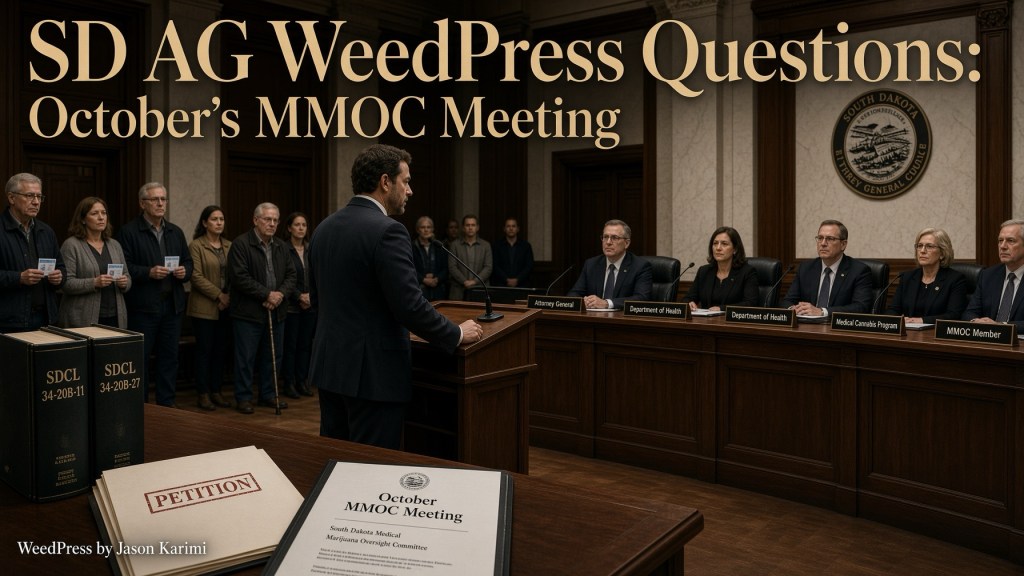
South Dakota’s August 17 MMOC meeting confirmed institutional uncertainty that WeedPress policy posts had already identified and documented in statutory detail. Those WeedPress posts do not replace official guidance, but they do supply usable legal architecture, prior administrative filings, and concrete policy questions that the Committee and DOH can employ as they move toward the October meeting and any subsequent legislative or rulemaking response. In an environment where the Department itself acknowledges more questions than answers, WeedPress’s pre-existing primary-source analysis of the exact statutory tension is a practical resource rather than a theoretical one.
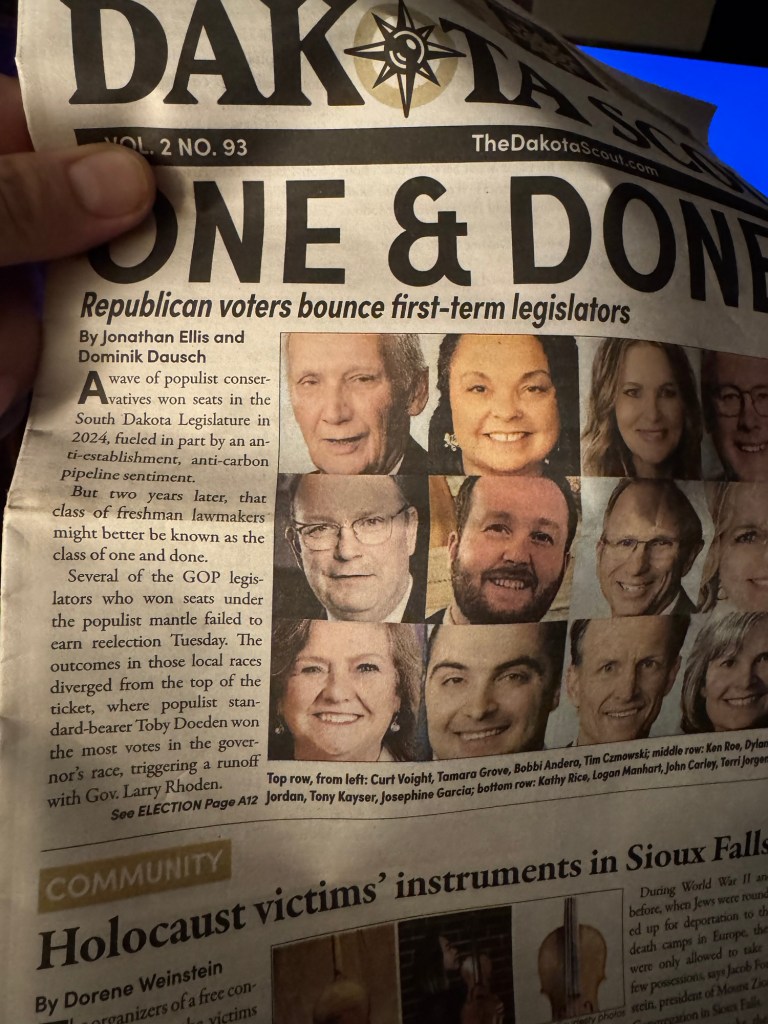
The next meeting of South Dakota’s Medical Marijuana Oversight Committee is expected in October. After the August 17 interim session in Pierre, Chairwoman Josephine Garcia told Dakota News Now that the committee hopes the Attorney General will appear and address what federal classification changes mean for the state program.¹ That invitation, if honored, is the first time the state’s chief legal officer would be asked, on the legislative record, to reconcile Chapter 34-20G’s medical framework with Chapter 34-20B’s Schedule I criteria.
The useful questions are not “what does rescheduling mean?” They are narrower:
Does cannabis’s continued listing as a Schedule I substance still satisfy SDCL § 34-20B-11 after the federal medical-use acknowledgment that took effect in April 2026?
What is the Department of Health’s interpretation of the mandatory “shall” in SDCL § 34-20B-27?
Those questions were already in the administrative record before August 17. The August meeting did not invent the tension. It confirmed that the administering agency still lacks written answers.
What August 17 actually put on the record
The Medical Marijuana Oversight Committee met August 17, 2026, at the Capitol.² Whitney Brunner, Medical Cannabis Program Administrator, reported program growth and operational repairs. As of June 30, 2026, the Department counted 19,375 registered patients, up from 14,843 the prior fiscal year.³ Department monthly data listed 19,530 approved patient cards as of August 3, 2026.⁴ Home-cultivation licenses rose from 61 in FY 2022 to 715 in FY 2026.⁵
Brunner also described an inspection overhaul after inconsistent citations, a pending rules package that would shift some first-offense minor violations to corrective-action plans, and a plan to issue digital registry cards beginning next summer.⁶ Those items matter to operators. They do not resolve scheduling.
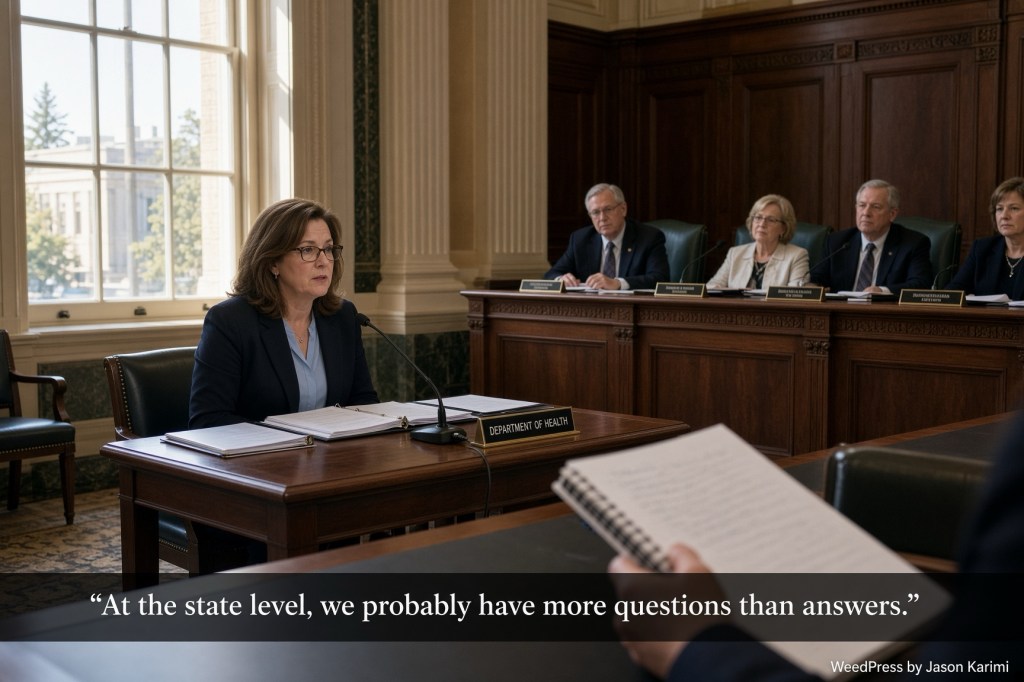
On federal classification, Brunner told the committee the federal government had shared little with the state beyond data requests. Her sentence is the operative one: “At the state level, we probably have more questions than answers.”⁷ She did not say whether South Dakota establishments must obtain DEA registration to remain in the state program, or what new federal compliance conditions attach to a state medical license.⁸ Kittrick Jeffries, chairman of the Cannabis Industry Association of South Dakota, said many association members were already pursuing DEA inspection and licensure on their own.⁹
National Conference of State Legislatures staff briefed members on tax and banking consequences of the federal change. Nicole Ezeh told the committee the reclassification should allow qualifying medical businesses to claim ordinary deductions previously blocked and should ease banking access.¹⁰ That is an implementation briefing, not a South Dakota Attorney General opinion and not a Department of Health declaratory ruling.
Garcia’s post-meeting statement is equally limited. The next meeting is “in October.” The Attorney General’s appearance is a hope, not a posted notice with a date, time, and confirmed witness list.¹¹ Anyone treating October as a locked hearing calendar should wait for the Legislature’s official interim notice.
What the federal order actually did—and what it did not
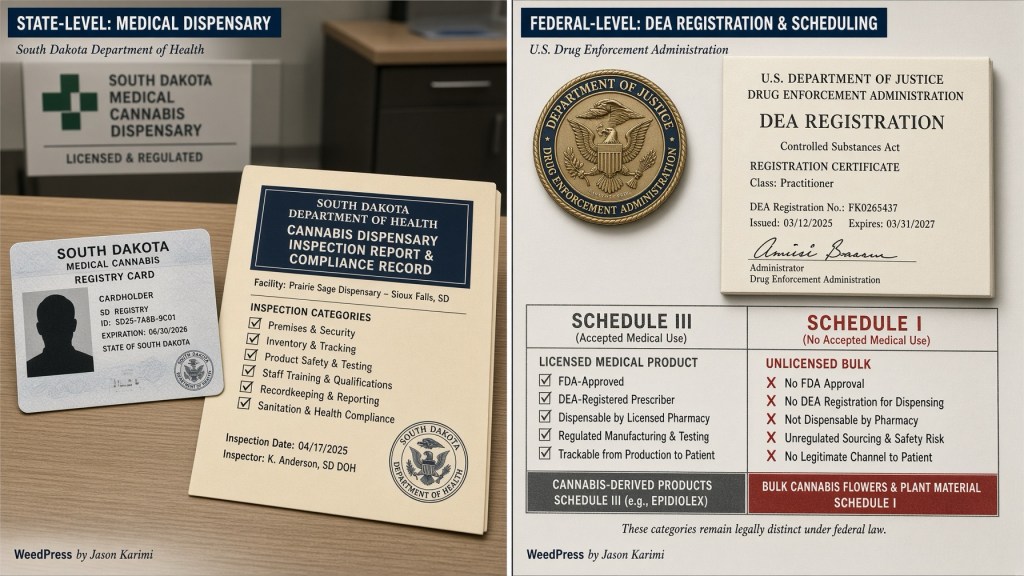
On April 23, 2026, the Department of Justice announced a final order placing two categories of marijuana in Schedule III of the federal Controlled Substances Act: (1) FDA-approved drug products containing marijuana, and (2) marijuana subject to a qualifying state-issued license to manufacture, distribute, and/or dispense marijuana for medical purposes.¹² The Federal Register final rule is effective April 28, 2026.¹³ Unlicensed bulk marijuana, crops outside a qualifying state medical license, and adult-use product remain Schedule I under the order as described by DOJ and subsequent analyses.¹⁴ A separate administrative hearing beginning June 29, 2026, was announced to consider broader rescheduling of marijuana as a whole.¹⁵ Whether that broader rulemaking has produced a final, all-marijuana Schedule III placement as of this writing is a fact that must be checked against the hearing record, not assumed from advocacy summaries.
Treasury and IRS stated that section 280E generally ceases to bar deductions for activities that, after the order, no longer constitute trafficking in a Schedule I or II substance, with guidance and transition rules to follow.¹⁶ That is federal tax architecture. It is not automatic conformity of South Dakota’s criminal schedules.
The federal medical-use acknowledgment is therefore real and bounded. It is an official recognition that specified medical marijuana—FDA-approved products and product under a qualifying state medical license—no longer meets the federal Schedule I premise of “no currently accepted medical use.” It is not a repeal of the CSA, not legalization of adult use, and not a self-executing amendment to SDCL chapter 34-20B.

The South Dakota statutes that October must confront
Schedule I placement in South Dakota is not a slogan. It is a three-element test. SDCL § 34-20B-11 provides that to be included within Schedule I, a substance shall have:
(1) a high potential for abuse;
(2) no accepted medical use in the United States; and
(3) a lack of accepted safety for use under medical supervision.¹⁷
The conjunction is “and.” All three criteria must hold for the classification to match the statute that authorizes it.
South Dakota has, since voter approval of Initiated Measure 26 in 2020 and program implementation in 2021, maintained a statewide medical cannabis system under chapter 34-20G: practitioner certification, patient registry cards, licensed establishments, testing, and Department administration.¹⁸ The Oversight Committee itself exists under SDCL §§ 34-20G-92 to 34-20G-94.¹⁹ The Department that administers 34-20G is the same “department” defined in 34-20B-1(8) as the Department of Health for the controlled-substances chapter.²⁰
Schedule III criteria in South Dakota require, among other things, “well documented and approved medical use in the United States.”²¹ That is the state-law counterpart to the federal medical-use finding the April order encoded for licensed medical product.
The recommendation statute is equally specific. SDCL § 34-20B-27 states:
The department shall make recommendations to the Legislature that a substance be added, deleted, or rescheduled when the department determines that such substance has a different potential for abuse.²²
“Shall” is mandatory language in ordinary South Dakota statutory construction. The trigger in the text is a departmental determination that the substance has a “different potential for abuse.” The statute does not say the Department may indefinitely decline to decide. It also does not, by itself, reschedule the substance. Recommendation goes to the Legislature. The Department’s duty is to determine and, when the determination is made, to recommend.
Two further points belong in any AG briefing book.
First, listing and criteria can diverge. A substance may remain named in a Schedule I list while the statutory criteria for that schedule no longer describe it. That divergence is a legislative-drafting problem and an enforcement-risk problem. It is not solved by repeating that “marijuana is still illegal for non-patients.”
Second, chapter 34-20G is an exception structure for certified patients and licensed establishments. It does not repeal § 34-20B-11. It does change the factual predicate of “no accepted medical use in the United States” if “accepted medical use” is given its ordinary meaning—physician-directed, state-licensed, and now federally placed in Schedule III when held under a qualifying state medical license.
Whether “accepted medical use in the United States” in § 34-20B-11 is satisfied by (a) South Dakota’s own 34-20G program, (b) the federal April order as to licensed medical product, (c) both, or (d) only an FDA new-drug approval, is precisely the question the Department has not answered in a published declaratory ruling. WeedPress has asked that question in a formal petition. The petition is not a ruling.
What is already in the Department’s file
On February 23, 2026, a Petition for Declaratory Ruling and Mandatory Scheduling Review of Cannabis was submitted to the Department of Health under SDCL §§ 1-26-13, 1-26-15, 34-20B-11, and 34-20B-27.²³ The petition asked whether cannabis may lawfully remain classified as Schedule I under the § 34-20B-11 criteria given chapter 34-20G, and whether the Department’s § 34-20B-27 duty is engaged. The Department confirmed receipt; carrier tracking showed delivery February 23, 2026.²⁴ Confirmation of receipt is not a decision on the merits.
In May 2026, after the federal order, advance notice went back to the Department that a further scheduling-review petition would follow the federal hearing process.²⁵ That sequence matters procedurally. The agency cannot claim surprise that the statutory criteria, the “shall” recommendation duty, and the federal medical-use acknowledgment were presented as linked questions.
Separately, on February 11, 2026, testimony before Senate Health and Human Services opposed SB 181 (a repeal-trigger tied to federal rescheduling) and SB 194 (potency caps). Both measures were moved to the 41st legislative day.²⁶ The policy point recorded there was stability of the patient program versus using federal movement as a pretext to collapse chapter 34-20G. That is a different question from whether Schedule I criteria still fit. Both questions can be true at once: the medical program should not be repealed by trigger, and the controlled-substances schedules should be internally consistent.
WeedPress’s function in this interval is not to substitute for the Attorney General or the Department. It is to keep the statutory architecture visible while those offices have not issued a written interpretation. The publication’s record on this file is petitions, hearing testimony, and annotated statutes—not Facebook slogans. A prior face-to-face discussion with Senator Chuck Grassley, as represented by WeedPress colleagues, is the author’s account that the statutory reading was understood; it is not an official Senate report and is flagged here as such until a contemporaneous primary source is produced.²⁷
Questions the Attorney General can answer in October without writing new policy
If the Attorney General appears, the Committee does not need a tour of national cannabis politics. It needs the State’s reading of existing text.
1. Criteria versus list. Does the Office of the Attorney General treat SDCL § 34-20B-11 as a live three-element test, or as recitals that no longer constrain the Schedule I list? If the test is live, which element does cannabis still satisfy after the April 2026 federal order as to state-licensed medical product?
2. “Accepted medical use in the United States.” Is South Dakota’s own 34-20G program relevant evidence of accepted medical use? Is the federal Schedule III placement of marijuana subject to a qualifying state medical license relevant evidence? If neither is relevant, what source would ever satisfy the statute?
3. The “shall” in § 34-20B-27. Has the Department determined that cannabis has a “different potential for abuse” than when it was placed? If no determination has been made, what factual record is the Department waiting for, and who is assigned to make the determination? If a determination has been made, where is the recommendation to the Legislature?
4. Dual-sovereign enforcement. After the federal order, what charging theory remains for conduct that is licensed under 34-20G? What charging theory remains for unlicensed possession under SDCL § 22-42-6?²⁸ Those are different cases. Conflating them is how agencies produce “more questions than answers.”
5. DEA registration and the state license. Is a South Dakota establishment license, standing alone, the “qualifying state-issued license” contemplated by the federal order, or does federal lawfulness of the medical activity now depend on DEA registration? Brunner did not answer that on August 17.²⁹ Operators are already spending money on inspections without a state legal position.
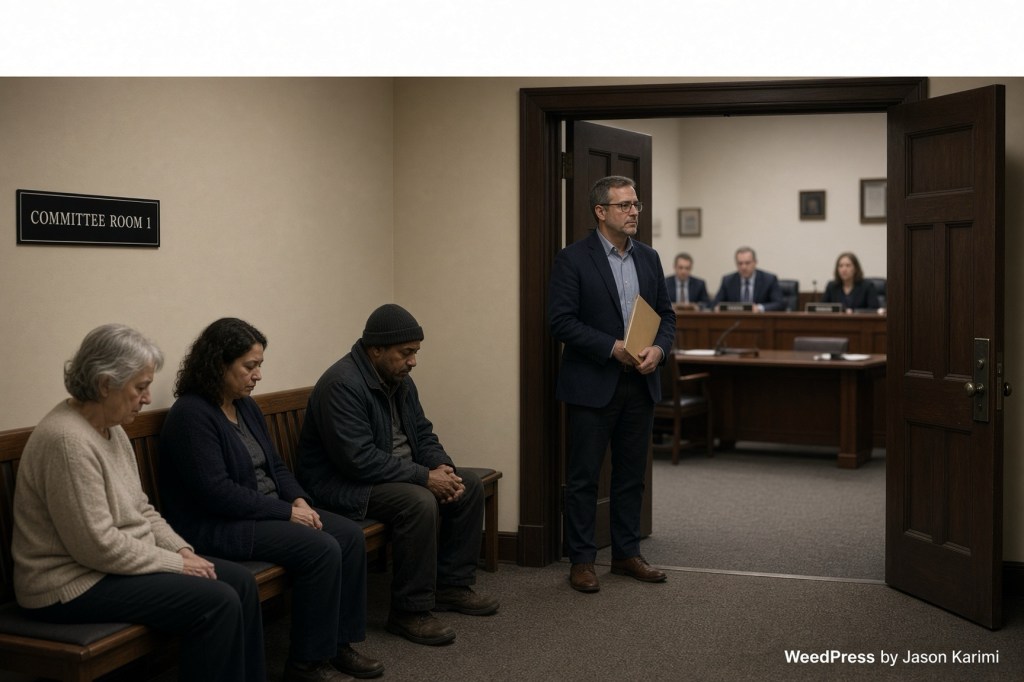
6. Transition risk. Jackley is the sitting Attorney General and is not seeking reelection; the Republican convention nominated Lance Russell for the November 3, 2026 general election.³⁰ An October appearance, if it occurs, is still this administration’s chance to leave a written construction rather than an oral impression. Successor offices inherit silence as easily as they inherit opinions.
None of those questions require the Attorney General to endorse adult-use legalization. They require him to read two chapters of Title 34 together.
What the record shows versus what advocates claim
The record shows:
The Oversight Committee met August 17, 2026. The program administrator stated the state has more questions than answers about the federal change.³¹ The chair hopes for an October meeting with the Attorney General.³² A federal final order in April 2026 placed FDA-approved marijuana products and marijuana under a qualifying state medical license in Schedule III; unlicensed and adult-use marijuana were described as remaining Schedule I pending any broader rulemaking.³³ SDCL § 34-20B-11 still requires “no accepted medical use in the United States” for Schedule I inclusion.³⁴ SDCL § 34-20B-27 still uses “shall” for departmental recommendations when abuse potential is determined to have changed.³⁵ A petition invoking those sections is in the Department’s receipt file.³⁶
The record does not show:
That South Dakota has already rescheduled cannabis. That chapter 34-20G is void. That adult use is lawful. That 280E relief or banking access is automatic for every licensee without regard to the order’s scope and IRS guidance. That the Attorney General is confirmed for a dated October hearing. That federal Schedule III status for licensed medical product has been formally mapped onto SDCL chapter 34-20B by any state officer.
Advocates often claim that rescheduling “legalizes” cannabis, that state Schedule I is already “null,” or that agencies are acting in bad faith by not rewriting the code overnight. Those claims outrun the documents. Schedule I can be legally incoherent as a criteria match and still remain on the books until the Legislature acts or a court so holds. Incoherence is a reason to ask the AG the questions above. It is not a substitute for an enactment.
Agencies often imply that nothing can be said until Washington finishes every guidance document. That claim also outruns the documents. §§ 34-20B-11 and 34-20B-27 are South Dakota statutes. Their text does not wait on a federal FAQ. The Department can say whether the three Schedule I elements still describe cannabis. The Attorney General can say how his office will read those elements in charging decisions and in advice to the Department. Refusing to say it is a choice, not a lack of authority.
October is useful only if someone puts that choice on the transcript. WeedPress will keep the statutory questions in the same form they were filed: criteria, “shall,” and the federal medical-use acknowledgment—probable arguments with citations, not a demand that the Committee perform a political identity. Patients and licensees need a written construction. Legislators need to know whether the next session must amend 34-20B, leave the mismatch in place, or pretend the August sentence—“more questions than answers”—is a governance model.
See you in October, South Dakota.
Expect surprises during this election season cycle around marijuana issues.
The time for setting the tone on the future of federal-state aligned marijuana policy and civil rights for patients is finally here. It took way too long to get here and there’s only one good shot at getting this course charted well.
No lawyer knows these laws better. If you’ve got questions, my team has the timely battle-tested answers.
Put up or shut up time is a go.
Play ball.
Footnotes
¹ Grant Green, SD Lawmakers Discuss How Medical Cannabis Program Can Improve, Dakota News Now (Aug. 17, 2026) (Chairwoman Garcia: next meeting in October; committee hopes Attorney General will testify), https://www.dakotanewsnow.com/2026/08/17/sd-lawmakers-discuss-how-medical-cannabis-program-can-improve/.
² Id.; S.D. Legislature, 2026 Medical Marijuana Oversight Committee (authority: S.D. Codified Laws §§ 34-20G-92 to 34-20G-94), https://sdlegislature.gov/Interim/Committee/501/Detail.
³ John Hult, Medical Marijuana Home Cultivation Licenses Surge in South Dakota, S.D. Searchlight (Aug. 17, 2026), https://southdakotasearchlight.com/2026/08/17/medical-marijuana-home-cultivation-licenses-surge-in-south-dakota/; Bob Mercer, Digital IDs Coming for S.D. Medical Cannabis Patients, KELOLAND (Aug. 17, 2026), https://www.keloland.com/news/capitol-news-bureau/digital-ids-coming-for-s-d-medical-cannabis-patients/.
⁴ S.D. Dep’t of Health, Medical Cannabis Data (update dated Aug. 3, 2026) (19,530 approved patient cards), https://doh.sd.gov/programs/medical-cannabis/med-cannabis-data/.
⁵ Hult, supra note 3 (61 home cultivators in FY 2022; 715 in FY 2026), https://southdakotasearchlight.com/2026/08/17/medical-marijuana-home-cultivation-licenses-surge-in-south-dakota/.
⁶ Makenzie Huber, Reclassification Eases Taxes and Banking for Medical Cannabis, but Leaves State with Questions, S.D. Searchlight (Aug. 17, 2026), https://southdakotasearchlight.com/2026/08/17/reclassification-eases-taxes-and-banking-for-medical-cannabis-but-leaves-state-with-questions/; Mercer, supra note 3, https://www.keloland.com/news/capitol-news-bureau/digital-ids-coming-for-s-d-medical-cannabis-patients/.
⁷ Huber, supra note 6 (quoting Whitney Brunner), https://southdakotasearchlight.com/2026/08/17/reclassification-eases-taxes-and-banking-for-medical-cannabis-but-leaves-state-with-questions/.
⁹ Id. (quoting Kittrick Jeffries), https://southdakotasearchlight.com/2026/08/17/reclassification-eases-taxes-and-banking-for-medical-cannabis-but-leaves-state-with-questions/.
¹⁰ Id. (NCSL presenter Nicole Ezeh on deductions and banking), https://southdakotasearchlight.com/2026/08/17/reclassification-eases-taxes-and-banking-for-medical-cannabis-but-leaves-state-with-questions/.
¹¹ Green, supra note 1, https://www.dakotanewsnow.com/2026/08/17/sd-lawmakers-discuss-how-medical-cannabis-program-can-improve/. No official October date was located on the Legislature’s committee page at the time of writing; confirm against the posted interim agenda, https://sdlegislature.gov/Interim/Committee/501/Detail.
¹² U.S. Dep’t of Justice, Press Release, Justice Department Places FDA-Approved Marijuana Products and Products Containing Marijuana Subject to a Qualifying State-issued License in Schedule III (Apr. 23, 2026), https://www.justice.gov/opa/pr/justice-department-places-fda-approved-marijuana-products-and-products-containing-marijuana.
¹³ Schedules of Controlled Substances: Rescheduling of FDA-Approved Products Containing Marijuana from Schedule I to Schedule III, 91 Fed. Reg. 22,714 (Apr. 28, 2026), https://www.govinfo.gov/app/details/FR-2026-04-28/2026-08176.
¹⁴ DOJ Press Release, supra note 12, https://www.justice.gov/opa/pr/justice-department-places-fda-approved-marijuana-products-and-products-containing-marijuana; Cong. Rsch. Serv., LSB11424, Department of Justice Eases Control of Medical Marijuana (Apr. 30, 2026), https://www.congress.gov/crs-product/LSB11424; U.S. Dep’t of the Treasury, Treasury, IRS Announce Process for Tax Guidance Following DOJ Final Order on Medical Marijuana Rescheduling (Apr. 23, 2026), https://home.treasury.gov/news/press-releases/sb0471.
¹⁵ DOJ Press Release, supra note 12 (hearing to begin June 29, 2026), https://www.justice.gov/opa/pr/justice-department-places-fda-approved-marijuana-products-and-products-containing-marijuana. Status of any final broader rule should be verified against DEA/DOJ publications after that hearing.
¹⁶ U.S. Dep’t of the Treasury, Treasury, IRS Announce Process for Tax Guidance Following DOJ Final Order on Medical Marijuana Rescheduling (Apr. 23, 2026) (discussing I.R.C. § 280E), https://home.treasury.gov/news/press-releases/sb0471.
¹⁷ S.D. Codified Laws § 34-20B-11, https://sdlegislature.gov/Statutes/34-20B-11.
¹⁸ S.D. Codified Laws ch. 34-20G, https://sdlegislature.gov/Statutes/34-20G; Huber, supra note 6 (program legal since 2021 after 2020 ballot measure), https://southdakotasearchlight.com/2026/08/17/reclassification-eases-taxes-and-banking-for-medical-cannabis-but-leaves-state-with-questions/.
¹⁹ S.D. Legislature, 2026 Medical Marijuana Oversight Committee (scope/authority listing), https://sdlegislature.gov/Interim/Committee/501/Detail.
²⁰ S.D. Codified Laws § 34-20B-1(8) (“Department,” the Department of Health), https://sdlegislature.gov/Statutes/34-20B-1.
²¹ S.D. Codified Laws § 34-20B-18(2), https://sdlegislature.gov/Statutes/34-20B-18.
²² S.D. Codified Laws § 34-20B-27, https://sdlegislature.gov/Statutes/34-20B-27.
²³ Jason Karimi, South Dakota’s Schedule I Problem Is Now in the Administrative Record, WeedPress (Feb. 23, 2026), https://weedpress.org/2026/02/23/south-dakotas-schedule-i-problem-is-now-in-the-administrative-record/.
²⁴ Jason Karimi, DOH Confirms Receipt: South Dakota’s Schedule I Review Petition Is Officially in the Record, WeedPress (Mar. 5, 2026), https://weedpress.org/2026/03/05/doh-confirms-receipt-south-dakotas-schedule-i-review-petition-is-officially-in-the-record/.
²⁵ Jason Karimi, Advance Notice to South Dakota Department of Health, WeedPress (May 14, 2026), https://weedpress.org/2026/05/14/advance-notice-to-south-dakota-department-of-health-petition-for-scheduling-review-will-follow-federal-rescheduling-hearings/.
²⁶ Jason Karimi, Don’t Punish Patients for Federal Uncertainty: My Testimony Opposing SB 181, WeedPress (Mar. 4–6, 2026) (Senate HHS, Feb. 11, 2026; SB 181 and SB 194 to the 41st day), https://weedpress.org/2026/03/04/dont-punish-patients-for-federal-uncertainty-my-testimony-opposing-sb-181/.
²⁷ Author’s representation of a face-to-face discussion with Sen. Chuck Grassley; not independently documented in a congressional hearing record cited here. No contemporaneous primary-source URL located.
²⁸ S.D. Codified Laws § 22-42-6 (unlawful possession of marijuana, degrees by amount), https://sdlegislature.gov/Statutes/22-42-6. Interaction with ch. 34-20G patient exceptions should be stated by the AG, not inferred. Chapter 34-20G: https://sdlegislature.gov/Statutes/34-20G.
²⁹ Huber, supra note 6, https://southdakotasearchlight.com/2026/08/17/reclassification-eases-taxes-and-banking-for-medical-cannabis-but-leaves-state-with-questions/.
³⁰ Ballotpedia, Attorney General of South Dakota (Jackley current officeholder; Lance Russell Republican nominee; general election Nov. 3, 2026), https://ballotpedia.org/Attorney_General_of_South_Dakota. Jackley’s congressional bid and decision not to seek AG reelection have been reported in state press; treat successor-office timing as election-dependent.
³¹ Huber, supra note 6, https://southdakotasearchlight.com/2026/08/17/reclassification-eases-taxes-and-banking-for-medical-cannabis-but-leaves-state-with-questions/.
³² Green, supra note 1, https://www.dakotanewsnow.com/2026/08/17/sd-lawmakers-discuss-how-medical-cannabis-program-can-improve/.
³³ DOJ Press Release, supra note 12, https://www.justice.gov/opa/pr/justice-department-places-fda-approved-marijuana-products-and-products-containing-marijuana; 91 Fed. Reg. 22,714, https://www.govinfo.gov/app/details/FR-2026-04-28/2026-08176.
³⁴ S.D. Codified Laws § 34-20B-11(2), https://sdlegislature.gov/Statutes/34-20B-11.
³⁵ S.D. Codified Laws § 34-20B-27, https://sdlegislature.gov/Statutes/34-20B-27.
³⁶ WeedPress, supra notes 23–24, https://weedpress.org/2026/02/23/south-dakotas-schedule-i-problem-is-now-in-the-administrative-record/; https://weedpress.org/2026/03/05/doh-confirms-receipt-south-dakotas-schedule-i-review-petition-is-officially-in-the-record/.


Leave a comment