On Wednesday, August 26, 2026, I mailed a $150 cashier’s check to the Thurston County District Court at P.O. Box 216, Pender, Nebraska 68047. The check covers the estimated cost of the Bill of Exceptions for the April 8, 2026 evidentiary hearing on my request to modify a probation condition under Nebraska’s First Freedom Act.¹
That payment is not a gesture. For the issues raised from that hearing, the Bill of Exceptions is what allows an appellate court to review what happened: what was said, what was admitted, and why the district court stopped the analysis where it did.²
I paid for that record because the issue is larger than one probation file.
It is whether Nebraska’s new religious-liberty statute means what the Legislature wrote.
The case
This is State v. Karimi, Thurston County District Court Case No. CR23-13.³ I asked the district court to modify a probation condition so that sacramental cannabis use in Rastafari practice would not be treated as an automatic violation. The request was brought under the First Freedom Act, Neb. Rev. Stat. §§ 20-701 to 20-705, and under the court’s authority to modify probation conditions.⁴
On July 1, 2026, the district court denied the motion. The court’s order did not hold that Rastafari is not a religion, and it noted Reverend Brandon Baker’s testimony that cannabis is the sacrament of the practice. As the order itself reflects, the court found no direct evidence of my personal sincerity because I did not testify and was not subject to cross-examination, and it described Reverend Baker’s testimony as corroborative but not on point.⁵
I have already written that ruling up. WeedPress published the court’s sincerity analysis and the reason I am appealing it: the First Freedom Act requires proof of a sincerely held religious exercise, but it does not prescribe an exclusive method of proof, and it does not say personal testimony is indispensable.⁶
What the First Freedom Act actually says
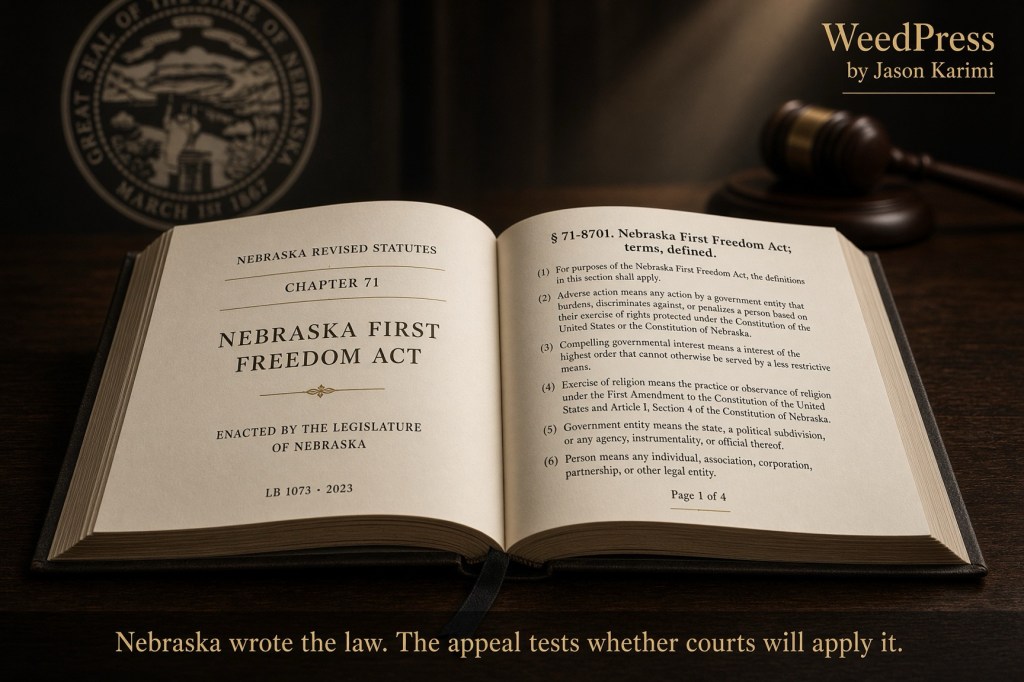
The First Freedom Act is not a toothless slogan. It is five short statutes enacted in 2024 as part of LB 43, operative July 19, 2024.⁷
The Act defines “exercise of religion” as the practice or observance of religion, including “any action that is motivated by a sincerely held religious belief, whether or not the exercise is compulsory or central to a larger system of religious belief.”⁸ That language matters. The Legislature told courts not to decide whether a practice is “central enough.” The question is sincerity and burden, not orthodoxy.
A “substantial burden” includes any action that “directly or indirectly constrains, inhibits, curtails, or denies the exercise of religion,” including criminal, civil, or administrative penalties.⁹ A probation condition that treats sacramental use as a violation is not a side issue under that definition. It is the kind of state action the statute was written to reach.
Then comes the operative command. Notwithstanding any other provision of law, state action shall not substantially burden a person’s exercise of religion unless the State shows that applying the burden to that person in this particular instance is essential to further a compelling governmental interest and is the least restrictive means of furthering that interest.¹⁰ The Act also allows the claim to be raised as a defense in a judicial proceeding.¹¹ And it applies to all state and local laws, including laws adopted before July 19, 2024.¹²
That last point is not academic. The probation condition existed before the Act. The Act still applies to its implementation.
The floor debate is part of the homework
I did not come to this statute from a blog post. I obtained the legislative floor discussion of the First Freedom Act, including the January 23, 2024 LB 43 debate, and published that record on WeedPress.¹³ Senators described the bill as restoring a compelling-interest standard for religious exercise in Nebraska—protection that does not depend on whether a practice is popular, familiar, or convenient for the State.
That is the homework. If Nebraska enacted a RFRA-style statute, then a court applying it has to use the statute’s definitions and its burden-shifting structure. It cannot invent an extra evidentiary hoop the Legislature did not write.
Why this appeal is being taken
To my knowledge, this is the first Nebraska appeal accepted for review under the First Freedom Act.¹⁴ I am not asking readers to treat that as a trophy. I am stating why the record matters. New statutes get their meaning from the first cases that force courts to apply them. If the first case is allowed to die quietly because the Bill of Exceptions was never paid for, the statute stays a press release.
The district court resolved the motion solely on sincerity and then said no further analysis was necessary. That is the legal issue on appeal: whether the court imposed an evidentiary requirement the Act does not contain, and whether, once sincerity is properly evaluated, the State must still prove a compelling interest and least-restrictive means.¹⁵
This argument is not new
The Nebraska filing did not invent the claim. In 2010, I argued in Warren County, Iowa district court that Rastafari sacramental practice required an exemption from probation drug-testing conditions. In 2022, I raised the same religious-exercise issue in federal court. Those filings are published on WeedPress.¹⁶
That history matters for the sincerity question the district court treated as empty. A belief argued in state court in 2010, argued again in federal court in 2022, and now raised under Nebraska’s First Freedom Act in 2026 is not a late invention for a probation file. It is a consistent religious-liberty claim, documented in public filings over sixteen years. The Nebraska appeal is the first time that claim is being tested under the First Freedom Act. It is not the first time the claim was made.
What happens next
The $150 payment allows preparation of the Bill of Exceptions to proceed. I will confirm with the Thurston County Clerk of District Court that the payment was received and applied to CR23-13.
I will finish the appellant brief and file it in the Nebraska Court of Appeals first. After it is filed, I will publish it on WeedPress. I do not publish merits briefs before they are in the court file. The record comes first. Commentary comes after.
This is the same method WeedPress has used throughout this case: file, then publish. The petition, the July 1 order, the floor debate, and the sincerity analysis are already on the site. The payment for the Bill of Exceptions is the next line in that paper trail.
Nebraska wrote a religious-liberty statute and said it applies to every state action, including old ones. I asked a court to apply it to a probation condition that burdens a sacramental practice.
The court said I had not proved sincerity because I did not take the stand. I paid $150 so an appellate court can review what actually happened.
That is the filing.
That is the record.
That is the point.
Footnotes
¹ Request for Bill of Exceptions and estimated-cost deposit, State v. Karimi, No. CR23-13 (Thurston Cty. Dist. Ct. Neb.), payment mailed Aug. 26, 2026, to Thurston Cty. Dist. Ct., P.O. Box 216, Pender, NE 68047.
² See Neb. Ct. R. App. P. § 2-105.01 (Bill of Exceptions; preparation and payment of estimated cost).
³ State v. Karimi, No. CR23-13 (Thurston Cty. Dist. Ct. Neb.).
⁴ Neb. Rev. Stat. §§ 20-701 to 20-705 (First Freedom Act); Neb. Rev. Stat. § 29-2263 (modification of probation). See also Jason Karimi, Petition For Religious Cannabis Exemption In Nebraska, WeedPress.
⁵ Order, State v. Karimi, No. CR23-13 (Thurston Cty. Dist. Ct. Neb. July 1, 2026). See Jason Karimi, Nebraska Judge: WeedPress Didn’t Provide Evidence of Religious Sincerity, WeedPress (July 1, 2026), https://weedpress.org/2026/07/01/nebraska-judge-weedpress-didnt-provide-evidence-of-religious-sincerity/.
⁶ Jason Karimi, Court Said I Didn’t Prove My Religion Because I Didn’t Testify. I’m Appealing Under Nebraska’s Religious First Freedom Act, WeedPress (July 23, 2026), https://weedpress.org/2026/07/23/court-said-i-didnt-prove-my-religion-because-i-didnt-testify-im-appealing-under-nebraskas-religious-first-freedom-act/.
⁷ First Freedom Act, Neb. Rev. Stat. §§ 20-701 to 20-705 (enacted by L.B. 43, 108th Leg., 2d Sess. (Neb. 2024)) (operative July 19, 2024).
⁸ Neb. Rev. Stat. § 20-702(1).
⁹ Neb. Rev. Stat. § 20-702(6).
¹⁰ Neb. Rev. Stat. § 20-703(1).
¹¹ Neb. Rev. Stat. § 20-704(1)–(2).
¹² Neb. Rev. Stat. § 20-705.
¹³ Nebraska First Freedom Act Floor Discussion, WeedPress (LB 43 floor debate, Jan. 23, 2024), https://weedpress.org/category/rfra-updates/; see also 108th Neb. Leg., Floor Debate on L.B. 43 (Jan. 23, 2024) (remarks of Sen. Sanders opening on L.B. 43).
¹⁴ Author’s review of publicly available Nebraska appellate dockets as of August 26, 2026. This statement reflects the author’s present knowledge and is not a representation that no other First Freedom Act appeal exists.
¹⁵ Order, State v. Karimi, No. CR23-13 (Thurston Cty. Dist. Ct. Neb. July 1, 2026); Neb. Rev. Stat. §§ 20-702(1), 20-703(1).
¹⁶ Defendant’s filings seeking a Rastafari exemption from probation drug-testing conditions, Warren Cty. Dist. Ct. (Iowa 2010), published on WeedPress.
¹⁷ Defendant’s federal-court filings raising a Rastafari religious-exercise claim (2022), published on WeedPress.
From the above WeedPress published 2022 motion in federal court filed by his attorney in Minnesota comes the below excerpt. Download the full filing if interested. It was very poorly done, but this does show the issue has been raised before on my behalf protesting unconstitutional religious persecution during state and federal supervised release periods over a period of nearly 20 years now.
This time in Nebraska I’m doing the filings pro se. Here’s what was filed in my federal case:
III. MR. KARIMI HAS PRACTICED RASTAFARIANISM FOR TWELVE YEARS AND USES MARIJUANA AS RELIGIOUS SACRAMENT
Rastafari is a religious and political movement that began in Jamaica in the 1930s and was adopted by many groups around the globe. “It combines Protestant Christianity, mysticism, and a pan-African political consciousness.” Rasta beliefs are based on a specific interpretation of the Bible and a central, monotheistic belief in a single God, referred to as Jah, who is deemed to partially reside within each individual.
Rastafari “levity,” or the principle of a balanced lifestyle, includes the wearing of long hair locked in its natural state, dressing in the colors of red, green, gold and black to symbolize the “life force of blood, herbs, royalty, and Africanness.” The colors also represent the Ethiopian flag as many Rastas accord Haile Selassie I, the Emperor of Ethiopia between 1930 and 1974, as a human prophet who fully recognized the inner divinity in every individual.Some members of the Rastafari Religion wear head-coverings in the form of turbans, while others choose to wear the traditional Rastacap or Tam. Religious rituals include prayer services, the smoking of ganja (marijuana) to achieve better meditation with Jah, and “bingis (all -night drumming ceremonies).”
Mr. Karimi has been a practicing Rastafarian since 2009 when he had an enlightening experience while with Rasta friends. Mr. Karimi stated that he was drawn to Rastafarianism because the members had biblical answers that no religion had offered him before. Mr. Karimi grew up in a Christian household where he was consistently dissatisfied with the lack of answers to his religious questions.
Today, Mr. Karimi incorporates his religious beliefs in his life. He frequently reads, interprets and discusses the bible with friends, often while smoking marijuana, their religious sacrament. Recently, Mr. Karimi was roommates with Jamison Arend, a licensed Rastafarian minister in Minnesota, who served as a mentor/father figure until Mr. Arend’s untimely death in December of 2020. Mr. Arend was instrumental in helping Mr. Karimi find his spirituality and his established beliefs in the Rastafari religion.
IV. CONCLUSION
For these reasons, Jason Robert Karimi, through counsel, respectfully moves the Court to permit his use of medical and religious marijuana and forego a Condition of Supervised Release that would prevent Mr. Karimi from using marijuana.
 WeedPress: The Paper Trail
Leave a comment