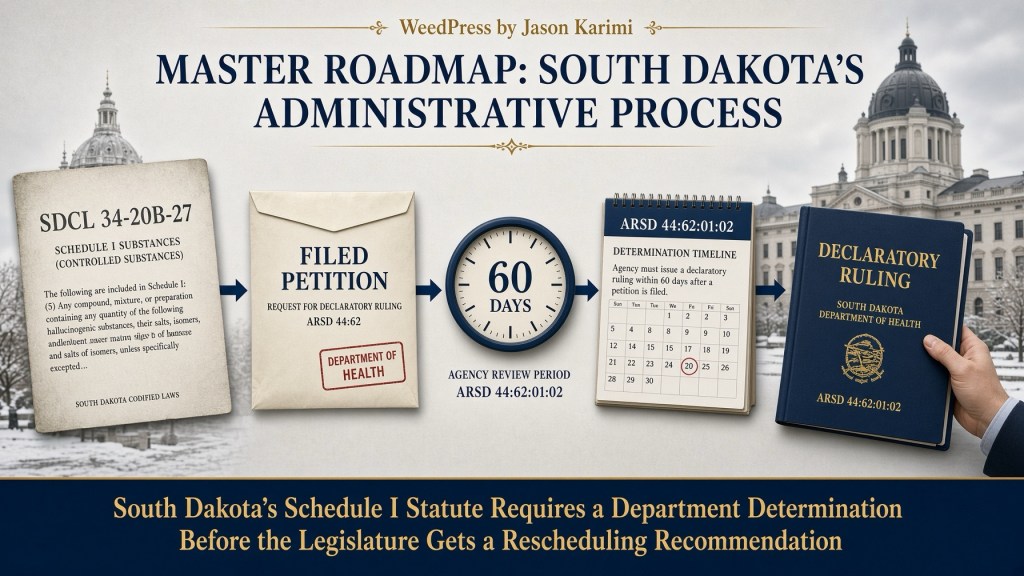
South Dakota has demonstrated that it can write controlled-substance statutes anticipating federal medical developments. That makes the state’s unresolved cannabis classification question harder to dismiss as something nobody could have anticipated.
SDCL 34-20B-27 does not amend the schedules by itself. It tells the Department of Health when a determination triggers a mandatory recommendation to the Legislature.¹ After the April 28, 2026 federal order placing certain state-licensed medical marijuana products in Schedule III, the unanswered Pierre question is not whether marijuana is still listed in chapter 34-20B. It is whether the department has made, or must make, the determination that statute requires before it recommends addition, deletion, or rescheduling.²
This article does not ask the department to open the medical market or rewrite licensing. It sets out the text, two readings of the duty, and the existing petition path for a written ruling before the next legislative session.³ Reading B below is an interpretive argument, not an uncontested command already written into the code.
What 34-20B-27 Actually Says
The section is short:
“The department shall make recommendations to the Legislature that a substance be added, deleted, or rescheduled when the department determines that such substance has a different potential for abuse.”⁴
“Department” in chapter 34-20B means the Department of Health.⁵ “Control” in the same chapter means to add, remove, or change placement under §§ 34-20B-27 and 34-20B-28.⁶ Nothing in § 34-20B-27 automatically changes South Dakota’s schedules upon a federal scheduling action.⁷
Schedule I criteria remain separate. For inclusion in Schedule I, a substance must have a high potential for abuse, no accepted medical use in the United States, and a lack of accepted safety for use under medical supervision.⁸ Federal placement of qualifying state-licensed medical marijuana in Schedule III is powerful evidence that the federal government now treats that category as satisfying the federal Schedule III framework applicable to it, although it does not itself determine how South Dakota must apply § 34-20B-11.⁹ South Dakota’s own Schedule III criteria separately require a potential for abuse less than the substances listed in Schedules I and II, and well-documented and approved medical use in the United States.¹⁰ It is not a South Dakota rescheduling order.
Two Readings Staff Will See
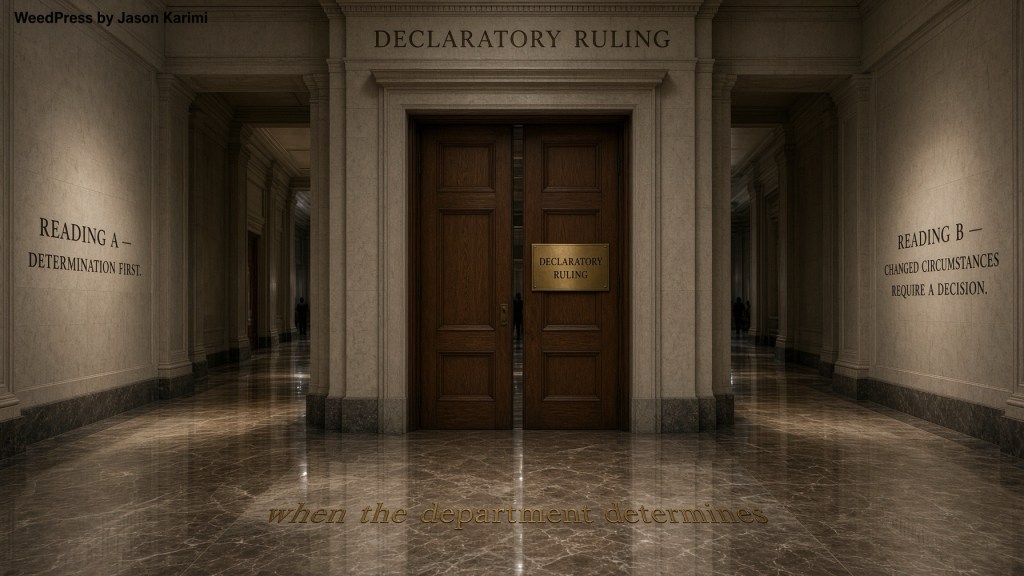
Reading A. The duty is triggered only after the department itself determines a different potential for abuse. Until that finding is made, there is no mandatory recommendation. Silence is legally available if the department has not completed that determination.¹¹
Reading B. A published federal finding that qualifying medical marijuana belongs in Schedule III presents the kind of changed circumstance that could require the Department to determine whether the substance has a “different potential for abuse” under § 34-20B-27. Once that federal action is on the record, the department cannot indefinitely avoid deciding whether potential for abuse is “different,” because the statute uses “shall” once the determination is made—and the determination is the department’s job, not a spectator sport.¹² That is the proposed reading, not a holding.
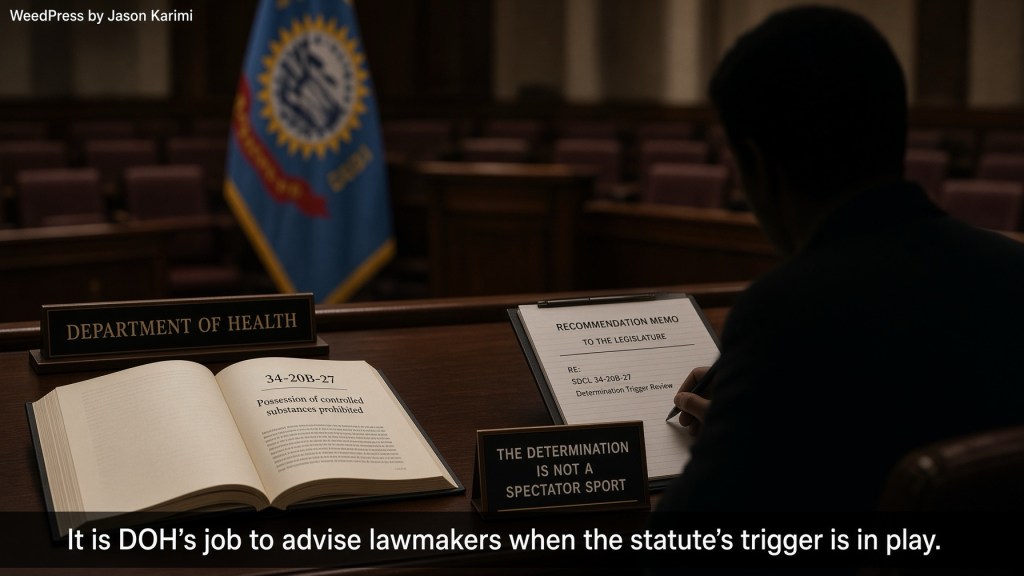
Both readings start from the same sentence. The difference is whether “determines” is a discretionary on-switch the department may leave off, or a responsibility the department owes the Legislature when the federal schedule for the same substance has moved.¹³ A declaratory ruling does not have to pick a political side. It has to say which reading the department is using.
What a Ruling Does—and Does Not Do
SDCL 1-26-15 requires each agency to provide by rule for filing and prompt disposition of a petition for declaratory ruling as to the applicability of any statutory provision, rule, or order of the agency.¹⁴ A ruling disposing of the petition has the same status as an agency decision or order in a contested case.¹⁵ The agency must file a copy with code counsel for publication in the Administrative Rules of South Dakota.¹⁶ The South Dakota Supreme Court has recognized § 1-26-15 as a valid mechanism for an agency to issue a declaratory interpretation of a statute it administers, with judicial review governed by the APA.¹⁷
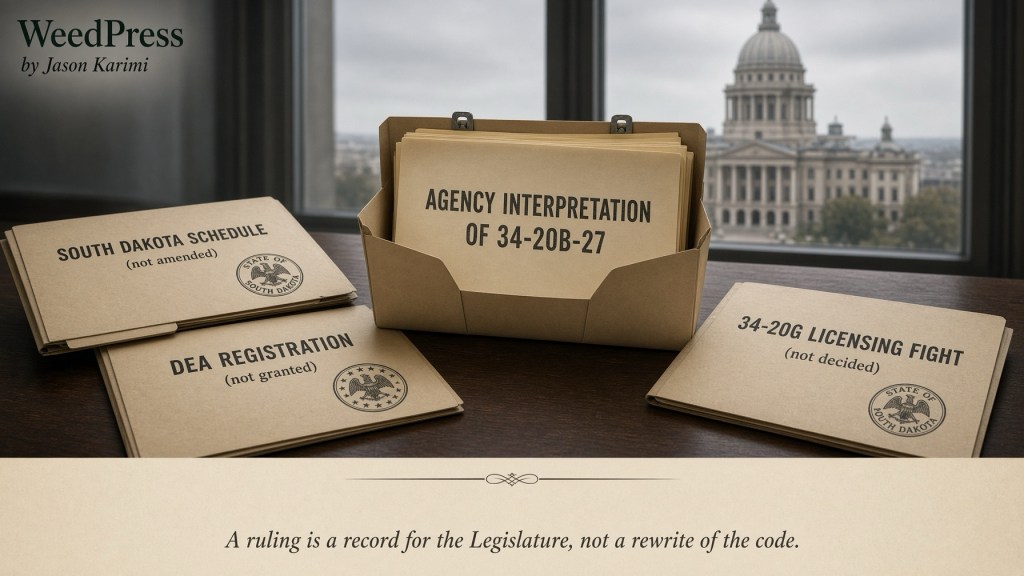
That is the point of using this tool before session. A published ruling creates an administrative record the Legislature can read. It does not bind the Legislature. It does not amend the South Dakota schedule or itself create authority for a federal DEA registration. It does not adjudicate a separate licensing dispute under chapter 34-20G.¹⁸
Department of Health Petition Rules
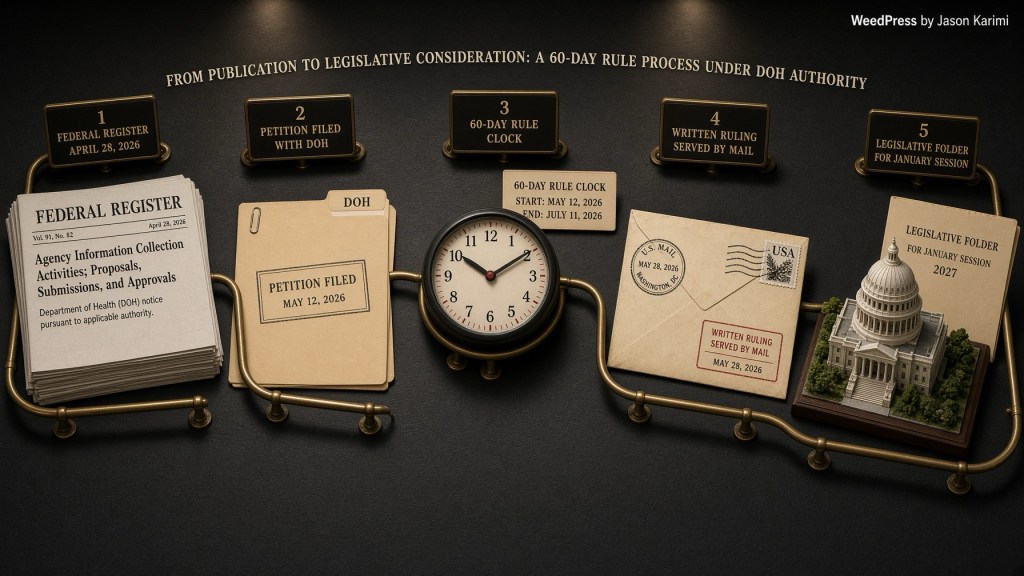
DOH already has the form. ARSD 44:62:01:01 requires a written petition that identifies and quotes the statute or rule, states the facts that give rise to the question, and states the precise issue to be answered.¹⁹ ARSD 44:62:01:02 allows the department to request more information, then requires the department to issue its ruling within 60 days after receipt of the petition or after receipt of the additional information, and to serve the petitioner by mail.²⁰
General authority for those rules is SDCL 34-1-25. The law implemented is SDCL 1-26-15.²¹
Checklist for a 34-20B-27 Petition
A petition that Pierre can process without a hunting expedition should contain:
1. Petitioner name, capacity, and address, using the ARSD 44:62:01:01 caption.²²
2. The exact text of SDCL 34-20B-27, 34-20B-11, and the definition of “department” in 34-20B-1.²³
3. The federal action relied on: 91 Fed. Reg. 22,714 (Apr. 28, 2026), limited to FDA-approved marijuana products and marijuana subject to a qualifying state medical-marijuana license.²⁴
4. Facts showing how the petitioner is affected by, or seeks a ruling concerning the applicability of, chapter 34-20B or related Department-administered law—not a request that the department legislate.²⁵
5. Precise questions, for example:
(a) Has the department determined, within the meaning of SDCL 34-20B-27, that marijuana or tetrahydrocannabinols have a different potential for abuse after the April 28, 2026 federal order?
(b) If not, does 34-20B-27 require the department to make that determination and, if so, on what timeline relative to the next legislative session?
(c) If the department has determined that the potential for abuse is not different, what statutory and factual basis supports that determination?²⁶
6. A clear statement of what is not requested: no change to residency rules, no demand for adult-use, no claim that the April order rewrote South Dakota’s code.
What Staff Can Do With the File
If the department answers that it has not yet determined a different potential for abuse, the Legislature still has the option to act on its own. If the department answers that 34-20B-27 does not require a recommendation until it chooses to determine, that interpretation is now on paper and can be tested or accepted. If the department answers that a recommendation is due, the recommendation still goes to the Legislature; the department does not move the schedule by memo.²⁷
The January session makes the timing of a written ruling practically important. The sixty-day clock in ARSD 44:62:01:02 runs from receipt of the petition or from receipt of additional information if the department requests it, so a late filing or an information request can push the ruling past the start of session.²⁸ Interim testimony without a written departmental position still leaves Health and LRC briefing in January a question that the Department’s existing declaratory-ruling procedure is designed to answer.
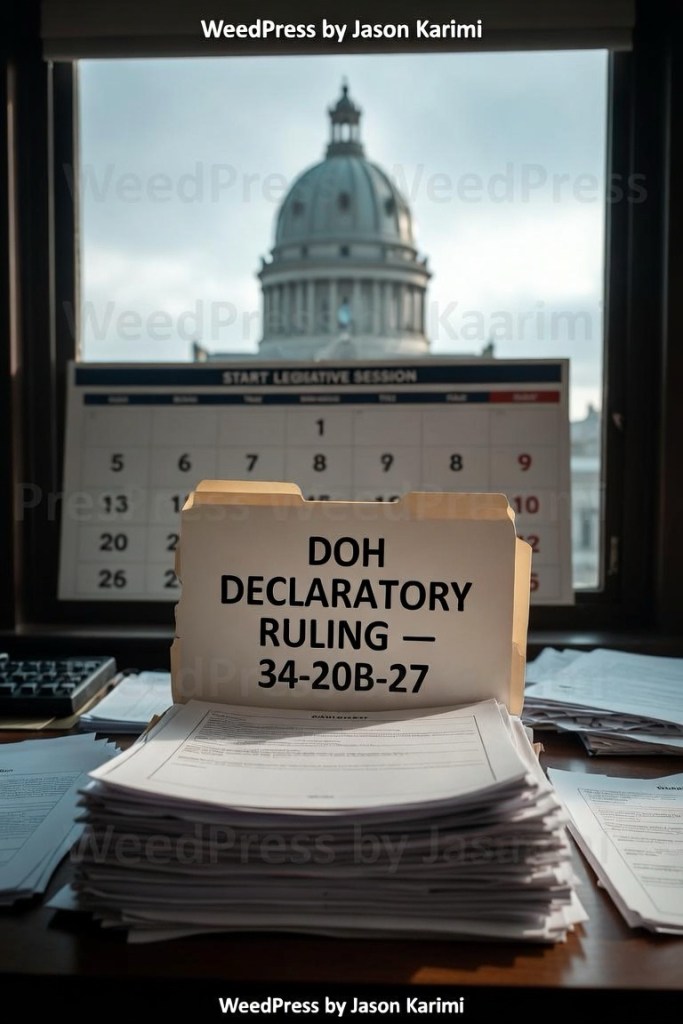
A ruling is not a verdict that South Dakota’s medical program is unlawful. It is a statement of how the department reads its own recommendation statute after a federal schedule change the state did not draft. That is the document that belongs in the folder before bills are introduced, not after.
Footnotes
¹ S.D. Codified Laws § 34-20B-27, https://sdlegislature.gov/Statutes/34-20B-27.
² Schedules of Controlled Substances: Rescheduling of Food and Drug Administration Approved Products Containing Marijuana From Schedule I to Schedule III; Corresponding Change to Permit Requirements, 91 Fed. Reg. 22,714 (Apr. 28, 2026), https://www.federalregister.gov/documents/2026/04/28/2026-08176/schedules-of-controlled-substances-rescheduling-of-food-and-drug-administration-approved-products; S.D. Codified Laws ch. 34-20B, https://sdlegislature.gov/Statutes/34-20B.
³ S.D. Codified Laws § 1-26-15, https://sdlegislature.gov/Statutes/1-26-15; S.D. Admin. R. 44:62:01:01 to :02, https://sdlegislature.gov/Rules/Administrative/44:62:01.
⁴ S.D. Codified Laws § 34-20B-27, https://sdlegislature.gov/Statutes/34-20B-27.
⁵ S.D. Codified Laws § 34-20B-1, https://sdlegislature.gov/Statutes/34-20B-1.
⁶ S.D. Codified Laws § 34-20B-1, https://sdlegislature.gov/Statutes/34-20B-1.
⁷ S.D. Codified Laws § 34-20B-27, https://sdlegislature.gov/Statutes/34-20B-27.
⁸ S.D. Codified Laws § 34-20B-11, https://sdlegislature.gov/Statutes/34-20B-11.
⁹ 91 Fed. Reg. 22,714 (Apr. 28, 2026), https://www.federalregister.gov/documents/2026/04/28/2026-08176/schedules-of-controlled-substances-rescheduling-of-food-and-drug-administration-approved-products; 21 U.S.C. § 812(b)(3), https://www.law.cornell.edu/uscode/text/21/812.
¹⁰ S.D. Codified Laws § 34-20B-18, https://sdlegislature.gov/Statutes/34-20B-18.
¹¹ S.D. Codified Laws § 34-20B-27, https://sdlegislature.gov/Statutes/34-20B-27.
¹² Id.
¹³ See, e.g., Rhines v. S.D. Dep’t of Corr., 2019 S.D. 59, ¶ 13, 935 N.W.2d 541, 545 (words and phrases in a statute must be given their plain meaning and effect).
¹⁴ S.D. Codified Laws § 1-26-15, https://sdlegislature.gov/Statutes/1-26-15.
¹⁵ Id.
¹⁶ Id.
¹⁷ In re Petition for Declaratory Ruling re SDCL 62-1-1(6), 2016 S.D. 21, 877 N.W.2d 340, https://law.justia.com/cases/south-dakota/supreme-court/2016/27463.html.
¹⁸ S.D. Codified Laws ch. 34-20B; S.D. Codified Laws ch. 34-20G, https://sdlegislature.gov/Statutes/34-20B; https://sdlegislature.gov/Statutes/34-20G.
¹⁹ S.D. Admin. R. 44:62:01:01, https://sdlegislature.gov/Rules/Administrative/44:62:01.
²⁰ S.D. Admin. R. 44:62:01:02, https://sdlegislature.gov/Rules/Administrative/44:62:01.
²¹ S.D. Admin. R. 44:62:01:01 to :02, https://sdlegislature.gov/Rules/Administrative/44:62:01; S.D. Codified Laws § 34-1-25, https://sdlegislature.gov/Statutes/34-1-25.
²² S.D. Admin. R. 44:62:01:01, https://sdlegislature.gov/Rules/Administrative/44:62:01.
²³ S.D. Codified Laws §§ 34-20B-1, 34-20B-11, 34-20B-27, https://sdlegislature.gov/Statutes/34-20B-1; https://sdlegislature.gov/Statutes/34-20B-11; https://sdlegislature.gov/Statutes/34-20B-27.
²⁴ 91 Fed. Reg. 22,714 (Apr. 28, 2026), https://www.federalregister.gov/documents/2026/04/28/2026-08176/schedules-of-controlled-substances-rescheduling-of-food-and-drug-administration-approved-products.
²⁵ S.D. Codified Laws § 1-26-15, https://sdlegislature.gov/Statutes/1-26-15; S.D. Admin. R. 44:62:01:01, https://sdlegislature.gov/Rules/Administrative/44:62:01.
²⁶ S.D. Codified Laws §§ 34-20B-11, 34-20B-27, https://sdlegislature.gov/Statutes/34-20B-11; https://sdlegislature.gov/Statutes/34-20B-27.
²⁷ S.D. Codified Laws § 34-20B-27, https://sdlegislature.gov/Statutes/34-20B-27.
²⁸ S.D. Admin. R. 44:62:01:02, https://sdlegislature.gov/Rules/Administrative/44:62:01.
 WeedPress: The Paper Trail
Leave a comment