If anybody says to you that your voice doesn’t matter, don’t believe it. It’s a strategy to create a place of negativity.
— Stevie Wonder, Minneapolis, October 14, 2016
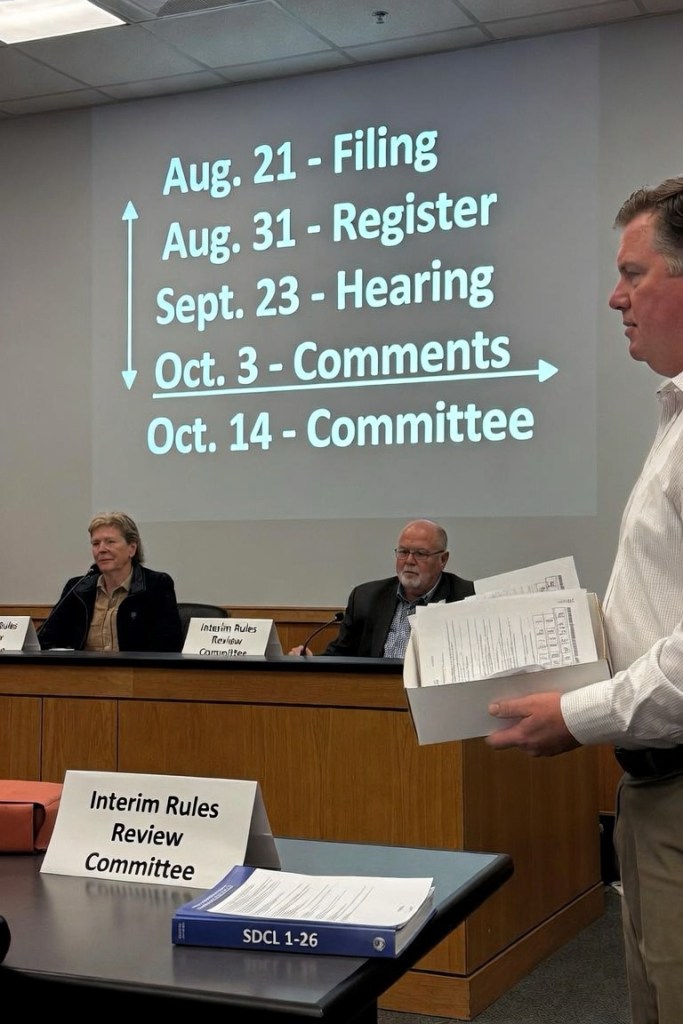
The Department of Health filed proposed amendments to Article 44:90 with the Legislative Research Council on August 21, 2026.¹ The South Dakota Register published that notice on August 31.² The public hearing is September 23, 2026, at 10:00 a.m. Central Time at the Floyd Matthew Training Center, Foss Building, 523 East Capitol Avenue, Pierre.³ Written comments are due October 3. The Interim Rules Review Committee is scheduled to take the package on October 14.⁴
The Department’s hearing notice enumerates 38 proposed amendments across Article 44:90, spanning 44:90:01:01 to 44:90:12:11.⁵ Article 44:90 is where patient cards, establishment registration, cameras, testing, packaging, recordkeeping, enforcement, and the proposed fine schedule actually live.⁶ Initiated Measure 26 became SDCL chapter 34-20G.⁷ The statute establishes the program’s legal framework. The rules determine many of the operational requirements, costs, timelines, and enforcement mechanisms that patients and establishments actually encounter.
That is why the rulemaking record matters.
Two official trend lines now run in opposite directions. They should be in the same hearing record.
Trend 1 – Patients keep arriving. The Department’s September 2, 2026 update lists 19,821 approved patient cards, 211 providers, and 620 caregivers.⁸ August was 19,530 patients. January 2026 was 18,114. July 2025 was 13,489.⁹ More than seventy percent of cardholders report severe, debilitating pain.¹⁰ Home-cultivation licenses rose from 61 in fiscal year 2022 to 715 in fiscal year 2026.¹¹ The Department has already told the Medical Marijuana Oversight Committee that the homegrow increase is a regulatory concern.¹²
Trend 2 – Licensed establishments keep leaving. The Department reported 139 certified establishments in state fiscal year 2023, including 79 dispensaries.¹³ By the August 27, 2026 public list, the Department of Health listed 108 licensed establishments: 62 dispensaries, 31 cultivation facilities, 14 manufacturing facilities, and one testing facility—31 fewer establishments than the SFY 2023 peak, a decline of about 22.3 percent.¹⁴ The annual registration fee for an establishment is $9,000.¹⁵ Small operators have already told lawmakers that modest fines force them to reshuffle payroll.¹⁶
A rules package that tightens operations, security, sampling, packaging, and enforcement deserves to be read alongside the economic condition of the market it regulates. South Dakota’s regulatory-impact requirements make that question harder to ignore.¹⁷ The hearing should not pretend otherwise.
What 44:90 actually controls
Chapter 34-20G authorizes four establishment types: cultivator, manufacturer, dispensary, and testing facility.¹⁸ Article 44:90 then fills in the machinery: applications and local-government Form E certifications;¹⁹ management, site, safety, and security plans;²⁰ camera placement and storage;²¹ inventory tracking and Metrc training;²² batch size, sampling, and certificates of analysis;²³ child-resistant and opaque exit packaging;²⁴ how the Department scores a “serious violation”;²⁵ and, in this package, proposed § 44:90:12:11 on the schedule of fines.²⁶ The Department’s own inspection reports show the same chapters cited again and again: inventory-tracking training, recordkeeping, camera placement, certificates of analysis, transport manifests, daily inventory, and batch size.²⁷
Those are the 38 proposed amendments identified in the Department’s public-hearing notice: patient registry cards, business registration, establishment operations and security, testing facilities, product manufacturing, dispensaries, sampling and testing, packaging, recordkeeping, and enforcement.²⁸ Until each proposed line is read against current text, no one should claim to know whether a given establishment’s next inspection gets easier or harder. The relevant question is where cost and paperwork move. In a market that has already lost roughly one in five licensed establishments, cost is policy.
Federal Schedule III does not write these rules. It does change the question Pierre has to answer.
In April 2026, federal authorities placed specified state-licensed medical marijuana products and certain FDA-approved marijuana drugs in Schedule III. Adult-use cannabis remains in Schedule I.²⁹ The National Conference of State Legislatures told the Medical Marijuana Oversight Committee on August 17 that the change is limited and that tax and interstate guidance is still missing.³⁰ Program Administrator Whitney Brunner told the same committee the state still lacks federal answers on implementation.³¹ Department slides put program revenue near $2.6 million, most of it from cardholder fees—not from a mature industrial tax base.³²
South Dakota also has its own scheduling statute. SDCL 34-20B-27 does not silently rewrite chapter 34-20B when Washington moves. It tells the Department when a determination triggers a recommendation to the Legislature.³³ WeedPress has already laid out that sequence.³⁴ The September 23 hearing is not that determination. Treating 44:90 as if federal Schedule III has already settled state law would be a category error. Treating 44:90 as if federal law is irrelevant would be the opposite error. The comments should force the Department to say, in the record, which proposed sections are responses to federal rescheduling and which are ordinary inspection cleanup.
What patients and remaining shops should put on paper
— Stevie Wonder, 2024
A comment that only says “protect patients” will be filed and forgotten. A comment that cites a numbered section and a Department number has to be answered.
Patients should ask whether card, photo, renewal, and caregiver rules add delay to a registry that already takes days to review and more days to mail a plastic card.³⁵ They should ask whether home cultivation—715 licenses in fiscal year 2026, two flowering plants and two non-flowering plants under statute—is being regulated in 44:90 by inspection language written for commercial rooms.³⁶ They should ask whether digital cards, which the Department has discussed publicly, appear in this draft or remain a press line.³⁷
Establishments should ask the only question that matches the license chart: does this package reduce the violations the Department already cites most often, or does it add new predicates for the same cameras, logs, and SOPs that already generate findings?³⁸ A serious-violation rule that lists gravity, willfulness, harm, prior history, duration, and likelihood of recurrence is already on the books.³⁹ Adding more “shalls,” including § 44:90:12:11, the existing schedule of fines, which the Department included in this amendment package, without publicly addressing the economic effect on a market that has already fallen to 108 licensed establishments is how a medical program becomes a program with cards and nowhere to buy.
The Administrative Procedures Act still applies. Chapter 1-26 requires notice, a hearing, and a path to the Interim Rules Review Committee.⁴⁰ The committee can declare the rulemaking complete, revert the package to an earlier step, or move to suspend the proposed rule.⁴¹ Silence by October 3 leaves the Department’s proposed text standing without a written objection in the record.
This hearing is the record
The documentary chain is now tight: August 21 filing, August 31 Register, September 23 hearing, October 3 written-comment deadline, October 14 Rules Review Committee.⁴² Patient counts are the success slide. Licensed-establishment counts are the contraction slide. Home cultivation is the trend the Department has already identified as a regulatory concern—and the one lawmakers may be forced to confront next. Federal Schedule III is the slide no one in Pierre can finish because Washington has not issued the guidance the states asked for.
WeedPress will treat the official proposed text at rules.sd.gov and doh.sd.gov/News as the document that matters—not the hearing headline. Comments should do the same. Quote the section. Attach the patient table. Attach the establishment decline. Ask the Department to put both numbers in the same finding of fact before October 14.
The program voters passed was a medical access statute. The program that emerges from 44:90 will determine what the remaining licensed establishments can still afford to operate. Those are not the same sentence. September 23 is when the file has to say so.
Footnotes
¹ S.D. Legislative Research Council, South Dakota Register, Vol. 53 (Aug. 31, 2026) (Department of Health filing dated Aug. 21, 2026; proposed amendments to S.D. Admin. R. art. 44:90), https://mylrc.sdlegislature.gov/api/Documents/Register/307532.pdf?Year=2026.
² Id.
³ Id. (hearing Sept. 23, 2026, 10:00 a.m. CT, Floyd Matthew Training Center, Foss Building, 523 East Capitol Avenue, Pierre).
⁴ Id. (written comments due Oct. 3, 2026; Interim Rules Review Committee Oct. 14, 2026).
⁵ Id. (notice enumerating 38 proposed amendments across S.D. Admin. R. art. 44:90, spanning 44:90:01:01 to 44:90:12:11).
⁶ S.D. Admin. R. art. 44:90, https://sdlegislature.gov/Rules/Administrative/44:90.
⁷ Initiated Measure 26 (approved Nov. 3, 2020), codified at S.D. Codified Laws ch. 34-20G, https://sdlegislature.gov/Statutes/34-20G.
⁸ S.D. Dep’t of Health, Medical Cannabis Data (updated Sept. 2, 2026) (August 2026: 19,821 patients, 620 caregivers, 211 providers), https://doh.sd.gov/programs/medical-cannabis/med-cannabis-data/.
⁹ Id.
¹⁰ S.D. Dep’t of Health, June 2026 Medical Cannabis Data, https://doh.sd.gov/media/dgvj4cqm/mc-june-data.pdf.
¹¹ Makenzie Huber, South Dakota Sees Surge In Patients Growing Medical Marijuana At Home, Marijuana Moment (Aug. 18, 2026), https://www.marijuanamoment.net/south-dakota-sees-surge-in-patients-growing-medical-marijuana-at-home/.
¹² Id.; KCCR, Department Of Health Concerned With Rapid Increase In Home Medical Marijuana Cultivator Licenses (Aug. 31, 2026), https://www.kccrradio.com/2026/08/31/department-of-health-concerned-with-rapid-increase-in-home-medical-marijuana-cultivator-licenses/.
¹³ S.D. Dep’t of Health, SFY 2023 Medical Cannabis Annual Report 5 (Nov. 29, 2023), https://doh.sd.gov/media/dlenc2n1/sfy-2023-medical-cannabis-annual-report.pdf.
¹⁴ S.D. Dep’t of Health, Medical Cannabis Establishments List (updated Aug. 27, 2026) (62 dispensaries, 31 cultivation facilities, 14 manufacturing facilities, and 1 testing facility), https://doh.sd.gov/programs/medical-cannabis/med-cannabis-establishments/establishments-list/; see also Jason Karimi, Why South Dakota’s Medical Cannabis Businesses Are Disappearing: The Pressures Behind a 24.5% License Decline, WeedPress (Aug. 1, 2026) (July 14, 2026 public-list count of 105 establishments), https://weedpress.org/2026/08/01/why-south-dakotas-medical-cannabis-businesses-are-disappearing-the-pressures-behind-a-24-5-license-decline/.
¹⁵ S.D. Dep’t of Health, Med Cannabis Establishments, https://doh.sd.gov/programs/medical-cannabis/med-cannabis-establishments/.
¹⁶ Grant Green, SD Lawmakers Discuss How Medical Cannabis Program Can Improve, Dakota News Now (Aug. 17, 2026), https://www.dakotanewsnow.com/2026/08/17/sd-lawmakers-discuss-how-medical-cannabis-program-can-improve/.
¹⁷ S.D. Codified Laws § 1-26-4.11 (regulatory impact analysis for proposed permanent rules), https://sdlegislature.gov/Statutes/1-26-4.11.
¹⁸ S.D. Codified Laws ch. 34-20G, https://sdlegislature.gov/Statutes/34-20G.
¹⁹ S.D. Admin. R. 44:90:03:01; S.D. Codified Laws § 34-20G-55, https://sdlegislature.gov/Statutes/34-20G-55.
²⁰ S.D. Admin. R. 44:90:03:05.
²¹ S.D. Admin. R. 44:90:04:07 to 44:90:04:09.
²² S.D. Admin. R. 44:90:04:16; 44:90:09:04.
²³ S.D. Admin. R. ch. 44:90:09.
²⁴ S.D. Admin. R. 44:90:10:01 to 44:90:10:06.
²⁵ S.D. Admin. R. 44:90:12:09, https://sdlegislature.gov/Rules/Administrative/44:90:12:09.
²⁶ S.D. Legislative Research Council, supra note 1 (proposed S.D. Admin. R. 44:90:12:11).
²⁷ S.D. Dep’t of Health, SFY 2024 Medical Cannabis Annual Report 10, https://doh.sd.gov/media/4ndgp2h3/fy2024_med-cannabis-annual-report.pdf; S.D. Dep’t of Health, February 2026 Medical Cannabis Data, https://doh.sd.gov/media/4jwdmzsj/february-med-cannabis-data.pdf.
²⁸ S.D. Legislative Research Council, supra note 1; see also Marijuana Herald, South Dakota Sets September 23 Hearing on Medical Marijuana Rule Changes as Patient Count Nears 20,000 (Sept. 7, 2026), https://themarijuanaherald.com/2026/09/south-dakota-sets-september-23-hearing-on-medical-marijuana-rule-changes-as-patient-count-nears-20000/.
²⁹ C.J. Keene, How Federal Cannabis Scheduling Shakeup Impacts South Dakota Medical Marijuana Policy, SDPB (Aug. 18, 2026), https://www.sdpb.org/politics/2026-08-18/how-federal-cannabis-scheduling-shakeup-impacts-south-dakota-medical-marijuana-policy.
³⁰ Id.
³¹ Id.; Marijuana Moment, Feds Aren’t Answering States’ Questions on Marijuana Rescheduling Process, South Dakota Official Says, https://www.marijuanamoment.net/feds-arent-answering-states-questions-on-marijuana-rescheduling-process-south-dakota-official-says/.
³² Keene, supra note 29.
³³ S.D. Codified Laws § 34-20B-27, https://sdlegislature.gov/Statutes/34-20B-27.
³⁴ Jason Karimi, South Dakota’s Schedule I Statute Requires a Department Determination Before the Legislature Gets a Rescheduling Recommendation, WeedPress (Sept. 5, 2026), https://weedpress.org/2026/09/05/south-dakotas-schedule-i-statute-requires-a-department-determination-before-the-legislature-gets-a-rescheduling-recommendation/.
³⁵ S.D. Dep’t of Health, Patients, Caregivers & Practitioners, https://doh.sd.gov/programs/medical-cannabis/patients-cargivers-practitioners/.
³⁶ Huber, supra note 11, https://www.marijuanamoment.net/south-dakota-sees-surge-in-patients-growing-medical-marijuana-at-home/.
³⁷ Green, supra note 16, https://www.dakotanewsnow.com/2026/08/17/sd-lawmakers-discuss-how-medical-cannabis-program-can-improve/.
³⁸ SFY 2024 Annual Report, supra note 27, https://doh.sd.gov/media/4ndgp2h3/fy2024_med-cannabis-annual-report.pdf.
³⁹ S.D. Admin. R. 44:90:12:09, https://sdlegislature.gov/Rules/Administrative/44:90:12:09.
⁴⁰ S.D. Codified Laws ch. 1-26, https://sdlegislature.gov/Statutes/1-26.
⁴¹ S.D. Codified Laws §§ 1-26-4.7, 1-26-4 to 1-26-8, https://sdlegislature.gov/Statutes/1-26-4.7.
⁴² S.D. Legislative Research Council, supra note 1.
Editors note: this article will be submitted alongside written commentary and will be filed by Sept. 16–20 (not Oct. 3 at 4:59 p.m.) Attach: (1) the article URL, (2) DOH Sept. 2 data page, (3) Aug. 27 establishment list printout with the 62/31/14/1 tally, (4) SFY 2023 annual report p. 5 showing 139, (5) § 1-26-4.11 and a one-line ask that the regulatory-impact analysis address establishment contraction. Two to four pages. Numbered requests. Deciding on travel by Sept. 18 after I see the proposed-text PDF line-by-line and whether operators are sending anyone. If the room will be empty except staff, appearance has value. If the room will be a circus, paper has more value than joining a busy room of chaos.
Over the next two days: Pull the official proposed-text PDF. Line-compare 12:09, 12:10, 12:11, 12:12 and any camera/Metrc/packaging changes. One table: current text / proposed text / cost effect.
September 24: Short WeedPress note: “comment filed, docket facts, hearing occurred.”
October 6-13: One page to IRRC members only if the Department’s post-hearing memo ignores the 108/19,821 pairing.
What to send
1. A two-to-four page comment letter on your letterhead or as “Jason Karimi, qualifying patient, Sioux Falls.”
2. The live article as Exhibit A (URL plus a PDF print).
3. Exhibit B: DOH Sept. 2 data page (19,821 / 620 / 211).
4. Exhibit C: Aug. 27 establishment list with the 62 / 31 / 14 / 1 count.
5. Exhibit D: SFY 2023 annual report page showing 139 establishments.
6. One sentence: “Please include this letter and exhibits in the official written-comment record under SDCL ch. 1-26.”
Email: MCQuestions@state.sd.us, and whatever address the Register notice lists for written comments. Save the sent mail.
The comment itself should be five asks, not the essay.
The economic-effect law
The main cite is SDCL 1-26-4.11. That is the regulatory impact analysis statute added in 2026 (SB 133). For every proposed permanent rule, before the agency proceeds under § 1-26-4, it must prepare an RIA that includes: whether the package is a major rule; need and legal basis; alternatives; and a cost-benefit evaluation covering direct benefits, cost savings, compliance costs, secondary or indirect costs, opportunity cost (private capital pulled from the market), and impact on small business, including how many small businesses are covered and what reporting and recordkeeping the rule adds. The agency chief signs it. “Small business” is 25 or fewer full-time employees.
That RIA must be served on code counsel and BFM, posted with the hearing notice, and sent to the Interim Rules Review Committee with the written-comment record at least seven days before Oct. 14. SDCL 1-26-4.
Two companion statutes, not substitutes:
• SDCL 1-26-4.2 — fiscal note: effect on state and local revenues, expenditures, and fiscal liability. That is the government’s budget, not the shops’.
• SDCL 1-26-2.1 — small-business impact statement when a rule has a direct impact on small business.
The argument here is 1-26-4.11 first. Then 1-26-2.1 because almost every remaining establishment is a small business. Use 1-26-4.2 only for “does the fiscal note treat license-fee and fine revenue as if 139 shops still exist.”
Exact ask to put in the letter
“The Department should state in the record whether the regulatory impact analysis required by SDCL 1-26-4.11 addresses compliance costs, secondary costs, opportunity costs, and small-business impact for a market that has fallen from 139 certified establishments in SFY 2023 to 108 licensed establishments on the Department’s August 27, 2026 list. If the analysis does not examine that contraction, the Department should supplement the analysis before the Interim Rules Review Committee meeting on October 14.”
 WeedPress: The Paper Trail
Leave a comment