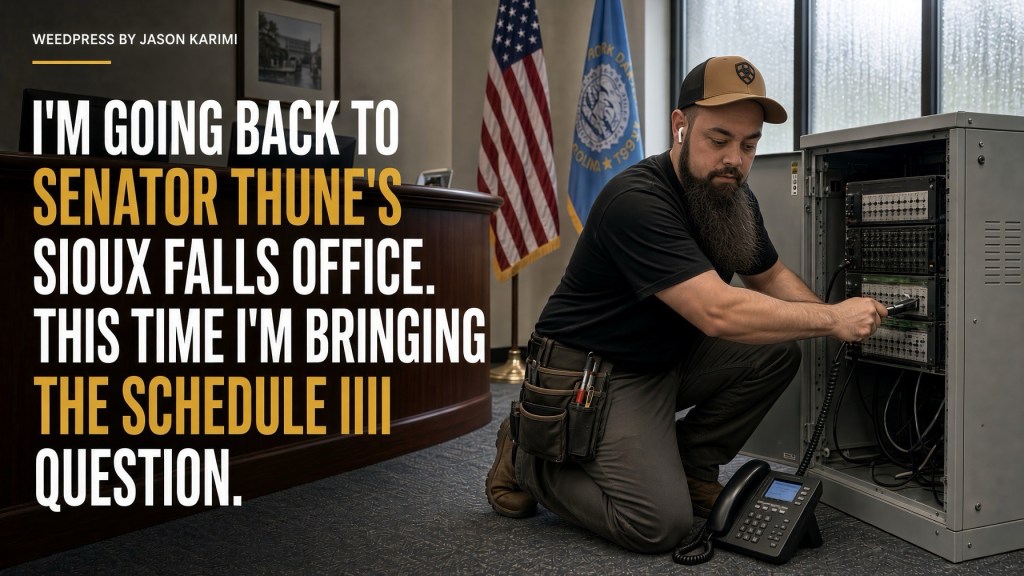
A new phone-installation job puts me back in the Sioux Falls office where I first asked about federal and state marijuana law. This time, Schedule III is already here.
I was hired for another installation job at Senator John Thune’s Sioux Falls office. This time the job is phones.¹
The last time I was in that suite I installed a television mount. While I was there I asked a question about federal and state marijuana law. The office did not send a form letter. The correspondence that followed put the lead role on the states, not on Congress.² WeedPress published that record.³
The law has moved since that letter. On April 28, 2026, the Department of Justice placed qualifying state-licensed medical marijuana and FDA-approved marijuana products in Schedule III.⁴ South Dakota still runs chapter 34-20G.⁵ Pierre still has not reconciled its own tetrahydrocannabinol scheduling provisions with that federal change.⁶ South Dakota officials have described uncertainty about what comes next. California regulators, meanwhile, have asked DEA for implementation guidance while also beginning state regulatory work of their own.⁷
That is the conversation I will have in the office while I pull cable.
The question is not whether a contractor installing phones speaks for the Senate Majority Leader. He does not. The question is whether the position Thune’s office put in writing still holds now that federal law places qualifying state-licensed medical marijuana in Schedule III rather than Schedule I.
Thune’s correspondence said the states have a lead role to play.⁸ If the answer is yes, then uncertainty about federal implementation does not answer what South Dakota is supposed to do with the statutes and rules it already administers. California has sought federal implementation guidance while beginning state regulatory work of its own. South Dakota can ask Washington questions and still answer the questions that belong to Pierre.
Federal placement of qualifying state-licensed medical marijuana in Schedule III does not repeal chapter 34-20G. It does not repeal SDCL §§ 34-20B-11 and 34-20B-14. It does not write South Dakota’s caregiver rules, testing rules, or home-cultivation rules. Those remain state statutes and state rules. My question is why a state that licensed the medicine would treat implementation of its own laws as something Washington must do for it.⁹
I will ask, in plain terms:
Does the office still hold that the states have the lead role on drug laws, as the prior correspondence said, now that federal law places qualifying state-licensed medical marijuana in Schedule III rather than Schedule I?
If the answer is that the federal change moved the lead back to Washington, the public is entitled to hear that from the office that put the opposite position in writing when the conflict was sharper.
The point of this visit is not a photo. It is the same point as the last one. Talk to the people in the room. Put the question on paper. Leave a record.
States that still describe themselves as uncertain about what comes next after April 28 have a responsibility to the public to implement and manage their own laws without treating federal uncertainty as a reason to freeze.¹⁰ Waiting is a choice. It is not a legal duty.
I will do the phone work I was hired to do. I will also ask the question the last job left open.
¹ The hire is for installation work in the Sioux Falls constituent office. It is not a statement of Senate employment or of the Senator’s policy staff.
² Jason Karimi, Senator John Thune: Federal Solution To State Medical Marijuana Laws In Hands Of State, Not Congress, WeedPress (July 4, 2025), https://weedpress.org/2025/07/04/senator-john-thune-federal-solution-to-state-medical-marijuana-laws-in-hands-of-state-not-congress/.
³ Id. (office hired the author to install a television mount; written response followed the on-site question).
⁴ Schedules of Controlled Substances: Rescheduling of Food and Drug Administration Approved Products Containing Marijuana From Schedule I to Schedule III; Corresponding Change to Permit Requirements, 91 Fed. Reg. 22,714 (Apr. 28, 2026).
⁵ S.D. Codified Laws ch. 34-20G.
⁶ S.D. Codified Laws §§ 34-20B-11, 34-20B-14; Jason Karimi, Schedule III Changed the Federal Rules. Here Are 26 Questions South Dakota Still Has to Answer., WeedPress (Sept. 29, 2026).
⁷ Cal. Dep’t of Cannabis Control, DCC-2026-03-E, Finding of Emergency and Notice of Proposed Adoption of Emergency Regulations (modifications to A and M designation following the April 28, 2026 order), https://www.cannabis.ca.gov/cannabis-laws/rulemaking/dcc-2026-03-e/finding/; see also reporting that DCC requested a DEA implementation meeting and that DEA indicated guidance would be released publicly rather than through state-specific briefings, while California proceeded with emergency regulatory work of its own, https://themarijuanaherald.com/2026/09/california-marijuana-regulator-says-dea-still-hasnt-provided-rescheduling-guidance-despite-repeated-outreach/.
⁸ Karimi, supra note 2.
⁹ 91 Fed. Reg. at 22,714 (qualifying state-issued medical-marijuana license as the federal predicate); S.D. Codified Laws ch. 34-20G (state program remains a state enactment).
¹⁰ Karimi, supra note 2; 91 Fed. Reg. 22,714.


Leave a comment