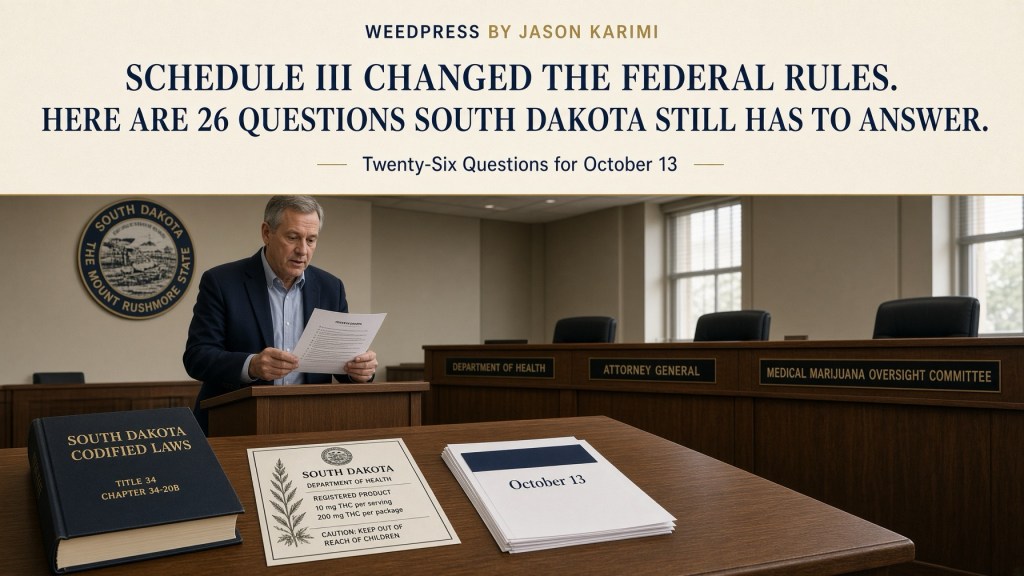
Caregivers, patient transfers, Schedule I, DEA registration, home cultivation and state certification all converge at the October 13 Medical Marijuana Oversight Committee meeting.
Twenty-Six Questions for October 13
The Medical Marijuana Oversight Committee meets Tuesday, October 13, 2026, in Room 362 of the State Capitol in Pierre. Confirm the hour on the posted agenda; the public calendar lists the block, and the October 13 agenda itself is not yet up.¹ That date is the first MMOC meeting after the Department’s 38-rule hearing, after the October 3 comment close, and one day before Interim Rules Review takes Article 44:90.²
IM 26 created the program and the committee.³ The committee evaluates and recommends. It does not write the statute and it does not adopt the rules.⁴ WeedPress has tracked that split, the yearly rule rewrites, and the August 17 packet that put federal Schedule III on the record without answering South Dakota’s own Schedule I test.⁵
October and November 2025 were a different room. Searchlight reported a “shock wave” after invited speakers and, two weeks later, a “rift” after eleven unposted motions.⁶ August 17, 2026 was not that meeting. Searchlight’s coverage was taxes, banking, home-cultivation counts, and the program administrator’s sentence that the State has “more questions than answers.”⁷ Those questions are still unanswered. Twenty-six of them now run directly into October 13.
How to put a comment on October 13. MMOC is not an APA docket. Register to testify on the LRC agenda page. Email the same document to committee staff and ask that it be posted as a handout — that is how Jim Sheehan’s August questions entered Hearing Documents.⁸ Bring paper. Read the first three questions into the microphone so they are on the audio even if the PDF is late.
Thirty days that run into this meeting
• August 17 — MMOC hears federal reclassification and program scale; the Schedule I statute is not resolved.⁹
• August 21 / 31 — DOH files 38 amendments to Article 44:90; the Register notices them.¹⁰
• September — WeedPress maps the federal nouns onto South Dakota desks: card versus establishment, certification versus Part 1306, Health versus Pharmacy, four certificates versus one federal license, the § 825(c) warning versus caregivers and § 34-20G-2(6).¹¹
• September 23 — DOH public hearing on the 38-rule package.
• October 3 — written-comment close on those rules.
• October 13 — MMOC, Room 362.
• October 14 — Interim Rules Review Committee.
The feature is the questions. They do not assert that federal law has already commanded a particular amendment. They identify the crosswalk and ask the desk that owns it.
A. The label versus the card
1. Who is “the patient” under 21 U.S.C. § 825(c) when 21 C.F.R. § 1301.13(k)(1)(iii) lets a registered dispenser dispense to a person South Dakota law authorizes to possess medical marijuana for another patient’s use?
2. After the original dispense, does the federal warning required by 21 U.S.C. § 825(c) — that it is a crime to transfer the drug to any person other than the patient — attach to a later no-value gift from one cardholder to another under SDCL § 34-20G-2(6)? Those are two different transactions. The first is the dispensary sale. The second is a later cardholder-to-cardholder transfer the South Dakota statute still protects when its conditions are met.
3. Will the Department of Health tell dispensaries, in writing, whether a designated caregiver may still acquire, transport, and hold product for a patient once the § 825(c) warning is on the package “where applicable”?
4. Will the Attorney General issue a written opinion on these federal–state implementation questions, or does the Office anticipate litigation that would make interim guidance infeasible the same way agencies like DEA sometimes withhold advice once a case is expected?
B. Schedule I is still on the books
5. After the April 28, 2026 federal order placing qualifying state-licensed medical marijuana in Schedule III, does tetrahydrocannabinol still meet SDCL § 34-20B-11 (“no accepted medical use in the United States”)?
6. Has the Department of Health confirmed receipt of the pending petition I filed asking whether the Department is required to review — or elects to review — South Dakota’s Schedule I treatment of tetrahydrocannabinol, now that federal law treats qualifying medical marijuana as having accepted medical use and has placed that product in Schedule III? If receipt is confirmed, has the Department granted the petition, denied it in writing with reasons, or initiated proceedings under SDCL § 1-26-13?
7. Why did the South Dakota Legislature enact a trigger that moves FDA-approved crystalline polymorph psilocybin to Schedule IV the day that product exists, and still leave tetrahydrocannabinol subject to South Dakota’s Schedule I statute after the State has licensed marijuana as medicine for years? House Bill 1099, signed March 10, 2026, amended SDCL § 34-20B-14 and placed that approved psilocybin product on Schedule IV.¹² It does not legalize mushrooms. It is a scheduling trigger. Tetrahydrocannabinol still has no equivalent scheduling answer from the South Dakota Legislature.
8. SDCL § 34-20B-11 still requires a Schedule I substance to have “no accepted medical use in the United States,” while § 34-20B-27 requires the Department of Health to recommend rescheduling when it determines that a substance has a different potential for abuse. After the federal government moved qualifying medical marijuana to Schedule III, has DOH reviewed whether tetrahydrocannabinols still satisfy South Dakota’s Schedule I criteria and whether § 34-20B-27 requires a recommendation to the Legislature? If not, will MMOC ask DOH to conduct that review?
C. Federal license versus four state certificates
9. South Dakota issues four establishment certificates under chapter 34-20G. 21 C.F.R. § 1301.13(k) builds federal registrations around three activities — manufacture, distribution, and dispensing. Which of the four state certificates is the federal “qualifying state-issued license,” and where does the fourth state class sit when the federal rule only names three?
10. If a state certificate is suspended, 21 C.F.R. § 1301.13(k) tethers the federal registration. Has DOH mapped that automatic consequence for cultivation, manufacturing, dispensary, and testing certificates?
11. South Dakota already requires testing laboratories to deal with the Drug Enforcement Administration. 21 C.F.R. § 1301.13(k) — the special-registration provision added for marijuana activities under a qualifying state-issued medical marijuana license — does not name a testing-facility class. Who registers the South Dakota testing facility, and under which paragraph of 21 C.F.R. § 1301.13(k) does that registration sit?
D. Certification is not automatically a complete federal document
12. Does South Dakota’s chapter 34-20G written certification contain every element required by 21 C.F.R. § 1301.13(k)(5), including the user’s full name and address and the practitioner’s name, address, and state license number?
13. If South Dakota’s existing certification does not contain every federal element, which agency will change the form or process — and under what authority?
14. After April 28, which South Dakota desk handles the state controlled-substance registration consequences for an establishment that obtains a federal registration under 21 C.F.R. § 1301.13(k)?
E. Home cultivation and the 38-rule package
15. Legislative Research Council flagged the under-21 cultivation restriction as weak statutory authority. Will MMOC treat that mark as a constraint that has to be answered before Interim Rules Review on October 14?
16. The April order creates a federal registration framework around state-licensed manufacture, distribution, and dispensing. Where does South Dakota-authorized patient cultivation fit? If home cultivation remains protected by state law, how does patient-grown marijuana interact with 21 U.S.C. § 825(c)’s warning for marijuana “dispensed to or for” a patient and 21 C.F.R. § 1301.13(k)’s registered-establishment framework?
17. Written comments on the 38-rule package closed October 3. What unanswered federal-crosswalk comments will MMOC forward to Rules Review the next day?
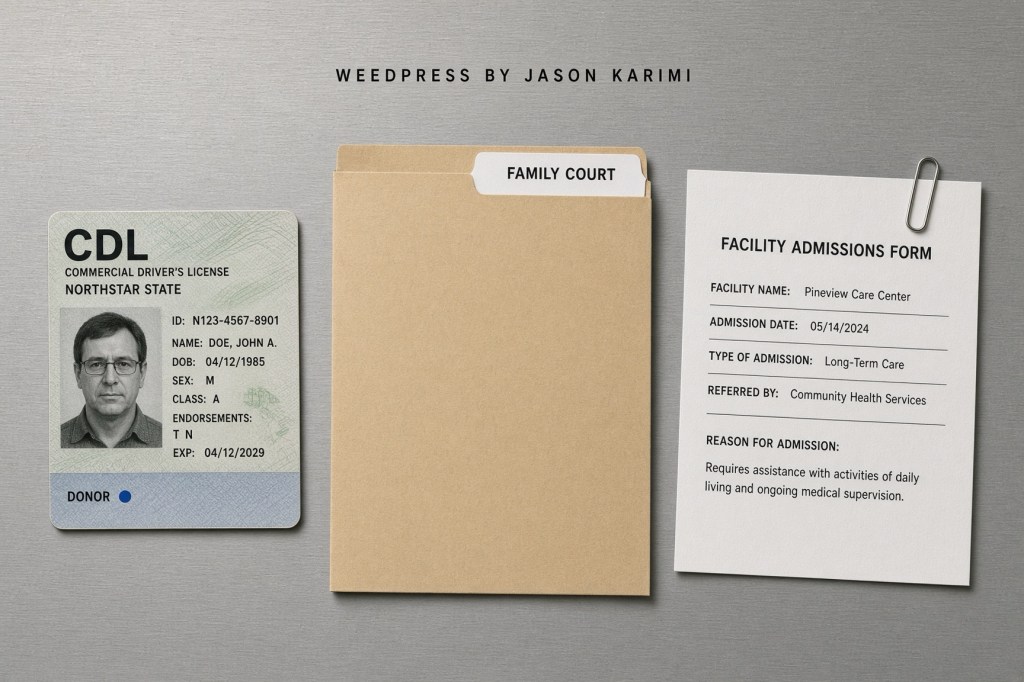
F. Security, testing, jobs, custody, ADA
18. 21 C.F.R. Part 1301 defers security to state law. Article 44:90 never cites Part 1301. After a shop takes a registration under 21 C.F.R. § 1301.13(k), which inspection manual controls?
19. Federal transportation testing and Pierre DOT testing sit on two desks. Schedule III moved neither. Will MMOC ask whether a cardholder CDL or safety-sensitive job is any different after April 28?
20. Does the Legislature’s later edit of the custody protection still let a court treat a valid card as a parenting defect after federal accepted-medical-use language exists?
21. Will DOH and DSS reexamine nursing-facility and recovery-housing bans now that the federal Controlled Substances Act treats qualifying medical marijuana as Schedule III, not Schedule I?
G. The waiver Pierre has not requested
22. Has the State sought, or will MMOC recommend seeking, a 21 U.S.C. § 822(d) public-interest waiver so patient and caregiver activity is not left on the unregistered side of the CSA?
23. If the answer is no, who owns that refusal in writing — DOH, the Attorney General, or the Governor?
H. Process so the answers stick
24. Will the Attorney General attend October 13 or send a written opinion on A–C so the committee is not taking legal advice from staff silence?
25. Will MMOC put the two caregiver/transfer questions and the § 34-20B-11 question into the official packet and ask for a dated written response?
26. A petition is on file at the Department of Health asking whether South Dakota’s Schedule I treatment of tetrahydrocannabinol still fits state law after federal recognition of accepted medical use. Will MMOC ask how the State would defend the continued application of South Dakota’s Schedule I tetrahydrocannabinol provisions if a defendant argues that the criteria in SDCL § 34-20B-11 are no longer met?
Until those answers are in the file, the partnership is only authorized. It is not yet performed.
Footnotes
¹ S.D. Legislature public schedule (MMOC, Oct. 13, 2026, Room 362); S.D. Legis. Rsch. Council, Medical Marijuana Oversight Committee — 2026, https://sdlegislature.gov/Interim/Committee/501/Detail; Jason Karimi, South Dakota’s Medical Marijuana Oversight Committee Meets October 13., WeedPress (Sept. 24, 2026), https://weedpress.org/2026/09/24/south-dakotas-medical-marijuana-oversight-committee-meets-october-13/.
² S.D. Dep’t of Health, proposed amendments to S.D. Admin. R. art. 44:90, filed Aug. 21, 2026; rules.sd.gov matter file, https://rules.sd.gov/detail?Id=970 (hearing Sept. 23, 2026; comment deadline Oct. 3, 2026; Interim Rules Review Oct. 14, 2026).
³ Initiated Measure 26 (2020); S.D.C.L. ch. 34-20G.
⁴ S.D.C.L. §§ 34-20G-92, 34-20G-93; Jason Karimi, What the MMOC Actually Recommended in 2025 — and Why It Still Doesn’t Control Policy, WeedPress (Jan. 19, 2026), https://weedpress.org/2026/01/19/what-the-mmoc-actually-recommended-in-2025-and-why-it-still-doesnt-control-policy/.
⁵ Jason Karimi, 38 Rules, 19,821 Patients, 108 Licensed Establishments: South Dakota Rewrites Its Medical Cannabis Program, WeedPress (Sept. 9, 2026), https://weedpress.org/2026/09/09/38-rules-19821-patients-108-licensed-establishments-south-dakota-rewrites-its-medical-cannabis-program/; Jason Karimi, MMOC’s First 2026 Meeting Put Federal Rescheduling on the Record. South Dakota Still Has Not Answered Its Own Schedule I Statute, WeedPress (Sept. 3, 2026), https://weedpress.org/2026/09/03/mmocs-first-2026-meeting-put-federal-rescheduling-on-the-record-south-dakota-still-has-not-answered-its-own-schedule-i-statute/; Jason Karimi, WeedPress Asks South Dakota Health Department to Rule Whether Schedule I Cannabis Still Fits the State’s Own Statute, WeedPress (Aug. 31, 2026), https://weedpress.org/2026/08/31/weedpress-asks-south-dakota-health-department-to-rule-whether-schedule-i-cannabis-still-fits-the-states-own-statute/.
⁶ Joshua Haiar, Oversight Committee Testimony Sends ‘Shock Wave’ Through SD Medical Marijuana Industry, S.D. Searchlight (Oct. 23, 2025), https://southdakotasearchlight.com/2025/10/23/oversight-committee-testimony-sends-shock-wave-through-sd-medical-marijuana-industry/; Joshua Haiar, Medical Marijuana Rift Widens as Oversight Panel Confuses and Upsets Industry with Slate of Motions, S.D. Searchlight (Nov. 5, 2025), https://southdakotasearchlight.com/2025/11/05/medical-marijuana-rift-widens-as-oversight-panel-confuses-and-upsets-industry-with-slate-of-motions/.
⁷ Reclassification Eases Taxes and Banking for Medical Cannabis, but Leaves State with Questions, S.D. Searchlight (Aug. 17, 2026), https://southdakotasearchlight.com/2026/08/17/reclassification-eases-taxes-and-banking-for-medical-cannabis-but-leaves-state-with-questions/ (quoting Whitney Brunner); Medical Marijuana Home Cultivation Licenses Surge in South Dakota, S.D. Searchlight (Aug. 17, 2026), https://southdakotasearchlight.com/2026/08/17/medical-marijuana-home-cultivation-licenses-surge-in-south-dakota/.
⁸ S.D. Legis. Rsch. Council press release (Aug. 13, 2026) (register to testify); S.D. Legis. Rsch. Council, MMOC Hearing Documents, Jim Sheehan, Self, Handout (Aug. 14, 2026), https://sdlegislature.gov/Interim/Committee/501/HearingDocuments.
⁹ S.D. Legis. Rsch. Council, Aug. 17, 2026 MMOC materials, https://sdlegislature.gov/Interim/Committee/501/HearingDocuments; Searchlight, supra note 7.
¹⁰ See note 2.
¹¹ Jason Karimi, DEA’s New Transfer Warning Collides With South Dakota’s Caregiver and Patient-Transfer Laws, WeedPress (Sept. 28, 2026), https://weedpress.org/2026/09/28/deas-new-transfer-warning-collides-with-south-dakotas-caregiver-and-patient-transfer-laws/; Jason Karimi, How to File a Written Comment on South Dakota’s 38-Rule Medical Cannabis Package, WeedPress (Sept. 21, 2026), https://weedpress.org/2026/09/21/how-to-file-a-written-comment-on-south-dakotas-38-rule-medical-cannabis-package/; Jason Karimi, SD AG WeedPress Questions: October’s MMOC Meeting, WeedPress (Aug. 27, 2026), https://weedpress.org/2026/08/27/sd-ag-weedpress-questions-octobers-mmoc-meeting/.
¹² H.B. 1099, 2026 Leg., 101st Sess. (S.D. 2026) (signed Mar. 10, 2026) (amending S.D.C.L. § 34-20B-14 and placing FDA-approved crystalline polymorph psilocybin on Schedule IV), https://sdlegislature.gov/Session/Bill/26592; Jason Karimi, SAMHSA Told States to Prepare for Psychedelic Medicines Before FDA Approval. South Dakota Already Wrote a Psilocybin Trigger—and Still Has Not Answered Federal Cannabis Schedule III., WeedPress (Sept. 4, 2026), https://weedpress.org/2026/09/04/samhsa-told-states-to-prepare-for-psychedelic-medicines-before-fda-approval-south-dakota-already-wrote-a-psilocybin-trigger-and-still-has-not-answered-federal-cannabis-schedule-iii/.


Leave a comment