
By Jason Karimi | WeedPress
November 6, 2026
Sales-tax relief for Iowa’s medical cannabis patients was back before the state’s advisory board Friday. The recommendations presented at the November 6 meeting call for removing the tax on dispensary purchases while maintaining the board’s opposition to raw cannabis. Patients could see some relief at the register. They would still be unable to buy flower through Iowa’s program.1
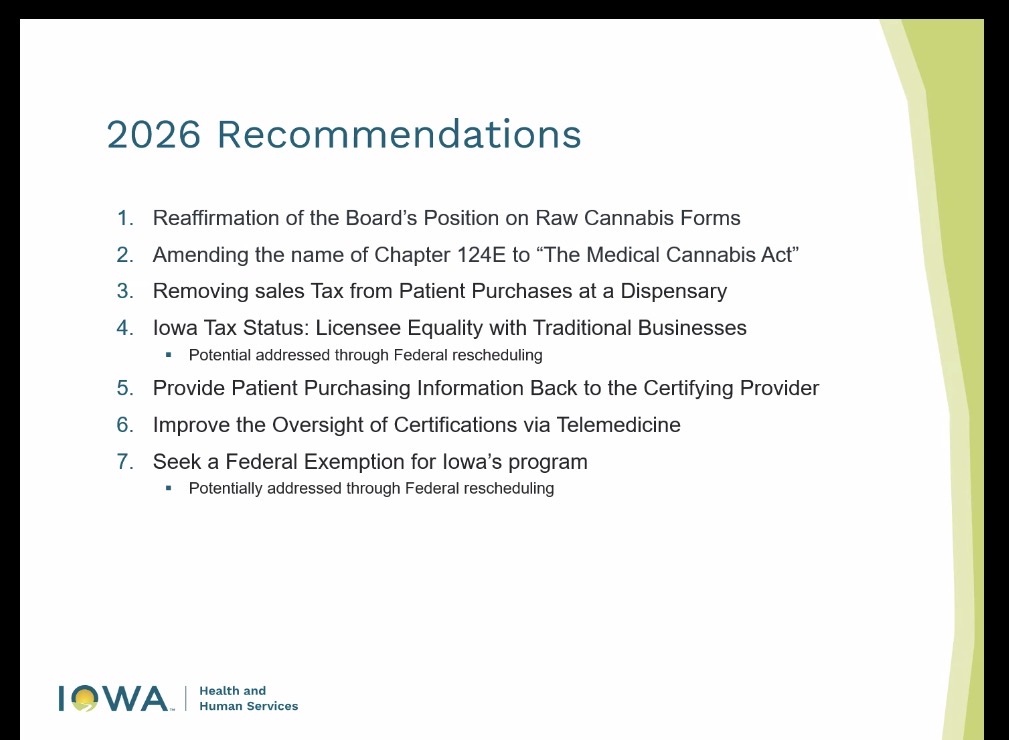
The seven-item list also calls for renaming the Medical Cannabidiol Act, giving certifying providers access to their patients’ purchase information, improving telemedicine oversight, changing the tax treatment of licensed businesses, and seeking a federal exemption. Beside the business-tax and federal-exemption recommendations, the presentation notes that federal rescheduling may address them.2
For businesses, that could mean substantial tax relief. The patient’s sales tax is a separate charge, and it will take a separate decision to remove it. Another item needs clarification for a different reason: Iowa already has a law requiring cannabis practitioners who use telemedicine to comply with a specified medical standard.
Friday’s agenda included federal updates and the annual report. WeedPress reviewed the recommendation slide and supporting records but has not independently verified the final wording of motions or how the board voted. The recommendations described below should not be read as changes already made to the law.3
The seven recommendations
The slide displayed during the November 6 meeting lists:
- Reaffirming the board’s position on raw cannabis forms.
- Renaming chapter 124E the “Medical Cannabis Act.”
- Removing sales tax from patient purchases at dispensaries.
- Providing equitable Iowa tax treatment for licensed businesses.
- Returning patient purchasing information to the certifying provider.
- Improving oversight of certifications through telemedicine.
- Seeking a federal exemption for Iowa’s program.4
Most of this will be familiar to anyone who read the previous annual report. Since then, Iowa has authorized more dispensaries, and the federal government has opened a registration pathway for qualifying medical marijuana businesses. Those changes leave the board with some recommendations still waiting on lawmakers and others that need to be reconsidered against what has already happened.5
The patient’s tax bill is still a separate decision
The board asked for a patient sales-tax exemption in its January 2026 report. It pointed to the treatment of traditional prescribed medications and asked lawmakers to reduce the cost of buying medical cannabis. That request is on the list again.6
Iowa generally charges 6 percent state sales tax, with a local option tax in many jurisdictions. Prescription drugs dispensed by specified licensed professionals qualify for an exemption. Medical cannabis patients still pay tax at the dispensary, even though they entered the program to treat a qualifying condition.7
The federal change affects what the business owes. Section 280E restricts deductions and credits for businesses trafficking in Schedule I or II controlled substances. In the April 28 order, federal officials said placing covered state medical marijuana in Schedule III removes that restriction for state licensees. They also expressly declined to determine any particular business’s federal tax liability.8
That is why the slide says rescheduling may address business tax equality. It gives operators a reason to expect relief. It leaves Iowa’s sales tax in place.
A business with a smaller tax bill may lower its prices, but patients have no guarantee it will. Exempting their purchases would take the tax off the receipt directly. Lawmakers can consider both kinds of relief without asking patients to wait and see whether the industry passes its savings along.
Flower remains the disagreement
The board is standing by an existing position on flower. Iowa HHS allows vaporizable cartridges and concentrates but lists raw cannabis flower that may be combusted or smoked as prohibited. The statute also prohibits smoking medical cannabidiol.9
Patients who want to vaporize dry flower have already brought that distinction to the board. The board has remained opposed. Its November 2025 minutes describe the subcommittee’s concerns about insufficient evidence for vaporized raw cannabis and the possibility that flower would be diverted for smoking. The board unanimously adopted the subcommittee memorandum for the annual report.10
The first item on Friday’s slide carries that position forward. It does not establish a new scientific finding from this meeting, and it does not mean Iowa is prohibiting the cartridges and concentrates it already allows.
WeedPress previously reported on the South Dakota dispensaries serving the Siouxland border market, where flower is part of the medical program. Iowa can license more stores and shorten patients’ drives, but those stores will still have to sell the forms Iowa permits.
For patients asking for flower, the disagreement remains unresolved. The board has explained why it opposes that request. Patients deserve an equally clear account of what that position leaves available to them, including the difference between vaporizing an extract and vaporizing the plant itself.
Telemedicine: what additional oversight is missing?
The telemedicine item needs an explanation from the board because part of what it previously requested is already in the statute.
Iowa Code section 124E.3(4) addresses practitioners who establish or maintain patient relationships through telemedicine and directs them to “comply with the requirements of 653 IAC 13.11(7).” The provision appears in the 2026 Code and was enacted in 2024.11
The board’s previous annual report nevertheless recommended adding that same cited standard to chapter 124E. Friday’s slide again calls for better oversight. The records leave open whether the board wants stronger enforcement, a broader requirement, a corrected cross-reference or some other amendment. Until the board explains that, patients cannot tell what would change at their next appointment.12
The Board of Medicine’s telemedicine standards are now published at rule 481—655.9. They require a valid physician-patient relationship and address evaluations, records, follow-up care and privacy. They also allow a relationship to be established remotely in specified circumstances.13
Patients should receive real medical care when they pay for a certification. For someone who relies on a remote appointment, though, an added travel requirement could make that care harder to obtain. A proposal to improve oversight should say what is going wrong now, how the change would fix it, and what patients and practitioners would have to do differently.
Letting the certifying provider see purchases
Once a practitioner certifies a patient, what should that practitioner be able to see about the patient’s dispensary purchases?
The previous annual report proposed letting HHS share that information with the certifying provider. Iowa already keeps a confidential patient file and requires a sales-tracking system that dispensaries use to check authorization and purchase limits. The law permits disclosures for specified purposes, but it does not give practitioners general access to purchase histories just because they certified the patient.14
A provider who knows which products a patient bought could have a better conversation about treatment. The record would still show a purchase. It would not establish how much the patient used, whether it helped, or why the patient chose it.
Before giving anyone new access, lawmakers should spell out whose records a practitioner could see, what information would be included and how the state would check for improper access. Patients ought to know who is looking at their purchases and why.
A federal exemption is still a legal question
The board has also kept a federal exemption on its list. Its previous annual report proposed a legal task force to help Iowa pursue one. Friday’s slide says rescheduling may address the issue, but it does not say an exemption has been obtained or that the legal work is finished.15
Carl Olsen wants Iowa to keep doing that work. In written comments prepared for Friday’s meeting, the longtime advocate asked the board to retain the task-force recommendation while the federal changes are contested. He pointed to 21 U.S.C. § 822(d) as a possible route.16
That provision lets the Attorney General waive registration requirements for certain manufacturers, distributors or dispensers by regulation when consistent with public health and safety. It does not, on its own, exempt Iowa’s entire program from federal drug law. An exemption proposal would have to explain exactly who it covers, what they could do and which requirements would be waived.17
Federal registration is already moving forward. On October 30, DOJ announced that DEA was issuing its first registrations to qualifying medical marijuana dispensaries, including businesses in South Dakota. DOJ also said a state license alone does not confer federal registration. Qualifying businesses that applied on time may continue specified activities while their applications remain pending, subject to the order’s conditions.18
The April order has been challenged in court. On September 9, the D.C. Circuit denied a request to stay it in the consolidated cases. That allowed the order to remain in place at that stage; it did not settle the underlying legal challenge. WeedPress has not independently checked the complete appellate docket through the end of Friday’s meeting.19
Iowa also has its own scheduling work. As WeedPress reported in October, the state’s September regulatory analysis proposed Schedule III treatment for qualifying products. That document proposed a change; it was not a final adoption notice. A federal registration, a federal waiver and an amendment to Iowa’s schedules each do a different job. None should be treated as proof that all three have been completed.20
A better name—and proof that recommendations can become law
The board also wants the statute’s name to catch up with the program. Chapter 124E is still called the Medical Cannabidiol Act, even though it permits products containing THC. The previous annual report described the confusion that terminology causes. Calling it the Medical Cannabis Act would make it easier to explain what patients are buying. It would leave the product restrictions in place.21
One earlier access recommendation has made it into law. House File 990 authorized up to ten dispensaries and removed the patient residency requirement. The Legislature’s official history records the governor’s signature on June 2 and an effective date of July 1, 2026. At the July board meeting, staff described preliminary planning for additional licenses. Authorization to license more stores did not mean five new stores had opened.22
Patients waiting on the rest of the list will need the same follow-through. A sales-tax exemption would show up on their receipts. A change in allowable forms would show up on dispensary menus. A telemedicine amendment would affect how they obtain or renew a certification. Federal protection has to cover the activity a patient or business is actually engaged in.
The sales-tax proposal leaves lawmakers with a straightforward choice. They can keep collecting the tax from medical cannabis patients or exempt those purchases. Federal rescheduling will not make that decision for Iowa.
Sources and notes
¹ Iowa Dep’t of Health & Hum. Servs., 2026 Recommendations, presentation slide displayed at Medical Cannabidiol Board meeting (Nov. 6, 2026) (screenshot retained by WeedPress) [hereinafter November 6 Recommendations Slide]. The slide establishes the seven-item list; it does not establish final motions, amendments or vote counts.
² Id. (items 4, 7 and accompanying rescheduling annotations).
³ Iowa Dep’t of Health & Hum. Servs., Medical Cannabidiol Board Meeting Agenda, items 5–7 (Nov. 6, 2026); Iowa Dep’t of Health & Hum. Servs., Medical Cannabidiol Board Meeting—Nov. 6, 2026. At review, the event page’s related files were the November 6 agenda and July 24 minutes. A complete November 6 presentation, recording, minutes and final motion text were not located.
⁴ November 6 Recommendations Slide, supra note 1 (wording condensed).
⁵ Iowa Med. Cannabidiol Bd., 2025 Annual Report to the Iowa General Assembly, at 8–10 (Jan. 2026) [hereinafter 2025 Annual Report]; see also sources cited infra notes 18, 22.
⁶ 2025 Annual Report, supra note 5, at 9, recommendation 4; November 6 Recommendations Slide, supra note 1, item 3.
⁷ Iowa Dep’t of Revenue, Sales & Use Tax Guide, “State Sales and Use Tax,” “Local Option Sales Tax,” & “Medical” (last visited Nov. 6, 2026); 2025 Annual Report, supra note 5, at 9. The annual report specifically describes medical cannabis patient purchases as taxable and recommends an exemption.
⁸ 26 U.S.C. § 280E (2024), official text; Schedules of Controlled Substances: Rescheduling of Food and Drug Administration Approved Products Containing Marijuana From Schedule I to Schedule III; Corresponding Change to Permit Requirements, 91 Fed. Reg. 22,714, 22,719–20 (Apr. 28, 2026) (effective Apr. 28, 2026) [hereinafter April 28 Order]. This article does not resolve individual tax liabilities, transition-year treatment or retrospective relief.
⁹ Iowa Dep’t of Health & Hum. Servs., For Patients, “Allowable Product Forms” (last visited Nov. 6, 2026); Iowa Code § 124E.17 (2026), official chapter text.
¹⁰ Iowa Med. Cannabidiol Bd., Meeting Minutes, item 7 (Nov. 14, 2025). This describes the board’s assessment and vote in 2025, not a new evidence review or verified vote on Nov. 6, 2026.
¹¹ Iowa Code § 124E.3(4) (2026) (citing 653 Iowa Admin. Code r. 13.11(7)); id. statutory history (2024 Iowa Acts ch. 1157, § 69).
¹² 2025 Annual Report, supra note 5, at 10, recommendation 7; November 6 Recommendations Slide, supra note 1, item 6. Further agency explanation is needed before characterizing the intended new requirement or treating the overlap as an agency error.
¹³ Iowa Admin. Code r. 481—655.9(4), (7)–(8), (10)–(15) (2025). The statute and prior annual report use the legacy 653—13.11 citation; the Board of Medicine’s published successor standards appear at 481—655.9. This article does not decide the legal effect of that cross-reference for every certifying profession.
¹⁴ 2025 Annual Report, supra note 5, at 9–10, recommendation 6; Iowa Code § 124E.11(1), (2)(h) (2026).
¹⁵ 2025 Annual Report, supra note 5, at 10, recommendation 8; November 6 Recommendations Slide, supra note 1, item 7.
¹⁶ Carl Olsen, Public Comment—November 6, 2026, at 1–2 (Nov. 6, 2026) (written submission). The submission is evidence of Olsen’s position; its broader legal conclusions are not adopted here as adjudicated facts. Oral delivery was not independently verified.
¹⁷ 21 U.S.C. § 822(d) (2024). Whether a particular proposed exemption is available and sufficient would depend on its terms, federal action and other applicable requirements.
¹⁸ U.S. Dep’t of Just., Off. of Pub. Affs., Justice Department Announces Issuance of Federal Registrations for Medical Marijuana Dispensaries (Oct. 30, 2026) (updated Nov. 3, 2026); see also April 28 Order, supra note 8 (codifying 21 C.F.R. § 1301.13(k)). The announcement does not establish any particular Iowa operator’s registration status.
¹⁹ Order at 1–2, SAM, Inc. v. U.S. Dep’t of Just., No. 26-1106 (D.C. Cir. Sept. 9, 2026), consolidated with Nos. 26-1130 & 26-1136, ECF No. 2192118 (court-filed document reproduced by Iowans for Medical Marijuana). The denial of interim relief is not a final merits judgment; the citation does not certify later docket developments.
²⁰ Iowa Dep’t of Inspections, Appeals & Licensing, Regulatory Analysis RA 26-323, at 1, 3–5 (Sept. 30, 2026). The document scheduled an October 20 hearing and proposed temporary Schedule III treatment for specified products. No later final adoption or effective date is asserted here.
²¹ Iowa Code § 124E.1 (2026); 2025 Annual Report, supra note 5, at 8–9, recommendation 2; November 6 Recommendations Slide, supra note 1, item 2.
²² H.F. 990, §§ 1–5, 91st Gen. Assemb. (Iowa 2026) (enrolled), official text; Iowa Gen. Assemb., Bill History for House File 990 (signed June 2, 2026; effective July 1, 2026); Iowa Med. Cannabidiol Bd., Meeting Minutes, at 2–3 (July 24, 2026) (posted for review at the Nov. 6 meeting). The current operating count and licensing timetable require a newer agency update.






Leave a Reply