South Dakota patients have spent the fall hearing a new set of words from dispensaries and regulators: DEA registration, timely applicant, federal verification, compliant supply chain.
The words matter because DEA’s April rule created a federal path for businesses that hold a state medical-marijuana license. A dispensary, cultivator, processor, or distributor with the right state license could apply for a Schedule III registration. Those who applied in the early window were allowed to keep operating while DEA processed the application.1
That federal path was written for licenses issued by a state.
Flandreau is different.
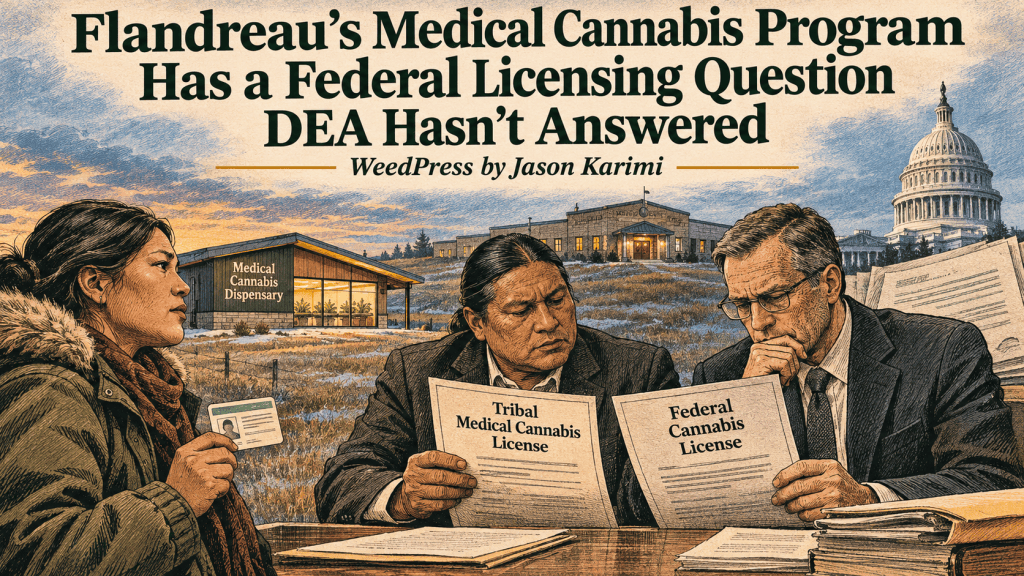
The Flandreau Santee Sioux Tribe has its own cannabis ordinance, its own Cannabis Control Commission, its own patient-registration system, and its own medical-cannabis program. The Tribe’s economic-development office says its Native Nations dispensary opened in July 2021.2 Its ordinance lets a patient with an unexpired card from another jurisdiction obtain a Tribal medical card after identity verification.3
That is a working medical program under Tribal law. It exists in South Dakota. Patients use it. Yet DEA’s new rule does not say where a Tribal license fits.
The federal definition of “state medical marijuana license” covers a license issued by a state entity, the District of Columbia, or a federal territorial entity.4 A Tribal government is not on that list. The expedited registration provision requires an applicant to submit proof of a state medical-marijuana license and allows early applicants to keep operating in conformity with a state-issued license while DEA considers the application.5
Neither the April rule nor DEA’s October timely-applicant guidance lays out a Tribal-license application path or says that a Tribal regulator’s license satisfies the rule’s state-license requirement.
That silence has now become a national issue.
On October 22, the National Congress of American Indians adopted a resolution demanding that DOJ consult with Tribal governments involved in cannabis and either amend the April order to include Tribally licensed cannabis or issue a separate order that does.6
The resolution names the problem plainly: Tribes asked DOJ to recognize Tribal licenses during the rulemaking process. DOJ issued a rule built around state licenses anyway.
Flandreau is not waiting for someone to invent Tribal cannabis
The Flandreau Santee Sioux Tribe did not wake up after the April rule and decide to test a theory. Its cannabis ordinance has been in place for years and was most recently amended in 2024.7
The code creates a Cannabis Control Commission and gives it authority over licensing, audits, background checks, compliance, and enforcement.8 It regulates cultivation, processing, distribution, transportation, security, inventory control, labeling, testing, patient cards, and medical use.9 The medical chapter recognizes qualified patients, permits a Tribal registration card, and provides an administrative appeal if a card application is denied.10
The program is not a loophole somebody scribbled onto the edge of state law. It is a government exercising its own authority inside its jurisdiction.
That is why the federal language matters.
DEA did not write a rule saying Tribes cannot regulate cannabis. It wrote something more bureaucratic and more consequential: a federal rule that treats a state license as the key document for federal registration.
For a state-licensed South Dakota operator, that creates a defined sequence. The business has a certificate from the Department of Health. It applies to DEA. It produces the state paperwork. It is evaluated under the new federal pathway.
For a Tribal operator, the sequence stops at the point where the federal rule asks for the wrong kind of license.
A Tribal government may have a complete regulatory system. Its license may be more detailed than the state certificate. Its business may have patient records, inventory controls, security procedures, testing requirements, inspections, and a local regulator with actual authority over the facility. But the April rule still says “state.”
A lawyer can argue for an inclusive reading. A DEA official may eventually accept a Tribal application. A future guidance document could explain the process. None of those things appears in the rule patients and businesses are being told to follow today.
DOJ called this a rule without Tribal implications
The April rule includes a short discussion of Executive Order 13175, the federal order requiring consultation when agency action has Tribal implications. DOJ concluded that the rule did not have substantial direct effects on one or more Indian Tribes, the federal-Tribal relationship, or the distribution of power and responsibilities between them.11
That conclusion is hard to square with what the rule actually does.
The rule establishes an expedited federal registration process for medical-cannabis businesses. It makes state licensure the gateway. It gives state licenses conclusive effect as evidence that an applicant is authorized under state law.12 It lets qualifying applicants operate while their federal applications are pending, so long as they are acting under a state-issued license.13
A Tribal government that regulates medical cannabis is plainly affected when the federal government creates a new medical-cannabis system and writes Tribal licensing out of its definitions.
NCAI’s resolution says Tribal governments participated while DOJ was considering the order and specifically asked the department to include Tribal licensing wherever it referenced state licensing.14 DOJ did not do it.
Now NCAI is asking DOJ to sit down with Tribal governments, hear from the people who actually operate these systems, and put the answer in writing.
That should have happened before the rule went into effect. It can still happen now.
Minnesota wrote down how two governments can work together
Minnesota offers the closest regional example of how governments can handle cannabis without pretending jurisdictional questions disappear because they are inconvenient.
Minnesota law directs the governor to negotiate cannabis compacts with Tribal governments.15 The Minnesota Office of Cannabis Management has published nine completed Tribal-state agreements.16 Each is its own agreement, but the basic point is the same: when products, patients, businesses, and regulators cross between systems, the rules need to be written down.
Minnesota’s compacts address testing, product tracking, packaging, record access, sales beyond Tribal land, notification of public-health concerns, and the conditions under which Tribal and state-licensed businesses can conduct transactions.17
The compact with the Shakopee Mdewakanton Sioux Community recognizes the Tribe’s regulatory authority over cannabis activity on Tribal land. It also creates a documented route for certain transactions between state-licensed and Tribally licensed businesses, with seed-to-sale records and defined responsibilities on both sides.18
Minnesota did not solve federal rescheduling for Tribal governments. A state compact cannot rewrite a DEA regulation.
But it did something South Dakota and DOJ would both benefit from doing: it acknowledged that separate governments need a clear operating agreement when their regulated systems meet.
People should not have to guess whether a product can cross from one system to another. A business should not have to gamble its DEA registration on somebody’s informal legal theory. A patient should not have to wonder whether the dispensary that has served their community for years was forgotten when federal agencies announced a new medical-cannabis framework.
What DOJ needs to answer
Flandreau is where this becomes real for South Dakota.
If a Tribal medical-cannabis establishment wants to obtain a DEA registration under the new Schedule III pathway, what license does it submit?
If a federally registered South Dakota dispensary wants to buy from a Tribally licensed manufacturer, what records establish that the transaction is allowed?
If a state-licensed manufacturer wants to sell to a Tribal dispensary, does DEA regard that purchaser as part of the new federal medical-cannabis system?
If the answer is yes, DEA should say so and publish the process.
If the answer is no, DEA should say that plainly too. Tribal governments, patients, and businesses deserve the truth before they build supply chains around an assumption.
DEA’s October guidance tells timely applicants and registrants to verify their trading partners’ federal status, obtain copies of relevant state licenses, and maintain due-diligence records.19 That is sensible as far as it goes. But it keeps returning to the same unanswered point: a Tribal government’s medical license is not a state license.
The NCAI resolution gives DOJ a clean way to fix the problem. Begin consultation. Add Tribal licensure to the rule, or issue a parallel order. Create an application process that recognizes a Tribal regulatory authority as a government rather than treating it as an oddity outside the form.
South Dakota’s medical-cannabis debate has been full of people talking about access, compliance, safety, and patient protection. Flandreau’s program belongs in that conversation. It should not be left waiting at the federal gate because DEA wrote a rule for every government except the one already regulating cannabis down the road.
Related: Tribal Operators Face Extra Risks Under Federal Rescheduling and Three Weeks Before DEA’s Nov. 29 Supply-Chain Guidance Date, South Dakota Faces Questions the Rule and Guidance Leave Open.
Footnotes
1 21 C.F.R. § 1301.13(k) (2026); Schedules of Controlled Substances: Rescheduling of Food and Drug Administration Approved Products Containing Marijuana From Schedule I to Schedule III; Corresponding Change to Permit Requirements, 91 Fed. Reg. 22,714, 22,721–22 (Apr. 28, 2026).
2 Flandreau Santee Sioux Tribe, Economic Development.
3 Flandreau Santee Sioux Tribe, Cannabis Control Ordinance § 29-11-3(c) (amended Feb. 20, 2024), PDF.
4 21 C.F.R. § 1300.01 (2026).
5 Id. § 1301.13(k), (k)(7).
6 Nat’l Cong. of Am. Indians, Res. No. PSC-26-048, Calling Upon the Department of Justice to Consult with and Recognize Tribal Governments in Its Actions Regarding Rescheduling Cannabis-Related Products (Oct. 22, 2026), PDF.
7 Flandreau Santee Sioux Tribe, Cannabis Control Ordinance, Legislative History.
8 Id. §§ 29-9-1 to -5.
9 Id. chs. 3–8.
10 Id. §§ 29-11-1 to -5.
11 91 Fed. Reg. at 22,720.
12 21 C.F.R. § 1301.13(k)(2).
13 Id. § 1301.13(k)(7).
14 NCAI Res. No. PSC-26-048, supra note 6.
15 Minn. Stat. § 3.9228 (2026), text.
16 Minn. Off. of Cannabis Mgmt., Compacts and Cooperative Agreements.
17 Id.
18 Compact Between Shakopee Mdewakanton Sioux Community and the State of Minnesota arts. II–IV (Feb. 24, 2026), PDF.
19 Drug Enf’t Admin., Medical Marijuana Timely Applicant Information (Oct. 30, 2026), PDF.



Leave a Reply