
By Jason Karimi, publisher.
Nine Republican-held seats in the Iowa House were decided by less than 5 percentage points on Nov. 3, by a combined 3,098 votes, according to certified results from the Iowa Secretary of State. Six more were decided by 5 to 10 points. Every House seat is on the ballot again in 2028.
In the Iowa Senate, the 25 even-numbered seats last elected in 2024 are on the 2028 ballot. Two Republican-held seats in that group were decided by under 2 points in 2024, according to the 2024 certified results: SD 20 (Sen. Mike Pike, 44 votes) and SD 38 (Sen. Dave Sires, 386 votes).
Iowa’s State Board of Canvassers certified the 2026 results on Nov. 24. Republicans kept control of the Legislature but lost 11 House seats. Certified results give Republicans 56 House seats and Democrats 44, down from 67 Republicans before the election.
Republican House seats decided by less than 5 points
In order of percentage margin:
- HD 19: Rep. Brent Siegrist, 39 votes out of 10,287. A recount in Pottawattamie County confirmed the result, Iowa Capital Dispatch reported.
- HD 83: Rep. Cindy Golding, 234 votes
- HD 94: Rep. Mike Vondran, 241 votes
- HD 87: Rep. Jeff Shipley, 328 votes
- HD 65: Rep. Shannon Lundgren, 459 votes
- HD 70: Rep. Norlin Mommsen, 428 votes
- HD 53: Rep. Dean Fisher, 453 votes
- HD 2: Rep. Robert Henderson, 380 votes
- HD 38: Matthew Oleson, an open seat, 536 votes
Republican House seats decided by 5 to 10 points
- HD 91: Rep. Judd Lawler, 901 votes (5.3 points)
- HD 22: Rep. Samantha Fett, 1,112 votes (6.3 points)
- HD 48: Rep. Chad Behn, 1,149 votes (7.7 points)
- HD 21: Rep. Brooke Boden, 1,113 votes (7.7 points)
- HD 93: Rep. Gary M. Mohr, 1,382 votes (8.1 points)
- HD 100: Rep. Blaine Watkins, 1,023 votes (9.2 points)
Four Democratic-held House seats were also decided by less than 5 points.
The full seat-by-seat data, including Senate seats, Democratic-held seats decided by close margins and roll-call votes, is in the WeedPress report Iowa Legislature: Competitive and Flippable Seats for 2028 (PDF).
Cannabis votes
Cannabis votes did not clearly separate the incumbents who lost from those who held on. Of the 10 Republican House incumbents defeated Nov. 3, five had voted for HF 2605, the 2024 law capping hemp-derived THC at 4 milligrams per serving and 10 milligrams per package. One voted against it, and four were not in the House at the time, according to the House Journal. Nine of the 10 voted for HF 990, the 2026 bill expanding the medical cannabidiol program, which passed the House 88-5 and the Senate 42-5. Among the closest Republican winners, Fisher voted against HF 990. Shipley voted against HF 2605. The two Republican floor managers of HF 990, Sen. Scott Webster and Rep. David Young, both lost on Nov. 3: Webster by 151 votes in SD 47 and Young by 740 votes in HD 28, according to the bill history and certified results.
What Iowa officials have said
Democrat Rob Sand, who backed legalizing recreational marijuana and regulating it like alcohol, won the governor’s race over Republican Zach Lahn, 759,570 to 608,025 (55.5% to 44.4%). The Legislature formally canvasses the governor’s race on Jan. 12. Lahn said in October he supported expanding medical marijuana but opposed “full legalization.” Democrat Nate Willems defeated Republican Attorney General Brenna Bird, 683,177 to 658,090.
The Republican Party of Iowa platform states: “We oppose legalizing the recreational use of marijuana.”
In October 2025, Bird joined attorneys general from other states in a letter to Congress urging action against intoxicating hemp products. The letter said manufacturers were exploiting the 2018 Farm Bill “to market dangerous drugs to the American public.” It also said, “In this way, legal, nonintoxicating hemp is used to make Frankenstein THC products that get adults high and harm and even kill children.” In an Aug. 4, 2026, letter that Bird also signed, the attorneys general urged Congress not to weaken the November 2025 federal redefinition of hemp. That letter warned of “increased youth access to intoxicating products.”
Gov. Kim Reynolds, who leaves office in January, told The Gazette in 2019, “I do not support recreational marijuana. I don’t. I won’t be the governor to do that.” She cited “the potency, the amount of psychotic episodes that are happening” and called marijuana “a gateway,” The Gazette reported. In June 2026, Reynolds signed HF 990.
Rep. Steve Holt, R-Denison, who managed HF 2605 in the House, said during the 2024 debate that lawmakers “were not approving THC to be used in intoxicating products,” the Quad-City Times reported.
Lahn, the 2026 Republican nominee for governor, told reporters Oct. 28 that marijuana’s “financial benefits have been overstated” and its “social impacts have been understated,” Marijuana Moment reported. Sand, while backing legalization, also called marijuana “a dangerous drug” that “you shouldn’t abuse,” and said, “We shouldn’t be throwing people in prison just for using it.”
Rogan, Texas and the cannabis vote
Podcaster Joe Rogan has said Texas Republicans’ crackdown on THC products helped cost them the Nov. 3 election, in which Texas Democrats won every statewide office on the ballot and a majority in the Texas House. In JRE MMA Show #188 with Paddy Pimblett, posted Nov. 11, he said the THC laws “probably cost them the election,” then narrowed it: “part of what cost them the election,” as quoted by Marijuana Moment and Newsweek. In episode #2581, released Nov. 13, he said, “Weed was a big factor,” according to HuffPost. In an Aug. 13 episode (#2539), he had warned, “Kids will turn on you if you tell them they can’t smoke weed,” Marijuana Moment reported. Rogan did not say that Texans handed the state to Democrats because of weed. Republican strategist Mike Madrid told Newsweek: “There are many reasons why Republicans lost Texas. Banning THC products wasn’t one of them.”
The evidence that cannabis voters act as a bloc is limited. Gallup found 64% of U.S. adults said marijuana use should be legal in October 2025, including 85% of Democrats and 66% of independents, with Republican support at its lowest level in a decade. In the 2024 AP VoteCast survey, 39% of voters who supported ending prohibition voted for Donald Trump, Marijuana Moment reported. Florida’s 2024 Amendment 3 won 55.9% of the vote, short of the 60% needed, while Trump won the state with 56.1%, according to state results. A 2025 study in Research & Politics found youth-salient ballot measures, including marijuana legalization, were associated with higher Millennial and Gen Z turnout, but did not measure effects on candidate choice. No 2026 exit poll result on cannabis in Texas or Iowa was found.
Data note: Election figures are from the Iowa Secretary of State’s certified 2026 and 2024 general-election results. Roll-call votes are from the Iowa House and Senate journals.
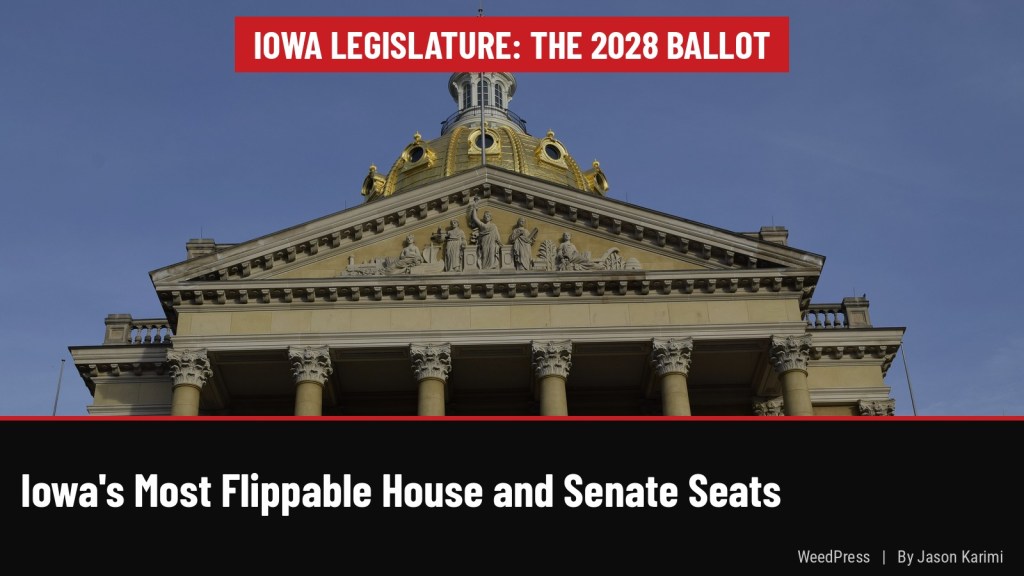
Header photo: Iowa State Capitol, Des Moines, by dwhartwig, via Wikimedia Commons, CC BY 2.0; cropped and text added by WeedPress.




Leave a Reply