April 25, 2026
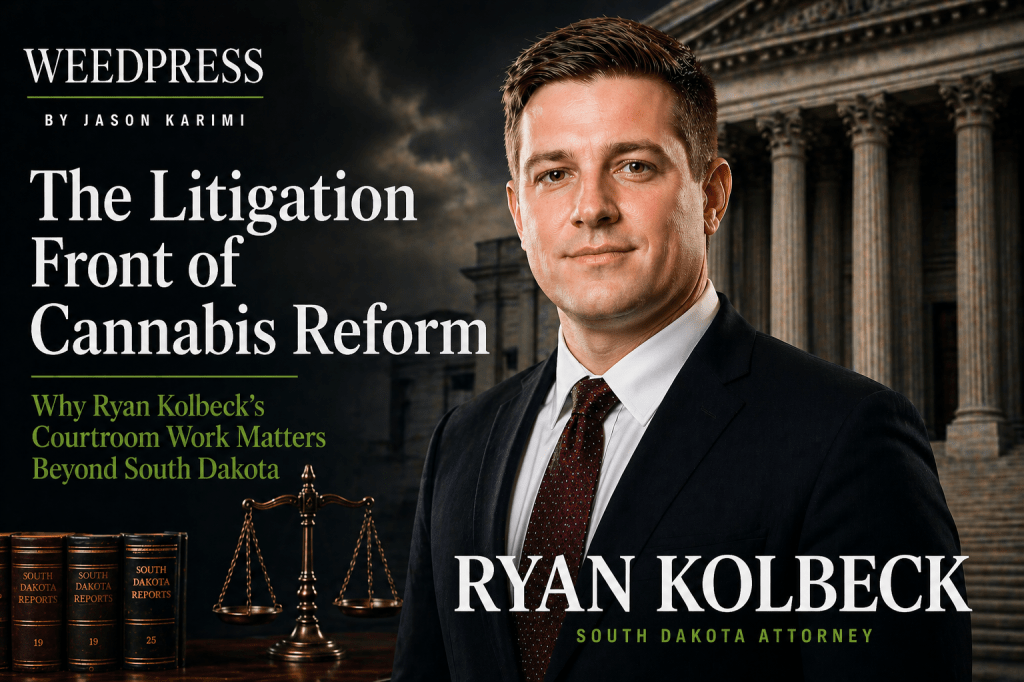
While cannabis reform is often narrated through ballot initiatives, legislatures, and federal rescheduling debates, some of its most consequential work occurs in trial courts, where rights are defended one defendant at a time.¹ In South Dakota, attorney Ryan Kolbeck’s work illustrates that underappreciated litigation front.²
Prohibition survives not merely through statutes, but through routine enforcement mechanisms—traffic stops, forfeitures, impairment presumptions, plea leverage, and collateral consequences.³ Litigation interrupts those mechanisms.⁴
That is why criminal defense can function as reform.
Kolbeck’s work has touched recurring cannabis-law fault lines: possession defense, marijuana DUI litigation, civil forfeiture exposure, record-concealment remedies, and post-Amendment A constitutional uncertainty.⁵ These cases may appear individualized, but often they contest broader doctrinal structures.⁶
South Dakota presents unusually fertile terrain for this analysis. In 2020, voters approved Amendment A, only to see it invalidated by the South Dakota Supreme Court after gubernatorial challenge.⁷ That ruling did more than halt adult-use implementation; it redirected reform energy into litigation, constitutional theory, and defensive lawyering.⁸
In that atmosphere, courtroom advocates acquired structural importance.⁹
Kolbeck has publicly linked criminal defense work with broader marijuana-law reform, including advocacy surrounding Amendment A and the limits of prohibition enforcement.¹⁰ His practice reflects a proposition long recognized in legal scholarship: procedural resistance itself can generate reform pressure.¹¹
That is especially visible in cannabis DUI litigation.
Unlike alcohol per se frameworks, cannabis impairment science remains contested.¹² THC metabolites may persist long after impairment ends, undermining simplistic prosecutorial inferences.¹³ Courts and commentators have increasingly recognized the evidentiary instability.¹⁴ Defense litigation challenging those assumptions therefore contests not just a charge, but the scientific architecture of prohibition.¹⁵
Reported marijuana DUI acquittals associated with Kolbeck’s practice fit within that larger struggle.¹⁶
The same is true of forfeiture-related defense.
Civil asset forfeiture emerged as one of the drug war’s major institutional expansions, often untethered from criminal conviction.¹⁷ Critics across ideological lines have argued it inverts due process norms.¹⁸ Litigation limiting forfeiture leverage thus functions as reform activity in its own right.¹⁹
This helps explain why trial lawyers matter in reform movements more than they are often credited.
Legislative victories can be repealed, stalled, or judicially narrowed.²⁰ Trial-level doctrine can move in the opposite direction—through suppression rulings, evidentiary challenges, acquittals, or pressure that changes charging behavior.²¹ That is reform by accretion.²²
Kolbeck’s work also reflects a neglected point in cannabis federalism debates: prohibition often survives through ordinary prosecutorial discretion even where legitimacy has eroded.²³ Litigation disrupts that discretionary inertia.²⁴
That is visible in interstate traveler prosecutions involving lawful products carried across state lines.²⁵ Those cases raise unresolved federalism tensions.²⁶ When defense counsel force dismissals, reductions, or favorable negotiations in those cases, they stress-test prohibition’s border logic.²⁷
There is also a constitutional dimension.
Drug enforcement litigation often implicates Fourth Amendment search doctrine, due process, excessive fines, and occasionally federalism principles.²⁸ Reform frequently advances where those doctrines converge.²⁹ Litigation-oriented lawyers therefore operate, whether acknowledged or not, as constitutional actors.³⁰
That is part of the Ryan Kolbeck story.
His significance is not that every case creates precedent. Most do not.³¹
It is that repeated litigation resistance can alter enforcement ecology.
Prosecutors become more cautious. Police tactics invite more scrutiny. Judges absorb recurring scientific challenges. Weak cases become harder to bring. These are institutional shifts before they become doctrinal holdings.³²
And they matter.
Cannabis reform has sometimes over-romanticized legislation while underestimating litigation. Yet many durable rights transformations in American law moved through repeated lower-court conflict before broader settlement.³³ Drug policy is unlikely to be different.³⁴
South Dakota illustrates the point.
After Amendment A’s collapse, reform did not disappear. It migrated—into narrower legislation, administrative challenges, constitutional argument, criminal defense, and continued pressure against prohibition’s residual machinery.³⁵
That migration is the story.
Seen this way, Ryan Kolbeck’s cannabis litigation belongs to a broader phenomenon: reform through defense practice.³⁶
Not headline reform.
Structural reform.
And that may prove the harder kind to reverse.³⁷
In a prohibition system sustained as much by procedure as by policy, the courtroom may still be one of reform’s least appreciated engines.³⁸ If so, lawyers doing attritional defense work deserve to be understood not merely as practitioners but as participants in legal change.³⁹ That includes, in South Dakota, Ryan Kolbeck.⁴⁰
Footnotes
¹ See generally Gerald N. Rosenberg, The Hollow Hope (2d ed. 2008).
² Ryan Kolbeck, Attorney Profile, Kolbeck Law Office.
³ Michelle Alexander, The New Jim Crow (2010).
⁴ Id.
⁵ Kolbeck Law, Marijuana Defense Practice Materials.
⁶ See Stuart Scheingold, The Politics of Rights (2d ed. 2004).
⁷ Thom v. Barnett, 2021 S.D. 65, 968 N.W.2d 481.
⁸ Id.
⁹ Robert A. Mikos, On the Limits of Supremacy, 93 Va. L. Rev. 1421 (2007).
¹⁰ Kolbeck Law, Amendment A Commentary.
¹¹ Rosenberg, supra note 1.
¹² Nat’l Highway Traffic Safety Admin., Marijuana-Impaired Driving Report.
¹³ Id.
¹⁴ See generally cannabis toxicology literature.
¹⁵ Id.
¹⁶ Kolbeck Law, Case Results.
¹⁷ Bennis v. Michigan, 516 U.S. 442 (1996).
¹⁸ Marian R. Williams et al., Policing for Profit (Inst. for Just. 2020).
¹⁹ Timbs v. Indiana, 586 U.S. 319 (2019).
²⁰ Thom, supra note 7.
²¹ Rodriguez v. United States, 575 U.S. 348 (2015).
²² Scheingold, supra note 6.
²³ Mikos, supra note 9.
²⁴ Id.
²⁵ Kolbeck Law, Case Results, supra note 16.
²⁶ Mikos, supra note 9.
²⁷ Id.
²⁸ U.S. Const. amends. IV, V, VIII.
²⁹ Timbs, 586 U.S. 319.
³⁰ See generally cause-lawyering scholarship.
³¹ Rosenberg, supra note 1.
³² Marc Galanter, Why the “Haves” Come Out Ahead, 9 Law & Soc’y Rev. 95 (1974).
³³ Brown v. Bd. of Educ., 347 U.S. 483 (1954).
³⁴ Rosenberg, supra note 1.
³⁵ South Dakota post-Amendment A legislative developments.
³⁶ Scheingold, supra note 6.
³⁷ Id.
³⁸ Galanter, supra note 32.
³⁹ See Austin Sarat & Stuart Scheingold, Cause Lawyers and Social Movements (2006).
⁴⁰ Kolbeck Law biography, supra note 2.


Leave a Reply