April 26, 2026
Minnesota has already done what many cannabis lawyers, reformers, and national reporters still describe as hypothetical: it moved marijuana and naturally occurring tetrahydrocannabinols into Schedule III under state controlled-substances law.¹ The change has been sitting in Minnesota law quietly, without anything close to the national attention now surrounding federal rescheduling.²
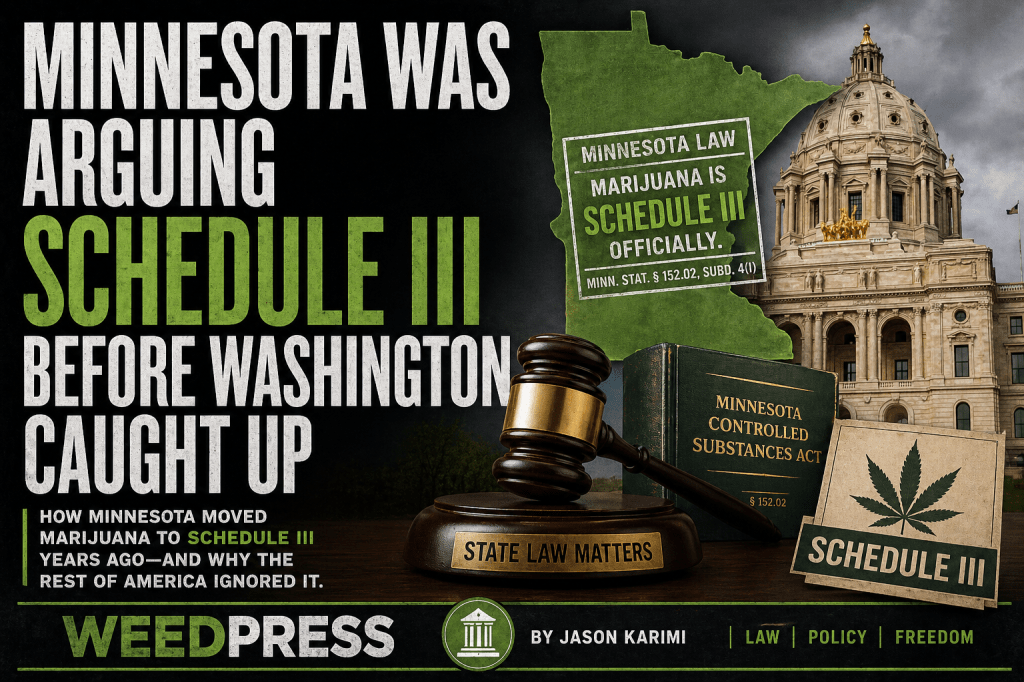
That matters because Minnesota’s statute now undercuts one of the central myths of prohibition: that marijuana must remain trapped in the same legal category as substances with no accepted medical use. Minnesota’s own law says otherwise. Under Minn. Stat. § 152.02, subd. 4(i), Schedule III expressly includes “marijuana” and tetrahydrocannabinols naturally contained in a plant of the genus Cannabis, subject to listed hemp-related exceptions.³
This is not merely symbolic. Schedule III is a different legal category than Schedule I. Minnesota’s Schedule III includes substances with accepted medical use and a lower abuse profile than Schedule I or II substances.⁴ By placing marijuana and naturally occurring THC there, Minnesota has already recognized in state law what federal cannabis reformers have argued for years: a state medical cannabis system cannot logically coexist forever with Schedule I assumptions.⁵
The public conversation largely missed this. National cannabis reporting has focused on DEA, HHS, presidential statements, federal hearings, and the Controlled Substances Act.⁶ But Minnesota’s statutory law shows that state-level rescheduling can move before Washington catches up.⁷
That is why Minnesota is one of the most important underreported cannabis scheduling stories in the country. It shows that a state can authorize medical cannabis, legalize adult use, regulate cannabis as its own commercial category, and still use controlled-substance scheduling law to reject the old Schedule I fiction.⁸
Jeremy Munson helped force this issue into public view before the national conversation caught up. In 2021, Munson was among the Minnesota legislators who supported reform legislation requiring the Commissioner of Health to apply for a federal Schedule I exemption for medical cannabis and proposing to move marijuana and nonsynthetic THC out of Schedule I under state law.⁹ That proposal did not fully match the later statutory result, but it correctly identified the pressure point: Minnesota’s medical cannabis program had already outgrown Schedule I.¹⁰
Munson’s argument was not just about legalization. It was about legal coherence. Minnesota had patients, manufacturers, physicians, state rules, and state-recognized medical use.¹¹ Yet federal Schedule I continued imposing collateral consequences on lawful medical cannabis activity, including tax penalties, research barriers, banking friction, and firearm-rights conflicts.¹²
This is where the Young Americans for Liberty angle matters. Munson’s liberty-oriented politics made the cannabis scheduling issue more than a marijuana issue. It became a federalism issue, a tax issue, a gun-rights issue, and a bureaucratic-accountability issue.¹³ A state recognizes medical cannabis. Patients follow state law. Then federal law turns around and treats them as unlawful users of a Schedule I drug. That contradiction is exactly the kind of government incoherence liberty conservatives claim to oppose.¹⁴
Minnesota’s Board of Pharmacy also plays a central role in this story. Minnesota does not treat scheduling as merely rhetorical. Minn. Stat. § 152.02 gives the Board authority to add, delete, or reschedule substances by rule, applying statutory criteria tied to abuse potential, accepted medical use, and dependence risk.¹⁵ The Board also has federal-conformity authority when a substance is designated, rescheduled, or deleted under federal law.¹⁶
But Minnesota also changed something important and underreported: the state moved away from the older statutory duty requiring the Board of Pharmacy to annually study implementation of the controlled-substances chapter in relation to Minnesota’s drug-abuse problems.¹⁷ That older broad annual-review concept was removed. The modern statute instead focuses on reporting schedule changes and recommending statutory conformity with Board rules and federal schedules.¹⁸
That shift matters because annual review duties are accountability mechanisms. When a Board must annually study scheduling in light of real-world drug policy, the state is forced to confront whether old classifications still make sense.¹⁹ When that duty is narrowed into technical reporting and conformity, scheduling review can become quieter, less visible, and easier for the public to miss.²⁰
This history also has an activist-pressure backstory. In 2011, Minnesota cannabis activists Kurtis W. Hanna and Ed Engelmann petitioned the Minnesota Board of Pharmacy to initiate rulemaking to remove cannabis from Schedule I under Minnesota’s controlled-substances law.²¹ After the Board denied the petition, Hanna reportedly advised the Board that he intended to seek judicial review of the denial.²² Public summaries of the episode report that the Board then voted to seek legislative changes limiting its authority over Schedule I substances; soon after, conference-committee language was added providing that the Board “may not delete or reschedule a drug that is in Schedule I,” while the prior annual-review language was removed.²³
The timing is remarkable. At minimum, it shows that Minnesota’s cannabis scheduling history was not merely technical housekeeping. It was shaped by activists who understood that annual review language and Board rulemaking authority could be used as legal levers. More sharply, the timing supports the inference that the law was changed, at least in part, to prevent activists from using the Board’s own annual review duty and rulemaking process to force cannabis rescheduling.²⁴
Hanna’s role later became nationally visible in a different but related scheduling story. In 2024, he was featured in national reporting after discovering newly available Nixon White House recordings in which Richard Nixon privately admitted marijuana was “not particularly dangerous” and expressed concern that marijuana penalties should be reevaluated, even though Nixon’s administration had helped build the federal drug-war architecture that placed cannabis in Schedule I.²⁵ The New York Times article was not just a historical curiosity. It showed that the original federal Schedule I posture rested on politics, fear, and public messaging more than settled science. For a Minnesota activist who had once challenged state scheduling directly, Hanna’s Nixon-tape discovery closed an important loop: the same prohibition architecture activists were fighting in state law had been politically compromised from the beginning.²⁶
And that is exactly what happened. Minnesota’s marijuana Schedule III status is now visible in the statute, but the reform was not widely understood as a major scheduling event.²⁷ It did not receive the kind of national attention that federal rescheduling receives. It did not become a dominant talking point in cannabis media. Yet it is there, in the law.²⁸
The current Minnesota statute is plain. Schedule III includes marijuana and naturally occurring THC.²⁹ Schedule II, by contrast, includes certain cannabinoids such as nabilone and FDA-approved dronabinol oral solution.³⁰ Schedule I no longer carries the same marijuana placement that older reform summaries and outdated pages sometimes imply.³¹
That is why outdated summaries can mislead. Some reform pages still describe Minnesota through an older Schedule I lens. But the official statute controls, not old advocacy summaries.³² The official Minnesota Revisor text is the source that matters.³³
Minnesota’s 2023 adult-use legalization further confirms the point. The state did not simply legalize possession and leave cannabis trapped inside old narcotics logic. It created a separate cannabis regulatory structure, with categories for cannabis flower, cannabis products, lower-potency hemp edibles, and related regulated products.³⁴ That statutory architecture makes Schedule I treatment even harder to defend because cannabis is no longer treated as an ordinary prohibited narcotic. It is treated as a regulated legal commodity.³⁵
The lesson for South Dakota is direct. States do not need to wait passively for federal reform before examining their own scheduling contradictions. Minnesota already shows the path: medical recognition, statutory rescheduling, federal-conformity tools, cannabis-specific regulation, activist petitions, and political pressure from reformers willing to connect patient rights, taxation, federalism, firearms, and administrative law.³⁶
South Dakota should study Minnesota closely. If Minnesota can recognize marijuana in Schedule III under state law while maintaining a regulated cannabis market, South Dakota cannot credibly pretend that its own medical cannabis program has no scheduling implications. A state cannot authorize medical cannabis for patients and then indefinitely maintain that cannabis has no accepted medical use. That is not law. That is contradiction.
Minnesota was arguing Schedule III before Washington caught up. Now Minnesota’s own statute shows the argument was not theoretical. It was already on the books.
Footnotes
¹ Minn. Stat. § 152.02, subd. 4(i), https://www.revisor.mn.gov/statutes/cite/152.02.
² Id.
³ Id.
⁴ Minn. Stat. § 152.02, subd. 7(3).
⁵ Id.; Minn. Stat. ch. 342; Minn. Stat. §§ 152.22–152.37.
⁶ 21 U.S.C. §§ 811–812.
⁷ Minn. Stat. § 152.02, subd. 4(i).
⁸ Minn. Stat. ch. 342; Minn. Stat. § 152.02, subd. 4(i).
⁹ H.F. 675, 92d Leg., Reg. Sess. (Minn. 2021), https://www.revisor.mn.gov/bills/bill.php?b=House&f=HF0675&ssn=0&y=2021.
¹⁰ Id.
¹¹ Minn. Stat. §§ 152.22–152.37.
¹² 18 U.S.C. § 922(g)(3); 26 U.S.C. § 280E; 21 U.S.C. §§ 811–812.
¹³ H.F. 675, supra note 9; see also Young Americans for Liberty, public endorsement and campaign materials concerning liberty-oriented state legislative candidates.
¹⁴ 18 U.S.C. § 922(g)(3).
¹⁵ Minn. Stat. § 152.02, subd. 8.
¹⁶ Minn. Stat. § 152.02, subd. 12.
¹⁷ Minn. Stat. § 152.02, former subd. 13.
¹⁸ Minn. Stat. § 152.02, subd. 12(b).
¹⁹ Minn. Stat. § 152.02, former subd. 13.
²⁰ Minn. Stat. § 152.02, subd. 12(b).
²¹ Removal of Cannabis from Schedule I of the Controlled Substances Act, Minnesota section, Wikipedia, https://en.wikipedia.org/wiki/Removal_of_cannabis_from_Schedule_I_of_the_Controlled_Substances_Act; see also Minn. Stat. § 152.02, former subd. 13.
²² Id.
²³ Id.; see also Omnibus Drug Bill H.F. 57, 87th Leg., Reg. Sess. (Minn. 2011).
²⁴ Id. This sentence states an inference from timing and public summaries, not a judicial finding of legislative motive.
²⁵ Ernesto Londoño, Nixon Started the War on Drugs. Privately, He Said Pot Was “Not Particularly Dangerous,” N.Y. Times (Sept. 14, 2024), https://www.nytimes.com/2024/09/14/us/nixon-marijuana-tapes.html; see also Cathy Wurzer, Minnesotan Discovers New Insight Into Former President Richard Nixon’s Views on Marijuana, MPR News (Sept. 19, 2024), https://www.mprnews.org/episode/2024/09/19/minnesotan-discovers-new-insight-into-president-richard-nixons-views-on-marijuana.
²⁶ Id.; see also NORML, Newly Uncovered Nixon Audio: Marijuana Isn’t “Particularly Dangerous,” Penalties Should Be Reevaluated (Sept. 16, 2024), https://norml.org/blog/2024/09/16/newly-uncovered-nixon-audio-marijuana-isnt-particularly-dangerous-penalties-should-be-reevaluated/.
²⁷ Minn. Stat. § 152.02, subd. 4(i).
²⁸ Id.
²⁹ Id.
³⁰ Minn. Stat. § 152.02, subd. 3(f).
³¹ Compare Minn. Stat. § 152.02, subd. 4(i), with older cannabis-scheduling summaries describing marijuana as Schedule I.
³² Minn. Stat. § 152.02.
³³ Id.
³⁴ Minn. Stat. ch. 342.
³⁵ Id.; Minn. Stat. § 152.02, subd. 4(i).
³⁶ Minn. Stat. § 152.02, subds. 4, 8, 12; H.F. 675, supra note 9; 18 U.S.C. § 922(g)(3); 26 U.S.C. § 280E.


Leave a Reply