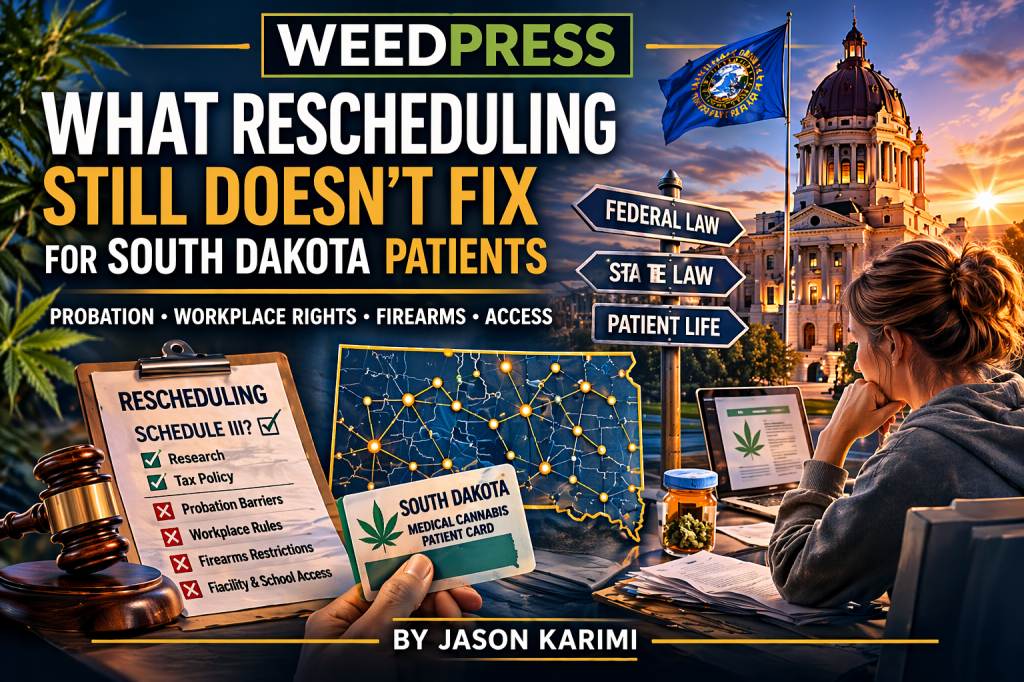
Editors note: this article was written prior the the April 23 final order rescheduling cannabis products into federal Schedule III. Article is published unchanged as originally drafted for clarity.
April 30, 2026
Too much cannabis coverage still treats federal rescheduling like a magic wand patients should uncritically celebrate.
I’ve studied these laws more than anyone on the planet over the past 17 years. Here is what patients need to know.
Even if marijuana ultimately moves to Schedule III, the hard part of cannabis federalism will remain exactly where patients, workers, and probationers live: in the overlap between federal prohibition, state program design, workplace rules, supervision rules, firearms law, and local institutional policy.² That is why rescheduling matters—and why it also risks being oversold.
Start with the most basic point: rescheduling is still not finished. In May 2024, DEA published its proposed rule to move marijuana to Schedule III after HHS recommended rescheduling in August 2023.³ DEA then noticed a formal administrative hearing process, and in January 2025 the agency announced that the scheduled hearing on the proposal had been postponed pending resolution of an appeal.⁴ Until a final rule exists, “rescheduling” remains a proposal with major symbolic force but incomplete legal effect.³ ⁴
Even if that final rule comes, South Dakota law still governs South Dakota’s program. The state’s medical-cannabis chapter provides that activity related to medical cannabis is lawful for purposes of state law so long as it is conducted in accordance with the chapter.⁵ That is useful, but it is also limited. “Lawful for purposes of state law” is not the same thing as “all consequences disappear.” State law can authorize the patient. Other legal systems can still burden the patient.⁵
That is why workers should not confuse rescheduling with workplace peace. South Dakota law expressly says no employer is required to allow the ingestion, possession, transfer, display, or transportation of cannabis in the workplace, or to allow an employee to work while under the influence. It also expressly preserves the employer’s ability to maintain a drug-free workplace policy, including a compliant drug-testing program.⁶ So even under a Schedule III future, the practical question for many workers will remain the same: what does my employer allow, and how much protection does state law actually give me? In South Dakota, that answer is still narrower than many patients assume.⁶
Probationers face a different version of the same trap. Rescheduling may change rhetoric in Washington, but it does not automatically rewrite supervision practices, judicial conditions, or local gatekeeping. In August 2025, the South Dakota Medical Marijuana Oversight Committee heard that the patient-certification website still asks whether the patient is on probation, and one practitioner objected that this information is not needed for medical care and could create unconscious bias.⁷ That single detail says a lot. It shows that even inside a lawful state program, probation status remains a live friction point. Rescheduling may soften the climate. It does not automatically erase supervision barriers or the institutional suspicion surrounding patients under court oversight.⁷
Patients also still run into place-based restrictions that rescheduling does not fix. South Dakota school rules provide that a student may not possess or self-administer medical cannabis on school property or at a school-sponsored activity, except through tightly controlled caregiver administration frameworks.⁸ And in 2026, lawmakers introduced House Bill 1053 to require terminal care facilities to allow terminally ill patients to use medical cannabis—legislation that would not have been necessary if the access problem were already solved.⁹ In other words, one of the central patient struggles remains exactly what it has long been: not simply “is it legal somewhere in theory,” but “can I actually use my medicine where I live, where I receive care, and where I am supervised?”⁸ ⁹
Federal firearms law remains another major collision point. ATF stated in 2023 that people purchasing firearms must still attest on Form 4473 whether they are an unlawful user of marijuana, and ATF tied that guidance back to its longstanding federal position on marijuana users and firearms transactions.¹⁰ Rescheduling to Schedule III may change arguments around medical legitimacy and research. But unless federal firearms policy changes too, cardholders are still stuck in a dangerous zone where state permission and federal collateral consequences do not line up cleanly.¹⁰
And then there is the broader product-law confusion that patients and consumers continue to navigate. South Dakota’s Attorney General said in 2025 that the legality of THC-infused and hemp-derived products remains fact-specific and that state law currently prohibits the sale of synthetic cannabinoids, certain higher-Delta-9 products, and hemp products containing chemically derived, modified, or converted cannabinoids.¹¹ So even as federal rescheduling dominates headlines, South Dakotans are still living inside a state-level cannabinoid landscape full of distinctions ordinary people do not intuitively understand. That confusion is not a side issue. It is part of the lived reality of cannabis law.¹¹
There is another reality rescheduling does not fix quickly: medical access still depends on the state’s certification and oversight architecture. South Dakota’s own data showed 18,759 approved patient cards and 219 approved practitioners as of April 2026.¹² That is meaningful growth. But the Department’s FY25 annual report also showed that practitioner participation had recently dipped because of system safeguards and login requirements, and the oversight committee reported a program administered by a relatively small staff.¹³ ¹⁴ A system can be lawful on paper, medically justified in principle, and still frustratingly fragile in practice.
So yes, rescheduling matters. It matters for research. It matters for federal tax treatment. It matters for medicine’s symbolic status and for the long argument over whether marijuana belongs in the same legal category as heroin.³ But South Dakotans should stop pretending that a new federal schedule automatically solves the most human cannabis problems.
It does not automatically fix probation friction.
It does not automatically fix employer control.
It does not automatically fix school or facility restrictions.
It does not automatically fix firearm conflicts.
And it does not automatically fix the bureaucratic architecture through which patients must still pass.
The real conversation still ahead is not whether federal rescheduling is good. It is whether South Dakota is willing to build a system worthy of what rescheduling is supposed to mean.
Until then, a lot of South Dakotans will remain stuck in the same old position: nominally lawful, politically useful, medically acknowledged—and still not fully free.
And the way for states to protect patients as pioneered by Weedpress: states, not the Feds, must apply for enforcing existing federal exemptions under the Controlled Substances Act and APA. Senator John Thune advised WeedPress this, just to get the record straight. Future WeedPress articles will document ongoing efforts we are pursuing to encourage state officials to file for existing federal exemptions, using 21 USC 822(d) like Iowa, Minnesota, and Hawaii lawmakers have been pursuing for the past six years. Receipts:
Footnotes
¹ See generally South Dakota Department of Health, Medical Cannabis in South Dakota (program overview and patient/practitioner portal structure).
² See generally Schedules of Controlled Substances: Rescheduling of Marijuana, 89 Fed. Reg. 44,597 (proposed May 21, 2024) (showing the proposal’s federal significance while leaving many state and collateral legal questions untouched).
³ Schedules of Controlled Substances: Rescheduling of Marijuana, 89 Fed. Reg. 44,597, 44,598 (proposed May 21, 2024) (noting HHS’s August 2023 recommendation that marijuana be rescheduled to Schedule III).
⁴ Drug Enforcement Administration, Hearing on the Proposed Rescheduling of Marijuana Postponed (Jan. 15, 2025); see also 89 Fed. Reg. 70,148 (Aug. 29, 2024) (announcing that the January 21, 2025 hearing was postponed pending appeal); see also 89 Fed. Reg. 70,148 (Aug. 29, 2024) (setting hearing procedures for the proposed rule).
⁵ S.D. Codified Laws ch. 34-20G, available at South Dakota Legislature statutes page (providing that activity related to medical cannabis is lawful for purposes of state law if conducted in accordance with the chapter).
⁶ S.D. Codified Laws § 34-20G-24, available at South Dakota Legislature statute page stating that no employer must allow ingestion, possession, transfer, display, or transportation of cannabis in the workplace or allow an employee to work while under the influence, and preserving drug-free workplace policies and testing); see also S.B. 12, 99th Leg., Reg. Sess. (S.D. 2024).
⁷ S.D. Medical Marijuana Oversight Committee Minutes, Aug. 19, 2025, available via South Dakota Legislature document set (recording practitioner concern that the patient-certification system asks whether a patient is on probation and that the question may create unconscious bias).
⁸ S.D. Admin. R. 24:80:02, available at South Dakota Administrative Rules page (providing that a student may not possess or self-administer medical cannabis on school property or at a school-sponsored activity, subject to caregiver-administration rules); see also Sioux Falls Sch. Dist., Students Administration of Medical Cannabis to Qualifying Students (policy summary).
⁹ H.B. 1053, 101st Leg., Reg. Sess. (S.D. 2026), available at South Dakota Legislature bill page (bill to require terminal care facilities to allow terminally ill patients to use medical cannabis); see also 2026 Bill Status Report, South Dakota Legislature.
¹⁰ Bureau of Alcohol, Tobacco, Firearms & Explosives, ATF Provides Clarification Related to New Minnesota Marijuana Law (May 30, 2023) (stating that firearm purchasers must attest on ATF Form 4473 whether they are unlawful users of marijuana and referencing longstanding federal guidance).
¹¹ S.D. Att’y Gen. Off. Op. 25-04, Legality of Selling THC-Infused and Hemp-Derived Products (Nov. 3, 2025) (describing product legality as fact-specific and explaining current state prohibitions on several THC and hemp-derived product categories).
¹² South Dakota Department of Health, Data & Statistics, Medical Cannabis Program (Apr. 1, 2026 data point showing 18,759 approved patient cards and 219 approved practitioners).
¹³ South Dakota Department of Health, 2025 Annual Report, at 52–53 (reporting practitioner declines tied to system safeguards requiring licensure-expiration data upon login).
¹⁴ South Dakota Medical Marijuana Oversight Committee, 2025 Final Report (describing the size of the program and the seven-person administrative staff).



Leave a Reply