As federal rescheduling advances, unresolved transparency gaps remain in South Dakota’s medical market.
South Dakota’s Medical Cannabis Program is designed to operate through patient, caregiver, practitioner, and establishment fees rather than ordinary general-fund appropriations.¹ But a fee-funded program still creates public administrative costs. Enforcement actions require inspectors, lawyers, agency leadership, public notices, patient communications, litigation management, and committee attention. The 2023 enforcement dispute involving 605 Cannabis LLC is a useful case study in how one major operator dispute can consume public resources.
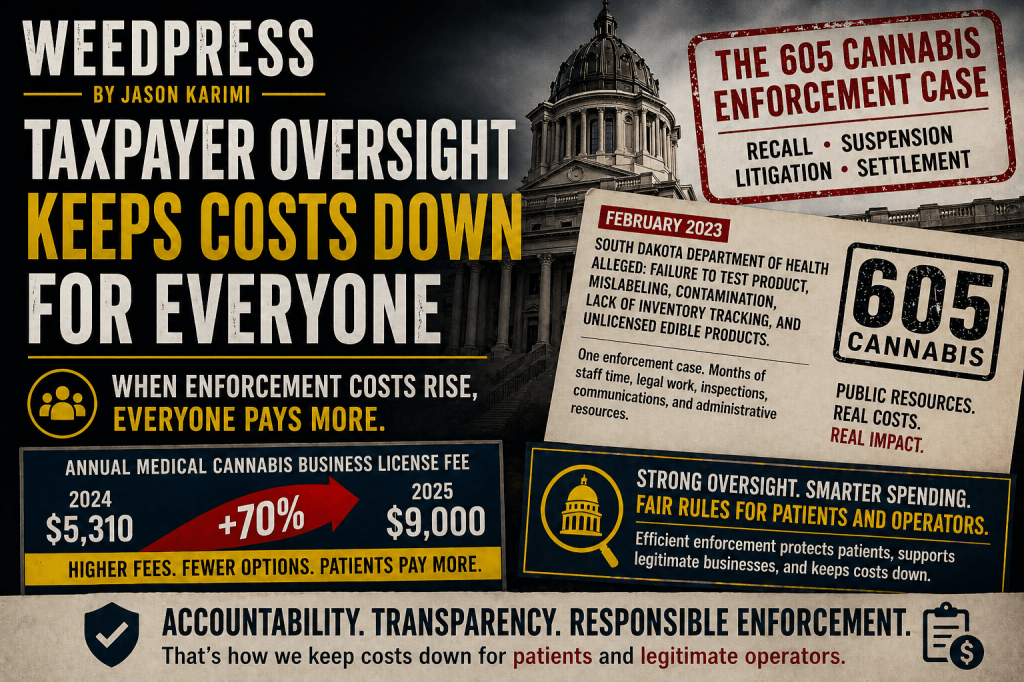
In February 2023, the South Dakota Department of Health requested a voluntary recall of medical cannabis products from 605 Cannabis, doing business as Badlands.² The recall notice stated that the Department had alleged “failure to test product, mislabeling, contamination, the lack of inventory tracking and the failure to have licenses for edible products.”³ Public reporting described the recall as involving 117 Badlands products.⁴
For patients, the practical question is simple: when testing, labeling, recalls, or contamination allegations arise, how quickly and clearly can they verify whether a product they purchased is safe, compliant, and accurately labeled?
605 Cannabis disputed the Department’s position and later sued the Department of Health, alleging regulatory overreach and substantial business losses.⁵ Public reporting described the company as claiming more than $1 million in damages from the enforcement action.⁶ The dispute was resolved in July 2023, and public reporting stated that the Department lifted the company’s suspension after settlement.⁷
The point is not that the Department acted improperly. The point is that major enforcement actions are expensive in administrative terms even when the program is fee-funded. A recall or suspension can require inspection work, legal review, enforcement orders, public communication, negotiations, litigation defense, and follow-up compliance work. Those costs may not appear as a single line item labeled “605 Cannabis,” but they still represent real public workload.
South Dakota’s program has grown substantially since launch. The Department of Health reported 14,843 approved patients in FY2025, and state data listed 18,306 approved patient cards on March 1, 2026.⁸ As the patient base grows, the regulatory burden grows with it: more applications, more renewals, more inspections, more complaints, more testing questions, and more enforcement decisions.
The state has already acknowledged rising administrative demands. In 2024, lawmakers approved a nearly 70 percent increase in annual medical cannabis business license fees, raising the fee from $5,310 to $9,000.⁹ Reporting on the change stated that officials tied the increase to covering program administrative costs.¹⁰
The Department’s 2025 Annual Report also reflects a maturing inspection program. It states that licensed establishments decreased from 124 in FY2024 to 118 in FY2025, and that the medical cannabis program conducted 112 routine inspections during FY2025.¹¹ The report also states that, with the addition of a second inspector, the program implemented a structured inspection schedule and was positioned to complete annual inspections for licensed establishments.¹²
That context matters. If one high-profile enforcement action can produce a recall, emergency suspension, litigation, settlement, and public controversy, then the Legislature should want better visibility into how enforcement resources are being spent. A fee-funded program can still become inefficient, opaque, or administratively strained.
There is also a fairness issue. Patients and businesses ultimately bear the costs of the system through fees, compliance costs, and product prices. If enforcement becomes more complex, those costs can move through the system. Patients may pay more. Smaller businesses may face heavier compliance burdens. Larger operators may be better positioned than smaller businesses to absorb regulatory shocks, legal costs, or prolonged compliance disputes.
The 605 case likely cost six figures in taxpayer dollars. Many small operators complained that the year after the 605 action, when costs increased 70%, that public dialogue around why those costs increased, (the perception being the 605 enforcement action was causally linked to the increased costs) was discouraged. This avoidance of discussion is a missed opportunity to protect already struggling operators bottom line if future major enforcement actions take place.
South Dakota should therefore consider more transparent reporting of enforcement workload. Annual reports already provide useful aggregate figures, but they do not appear to provide detailed public breakdowns showing the administrative cost of major enforcement matters, litigation-related workload, recall management, inspection follow-up, or operator-specific compliance patterns.¹³
That does not mean every enforcement file should become public in real time. Some matters may involve confidential business information, active investigations, or settlement negotiations. But the public can still receive better aggregate data: number of recalls, number of suspensions, number of contested enforcement actions, average time to resolution, number of staff hours devoted to enforcement categories, and whether litigation costs are borne by program fees, general state resources, or some combination.
The 2023 605 Cannabis matter should not be exaggerated. The company disputed the allegations, the matter settled, and public reporting indicates the suspension was lifted.¹⁴ But the case remains useful because it shows how a single enforcement action involving a major operator can trigger a chain of administrative consequences.
Medical cannabis regulation is not only about patient access. It is also about whether the state can operate a fair, efficient, transparent regulatory system. If South Dakota’s program is going to rely on fees from patients and businesses, the public should be able to see whether those fees are producing efficient oversight or simply absorbing the hidden costs of repeated enforcement conflict.
Legislators should consider requiring clearer annual reporting on medical cannabis enforcement costs, recall activity, contested cases, litigation workload, inspection capacity, and program staffing. Better reporting would not weaken enforcement. It would strengthen public confidence by showing whether South Dakota’s medical cannabis program is using its resources wisely.
This article is for informational purposes only and does not constitute legal advice. All statements are based solely on publicly available information as of April 2026 and represent the author’s good-faith review of those sources.
Footnotes
¹ S.D. Codified Laws ch. 34-20G; S.D. Dep’t of Health, Medical Cannabis Program, https://medcannabis.sd.gov/.
² S.D. Dep’t of Health, Recall of Medical Cannabis Product from 605 Cannabis d/b/a Badlands (Feb. 10, 2023), https://medcannabis.sd.gov/docs/02-10-23_Recall_Badlands.pdf.
³ Id.
⁴ Joe Sneve, 605 Cannabis Fighting State Recall, Sues SD Health Department, Aberdeen Insider / The Dakota Scout (Mar. 29, 2023), https://aberdeeninsider.com/605-cannabis-fighting-state-recall-sues-sd-health-department/.
⁵ Beth Warden, 605 Cannabis Sues State Over Inspection Report, Dakota News Now (Mar. 29, 2023), https://www.dakotanewsnow.com/2023/03/29/605-cannabis-sues-state-over-inspection-report/.
⁶ Health Agency Sued by SD Medical Cannabis Company, NECANN (Mar. 30, 2023), https://necann.com/cannabis-news/health-agency-sued-by-sd-cannabis-company/.
⁷ Settlement Reached Between SD Department of Health and 605 Cannabis, KORN News Radio (July 22, 2023), https://kornradio.com/latestnews/settlement-reached-between-sd-department-of-health-and-605-cannabis/; Joe Sneve, Worthing-Based Cannabis Company’s Suspension Lifted, The Dakota Scout (July 21, 2023), https://www.thedakotascout.com/p/worthing-based-cannabis-companys.
⁸ S.D. Dep’t of Health, 2025 Annual Report 52–54 (2026), https://doh.sd.gov/media/lfnlqfxu/2025-sd-doh-annual-report.pdf; S.D. Dep’t of Health, Medical Cannabis March Data, 2026, https://doh.sd.gov/data-reports/.
⁹ Joshua Haiar, Lawmakers Make It Official: Annual Fees for Medical Pot Businesses Will Jump 70 Percent, South Dakota Searchlight (Aug. 20, 2024), https://southdakotasearchlight.com/2024/08/20/annual-fees-for-medical-marijuana-businesses-will-jump-70-percent/.
¹⁰ Id.; Medical Marijuana Businesses in South Dakota Face a 70% Increase in State Fees, Marijuana Moment (July 31, 2024), https://www.marijuanamoment.net/medical-marijuana-businesses-in-south-dakota-face-a-70-increase-in-state-fees/.
¹¹ S.D. Dep’t of Health, 2025 Annual Report 54 (2026), https://doh.sd.gov/media/lfnlqfxu/2025-sd-doh-annual-report.pdf.
¹² Id.
¹³ Id.; S.D. Dep’t of Health, Medical Cannabis Program, https://medcannabis.sd.gov/.
¹⁴ KORN News Radio, supra note 7; The Dakota Scout, supra note 7.


Leave a Reply