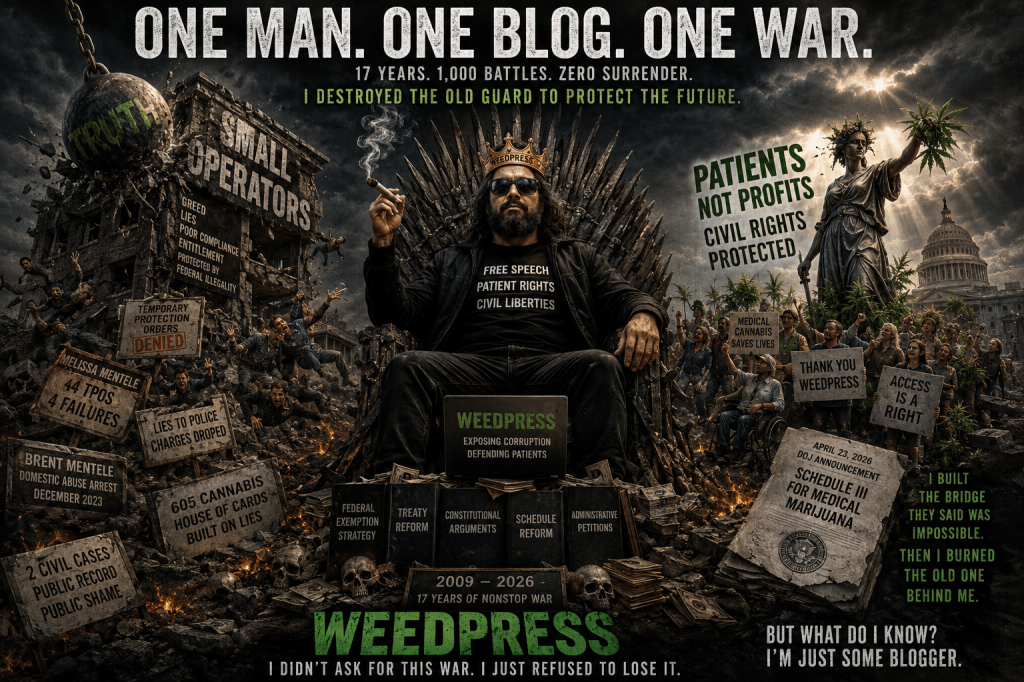
I have spent most of my adult life arguing that state medical cannabis programs could not survive forever as legally tolerated gray markets.¹
They needed federal recognition. They needed treaty analysis. They needed administrative pathways. They needed constitutional pressure. They needed people willing to say the uncomfortable thing before the institutions were ready to admit it.
For years, that sounded crazy.
Then, on April 23, 2026, the Department of Justice announced that FDA-approved marijuana products and marijuana products subject to qualifying state medical licenses would move into Schedule III.² The Federal Register order followed on April 28.³ It did not federally legalize marijuana. But it did something more structurally important: it recognized state-licensed medical cannabis as part of a federal scheduling architecture.⁴
That was the ballgame.
Not the final ballgame. Not the utopia. Not full legalization. But the end of the old fantasy that small state operators could live forever inside legal contradiction while avoiding federal normalization.
For nearly two decades, I believed the fight was not merely “legalize weed.” The deeper question was always this:
How does a federally illegal industry survive long enough to become politically, medically, and legally unavoidable?
That was not a fake question. In the 2010s, federal legalization was not inevitable. DEA hostility was real. Treaty arguments were treated as immovable. Banking risk was real. Tax punishment under 280E was real. Institutional investors stayed away because the industry was federally radioactive.⁵⁻⁸
That environment created the first generation of state cannabis markets: activists, patients, risk-takers, small operators, true believers, opportunists, and people willing to work where normal corporations would not.
But markets do not stay frozen in their founding mythology.
https://papers.ssrn.com/sol3/papers.cfm?abstract_id=6726361
Once federal protection becomes plausible, the market changes. Once Schedule III enters the conversation, the market changes. Once federal registration pathways appear, the market changes. Once tax treatment changes, capital changes. Once capital changes, the operators change.⁹
That is the part many small operators never wanted to face.
Federal legitimacy does not preserve the old industry. It replaces it.
I helped argue for the architecture that made that replacement possible.
I started in Iowa in 2009, when medical cannabis advocacy was lonely, chaotic, and politically brutal. Iowa was not California. It was not Colorado. It was not Oregon. It was a state where organizing cannabis patients was hard, where every step required forcing lawmakers, reporters, agencies, and party officials to acknowledge people they preferred to ignore.
Senator Joe Bolkcom later put the policy critique plainly when he said marijuana prohibition had been a “costly failure” that caused more harm than good.²⁰ But anyone who worked Iowa cannabis politics knows the deeper truth: the issue was hard to organize, hard to fund, hard to professionalize, and hard to keep alive.
I did not give up.
Public records show me speaking as Iowa Patients for Medical Marijuana before the Iowa Medical Cannabidiol Advisory Board in 2018.¹⁷ Legislative records show me registered for Iowa Patients for Medical Marijuana on cannabis legislation in 2022.¹⁸ Iowa Health and Human Services minutes still show me appearing before the Medical Cannabidiol Board in 2025, years after most people had moved on, burned out, or rebranded.¹⁹

That is my impact, and career arc. Not a press-release career. A trench career.
I met with governors. I met with speakers. I worked around national conservative, libertarian, and free-market political infrastructure. I learned that reform does not happen because people chant slogans. It happens because someone figures out where law, money, politics, enforcement discretion, and institutional self-interest intersect.²¹⁻²⁵
Over time, my view hardened.

I came to believe state medical cannabis programs needed federal exemption theories, federal-question preservation, administrative petitions, treaty reinterpretation, and pressure campaigns aimed at the actual legal architecture.²⁶⁻³⁴ That made me more aggressive. More combative. Sometimes too combative.
In hindsight, I can admit that.
Movements distort people. They make everything feel existential. They turn tactical disagreements into moral wars. They reward obsession, then punish the obsessed for becoming abrasive. They make people personalize structural conflict.
But the structural conflict was real.
Early cannabis operators benefited from federal illegality because it kept larger, more conventional corporate actors out. The same federal risk that hurt patients also protected small incumbents from serious competition. As long as federal law remained incoherent, small operators could claim revolutionary status while operating inside protected state markets.
But the second federal normalization arrived, that moat began drying up.
This is why the 2026 Schedule III order matters. The DOJ order recognized a category of marijuana tied to FDA approval or qualifying state medical licenses.² The Federal Register notice described the framework, including consistency with international controls and medical cannabis concepts under federal regulations.³ The DEA also moved toward expedited registration mechanics for state medical marijuana license holders.²
That is not hippie legalization.
That is institutional legalization.
And institutional legalization is where small operators go to meet banks, compliance lawyers, tax lawyers, national brands, private equity, pharmaceutical logic, and professionalized regulatory capture.
This did not happen in a vacuum.
Canada federally legalized cannabis in 2018 and tested the international treaty system in real time.¹³ ¹⁴ Bolivia had already shown that the drug-control treaty system was not divine scripture when it withdrew from and re-acceded to the 1961 Single Convention with a reservation regarding coca leaf chewing.¹²
The psychedelics movement also changed the frame. MAPS, Rick Doblin, MDMA-assisted therapy, FDA advisory processes, and the broader medicalization of Schedule I substances helped normalize a once-radical proposition: that “no accepted medical use” was not a permanent truth, but an administrative conclusion vulnerable to science, politics, and persistence.¹⁵ ¹⁶
Cannabis rode that same historical wave.
So maybe I was too small-picture at times. Maybe I thought too much depended on Iowa, or South Dakota, or one board, or one hearing, or one factional fight. Maybe I overestimated the importance of local enemies and underestimated the massive institutional tide forming beneath us.
But I was not wrong about the vulnerability.
I was not wrong that federal illegality was the central contradiction. I was not wrong that treaty interpretation mattered. I was not wrong that exemption pathways mattered. I was not wrong that state medical programs needed federal architecture to survive. And I was not wrong that once federal architecture arrived, the market would stop belonging to the original small operators.
That is the hard truth.
The people who built early cannabis markets were not necessarily the people best positioned to survive federal normalization.
Some were activists. Some were dreamers. Some were patients. Some were opportunists. Some were operators who mistook temporary protection from federal illegality for permanent business strength.
But federal recognition changes the species of the industry.
It rewards compliance capacity. It rewards documentation. It rewards banking readiness. It rewards legal sophistication. It rewards tax planning. It rewards scale. It rewards people who can survive audits, registrations, inspections, enforcement memoranda, securities scrutiny, and interstate corporate competition.³⁷ ³⁸ ³⁹
That is not a moral judgment. It is a market transition.
In South Dakota, I came because the state was politically accessible, small enough to map, and vulnerable to disciplined public-records work. South Dakota’s medical cannabis program was voter-approved, fee-funded, regulated, and politically exposed.³⁵ ³⁶ I even was quoted for a headline article in The Argus Leader, proving how easy this state was to manipulate politically for patients over business conflicts of interest:
The same structural fight followed me there.
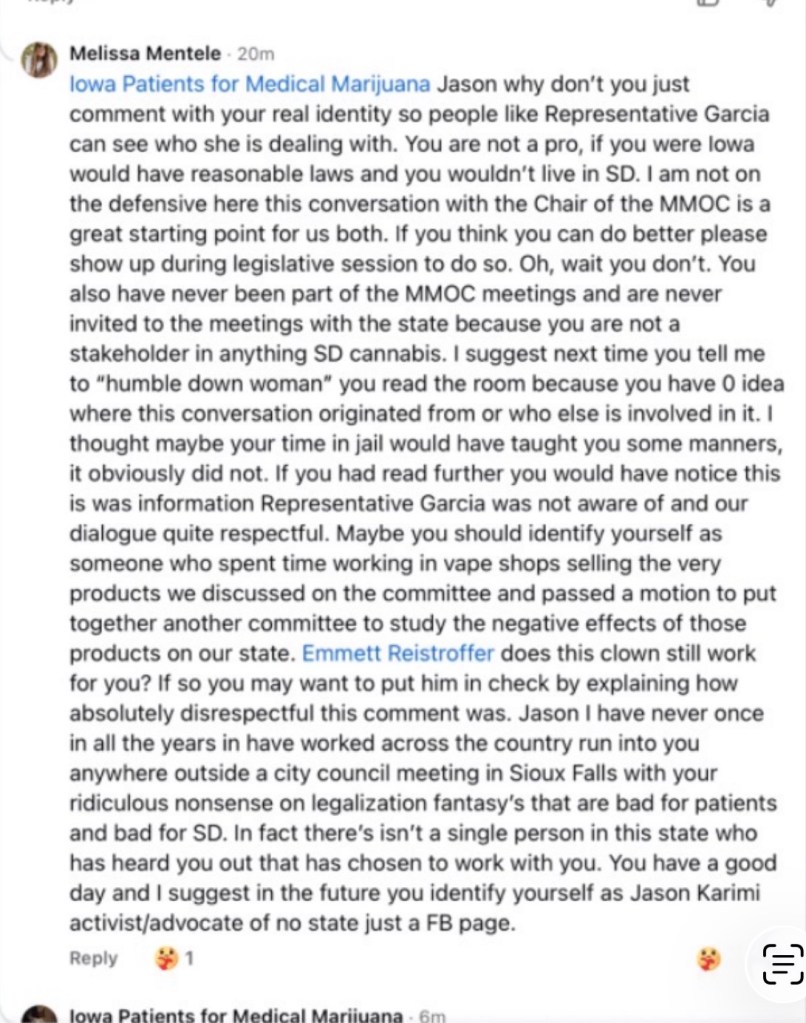
Look at the conflict unfolding around 605 Cannabis and its COO, Melissa Mentele. Over the last several months, multiple temporary protection order petitions connected to disputes over WeedPress reporting have failed in court, while related criminal allegations tied to online speech did not ultimately result in sustained prosecution. Court records connected to broader personal and civil disputes involving members of the Mentele family have also entered the public record and become part of the larger paper trail surrounding South Dakota’s cannabis industry conflicts.
But the important point is not personal scandal.
The important point is structural transition.
The activist-era cannabis market was built in legal instability. Small operators could survive through relationships, local influence, political ambiguity, and the fragmentation created by federal prohibition. But once federal normalization begins—once registration systems, compliance structures, institutional capital, and federal scheduling pathways emerge—the market changes character.
That transition is uncomfortable because it exposes weaknesses that were easier to hide in a gray-market political environment.
This is not about celebrating anyone’s hardship. It is about recognizing what happens when an industry evolves from activist protection into institutional regulation. Operators who were once protected by legal ambiguity suddenly face scrutiny, documentation demands, public-records exposure, compliance pressure, capital competition, and professionalized oversight.
That is not cruelty.
That is normalization.
And normalization is exactly what I spent nearly two decades arguing toward.
I met with governors. I met with legislative leadership. I worked alongside national political and policy organizations ranging from Young Americans for Liberty to Americans for Prosperity when broader coalition work served the reform effort. I was never just blogging. I was attempting to push cannabis reform into durable institutional legitimacy.
Now the contradiction at the center of the industry is impossible to ignore.
The same federal ambiguity that once protected small operators from large-scale competition is disappearing. The compliance era is arriving. Institutional capital is arriving. Federal integration is arriving. And many of the operators who thrived during the activist phase are discovering that surviving normalization requires a completely different skill set than surviving prohibition.
That is the transition people are witnessing in real time.
For seventeen years, I argued that cannabis would eventually move from outsider activism into institutional acceptance—through federal reinterpretation, medical legitimacy, treaty flexibility, administrative pressure, and constitutional conflict.
Now it is happening.
And whether people like me personally is almost beside the point.
Because the larger structural argument won.
The April 2026 federal action did not merely reschedule certain marijuana products. It signaled that state-licensed medical cannabis operators can be processed through federal systems. It opened a new registration conversation. It reduced some of the old Schedule I tax and research pressure. It preserved federal controls while acknowledging medical use.² ³
That is exactly the kind of hybrid federal-state architecture I spent years arguing toward.
And here is the uncomfortable consequence:
Small operators are not saved by federal legitimacy. They are exposed by it.
The old excuse was federal illegality. The new standard is federal compliance.
The old shield was chaos. The new test is competence.
The old market rewarded survival. The new market rewards institutional fitness.
That is why the next phase of cannabis reform will be brutal. The people who treated medical cannabis as a local fiefdom are about to compete against people who treat it as a regulated national industry. The people who thought a license was a kingdom are about to learn that a license is only an entry ticket. The people who thought criticism could be silenced are about to learn that federal legitimacy brings more scrutiny, not less.
I did not waste my life.
I spent 17 years pushing toward the legal architecture that would make this moment possible. I may have been abrasive. I may have personalized too much. I may have fought too many local battles like they were the whole war.
But I saw the war.
The war was always federal legitimacy.
The war was always accepted medical use.
The war was always treaty flexibility.
The war was always whether state cannabis programs would become durable legal institutions or remain fragile political experiments protected by confusion.
Now that the federal government has moved, every small operator has to answer the question I have been asking since Iowa:
Can you survive legitimacy?
Because legitimacy is not a trophy. It is a filter.
It separates activists from institutions. Survivors from operators. Operators from professionals. Professionals from casualties.
And if that sounds harsh, remember: I warned everyone what federal normalization would do.
But what do I know?
I’m just some blogger from Iowa who never stopped pushing until the federal government itself began building the exemption architecture the industry once insisted was impossible.⁴⁰
Footnotes
- Jason Karimi, Personal observations and advocacy involvement in Iowa and Midwest cannabis reform efforts (2009–2026) (on file with author).
- Press Release, U.S. Dep’t of Justice, Justice Department Places FDA-Approved Marijuana Products and Products Containing Marijuana Under Schedule III (Apr. 23, 2026), https://www.justice.gov/opa/pr/justice-department-places-fda-approved-marijuana-products-and-products-containing-marijuana.
- Schedules of Controlled Substances: Rescheduling of Marijuana Products, 91 Fed. Reg. _ (Apr. 28, 2026).
- See id.
- See Controlled Substances Act, 21 U.S.C. §§ 801–971 (2024).
- See Gonzales v. Raich, 545 U.S. 1 (2005).
- See U.S. Dep’t of Justice, Guidance Regarding Marijuana Enforcement (Cole Memorandum) (Aug. 29, 2013) (rescinded 2018).
- See Internal Revenue Code § 280E, 26 U.S.C. § 280E.
- See Alex Kreit, Marijuana Legalization and Preemption, 65 B.C. L. Rev. 1021 (2024).
- See David Bewley-Taylor, International Drug Control: Consensus Fractured 213–24 (Cambridge Univ. Press 2012).
- Single Convention on Narcotic Drugs art. 4, Mar. 30, 1961, 18 U.S.T. 1407.
- See United Nations Office on Drugs & Crime, Bolivia to Re-Accede to UN Drug Convention While Making Exception on Coca Leaf Chewing (Jan. 15, 2013), https://www.unodc.org/unodc/en/frontpage/2013/January/bolivia-to-re-accede-to-un-drug-convention-while-making-exception-on-coca-leaf-chewing.html.
- See Cannabis Act, S.C. 2018, c. 16 (Can.).
- See Health Canada, Cannabis Legalization and Regulation, https://www.canada.ca/en/services/health/campaigns/cannabis.html.
- See Multidisciplinary Association for Psychedelic Studies (MAPS), FDA Public Release of Complete Response Letter Regarding MDMA-Assisted Therapy (2025), https://maps.org.
- See Rick Doblin, MAPS and the Future of Psychedelic Medicine, 34 J. Psychoactive Drugs 1 (2023).
- See Iowa Med. Cannabidiol Advisory Bd., Meeting Minutes (Jan. 19, 2018), https://files.iowamedicalmarijuana.org/imm/mcab/mcab-minutes-2018-01-19.pdf.
- Iowa Legislature, Lobbyist Declarations for HF2307, https://www.legis.iowa.gov/lobbyist/reports/declarations?ba=HF2307&ga=89.
- Iowa Dep’t of Health & Hum. Servs., Med. Cannabidiol Bd. Meeting Materials (2025), https://hhs.iowa.gov/media/16896/download.
- Katarina Sostaric, Iowa Democrats Propose Path to Legalizing Marijuana, Radio Iowa (Dec. 21, 2021), https://www.radioiowa.com/2021/12/21/three-democrats-propose-path-to-legalizing-marijuana-in-iowa/.
- See Americans for Prosperity, https://americansforprosperity.org.
- See Young Americans for Liberty.
- See generally Erwin Chemerinsky et al., Cooperative Federalism and Marijuana Regulation, 62 UCLA L. Rev. 74 (2015).
- See Robert A. Mikos, Marijuana Federalism, 65 Case W. Res. L. Rev. 769 (2015).
- See Sam Kamin, Medical Marijuana in the States: Challenges of Federalism, 65 Hastings L.J. 567 (2014).
- See 21 U.S.C. § 811.
- See Alliance for Hippocratic Medicine v. FDA, 78 F.4th 210 (5th Cir. 2024).
- See Gonzales v. O Centro Espírita Beneficente União do Vegetal, 546 U.S. 418 (2006).
- See Religious Freedom Restoration Act of 1993, 42 U.S.C. §§ 2000bb–2000bb-4.
- See U.S. Const. art. VI, cl. 2.
- See Wickard v. Filburn, 317 U.S. 111 (1942).
- See Raich, 545 U.S. at 22.
- See Memorandum from James M. Cole, Deputy Att’y Gen., to All U.S. Att’ys (Aug. 29, 2013).
- See Memorandum from Jefferson B. Sessions III, Att’y Gen., to All U.S. Att’ys (Jan. 4, 2018).
- See WeedPress, Public Oversight and Program Integrity Timeline for South Dakota’s Medical Cannabis Program (2026), https://weedpress.org.
- See South Dakota Medical Cannabis Program, S.D. Codified Laws ch. 34-20G.
- See U.S. Dep’t of Treasury, FinCEN Guidance FIN-2014-G001 (Feb. 14, 2014).
- See generally Jonathan H. Adler, Marijuana Federalism and the States as Laboratories of Democracy, 62 Vill. L. Rev. 617 (2017).
- See Nat’l Conf. of State Legislatures, State Medical Cannabis Laws (2026), https://www.ncsl.org.
- Jason Karimi, Personal correspondence, strategy memoranda, and archival materials concerning cannabis reform efforts (2009–2026) (on file with author). See also November 9 statement from 605 Cannabis that their business interests opposed federal exemptions for their patients screenshot below on Rep Garcia of the MMOC regulatory committee Facebook comment section:


Leave a Reply