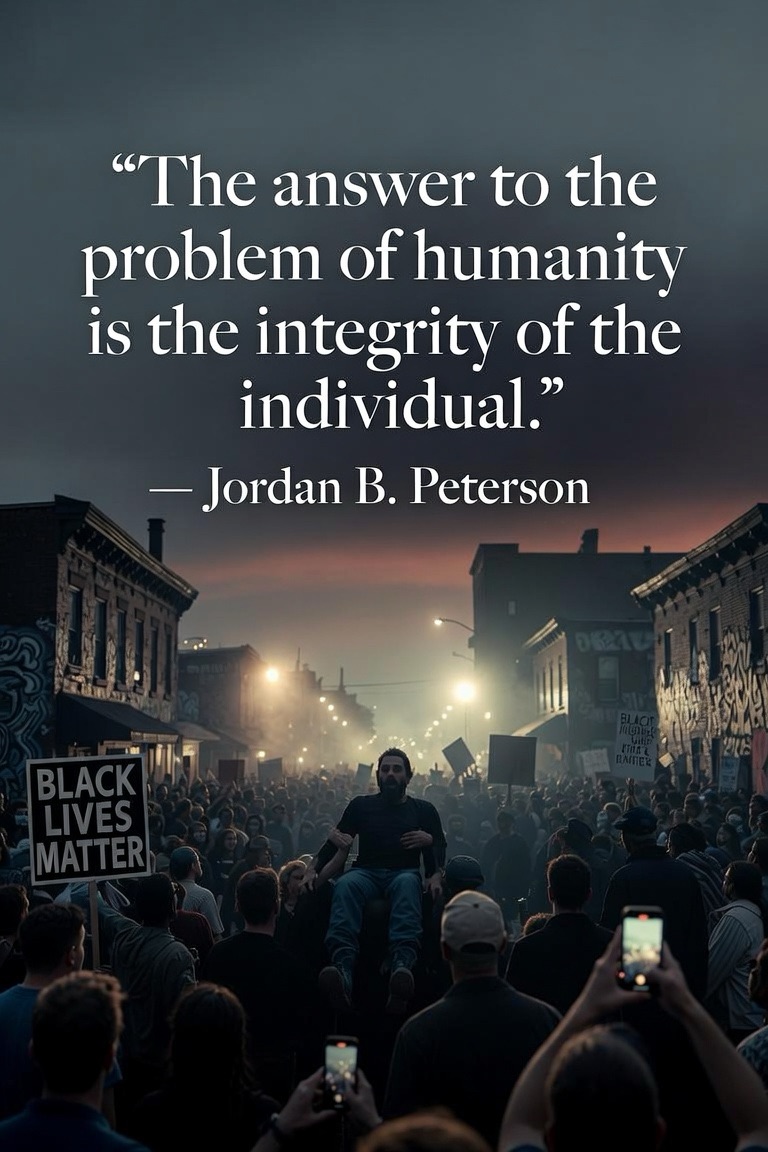
In a lecture examining the psychology of those who embrace solitude as a forge for original thought and voluntary responsibility, Jordan B. Peterson returns to a recurring theme that cuts through every domain of human organization: “The answer to the problem of humanity is the integrity of the individual. That’s the answer. So states that are predicated on that realization are healthy. So states that aren’t are doomed to stagnation and catastrophic collapse.”¹ (states meaning individual internal states.)
Peterson frames integrity not as abstract virtue but as the concrete capacity of persons to shoulder voluntary responsibility, tell the truth even when costly, and act competently under pressure rather than default to self-tyranny or the tyranny of the crowd. When individuals lack this integration—when policy, training, culture, or belief systems erode the incentive or the will to do what is right in the moment—systems fail.
The 2020 death of George Floyd in Minneapolis offers a stark, local case study in exactly this dynamic.
The Incident: Primary Sources Show Medical Distress, Policy Constraints, and Crowd Interference
On May 25, 2020, Minneapolis Police Department officers responded to a forgery call at Cup Foods. George Floyd, 46, had ingested a significant quantity of fentanyl and methamphetamine. Body-camera transcripts and trial testimony establish that Floyd repeatedly told officers “I can’t breathe” more than twenty times while being restrained.²
Officers Thomas Lane and J. Alexander Kueng initially attempted to place Floyd in a squad car. Floyd resisted, citing claustrophobia. Once on the ground, prone and handcuffed, Derek Chauvin placed his knee on Floyd’s neck for approximately nine and a half minutes. Lane asked twice whether Floyd should be rolled to his side; Chauvin declined. Bystanders grew in number—estimates placed the crowd at roughly twenty or more—and became increasingly vocal and, in places, physically aggressive. One bystander identifying as a Minneapolis Fire Department employee attempted to intervene and check Floyd’s pulse; Chauvin pointed mace at her and warned her off.³
When the ambulance arrived, officers directed it to stage at a distance rather than approach immediately. Floyd was already unresponsive. Paramedics later administered Narcan, but the window for effective intervention had narrowed. The Hennepin County Medical Examiner ruled the death a homicide caused by asphyxia due to neck compression, with contributing conditions including heart disease and the presence of fentanyl and methamphetamine.⁴
Minneapolis Police Department training at the time, according to testimony from the department’s medical support coordinator and training commander, instructed officers to roll prone subjects into the side recovery position to facilitate breathing and to begin CPR immediately if no pulse was detected—without waiting for an arriving ambulance.⁵ Officers are also trained on “excited delirium” or medical emergency protocols that can overlap with use-of-force scenes. Yet the dominant on-scene priority articulated in real time and reflected in policy emphasis was scene security, especially when bystanders were loud, close, and hostile.
The result was a cascade: policy and training that subordinated immediate life-saving medical intervention to crowd-management concerns; officers operating under that framework while distracted by interlopers; and a failure to create strong individual or departmental legal liability that would have forced the instantaneous, audible prioritization of “Narcan now” or “roll him now” over scene security theater.
Belief Systems That Shift Blame from Policymakers to Cops
In significant segments of Minneapolis discourse—particularly within activist networks, certain media frames, and portions of the local Black community—the dominant narrative located the failure almost exclusively in individual officer racism or “police brutality” as a systemic feature. This framing had real emotional power and surfaced genuine questions about use-of-force culture. But it systematically under-weighted the upstream policy architecture: training manuals, liability rules, collective-bargaining constraints, and departmental incentives that rewarded scene control over aggressive medical rescue in ambiguous, high-stress medical/use-of-force hybrids.
When belief systems collapse complex policy failure into a simple morality play of “cops versus community,” two distortions follow. First, the actual levers of reform—rewriting training to create affirmative duties with personal and departmental liability for failure to render aid, mandating immediate Narcan deployment in suspected overdose cases even amid crowd noise, and insulating officers who break formation to save a life—are obscured. Second, the narrative licenses collective action that punishes the wrong targets: small businesses (many minority-owned), neighborhoods already struggling with violence, and the legitimacy of any future reform effort. The 2020 riots that followed Floyd’s death produced an estimated $1–2 billion in insured damages nationwide, with Minneapolis suffering concentrated destruction in its own commercial corridors. Little of that destruction produced durable policy improvements in training liability or medical-emergency protocols.
Peterson’s point lands here with precision. When the integrity of the individual is subordinated to collective belief systems—whether those systems are departmental training that diffuses responsibility or activist ideologies that diffuse responsibility onto an entire profession—the result is not justice but entropy. Officers who might have acted with greater individual initiative under a different liability regime instead followed the safer, policy-compliant path. Citizens who might have demanded precise policy fixes instead burned the city. Policymakers who might have been held accountable for writing rules that predictably produced hesitation in medical crises escaped scrutiny behind the fog of “systemic” condemnation.
The Integrity of the Individual as Policy Corrective
Peterson’s lecture does not romanticize solitude for its own sake; it treats chosen aloneness as one crucible in which individuals develop the capacity to bear responsibility without collapsing into resentment or crowd conformity. Applied to the Floyd case, the same logic demands:
• Officers with sufficient individual integrity and training to recognize medical emergency and act—even when policy language is ambiguous and the crowd is loud. A regime of personal liability for failure to render aid would have aligned individual interest with that integrity.
• Bystanders with sufficient integrity to refrain from physically interfering or escalating to the point that officers reasonably perceived scene security as the overriding threat.
• Policymakers and training commanders with sufficient integrity to write rules that do not create perverse incentives—rules that treat suspected opioid distress or positional asphyxia risk as medical emergencies first, with use-of-force as a secondary, calibrated response.
• Citizens and commentators with sufficient integrity to distinguish between legitimate critique of specific policies and the destructive simplification that produces riots with no policy return.
States (and cities) predicated on the integrity of the individual remain healthier precisely because they incentivize and protect that integrity rather than diffusing it into collective narratives or bureaucratic cover.
Historical Parallels and Prior WeedPress Analysis
This is not the first time Minneapolis and surrounding communities have confronted the tension between structured militancy, informal community enforcement, and state policy. Earlier WeedPress analysis of the historical trajectories of groups such as the Black Panthers, Bloods, and Crips examined how community-based organizations that attempted to supply order, accountability, and mutual aid in the absence of functional state institutions often devolved into predation or were crushed when they challenged state monopoly on legitimate violence—while state policies that failed to create clear liability and positive duties for protection repeatedly produced the very disorder those groups claimed to remedy.⁶
The same structural pattern appears in the Floyd aftermath: belief systems that correctly identified problems in policing culture misdiagnosed the causal mechanism (individual moral failure versus policy design that erodes individual responsibility) and therefore prescribed solutions (defunding, de-policing, narrative warfare) that predictably increased disorder without repairing the underlying incentive structure. Individual integrity—whether of officers willing to deviate from flawed training to save a life, or of citizens willing to demand better rules rather than burn the neighborhood—remains the only reliable corrective.
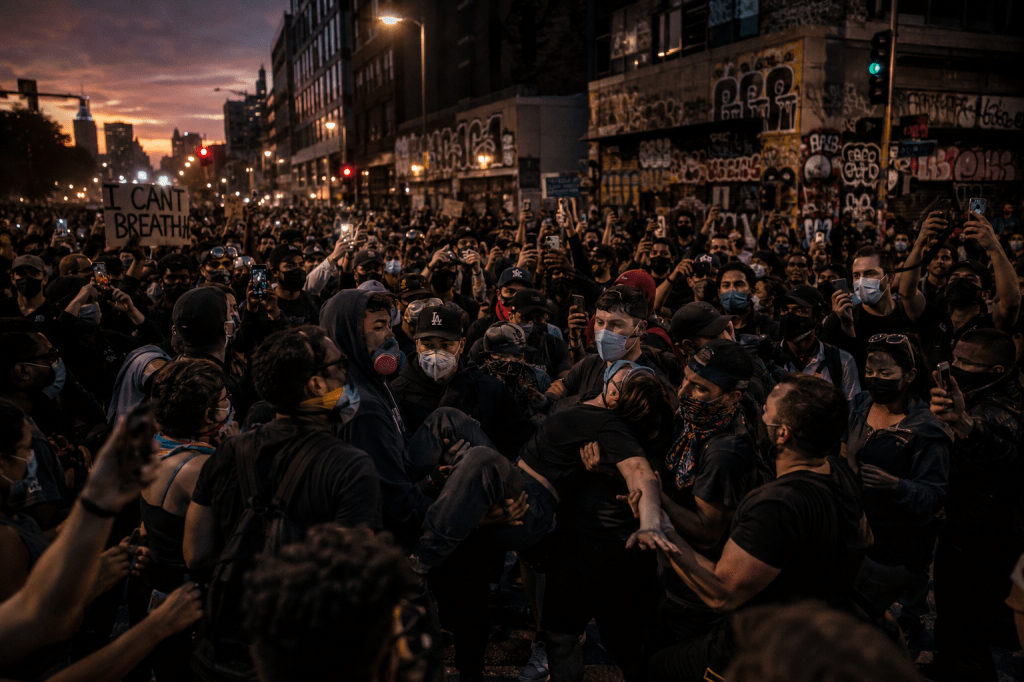
Toward Policy That Rewards Integrity
Practical reforms consistent with Peterson’s diagnosis would include:
1. Statutory or departmental rules creating affirmative, personal liability for failure to render immediate medical aid (including Narcan deployment and positional change) in any situation where an individual is in obvious or suspected medical distress, with qualified immunity cabined accordingly.
2. Training overhaul that treats suspected overdose or positional asphyxia as primary medical emergencies requiring audible, recorded commands for aid even when bystanders are present and hostile.
3. After-action review protocols that evaluate not only use of force but also the speed and decisiveness of medical intervention, with career consequences for diffusion of responsibility.
4. Public education and community standards that distinguish between accountability for policy failure and collective punishment of entire professions or neighborhoods.
None of these reforms require abandoning legitimate scrutiny of use-of-force incidents. They require restoring the integrity of the individual—officer, citizen, and policymaker—as the unit of analysis and the unit of responsibility.
Peterson’s lecture on solitude and responsibility ends with a practical injunction: shoulder your cross voluntarily, reduce overwhelming responsibility to tolerable increments, and move forward. Applied to Minneapolis and to every jurisdiction still wrestling with the aftermath of 2020, the prescription is the same. Fix the policy. Insist on individual integrity. Refuse the false choice between collective blame that destroys cities and individual evasion that leaves preventable deaths unexamined. The states—and the cities—that predicate their order on that realization will be the ones that remain functional rather than doomed to stagnation and collapse.
Footnotes
¹ Jordan B. Peterson, Psychology of People Who Love Being Alone, YouTube (July 10, 2026), https://youtu.be/GBG4k61oUZM.
² Associated Press, Bodycam transcripts reveal more detail in Floyd case (July 9, 2020), https://www.police1.com/officer-misconduct-internal-affairs/articles/bodycam-transcripts-reveal-more-detail-in-floyd-case-ZmP5hFkutHvFKJSw/.
³ Testimony and reporting from United States v. Kueng et al. (D. Minn. federal civil-rights trial, 2022), as covered in PBS NewsHour and contemporaneous trial coverage.
⁴ Hennepin County Medical Examiner autopsy findings on George Floyd (publicly referenced throughout State v. Chauvin proceedings and related coverage).
⁵ Testimony of Nicole Mackenzie, Minneapolis Police Department medical support coordinator and training instructor, in the federal civil-rights trial of the other officers (January–February 2022).
⁶ Jason Karimi, Crips and Bloods, Black Panthers Pray Publicly In Christ Name To Unite All Colors And Creeds | 38th And Chicago Minneapolis 5-29-2020, https://weedpress.org/2020/05/31/crips-and-bloods-black-panthers-pray-publicly-in-christ-name-to-unite-all-colors-and-creeds-38th-and-chicago-minneapolis-5-29-2020/
 WeedPress: The Paper Trail
Leave a comment