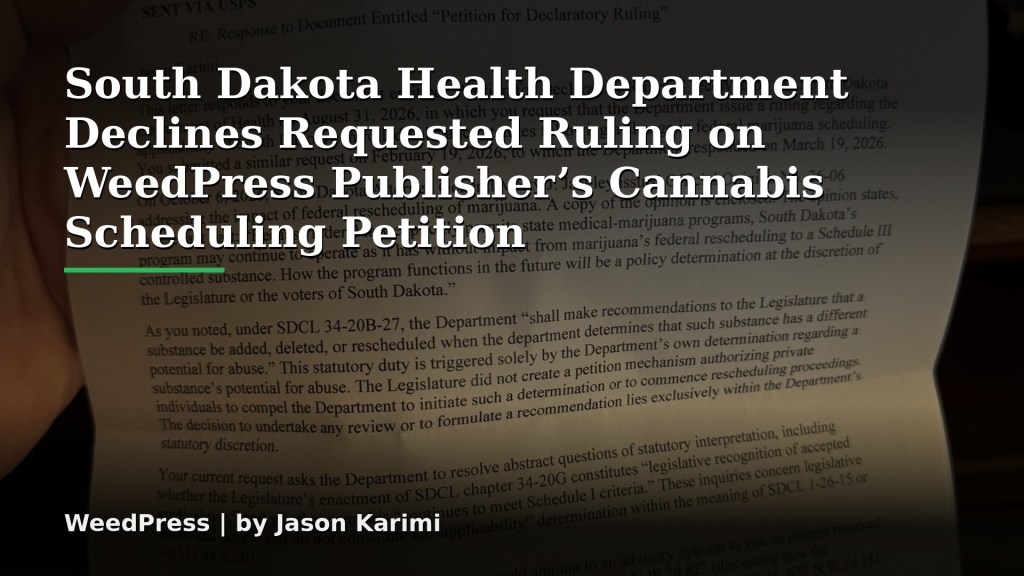
In an Oct. 22 letter, the department’s chief legal counsel said the August petition sought an advisory opinion, raised policy questions for lawmakers rather than a question for the declaratory-ruling process, and that a private petition could not compel the department to begin a scheduling review. The department said it remains willing to accept materials for staff consideration.
By Jason Karimi, Publisher
Disclosure: WeedPress publisher Jason Karimi, the author of this article, filed the petition described here and received the department’s letter. Because he is a party, this article quotes the department’s reasoning at length and links the letter so readers can read it directly. The posted copy has his street address redacted; nothing else is removed.
The South Dakota Department of Health has declined a petitioner’s request for a declaratory ruling on whether hashish, hash oil and tetrahydrocannabinol still meet South Dakota’s Schedule I criteria. The petition raised that question after the federal government moved marijuana subject to a state medical-marijuana license to federal Schedule III.¹,² In a two-page letter dated Oct. 22, 2026, Jennifer M. Jorgenson, a special assistant attorney general and the department’s chief legal counsel, wrote that the department “declines to issue what would amount to an advisory opinion to you on matters reserved to the Legislature.”³
The letter responds to a “Petition for Declaratory Ruling” that the department received Aug. 31 from WeedPress publisher Jason Karimi, a registered South Dakota medical cannabis patient.³,⁴ The department’s letter describes it as his second such request this year, saying he “submitted a similar request on February 19, 2026, to which the Department responded on March 19, 2026.”³,⁵
What the petition asked
The August petition asked the department to decide whether hashish, hash oil and tetrahydrocannabinol, as listed in state Schedule I at South Dakota Codified Laws (SDCL) 34-20B-14(10) and (20), still satisfy all three criteria that SDCL 34-20B-11 sets for Schedule I. One of those criteria is “no accepted medical use in the United States.” The petition asked that question in light of the April 28, 2026, federal order placing marijuana subject to a state medical-marijuana license in federal Schedule III,¹ and in light of the department’s own administration of the state medical cannabis program under SDCL chapter 34-20G.⁴,⁶
If any listed substance no longer met the criteria, the petition asked whether SDCL 34-20B-27 required the department to recommend to the Legislature that it be deleted from Schedule I or rescheduled.⁴,⁷ The petition stated that it did not ask the department to amend the statutes, because “[o]nly the Legislature can add, delete, or reschedule a substance.”⁴
What the department said
The letter gives four reasons for declining. It opens with the Attorney General. “On October 6, 2026, South Dakota Attorney General Marty J. Jackley issued Official Opinion No. 26-06 addressing the impact of federal rescheduling of marijuana,” the letter says, enclosing a copy and quoting this passage:³
“Because federal law explicitly permits state medical-marijuana programs, South Dakota’s program may continue to operate as it has without impact from marijuana’s federal rescheduling to a Schedule III controlled substance. How the program functions in the future will be a policy determination at the discretion of the Legislature or the voters of South Dakota.”³,²
Second, the letter says the scheduling statute leaves the decision whether to start a review to the department’s own discretion. It quotes SDCL 34-20B-27, which says the department “shall make recommendations to the Legislature that a substance be added, deleted, or rescheduled when the department determines that such substance has a different potential for abuse.”³,⁷ The letter continues:
“This statutory duty is triggered solely by the Department’s own determination regarding a substance’s potential for abuse. The Legislature did not create a petition mechanism authorizing private individuals to compel the Department to initiate such a determination or to commence rescheduling proceedings. The decision to undertake any review or to formulate a recommendation lies exclusively within the Department’s statutory discretion.”³
Third, the letter says the petition does not raise the kind of question the declaratory-ruling process covers. It describes the request as asking the department “to resolve abstract questions of statutory interpretation, including whether the Legislature’s enactment of SDCL chapter 34-20G constitutes ‘legislative recognition of accepted medical use,’ and whether cannabis ‘continues to meet Schedule I criteria.’” Those inquiries, the letter says, “concern legislative intent and policy and do not constitute an ‘applicability’ determination within the meaning of SDCL 1-26-15 or ARSD 44:62:01.”³
Fourth, the letter cites separation-of-powers principles. It cites State v. Schroeder, 2004 S.D. 21, 674 N.W.2d 827, which it describes as “discussing how the Legislature is tasked with changing controlled substance laws,” and State v. Moschell, 2004 S.D. 35, 677 N.W.2d 551, quoting it for the principle that “[N]o branch may encroach on the powers of another.”³,⁸
On its second page, the letter says the department “remains willing to receive and review information submitted by members of the public,” that materials “will be forwarded to the appropriate program staff for consideration,” and that additional background materials or data may be submitted “at any time.” It adds that “any decision to initiate a statutory review or to issue a recommendation must be based on the Department’s independent assessment under SDCL 34-20B-27 and, if made, will be directed to the Legislature in accordance with statute.” The letter also suggests contacting legislators, “as decisions regarding controlled-substance policy fall within the Legislature’s authority,” and links the Legislature’s contact list.³
The Attorney General’s opinion
The department cited Official Opinion 26-06 in its letter. According to the opinion, it answered a question from members of the Legislature’s Medical Marijuana Oversight Committee about how federal rescheduling would affect South Dakota’s program. It concluded that the impact on South Dakota’s medical-marijuana program would likely be “negligible.”² The opinion also said that if South Dakota chose to move marijuana to Schedule III, that action “would have to be taken by either the Legislature or the voters, independent from the rescheduling of marijuana federally.”²
The opinion addressed which state office weighs scheduling questions. “The Department of Health is statutorily tasked with making recommendations to the Legislature as to where particular substances should be placed on the Schedule,” it says. “The Attorney General is not the entity statutorily designated to make determinations on abuse and dependence risks for particular substances.”² It also states that “marijuana is not scheduled in South Dakota as a controlled substance pursuant to SDCL ch. 34-20B,” although possession and distribution remain prohibited outside the medical program.² The August petition concerned the separate Schedule I listings for hashish, hash oil and tetrahydrocannabinol.⁴
The rules on declaratory rulings
State law requires each agency to “provide by rule for the filing and prompt disposition of a petition for declaratory ruling as to the applicability of any statutory provision or of any rule or order of the agency.” It also says, “A ruling disposing of a petition has the same status as an agency decision or order in a contested case.”⁹ The department’s rule, in the Administrative Rules of South Dakota, or ARSD, allows it to ask the petitioner for more information. The rule says that within 60 days after receiving a petition, or after receiving information it requested, the department “shall issue its declaratory ruling and serve a copy by mail on the petitioner.”¹⁰
The Oct. 22 letter is dated 52 days after the department received the petition. It was sent by U.S. mail and does not state a separate service date. The letter does not request more information. It also does not expressly say whether the department considers the letter a ruling disposing of the petition under SDCL 1-26-15. SDCL 1-26-31 says an appeal from a final agency decision must be taken within 30 days after the agency served notice of the decision. This article does not determine whether the Oct. 22 letter is such a decision.³,⁹,¹¹
What the department says can happen next
The department’s letter says Karimi may submit materials for staff consideration, with any review left to the department’s “independent assessment,” and may contact legislators.³
The department’s full letter, with the publisher’s street address redacted, is posted in the WeedPress Records Library. The enclosed copy of the Attorney General’s opinion was not legible in WeedPress’s photograph of the letter; the official text is linked instead.³,² Tips or documents: weedpressnewstips@gmail.com
Update: Karimi’s reply
WeedPress publisher Jason Karimi, who filed the petition, sent the department a written reply on Oct. 29, 2026, addressed to Jorgenson. The letter makes two requests.
First, it accepts the department’s offer to receive materials and asks the department to use its discretion under SDCL 34-20B-27 to determine whether hashish, hash oil and tetrahydrocannabinol, listed in Schedule I at SDCL 34-20B-14(10) and (20), have “a different potential for abuse.” Under that statute, such a determination would lead to a recommendation to the Legislature. The letter asks the department to say in writing whether it will undertake the review. It cites the federal rescheduling order, 91 Fed. Reg. 22,714, and Attorney General Official Opinion No. 26-06.
Second, it asks the department to confirm whether it regards its Oct. 22 letter as its ruling disposing of the petition under SDCL 1-26-15 and ARSD 44:62:01:02. It says Karimi will otherwise treat the Oct. 22 letter as the department’s final disposition of the petition and reserves his rights to judicial review.
Read Karimi’s Oct. 29 letter (PDF, contact details redacted).
Related coverage
- WeedPress Asks South Dakota Health Department to Rule Whether Schedule I Cannabis Still Fits the State’s Own Statute
- “We Don’t Think Anything Has Changed”: Full Transcript of the South Dakota AG’s Office on Federal Rescheduling
- South Dakota’s Attorney General Answered the Schedule III Question. The Department of Health Still Has Its Own Statute to Answer.
- South Dakota Attorney General Says Federal Schedule III Has “Negligible Impact” on State Medical Program; MMOC Receives Patient and Advocacy Materials
- Advance Notice to South Dakota Department of Health: Petition for Scheduling Review Will Follow Federal Rescheduling Hearings
- South Dakota’s Schedule I Problem Is Now in the Administrative Record
Notes
¹ Schedules of Controlled Substances: Rescheduling of Food and Drug Administration Approved Products Containing Marijuana From Schedule I to Schedule III; Corresponding Change to Permit Requirements, 91 Fed. Reg. 22,714 (Apr. 28, 2026) (placing in Schedule III certain FDA-approved drug products and “marijuana subject to a state medical marijuana license”), https://www.federalregister.gov/documents/2026/04/28/2026-08176/schedules-of-controlled-substances-rescheduling-of-food-and-drug-administration-approved-products.
² S.D. Att’y Gen., Official Op. No. 26-06, Official Opinion Concerning Impact of Federal Rescheduling of Marijuana (Oct. 6, 2026), https://atg.sd.gov/OurOffice/OfficialOpinions/opinionhtml.aspx?id=1779.
³ Letter from Jennifer M. Jorgenson, Special Assistant Att’y Gen. & Chief Legal Counsel, S.D. Dep’t of Health, to Jason Karimi, at 1–2 (Oct. 22, 2026) (sent via USPS; street address redacted by WeedPress), https://weedpress.org/wp-content/uploads/2026/10/2026-10-22-doh-response-to-aug-31-petition-redacted.pdf.
⁴ Jason Karimi, Petition for Declaratory Ruling (S.D. Dep’t of Health, received Aug. 31, 2026) (on file with WeedPress); see Jason Karimi, WeedPress Asks South Dakota Health Department to Rule Whether Schedule I Cannabis Still Fits the State’s Own Statute, WeedPress (Aug. 31, 2026), https://weedpress.org/2026/08/31/weedpress-asks-south-dakota-health-department-to-rule-whether-schedule-i-cannabis-still-fits-the-states-own-statute/.
⁵ Jason Karimi, South Dakota DOH Avoids the Merits on Cannabis Scheduling, Hides Behind Procedure, WeedPress (Mar. 19, 2026), https://weedpress.org/2026/03/19/south-dakota-doh-avoids-the-merits-on-cannabis-scheduling-hides-behind-procedure/.
⁶ S.D. Codified Laws §§ 34-20B-11, 34-20B-14(10), (20), https://sdlegislature.gov/Statutes/34-20B-11; https://sdlegislature.gov/Statutes/34-20B-14.
⁷ S.D. Codified Laws § 34-20B-27, https://sdlegislature.gov/Statutes/34-20B-27.
⁸ State v. Schroeder, 2004 S.D. 21, 674 N.W.2d 827; State v. Moschell, 2004 S.D. 35, 677 N.W.2d 551 (both as cited and described in Jorgenson letter, supra note 3).
⁹ S.D. Codified Laws § 1-26-15, https://sdlegislature.gov/Statutes/1-26-15.
¹⁰ S.D. Admin. R. 44:62:01:01, 44:62:01:02, https://sdlegislature.gov/Rules/Administrative/44:62:01:02.
¹¹ S.D. Codified Laws § 1-26-31, https://sdlegislature.gov/Statutes/1-26-31.



Leave a Reply