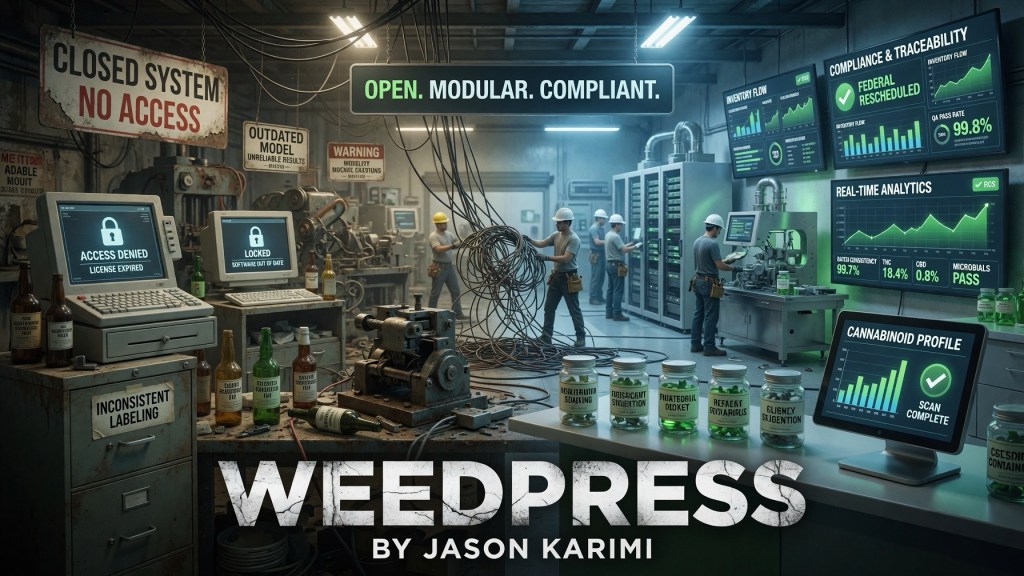
The cannabis industry is still operating on incomplete infrastructure—both technological and scientific. That was the central message of a recent Trade to Black episode from The Dales Report, featuring Flowhub founder and CEO Kyle Sherman and Dr. Paul Shields.¹ The conversation made clear that many of the systems currently supporting cannabis retail and medical use were never built for the industry’s next phase. As federal rescheduling advances and the market matures, those foundational weaknesses are becoming harder to ignore.
Closed Technology Ecosystems Are Holding Retailers Back
Kyle Sherman argued that many dispensaries remain locked into single-vendor technology platforms that attempt to handle point-of-sale, e-commerce, payments, loyalty, compliance, and analytics under one roof.² These closed systems create significant problems.
When a retailer is dependent on a single company’s entire stack, it loses the ability to select best-in-class tools for each function. The operator becomes constrained by the vendor’s development roadmap, pricing decisions, and priorities rather than by what the market and customers actually require. In an industry that is becoming more competitive and more sophisticated, this lack of flexibility is a structural disadvantage.
Sherman emphasized that retailers need to own four critical assets themselves:
• Their customer relationships
• Their data
• Their brand experience across channels
• The freedom to choose technology partners
Without control over these elements, operators remain dependent on platforms that were never designed to serve the full range of modern retail needs.
Headless Commerce as a Practical Path Forward
The solution Sherman described is a form of headless commerce—what Flowhub calls Open Ecommerce. Under this model, the core system (typically the POS and inventory backbone) remains in place, while the customer-facing shopping experiences are decoupled and flexible.³
This architecture allows operators to build custom websites, mobile apps, kiosks, and additional sales channels without replacing their entire technology stack. The result is modularity: retailers can adopt new tools and channels as they emerge without being forced into costly and disruptive system overhauls.
The broader implication is straightforward. As cannabis retail moves toward multi-channel operations and more demanding customers, the operators who control their data and customer relationships—and who can integrate best-in-class tools—will be better positioned than those locked into rigid, closed platforms.
Retail-Dose Versus Therapeutic-Dose CBD
In the medical portion of the discussion, Dr. Paul Shields highlighted a significant gap between retail-dose and therapeutic-dose CBD products.⁴ Retail-dose products are generally formulated at lower concentrations for consumer wellness and lifestyle use. Therapeutic-dose products require higher, more consistent concentrations intended for medical purposes.
This distinction creates practical problems. Many products currently on the market are manufactured and standardized for the retail consumer side. Patients seeking reliable therapeutic effects often encounter inconsistent dosing and manufacturing standards that were never designed for medical use. The result is a mismatch between patient expectations and product performance.
Real Drug Interaction Risks
Shields also stressed that cannabinoids, particularly CBD, carry genuine interaction risks with conventional medications.⁵ Two categories received particular attention:
• Blood thinners (anticoagulants), where CBD’s effects on liver enzymes can alter how these drugs are metabolized.
• Antiepileptic medications, where interactions may change effectiveness or side-effect profiles.
These risks are under-discussed in much of the consumer-facing conversation around CBD. As more patients combine cannabinoids with existing prescriptions, the potential for clinically significant interactions requires greater attention from both consumers and healthcare providers.
Terpenes and the Entourage Effect Remain Open Questions
Finally, Shields noted that the widely discussed “entourage effect”—the theory that cannabinoids and terpenes work synergistically—still rests on incomplete scientific evidence.⁶ Open research questions remain regarding:
• Whether observed benefits are truly synergistic or largely additive
• Which specific combinations produce reliable, measurable outcomes
• How manufacturing and formulation affect whether any entourage effect is present in finished products
The industry frequently presents the entourage effect as established fact. The research, however, has not fully caught up to the marketing claims.
Broader Implications
Taken together, the two segments of the discussion point to the same underlying problem: cannabis is still operating on incomplete foundations. On the technology side, closed systems limit retailer autonomy and slow adaptation. On the medical side, dosing inconsistencies, under-examined drug interactions, and incomplete research on the entourage effect create reliability and safety gaps.
As the industry moves further into a post-rescheduling environment, these weaknesses will matter more. Operators who control their data, customer relationships, and technology choices will have structural advantages. Patients and providers who demand clearer dosing standards and better information on interactions will push the market toward higher-quality products. The systems built during the early, more fragmented phase of legalization are no longer sufficient.
Cannabis is being forced to rebuild from the ground up—not because the industry is failing, but because the next phase of growth requires better infrastructure than the current one provides.
Footnotes
¹ Cannabis Is Being Rebuilt From The Ground Up | TTB Presented by Flowhub, TDR (The Dales Report), YouTube (July 22, 2026), https://www.youtube.com/watch?v=MnZp-azMce0.
² Id. (discussion with Kyle Sherman, Founder and CEO of Flowhub).
³ Id.
⁴ Id. (Vantage Standard segment with Dr. Paul Shields).
⁵ Id.
 WeedPress: The Paper Trail
Leave a comment