Related: Not for Sale: Hot Springs Votes to Ban Cannabis License Sales, Require City OK for Control Changes (Oct. 31, 2026; updated Nov. 2)
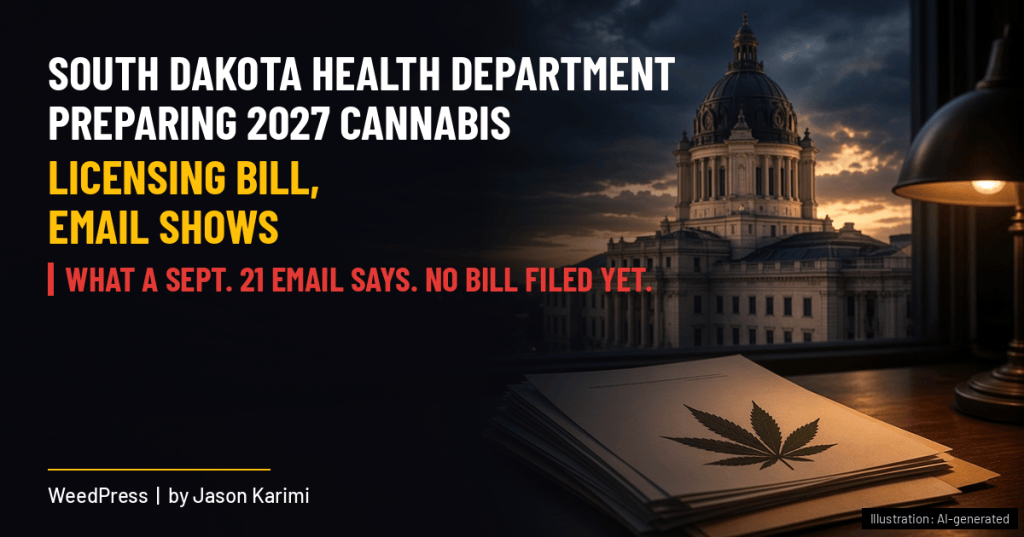
A Sept. 21 email says the department wants to give cities and counties more say over who gets medical cannabis establishment registrations when local caps limit how many can open.
By Jason Karimi, Publisher
The short version
- In a Sept. 21 email about a stakeholder meeting for municipalities, the South Dakota Department of Health said it was preparing legislation for the 2027 session to revise four sections of the state’s medical cannabis law: SDCL 34-20G-55, -56, -58 and -72.¹
- The email says the changes would give municipalities and counties “express authority” to set rules for choosing among applicants when more apply than a local limit allows, and would “remove or modify certain Department requirements” for establishments seeking state certification.¹
- WeedPress has not seen the draft, no 2027 bill had been filed as of Nov. 2, and the email does not say which requirements would change.¹,²
- WeedPress obtained the email through an open records request to the City of Hot Springs.³
The South Dakota Department of Health said in a September email that it was preparing legislation for the 2027 session that would give municipalities and counties “express authority to establish and apply rules for determining registration preferences” when more businesses seek state registration certificates, which work as the state’s medical cannabis establishment licenses, than a local cap allows.¹
The proposed legislation, according to the Sept. 21 email, “would remove or modify certain Department requirements for establishments applying for state certification.” The email does not say which requirements.¹
WeedPress has not seen the draft, and as of Nov. 2 no 2027 bill had been filed.¹,²
What the email says
The email came from Whitney Brunner, administrator of the department’s Office of Medical Cannabis in the Division of Licensure and Accreditation. It was sent Sept. 21 at 10:52 a.m. under the subject line “Medical Cannabis Legislation Stakeholder Forum.”¹
“The Department of Health is preparing legislation for the 2027 Legislative Session to revise SDCL 34-20G-55, 34-20G-56, 34-20G-58, and 34-20G-72,” Brunner wrote. “The proposed changes would give municipalities and counties express authority to establish and apply rules for determining registration preferences when more applicants seek registration than the local numerical limit allows and would remove or modify certain Department requirements for establishments applying for state certification.”¹
The email said the department would host a virtual stakeholder meeting “for municipalities to provide feedback on the proposed legislation,” said “the draft legislation will be distributed prior to the meeting,” and requested responses to a scheduling poll by Friday, Sept. 25.¹
No draft is attached. In the copy the city provided, the email is addressed to Brunner’s own address, and no other recipients are shown, so it does not show which municipalities received it or whether any counties received separate notice.¹
What the four sections say now
Section 34-20G-55 lists what the department needs before it registers an establishment. Within 90 days of an application, the department “shall register” an establishment that submits the fee; an application listing its name, address and officers and board members, plus “any additional information requested by the department”; operating procedures; a sworn statement on local zoning where a city or county has zoning restrictions; and any required local registration, license or permit. The address may not be within 1,000 feet of an existing school. No officer or board member may have served with an establishment whose registration was revoked, none may be under 21, and at least one principal officer must be a South Dakota resident.⁴
Section 34-20G-56 covers local caps. If a county or municipality “has enacted a numerical limit” and more applicants seek registration, “the department shall solicit and consider input” from the county or municipality “as to its preference for registration.”⁵
Section 34-20G-58 lets a municipality adopt an ordinance “not in conflict with this chapter” setting time, place and manner rules; “a limit on the number” of establishments; setbacks and distance rules; a local license, permit or registration; and “reasonable fees.” A county may adopt an ordinance on the same matters; it applies throughout the county except inside a municipality that has its own ordinance under the section.⁶
Section 34-20G-72 tells the department to write rules on many subjects. One is “a system to numerically score competing medical cannabis establishment applicants, in cases where more applicants apply than are allowed by the local government.” The score must include “the preference of the local government”; for dispensaries, the location’s suitability and accessibility for patients; the “character, veracity, background, qualifications, and relevant experience” of principal officers and board members; and the applicant’s business plan.⁷
How the state chooses now where local caps apply
Under the department’s current rules, when more establishments apply than a local government allows, the department scores each application on one-point criteria worth up to six points. One point is for a local government’s endorsement of the application “as beneficial to the community.” Another is for the local government not telling the department the location is unsuitable “due to zoning regulations or inaccessibility to the public.”⁸ Certificates go out in score order until the overall local limit, or the limit for each establishment type, is reached. If applicants tie, “the affected applicants and interested members of the public must have the opportunity to view, in person or via videoconference, a random lottery” that ranks them and sets a waiting list.⁹ Those two rules were not among the medical cannabis rules amended effective Nov. 5.¹⁰
In WeedPress’s reading, that means a local government’s preference is now one part of a state scoring system, worth up to two of six points, and ties go to a lottery. The email says the proposed legislation would give local governments “express authority to establish and apply rules for determining registration preferences.” That could go beyond the input role the law gives them now. But the email does not say what local rules would be allowed, how much weight they would carry, or whether the state scoring system or the lottery would remain.¹,⁸,⁹
For establishments, the email says only that “certain Department requirements” for state certification would be removed or modified. Section 34-20G-55 is where the law lists the conditions for state registration, but the email does not say which of them, if any, would change.¹,⁴
How WeedPress got the email
On Oct. 31, WeedPress asked the City of Hot Springs for records about Ordinance 1293, which bars the sale, assignment, pledge or lease of city cannabis licenses and requires city approval before any change in control.¹¹ One item asked for an email mentioned at the City Council’s Sept. 21 meeting, whose minutes noted that “possible changes in SDCL could guide direction of ordinance change.”¹²
Finance Officer Misty Summers-Walton answered the request Nov. 2 and copied City Administrator Aerial Allison on that item.¹³ Allison replied that afternoon: “Email referenced in #5 is attached.”³ The attachment is Brunner’s email, which Mary Hardy of the City of Hot Springs forwarded at 11:49 a.m. on Sept. 21 to Allison and Summers-Walton, with Mayor Bob Nelson copied, under the note “FYI.”¹,¹¹
The email does not mention license sales, transfers or ownership changes, the subject of Ordinance 1293.¹,¹¹ WeedPress redacted only the email’s scheduling-poll link before publishing it. Read the email (PDF). It is also in the WeedPress Records Library.¹,¹⁴
What isn’t known
- The draft. The email says it would be distributed before the stakeholder meeting. WeedPress has not seen it.¹
- The meeting. The email does not give a date, and WeedPress does not know whether the meeting has been held, who was invited or who attended.¹
- Which requirements would change. The email does not list them.¹
- Whether a bill will be filed. As of Nov. 2, the Legislature’s website listed no bills for the 2027 session.² Any bill that is filed could differ from the plan described in the email.
WeedPress asked the Department of Health on Nov. 2 for the draft and for comment on these questions, and requested a reply by 5 p.m. CT Wednesday, Nov. 4. A department spokesperson replied Nov. 2 that the department would answer the questions separately; it had not done so by publication. WeedPress also requested the draft, the meeting invitation and recipient list, meeting materials and municipal comments under the state’s open records law. This story will be updated with any response.¹⁵
What readers can do
- Follow the 2027 session. The session opens Jan. 12, 2027. By WeedPress’s calculation under state law, prefiling opens Dec. 13, 2026. WeedPress’s 2027 South Dakota Cannabis Bill Tracker will add a bill on this subject if one is filed.¹⁶,¹⁷
- Read the bill when it is filed. Bills filed for the 2027 session will be listed on the Legislature’s 2027 bills page.²
- Ask your city or county. Where establishments are capped, you can ask your city council or county commission whether it received the draft and what feedback, if any, it gave.
- Contact the department and your legislators. The department’s medical cannabis program page lists contact information for the program.¹⁸ You can also share your views with your own state legislators.
Know when the stakeholder meeting was held, or seen the draft? Send tips to weedpressnewstips@gmail.com.
Notes
¹ Email from Whitney Brunner, Adm’r, Office of Med. Cannabis, Div. of Licensure & Accreditation, S.D. Dep’t of Health (Sept. 21, 2026, 10:52 a.m.) (“Medical Cannabis Legislation Stakeholder Forum”), forwarded by Email from Mary Hardy, City of Hot Springs, to Aerial Allison, City Adm’r, and Misty Summers-Walton, Fin. Officer, City of Hot Springs (Sept. 21, 2026, 11:49 a.m.) (provided by the City of Hot Springs Nov. 2, 2026; scheduling-poll link redacted by WeedPress), https://weedpress.org/wp-content/uploads/2026/10/hot-springs-doh-medical-cannabis-legislation-email-2026-09-21-redacted.pdf.
² S.D. Legis. Rsch. Council, Bills: 2027 Session (102nd Session), https://sdlegislature.gov/Session/Bills/174 (no bills listed when checked Nov. 2, 2026, 3:03 p.m. CST).
³ Email from Aerial Allison, City Adm’r, City of Hot Springs, to Jason Karimi, Publisher, WeedPress, and Misty Summers-Walton, Fin. Officer, City of Hot Springs (Nov. 2, 2026, 2:46 p.m. CST) (response to item 5 of open records request under S.D. Codified Laws ch. 1-27) (on file with WeedPress).
⁴ S.D. Codified Laws § 34-20G-55 (2026), https://sdlegislature.gov/Statutes/34-20G-55.
⁵ S.D. Codified Laws § 34-20G-56 (2026), https://sdlegislature.gov/Statutes/34-20G-56.
⁶ S.D. Codified Laws § 34-20G-58 (2026), https://sdlegislature.gov/Statutes/34-20G-58.
⁷ S.D. Codified Laws § 34-20G-72(2) (2026), https://sdlegislature.gov/Statutes/34-20G-72.
⁸ S.D. Admin. R. 44:90:03:15 (2026), https://sdlegislature.gov/Rules/Administrative/44:90:03:15.
⁹ S.D. Admin. R. 44:90:03:16 (2026), https://sdlegislature.gov/Rules/Administrative/44:90:03:16.
¹⁰ Filings with the Office of the Secretary of State: Final Administrative Rules, Department of Health, 53 S.D. Reg. 56 (Oct. 26, 2026), https://mylrc.sdlegislature.gov/api/Documents/Register/308659.pdf (listing ARSD art. 44:90 amendments effective Nov. 5, 2026; §§ 44:90:03:15 and 44:90:03:16 not listed).
¹¹ Jason Karimi, Not for Sale: Hot Springs Votes to Ban Cannabis License Sales, Require City OK for Control Changes, WeedPress (Oct. 31, 2026; updated Nov. 2, 2026), https://weedpress.org/2026/10/31/hot-springs-ordinance-1293-cannabis-license-sales/.
¹² City of Hot Springs, Minutes of the Regular City Council Meeting (Sept. 21, 2026) (Administrative and Finance Committee report), https://hotspringssd.gov/Documents/Government/City%20Council/2026/09212026/MIN09212026.pdf.
¹³ Email from Misty Summers-Walton, Fin. Officer, City of Hot Springs, to Jason Karimi, Publisher, WeedPress (Nov. 2, 2026, 2:27 p.m. CST) (response to open records request under S.D. Codified Laws ch. 1-27) (on file with WeedPress).
¹⁴ WeedPress, WeedPress Records Library, Other South Dakota records, https://weedpress.org/records-library/#sdother.
¹⁵ Email from Jason Karimi, Publisher, WeedPress, to S.D. Dep’t of Health, Office of Commc’n & Mktg., and Office of Med. Cannabis (Nov. 2, 2026) (press questions and open records request under S.D. Codified Laws ch. 1-27; answers requested by Nov. 4, 2026, 5 p.m. CST) (on file with WeedPress).
¹⁶ WeedPress, 2027 South Dakota Cannabis Bill Tracker (updated Nov. 2, 2026), https://weedpress.org/cannabis-bill-tracker/.
¹⁷ S.D. Codified Laws § 2-7-4 (2026), https://sdlegislature.gov/Statutes/2-7-4.
¹⁸ S.D. Dep’t of Health, Medical Cannabis Program, https://doh.sd.gov/programs/medical-cannabis/ (last visited Nov. 2, 2026).



Leave a Reply