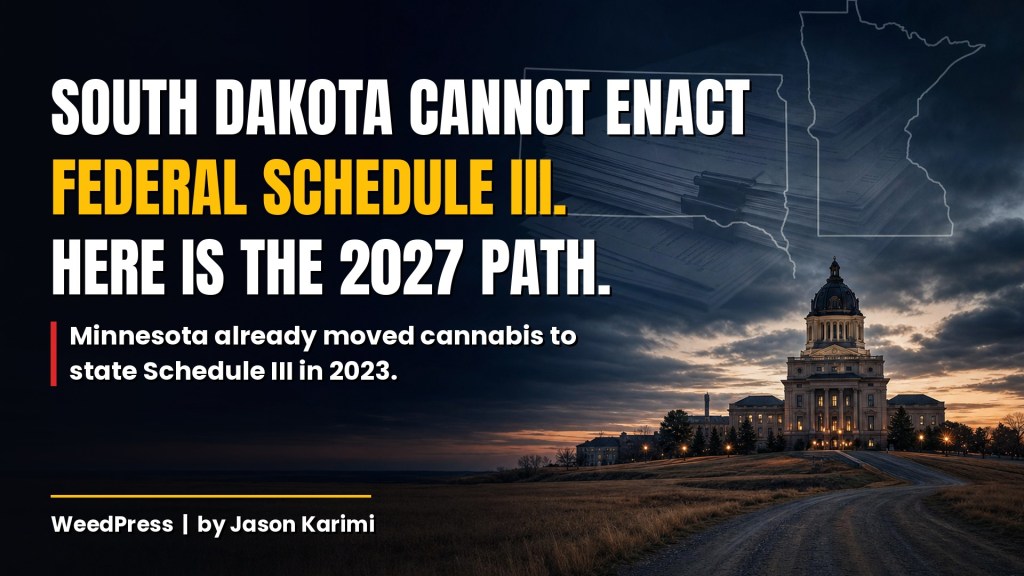
Federal placement of state-licensed medical cannabis in Schedule III does not rewrite South Dakota’s controlled-substances list.¹ Pierre does not vote on the Controlled Substances Act. What Pierre can do is what Minnesota did in 2023: amend its own state schedule so that THC is no longer treated as a Schedule I substance under state law.²
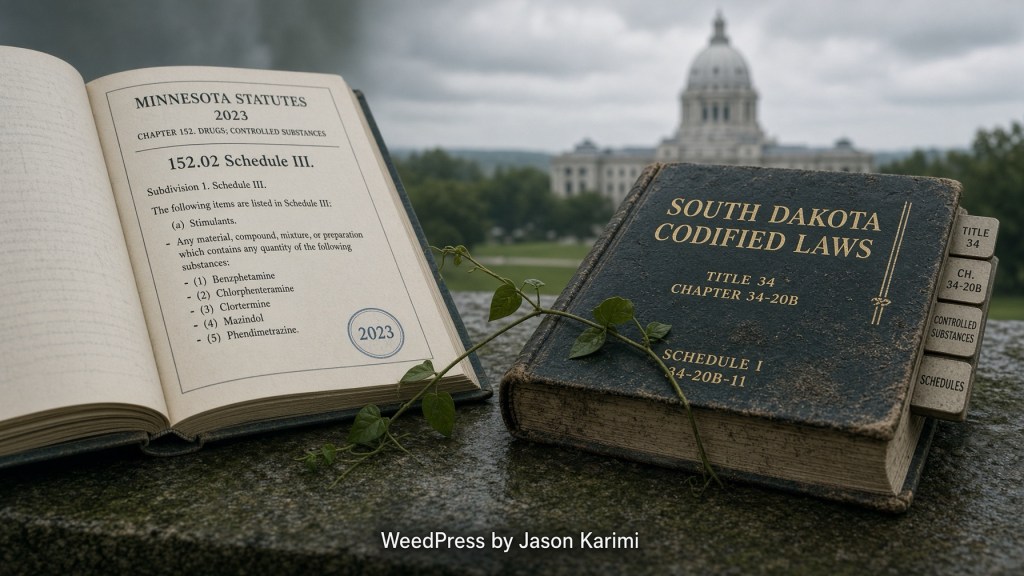
That year, the Minnesota Legislature enacted H.F. 100, signed into law as chapter 63 of the 2023 Minnesota Session Laws. Article 8 of the act, titled “Scheduling of Marijuana,” removed marijuana and tetrahydrocannabinols from Minnesota’s Schedule I list and placed them in Schedule III of Minn. Stat. § 152.02.³ The Minnesota House Research Department summarized the article in one sentence: it “reschedules marijuana from Schedule I to Schedule III.”⁴ Minnesota then built a separate adult-use code in chapter 342. The scheduling article was the list cleanup; the commercial chapter was the policy choice. Those are different jobs.⁵
South Dakota has done only the second job, and only in miniature — a medical program in chapter 34-20G — while leaving the first job unfinished. Its schedule is built differently from Minnesota’s. Marijuana itself is not on it. SDCL 34-20B-14(20) lists tetrahydrocannabinol in Schedule I but excepts “marijuana in its natural and unaltered state,” and § 34-20B-14(10) separately lists hashish and hash oil.⁶ Outside the medical program, marijuana is prohibited by its own criminal chapter, 22-42. Attorney General Marty Jackley’s Official Opinion 26-06 says it directly: marijuana “is not scheduled in South Dakota as a controlled substance pursuant to SDCL ch. 34-20B.”⁷ But tetrahydrocannabinol, hashish, and hash oil still sit in Schedule I, measured against a criteria statute that requires “no accepted medical use in the United States.”⁸ Minnesota stopped carrying that fiction on its own books three years ago. South Dakota now trails both its neighbor and the federal medical listing.
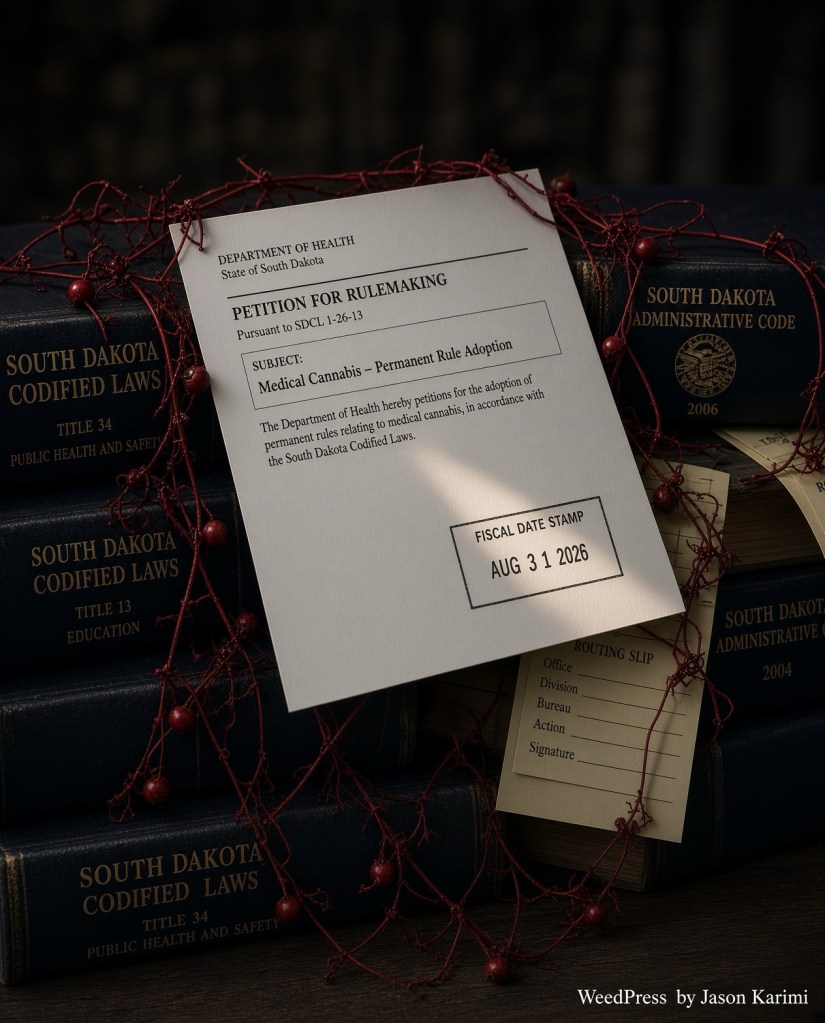
I have spent years getting cannabis language sponsored, drafted, heard, and passed in other rooms. South Dakota does not need another personality on the Medical Marijuana Oversight Committee. It needs a member bill that treats this as schedule hygiene — the same genre as the technical scheduling bills Health and Human Services already passes.⁹ The Department of Health now has a stamped petition asking whether the listed substances, tetrahydrocannabinol among them, still meet all three Schedule I criteria in SDCL 34-20B-11 after the federal change, and whether a “no” answer triggers the Department’s duty to recommend rescheduling to the Legislature.¹⁰ The next step is legislative, not theatrical.
What Changed in October
On October 6, 2026, Attorney General Jackley answered a question from four Medical Marijuana Oversight Committee members — Vice Chair Sen. John Carley, Chair Rep. Josephine Garcia, Sen. Lauren Nelson, and Rep. Bobbi Andera — about what federal Schedule III means for South Dakota’s medical program. Official Opinion 26-06 concludes that “the federal rescheduling of marijuana will likely have a negligible impact on South Dakota’s medical-marijuana program,” because DEA’s April 2026 rule lets state-licensed operators continue under federal registration, and it finds no federal preemption.¹¹ On the state schedule, the opinion is even more direct: if South Dakota chose to reschedule marijuana to Schedule III, “this action would have to be taken by either the Legislature or the voters, independent from the rescheduling of marijuana federally.” The opinion adds that the Department of Health is the agency statutorily tasked with recommending where substances belong on the schedule, and that choosing among the six options the members proposed “is a policy determination for the Legislature or the voters of South Dakota.”¹² That is this article’s point in the Attorney General’s words: the state fix is legislative.
The committee met on October 13 in Pierre — its second meeting of the 2026 interim and its only one in October.¹³ Assistant Attorney General Grant Flynn presented the opinion. According to WeedPress’s transcript of the meeting video, he told members that South Dakota “does not schedule marijuana as a Schedule I right now. Never has,” and that what the state does schedule is tetrahydrocannabinol, listed in Schedule I in chapter 34-20B. He said there “has been some debate” over whether that listing reaches naturally occurring THC or only synthetic or manufactured THC, without on-point guidance from the South Dakota Supreme Court, and that the gap between prosecuting extracts as felonies and marijuana as a misdemeanor is “open to interpretation.” He also said that, as far as he knew, his office had “no intention of going in and trying to amend those statutes,” and that the Department of Health brings a bill each year amending the list of scheduled drugs.¹⁴
The rest of the agenda featured Bertha Madras of Harvard Medical School; Kevin Sabet, president and CEO of Smart Approaches to Marijuana; Jeremy Barthels of Northwestern Health Sciences University; Dr. Kenneth Finn; a Department of Health follow-up from August; and public comment.¹⁵ As of October 26, the Legislative Research Council had not posted minutes of the meeting, and no committee draft bill or formal 2027 recommendation had been posted.¹⁶
The Department’s answer to the petition is due. Under ARSD 44:62:01:02, the Department must issue its declaratory ruling and mail a copy to the petitioner within 60 days after receiving a petition, or after receiving further information if it asks for some.¹⁷ WeedPress delivered its petition on August 31; sixty days ran on October 30. As of October 27, WeedPress had not received a ruling.
What the Statute Already Says
South Dakota law is not silent. To be included in Schedule I, a substance must have a high potential for abuse, no accepted medical use in the United States, and a lack of accepted safety for use under medical supervision.¹⁸ That is the Legislature’s own test, and the Legislature applies it to tetrahydrocannabinol, hashish, and hash oil.
A federal acknowledgment of accepted medical use under Schedule III puts direct pressure on the second and third criteria.¹⁹ Minnesota did not wait for a federal order. It moved its state list in 2023 because a Schedule I listing could not be defended once the state itself had authorized medical, and then adult-use, cannabis.²⁰ South Dakota has authorized medical cannabis since IM 26, yet it still lists THC in Schedule I under a test that requires no accepted medical use. That is the contradiction a 2027 bill should fix.
The bill should not say South Dakota is “going Schedule III,” as if Pierre controlled the CSA. The CSA schedules are federal. The state’s job is conformity: amend the Schedule I listing for tetrahydrocannabinol in chapter 34-20B (and decide how hashish and hash oil should be treated), preserve the medical program in chapter 34-20G, and refuse to open an adult-use fight this Legislature will not win.²¹
Minnesota’s 2023 act shows that the scheduling piece can be written as its own article. Copy that structure. Do not copy Minnesota’s adult-use chapter unless a sponsor wants a bill that dies in committee.
Somewhere ages and ages hence:
Two roads diverged in a wood …
— Robert Frost, “The Road Not Taken”
Which Committee Actually Hears It
In 2026, bills to “modify provisions related to the controlled substances schedule” went to Health and Human Services. House Bill 1016, a schedule-update bill with an emergency clause, was referred there and became law.²²
The same House committee handled bills rescheduling an FDA-approved psilocybin product to Schedule IV, adding substances to Schedule I, and placing medetomidine in Schedule III.²³ Senate Health and Human Services is charged with bills relating to drugs.²⁴
That is the path: House or Senate Health and Human Services first, then the floor, then the other chamber’s Health and Human Services committee, then the governor.
Do not write this as a crime bill.
Judiciary is where “backdoor legalization” goes to die. The MMOC does not hear session bills. It can recommend; it cannot amend chapter 34-20B.²⁵ October showed the limit: the committee heard the Attorney General’s Office, outside presenters, and the public, but it does not hold the pen on a session bill. Do not confuse an interim oversight meeting with the committee of reference.
The current chairs, for the remainder of this term, are Rep. Brian Mulder of House Health and Human Services and Sen. Kevin Jensen of Senate Health and Human Services.²⁶ Those names may change after the November 3 general election and the organization of the 2027 Legislature. The committee of reference probably will not.
Who Writes the First Draft
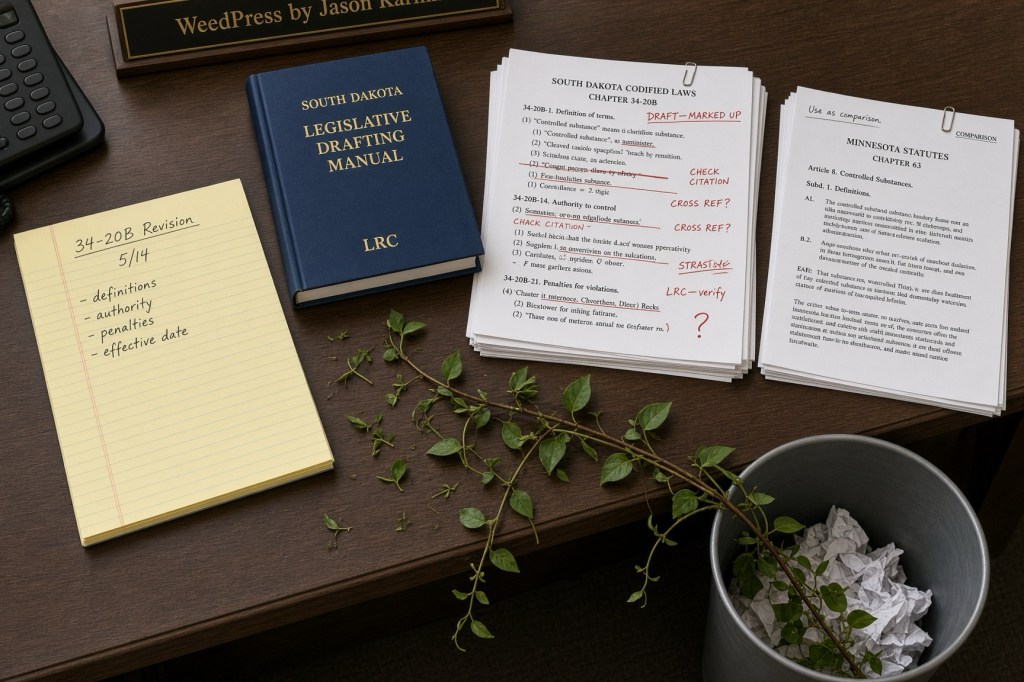
Not a blogger. Not a trade group. The Legislative Research Council writes the bill after a sitting member files a draft request. Joint Rule 6A-5 requires LRC style-and-form review before introduction.²⁷ State law assigns LRC the duty to assist members in preparing bills.²⁸
A member asks LRC for a draft that amends chapter 34-20B so that tetrahydrocannabinol — at a minimum, as contained in cannabis regulated under chapter 34-20G — is no longer listed as if it still met the Schedule I criteria, without creating adult-use commerce. The target is the THC listing, not a “marijuana” listing; marijuana in its natural and unaltered state is already outside the schedule. LRC assigns a drafter. Outside drafts with sloppy citations take longer to repair than a clean concept memo.²⁹ Give the member a one-pager, Minnesota’s 2023 scheduling article as a comparison, the petition stamp, Opinion 26-06, the Department’s ruling once it exists, and the list of affected sections. Let LRC write the act.
Prefile in the thirty days before session.³⁰ Session draft-request deadlines are short, and a January surprise is how a good idea misses the calendar.
Ask for a member bill, not an agency committee bill. An agency bill invites the Department and the Attorney General to hold the pen. The member should hold the pen, and Health should have to react.
How to Write It So It Survives
Keep it ugly and narrow.
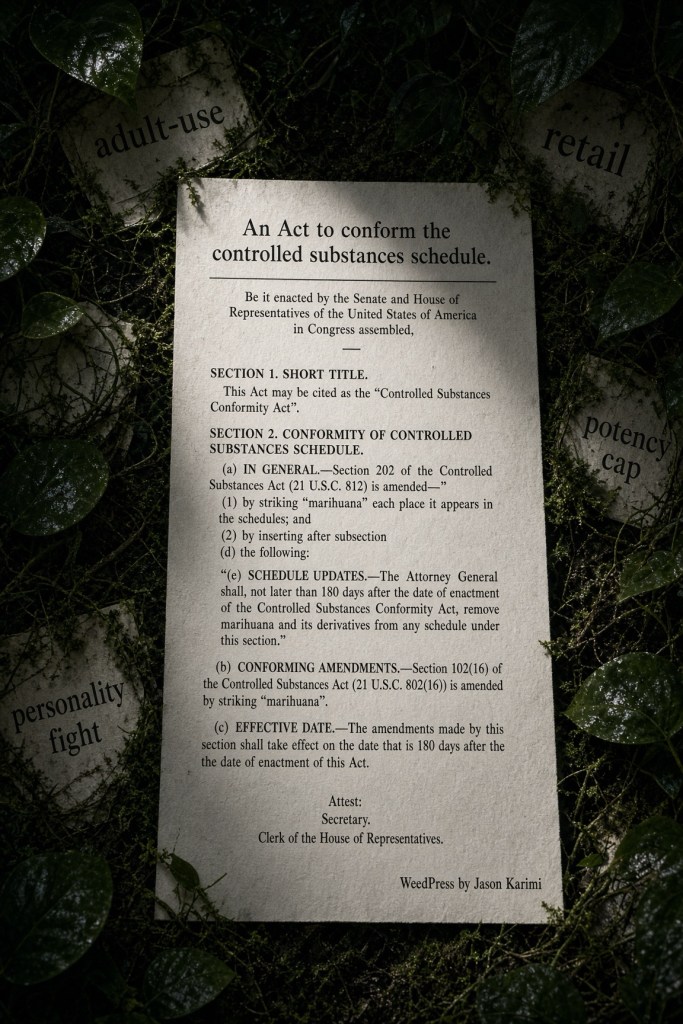
Minnesota’s Article 8 is the model for scope: change the schedule list. Do not smuggle in retail sales, home-grow expansion, or a new commercial chapter.
Problem: Tetrahydrocannabinol remains listed in Schedule I under SDCL 34-20B-14(20), and hashish and hash oil under § 34-20B-14(10) — after federal Schedule III placement of state-licensed medical cannabis, and after Minnesota moved marijuana and tetrahydrocannabinols to its state Schedule III in 2023 — while SDCL 34-20B-11 still requires “no accepted medical use in the United States” for any Schedule I listing. Marijuana in its natural and unaltered state is excepted from the THC listing and, according to the Attorney General, is not scheduled at all; it is regulated separately under chapter 22-42.³¹
Fix: Amend the THC listing (and, if the sponsor chooses, the hashish and hash-oil listing) or create an express exception for cannabis and cannabis products regulated under chapter 34-20G, so the medical program is not left next to a Schedule I listing that the statute’s own criteria no longer support. Clear text would also settle the question the Attorney General’s Office raised in October: whether the THC listing reaches naturally occurring THC.
Guardrails: No adult-use chapter, no new retail scheme, and no silent repeal of patient or establishment rules.
Effective date: One that does not create a criminal gap.
The moment anyone can call it legalization by the back door, cautious votes disappear. Draft it so that the smear has to lie. Point to Minnesota only as proof that a state can separate “fix the schedule” from “pass adult-use.” South Dakota voters approved adult-use legalization once, in Amendment A in November 2020, but the South Dakota Supreme Court struck it down in November 2021 for violating the state constitution’s single-subject rule. Voters then rejected adult-use initiatives in 2022 (IM 27) and 2024 (IM 29).³² The state has not yet done the list cleanup Minnesota finished three years ago.
Who Breaks When the Newspaper Uses the Wrong Word
Not a secret list. A type.
Operators who will read the analysis and refuse to put their logo on the bill. Medical-only Republicans who will vote for pharmacy schedule updates but still vote no if the headline reads “Pierre legalizes weed.” Law-enforcement seats around the oversight table that spent 2025 on potency, inspections, and unregulated THC, not reclassification.³³ Leadership, if the first clip is a blogger saying “reschedule” instead of a clinician saying “conform the list.” Any member who has to explain the messenger to a county party chair instead of explaining SDCL 34-20B-11.
The people who last longer: a sponsor holding a narrow LRC draft and, if one exists, a Department letter saying this is a legislative matter; a physician or pharmacist who never makes the hearing about personalities; and HHS members who already pass technical scheduling bills and can be shown that this bill belongs to that genre.

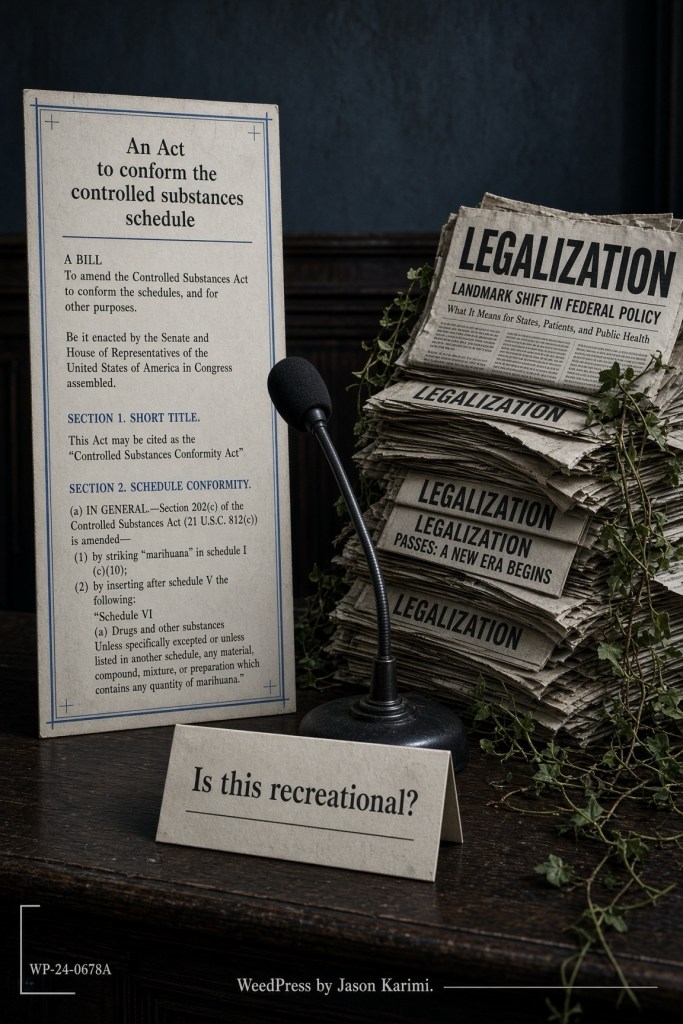
The break comes at one question: “Is this recreational?” If the sponsor cannot answer it in ten seconds, the bill is already wounded. The answer is no. The bill does not authorize adult-use sales. It fixes the state controlled-substances list so that THC is no longer listed in Schedule I after the federal government recognized accepted medical use, after Minnesota moved its own list to Schedule III in 2023, and when South Dakota’s own criteria require that recognition to matter.
What Not to Do
Do not preview the bill as a personal victory.
Do not testify first if a doctor or the sponsor can say the same thing with less static.
Do not tell the public Pierre is “making South Dakota Schedule III.” Pierre would be amending South Dakota law so that it no longer contradicts itself. Minnesota has already shown that a scheduling article can be written without pretending a state legislature enacts the federal CSA.

The File That Makes the Conversations Possible
A stamped applicability petition does not pass a bill, but it gives a member something better than a theory. It shows that the agency running the medical program was asked, in the form the agency itself published, whether the Schedule I criteria still hold.³⁴ If Health says the listing is a legislative problem, carry that sentence to LRC. If Health stalls, carry the stall. If Health denies the petition, appeal the denial under the Administrative Procedures Act and still draft the bill.³⁵ Courts do not order the Legislature to pass a schedule amendment.³⁶ They can review whether the Department handled the petition lawfully. The statute still moves only if a member files the request and HHS hears a boring bill.
Minnesota moved first on the state list in 2023. The federal government moved state-licensed medical cannabis to Schedule III in 2026. South Dakota is late to both, and its Attorney General has now said in writing that any state change belongs to the Legislature or the voters. The pathway is still ordinary: an LRC draft, Health and Human Services, a narrow conformity title, and a sponsor who can say this is not adult-use. Boring is how scheduling changes survive in South Dakota.
Footnotes
¹ See 21 U.S.C. § 812; Schedules of Controlled Substances: Rescheduling of Food and Drug Administration Approved Products Containing Marijuana From Schedule I to Schedule III; Corresponding Change to Permit Requirements, 91 Fed. Reg. 22,714 (Apr. 28, 2026) (to be codified at 21 C.F.R. pts. 1300, 1301, 1308, 1312).
² Compare Minn. Stat. § 152.02, subd. 4 (2024) (listing marijuana and tetrahydrocannabinols in Schedule III after the 2023 amendment), with S.D. Codified Laws § 34-20B-14(10), (20) (2026).
³ Act of May 30, 2023, ch. 63, art. 8, §§ 1–2, 2023 Minn. Laws (H.F. 100) (“Scheduling of Marijuana”; amending Minn. Stat. § 152.02, subds. 2, 4).
⁴ Minn. House Rsch. Dep’t, Bill Summary: H.F. 100, art. 8 (2023) (“Reschedules marijuana from Schedule I to Schedule III.”).
⁵ Minn. Stat. ch. 342 (2024) (adult-use cannabis regulatory code).
⁶ S.D. Codified Laws § 34-20B-14(10), (20) (2026).
⁷ S.D. Att’y Gen. Op. No. 26-06 (Oct. 6, 2026), https://atg.sd.gov/OurOffice/OfficialOpinions/opinionhtml.aspx?id=1779; see S.D. Codified Laws § 22-42-6 (2026).
⁸ S.D. Codified Laws § 34-20B-11(2) (2026).
⁹ See H.B. 1016, 101st Leg., Reg. Sess. (S.D. 2026) (enacted).
¹⁰ S.D. Codified Laws §§ 1-26-15, 34-20B-27 (2026); S.D. Admin. R. 44:62:01:01; Petition for Declaratory Ruling, S.D. Dep’t of Health (received Aug. 31, 2026).
¹¹ S.D. Att’y Gen. Op. No. 26-06 (Oct. 6, 2026), https://atg.sd.gov/OurOffice/OfficialOpinions/opinionhtml.aspx?id=1779 (citing 21 C.F.R. § 1301.13(k)(1) (2026)).
¹² Id. The opinion cites S.D. Codified Laws § 34-20B-18 for the Department’s recommendation role; the Department’s duty to recommend additions, deletions, or rescheduling appears in S.D. Codified Laws § 34-20B-27 (2026).
¹³ S.D. Legis. Rsch. Council, Medical Marijuana Oversight Comm., Agenda: Second Meeting, 2026 Interim (Oct. 13, 2026), https://mylrc.sdlegislature.gov/api/Documents/307903.pdf.
¹⁴ Jason Karimi, “We Don’t Think Anything Has Changed”: Full Transcript of the South Dakota AG’s Office on Federal Rescheduling, WeedPress (Oct. 25, 2026), https://weedpress.org/2026/10/25/we-dont-think-anything-has-changed-full-transcript-of-the-south-dakota-ags-office-on-federal-rescheduling/ (transcribing the meeting video at 00:23:01–00:23:51 and 00:29:07–00:29:31).
¹⁵ S.D. Legis. Rsch. Council, Medical Marijuana Oversight Comm., Agenda: Second Meeting, 2026 Interim (Oct. 13, 2026).
¹⁶ S.D. Legis. Rsch. Council, Medical Marijuana Oversight Comm. (2026 Interim), Hearing Documents and Minutes, https://sdlegislature.gov/Interim/Committee/501/HearingDocuments (last visited Oct. 26, 2026).
¹⁷ S.D. Admin. R. 44:62:01:02.
¹⁸ S.D. Codified Laws § 34-20B-11.
¹⁹ 21 U.S.C. § 812(b)(3); 91 Fed. Reg. 22,714.
²⁰ 2023 Minn. Laws ch. 63, art. 8.
²¹ Compare S.D. Codified Laws §§ 34-20B-11, -14(10), (20), with id. ch. 34-20G.
²² H.B. 1016, 101st Leg., Reg. Sess. (S.D. 2026) (referred to H. Health & Hum. Servs. Comm. Jan. 13, 2026; signed by the Governor Feb. 12, 2026).
²³ H.B. 1099, 101st Leg., Reg. Sess. (S.D. 2026) (signed Mar. 10, 2026); H.B. 1162, 101st Leg., Reg. Sess. (S.D. 2026) (signed Mar. 9, 2026); H.B. 1169, 101st Leg., Reg. Sess. (S.D. 2026) (signed Mar. 9, 2026).
²⁴ S.D. Legis. Rsch. Council, Legislator Reference Book (Senate Health and Human Services subject matter includes drugs).
²⁵ S.D. Codified Laws §§ 34-20G-92 to -93 (2026).
²⁶ S.D. Legislature, 2026 Session Committees: House Health and Human Services; Senate Health and Human Services.
²⁷ S.D. Joint R. 6A-5.
²⁸ S.D. Codified Laws § 2-9-1 et seq. (2026).
²⁹ S.D. Legis. Rsch. Council, Guide to Legislative Drafting.
³⁰ S.D. Codified Laws § 2-7-4 (2026).
³¹ S.D. Codified Laws §§ 22-42-6, 34-20B-11(2)–(3), -14(10), (20) (2026); S.D. Att’y Gen. Op. No. 26-06 (Oct. 6, 2026); 2023 Minn. Laws ch. 63, art. 8; 91 Fed. Reg. 22,714.
³² Thom v. Barnett, 2021 S.D. 65, 967 N.W.2d 261 (Nov. 24, 2021) (holding that Amendment A violated S.D. Const. art. XXIII, § 1); S.D. Sec’y of State, Official Election Results: Initiated Measure 27 (Nov. 8, 2022) (measure rejected); S.D. Sec’y of State, Official Election Results: Initiated Measure 29 (Nov. 5, 2024) (measure rejected).
³³ S.D. Legis. Rsch. Council, Medical Marijuana Oversight Committee, 2025 Final Report, in 2025 Interim Committee Final Reports 57–59.
³⁴ S.D. Codified Laws § 1-26-15; S.D. Admin. R. 44:62:01:01.
³⁵ S.D. Codified Laws ch. 1-26.
³⁶ A court may interpret or review agency action; it cannot compel the Legislature to enact a schedule amendment.




Leave a Reply