Related: What Nov. 29 Did and Did Not Change: The DEA Supply-Chain Date and the Court’s Pause.
A short guide to what federal Schedule III did and did not change for medical cannabis, what the Nov. 29 date in DEA’s Oct. 30 document means after the D.C. Circuit’s Nov. 25 administrative stay, and what Iowa’s pending Schedule III proposal would cover. Every answer is footnoted to a statute, rule, court order or official notice. This is general information, not legal advice. Last reviewed: Nov. 29, 2026.
What the public record shows
Updated as of Nov. 29, 2026. Five points from the documents cited below. The full FAQ follows.
- Federal Schedule III did not make marijuana legal under federal law. The April 28, 2026, final rule moved certain marijuana to Schedule III; other marijuana remains in Schedule I. Schedule III substances are still controlled substances.
- The rule did not rewrite South Dakota’s medical cannabis statutes or Article 44:90. Cardholder rules that took effect Nov. 5, 2026, come from the state rules.
- The Nov. 29 date is a DEA-document date, now partly stayed, and it is aimed at timely applicants and registrants, not at cardholders.
- The FAQ’s guns and travel answers do not claim a federal safe harbor. South Dakota’s protections apply for purposes of state law; 18 U.S.C. § 922(g)(3) and the state-required firearms notice remain in the record. Later 2026 developments are pointed to the Patient Rights Guide rather than relitigated here.
- On 21 U.S.C. § 822(d): the government’s Nov. 23 brief cited subsection (d) as the authority for the 60-day timely-applicant provision; the April 28 final rule lists § 822 among the authority citations and does not cite subsection (d) by number. That is a description of the citations, not a legality conclusion.
Document index (primary records): the FAQ’s notes ¹–¹¹.
Did Schedule III make marijuana legal under federal law?
No. The April 28, 2026, final rule moved certain marijuana from Schedule I to Schedule III of the federal Controlled Substances Act: Food and Drug Administration-approved products containing marijuana, and marijuana that is subject to a state medical marijuana license, as the rule defines those categories. Other marijuana remains in Schedule I. Schedule III substances are still controlled substances. Manufacturing, distributing or dispensing them still requires a DEA registration, unless a separate waiver or exception applies.¹
Did it change my South Dakota medical cannabis card?
The April 28 rule did not rewrite SDCL chapter 34-20G or the Department of Health’s Article 44:90 rules. A registry identification card remains a state credential. South Dakota’s cardholder rules that took effect Nov. 5, 2026 — including the single cultivation card, the caregiver card-destruction rule, fee language, and the 100-milligram edible serving limit — come from the state rules, not from the federal schedule change.²
What was the Nov. 29 date, and what is its status now?
DEA’s Oct. 30, 2026, “DEA Medical Marijuana Timely Applicant Information” document said timely applicants were “expected to complete these activities and establish compliant supply chains no later than November 29, 2026,” and that timely applicants and registrants “may not lawfully engage in any schedule III medical marijuana activities” with entities that missed the April 28–June 26, 2026, application window, or that have not applied, until those entities become DEA registrants. The document also says its contents “do not have the force and effect of law.”³
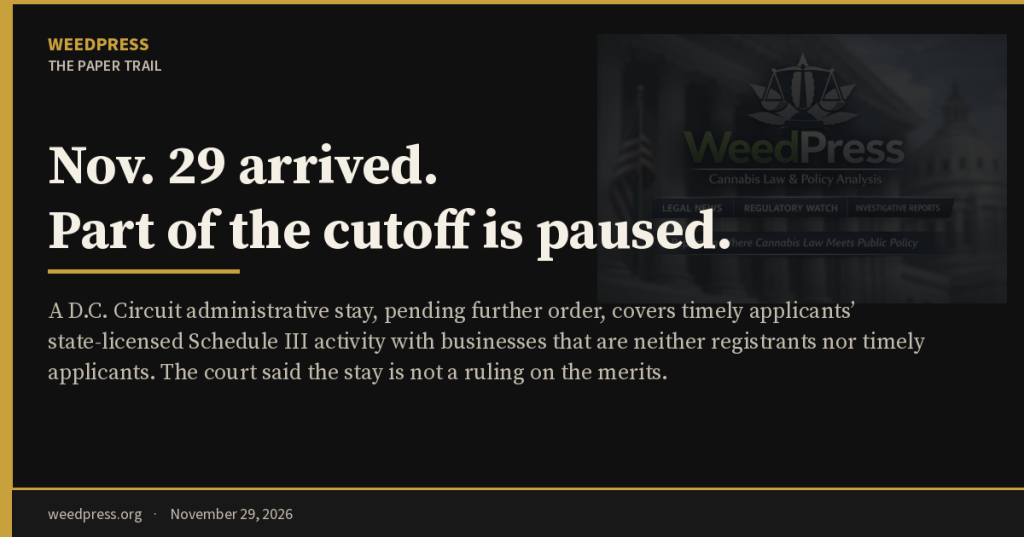
On Nov. 25, 2026, the D.C. Circuit administratively stayed that document, pending further order of the court, insofar as it relates to timely applicants’ engagement in schedule III medical marijuana activities that are in conformity with a state-issued license and are with entities that are neither federal registrants nor timely applicants. The court said the stay “should not be construed in any way as a ruling on the merits.” As of Nov. 29, 2026, no later order appeared on the public docket.⁴ The Nov. 29 date is directed at timely applicants and registrants, not at cardholder possession or use under South Dakota law.
Can I take my cannabis to another state, or onto federal land?
South Dakota’s medical cannabis protections apply “for the purposes of state law.” They stop at the state line. Federal law still makes it a crime to possess a controlled substance unless it was obtained directly from, or under a valid prescription or order of, a practitioner. The April 28 rule does not expressly say whether a patient’s possession is lawful under federal law, or whether a cardholder may carry cannabis onto federal land or into another state. Other states apply their own laws.⁵
What about guns?
South Dakota’s medical cannabis law does not override federal firearms law. Federal law, 18 U.S.C. § 922(g)(3), prohibits anyone “who is an unlawful user of or addicted to any controlled substance” from shipping, transporting, receiving or possessing a firearm or ammunition. South Dakota requires every card application and renewal to include a notice that, until marijuana is legalized under federal law, a current user of marijuana is, under federal law, an unlawful user of a controlled substance, and that federal law does not exempt the use of marijuana for medicinal purposes.⁶ Later 2026 developments — including the Supreme Court’s decision in United States v. Hemani and an ATF revision of the regulatory definition of “unlawful user” — are described, with citations, in the Patient Rights Guide. How those developments apply to a South Dakota cardholder has not been settled.⁷
What is Iowa proposing, and when are the dates?
The Iowa Board of Pharmacy’s revised Notice of Intended Action, ARC 0756D, published Nov. 25, 2026, would add marijuana, marijuana extract and naturally derived delta-9-tetrahydrocannabinols to Iowa Schedule III only “in a U.S. Food and Drug Administration-approved prescription drug medication.” A September version of the proposal had also referred to products subject to a state medical marijuana license under Iowa Code chapter 124E, which governs Iowa’s medical cannabidiol program; the November notice drops that language. The board says the change is “to better align this proposed rulemaking with Iowa Code section 124.201A(2).” The proposal is not final. Written comments must be received by 4:30 p.m. on Dec. 15, 2026. A public hearing is set for 11:30 a.m. that day at 6200 Park Avenue, Suite 100, in Des Moines.⁸
What is 21 U.S.C. § 822(d)?
It is the subsection of the Controlled Substances Act that allows the Attorney General, by regulation, to “waive the requirement for registration of certain manufacturers, distributors, or dispensers if he finds it consistent with the public health and safety.”⁹ In a Nov. 23, 2026, brief in the D.C. Circuit, the government cited § 822(d) as the authority for the 60-day timely-applicant provision in 21 C.F.R. § 1301.13(k)(7).¹⁰ The April 28, 2026, final rule creates that 60-day provision and lists 21 U.S.C. § 822 among the authority citations for the amended registration rules; the published rule text does not cite subsection (d) by number.¹¹
Where are the longer explainers?
South Dakota Medical Cannabis Patient Rights: Quick Guide. South Dakota Cannabis Law: Catch-Up Guide. Federal Compliance Matrix. South Dakota DEA Supply Chain: Start Here. Iowa Narrows Schedule III Proposal to FDA-Approved Drugs, Leaving Medical Cannabis Program Out.
Notes
¹ 91 Fed. Reg. 22,714 (Apr. 28, 2026), https://www.federalregister.gov/documents/2026/04/28/2026-08176/schedules-of-controlled-substances-rescheduling-of-food-and-drug-administration-approved-products; 21 U.S.C. §§ 812, 822–823, https://www.law.cornell.edu/uscode/text/21/812.
² S.D. Codified Laws ch. 34-20G (2026), https://sdlegislature.gov/Statutes/34-20G; S.D. Admin. R. art. 44:90 (2026), https://sdlegislature.gov/Rules/Administrative/44:90; What Changes for South Dakota Medical Cannabis Patients and Caregivers as Revised Rules Took Effect Nov. 5, 2026, WeedPress (Nov. 5, 2026), https://weedpress.org/2026/11/05/what-changes-south-dakota-medical-cannabis-patients-caregivers-rules-nov-5/.
³ Drug Enforcement Administration, DEA Medical Marijuana Timely Applicant Information (Oct. 30, 2026), https://www.deadiversion.usdoj.gov/drugreg/Timely-Applicant-Information-for-Medical-Marijuana-Applicants.pdf.
⁴ Standard Wellness Utah, LLC v. DEA, No. 26-1324 (D.C. Cir. Nov. 25, 2026) (per curiam administrative stay) (consolidated with Nos. 26-1325 and 26-1329), Document #2205508; CourtListener docket, date of last known filing Nov. 25, 2026, checked Nov. 29, 2026, https://www.courtlistener.com/docket/75142937/standard-wellness-utah-llc-v-dea/.
⁵ S.D. Codified Laws § 34-20G-15 (2026), https://sdlegislature.gov/Statutes/34-20G-15; 21 U.S.C. § 844(a), https://www.law.cornell.edu/uscode/text/21/844; 91 Fed. Reg. 22,714 (Apr. 28, 2026).
⁶ 18 U.S.C. § 922(g)(3), https://www.law.cornell.edu/uscode/text/18/922; S.D. Codified Laws § 34-20G-28.1 (2026), https://sdlegislature.gov/Statutes/34-20G-28.1.
⁷ South Dakota Medical Cannabis Patient Rights: Quick Guide, Traveling and Guns sections, https://weedpress.org/patient-rights-guide/, citing United States v. Hemani, No. 24-1234, 608 U.S. ___ (June 18, 2026), https://www.supremecourt.gov/opinions/25pdf/24-1234_g2bh.pdf, and Revising Definition of “Unlawful User of or Addicted to Controlled Substance,” 91 Fed. Reg. 2,698 (Jan. 22, 2026), https://www.federalregister.gov/d/2026-01141.
⁸ Iowa Board of Pharmacy, Notice of Intended Action, ARC 0756D (Nov. 25, 2026), https://www.legis.iowa.gov/docs/aco/arc/0756D.pdf; Iowa Code § 124.201A(2), https://www.legis.iowa.gov/docs/code/124.201A.pdf.
⁹ 21 U.S.C. § 822(d), https://www.law.cornell.edu/uscode/text/21/822.
¹⁰ Respondents’ Response in Opposition to the Emergency Motions for Stay Pending Review at 8, 12, 16, Standard Wellness Utah, LLC v. DEA, No. 26-1324 (D.C. Cir. filed Nov. 23, 2026), Document #2204745, https://www.courtlistener.com/docket/75142937/standard-wellness-utah-llc-v-dea/.
¹¹ 91 Fed. Reg. 22,714, 22,721–22,722 (Apr. 28, 2026).

