Related: Here Are My Comments to the Iowa Board of Pharmacy on Its Schedule III Proposal
By Jason Karimi, publisher.
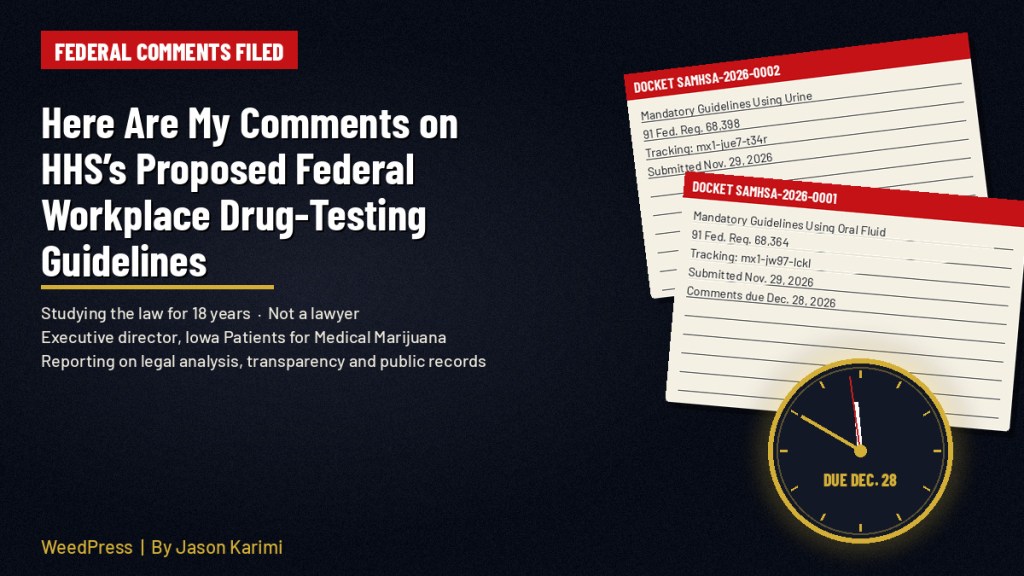
Tonight I filed two formal comments with the U.S. Department of Health and Human Services, as executive director of Iowa Patients for Medical Marijuana and as publisher of WeedPress. The comments concern HHS's proposed revisions to the Mandatory Guidelines for Federal Workplace Drug Testing Programs — one set for urine testing (docket SAMHSA-2026-0002) and one for oral-fluid testing (docket SAMHSA-2026-0001). Both proposals were published in the Federal Register on Oct. 29, 2026. Comments on both are due on or before Dec. 28, 2026.
I have spent 18 years studying the constitutional and administrative law that affects cannabis patients, and I use that work to file comments and to report on legal analysis, transparency, open-records requests and public records. I am the executive director of Iowa Patients for Medical Marijuana, which has advocated for Iowa patients for 18 years. I am not a lawyer, and this is not legal advice.
The clock is ticking. A lot is moving at once — Iowa's own Schedule III proposal, the federal supply-chain date, a federal court pause, and these workplace testing rules. Every day of the comment period matters.
What the proposals would do, and what the comments ask
HHS is proposing to revise the federal workplace drug-testing guidelines that apply to urine and to oral fluid. The comments do not ask HHS to tolerate impairment on the job, or to treat a state medical-cannabis card alone as a federal prescription. They ask HHS not to carry forward a rule written on the premise that marijuana is a Schedule I substance.
Since April 28, 2026, federal regulations have placed state-licensed medical marijuana in Schedule III. Both proposals still say that a physician's recommendation for a "Schedule 1" controlled substance is not a legitimate medical explanation for a positive test. The preambles do not mention marijuana, Schedule III or the April 28 order.
The comments ask HHS to revise that sentence so it does not apply to marijuana described in 21 C.F.R. § 1308.13(g)(2) through (4), to give Medical Review Officers a documentation standard they can apply, to explain how testing for marijuana fits Executive Order 12564's definition of "illegal drugs," and to say what a positive result does and does not show about impairment. The oral-fluid comment also notes that no laboratory has yet been certified to test oral fluid, which gives HHS a chance to get the rule right before federal oral-fluid testing begins.
I submitted the urine comment on Regulations.gov on Nov. 29, 2026, at about 2:00 a.m. Central, tracking number mx1-jue7-t34r. I submitted the oral-fluid comment about two minutes later, at about 2:02 a.m. Central, tracking number mx1-jw97-lckl. Both comments are published below in full, as submitted, without my personal contact information.
How to comment
The comment period for both dockets closes on or before Dec. 28, 2026.
You can comment on the urine proposal on Regulations.gov, docket SAMHSA-2026-0002, at https://www.regulations.gov/commenton/SAMHSA-2026-0002-0001. You can comment on the oral-fluid proposal on Regulations.gov, docket SAMHSA-2026-0001, at https://www.regulations.gov/commenton/SAMHSA-2026-0001-0001. The official notices are in the Federal Register: the urine proposal at 91 Fed. Reg. 68,398 (document 2026-22122), and the oral-fluid proposal at 91 Fed. Reg. 68,364 (document 2026-22121).
HHS also accepts comments by regular mail, express or overnight mail, or hand delivery, at: SAMHSA, Center for Substance Abuse Prevention (CSAP), Division of Workplace Programs (DWP), 5600 Fishers Lane, Room 16N02, Rockville, MD 20857. Refer to the docket number, and use only one method. HHS does not accept comments by fax. If you intend to deliver comments by hand or courier, the notices ask you to call (240) 276-2600 in advance to schedule your arrival.
The notices say comments are posted in their entirety, including any personal or confidential business information they contain.
Comment on the urine guidelines (SAMHSA-2026-0002)
Submitted Nov. 29, 2026, about 2:00 a.m. CT. Tracking number: mx1-jue7-t34r.
Comment on Proposed Revisions to the Mandatory Guidelines for Federal Workplace Drug Testing Programs Using Urine (UrMG)
Docket No. SAMHSA-2026-0002 · RIN 0930-AA40 · 91 Fed. Reg. 68,398 (Oct. 29, 2026)
Submitted by: Iowa Patients for Medical Marijuana, by Jason Karimi, Executive Director
Jason Karimi is also the publisher of WeedPress (weedpress.org).
Iowa Patients for Medical Marijuana
Date: November 29, 2026
To the Division of Workplace Programs, Center for Substance Abuse Prevention, Substance Abuse and Mental Health Services Administration:
I am the publisher of WeedPress, a news site that covers medical cannabis law in South Dakota and the region, and the executive director of Iowa Patients for Medical Marijuana, which has advocated for Iowa patients for 18 years. I write for the patients we serve: people with cancer, epilepsy, multiple sclerosis, chronic pain and other serious conditions who use cannabis under a state medical program, and some of whom work for, or want to work for, the federal government.
I support accurate, scientifically sound federal workplace testing, and I do not ask HHS to tolerate impairment on the job. My concern is narrower and, I think, unavoidable. These proposed Guidelines were published six months after the Justice Department moved state-licensed medical marijuana into Schedule III, yet they carry forward, unchanged, a rule written on the premise that marijuana is a Schedule I substance. The final Guidelines should not do that.
1. The proposal keeps a “Schedule 1” rule that no longer fits federal law
Proposed Section 13.5(d)(2) directs the Medical Review Officer (MRO) to report a positive result as negative when the donor “provides documentation (e.g., a valid prescription) to support a legitimate medical explanation.” Proposed Section 13.5(d)(2)(iii) then says: “A physician’s authorization or medical recommendation for a Schedule 1 controlled substance is not a legitimate medical explanation for a positive drug test result.”
HHS explained that sentence when it adopted it in 2023: “marijuana remains a Schedule I controlled substance and cannot be prescribed under Federal law,” and “therefore, a physician’s recommendation for marijuana use is not a legitimate medical explanation for a positive marijuana test.” HHS’s current MRO Guidance Manual, effective July 7, 2025, rests on the same premise: “As of the publishing date of this manual, marijuana remains a Schedule I drug.”
That premise changed on April 28, 2026, for a defined category of marijuana. The final order published that day added 21 C.F.R. § 1308.13(g)(2), which places in Schedule III “[m]arijuana, as defined in 21 U.S.C. 802(16), in a U.S. Food and Drug Administration approved product or subject to a state medical marijuana license,” with matching entries for marijuana extract and naturally derived delta-9-THC. The same order provides that “a certification or other document (including an electronic document) that state law deems sufficient for a user to obtain marijuana or products containing marijuana for medical purposes shall be sufficient to permit dispensing” by a DEA registrant, if it is dated and signed on the day issued, bears the user’s full name and address, and contains the name, address and state license number of the practitioner. The order also states that dispensaries “must register with DEA as ‘practitioners’ under 21 U.S.C. 823(g).” On Oct. 30, 2026, the Justice Department announced initial registrations of “more than 900 dispensaries across Alabama, Florida, Mississippi, South Dakota, Texas, Virginia, and West Virginia.”
The proposal’s preamble describes the Section 13.5 changes only as changes to MRO handling of invalid results. It does not mention marijuana, Schedule III or the April 28 order. So the proposed text would tell MROs, in late 2026, to treat a patient’s medical documentation as a recommendation for a “Schedule 1” substance, even when the product in question falls within 21 C.F.R. § 1308.13(g)(2) and was dispensed by a DEA-registered practitioner on documentation the Justice Department has deemed sufficient to permit dispensing.
Request 1. Revise Section 13.5(d)(2)(iii) so it no longer applies to marijuana, marijuana extract or naturally derived delta-9-THC described in 21 C.F.R. § 1308.13(g)(2) through (4). In its place, add a provision stating that documentation showing the donor obtained such a product from a DEA-registered dispenser, on a certification meeting 21 C.F.R. § 1301.13(k)(5), is a legitimate medical explanation, which the MRO verifies under Section 13.5(d)(2) using the same review steps it applies to a prescription. This comment does not ask HHS to treat state registration alone as a federal prescription, or to limit any agency’s rules against on-duty use, possession or impairment.
Request 2. If HHS does not adopt Request 1, the final notice should say plainly whether the “Schedule 1” sentence applies to marijuana described in § 1308.13(g)(2), and explain the legal basis under current law. Federal employees and applicants should be able to know the rule before they are tested, and individual MROs should not be left to decide a federal scheduling question one donor at a time.
2. Executive Order 12564 frames “illegal drugs” around Schedules I and II
The notice cites Executive Order 12564 and Section 503 of Public Law 100-71 as authority for these Guidelines. The Executive Order directs agencies to test “for the use of illegal drugs,” and defines “illegal drugs” as “a controlled substance included in Schedule I or II . . . the possession of which is unlawful under chapter 13 of that Title,” adding that the term “does not mean the use of a controlled substance pursuant to a valid prescription or other uses authorized by law.” In 2023, HHS answered marijuana comments by saying, “Current Federal law requires Federal agencies to test for marijuana under E.O. 12564.”
The proposed text tracks that framing. Section 3.1(b) authorizes testing for “other Schedule I or II drugs,” and Section 3.2 limits additional testing to “drugs listed in Schedule I or II of the Controlled Substances Act.” Section 3.1(a), meanwhile, requires every specimen to be tested for marijuana metabolites without distinguishing marijuana that remains in Schedule I from marijuana that the April 28 order placed in Schedule III.
Federal law also matters to the question of whether a patient’s possession is “unlawful” for purposes of the Executive Order’s definition. Under 21 U.S.C. § 844(a), possession of a controlled substance is unlawful “unless such substance was obtained directly, or pursuant to a valid prescription or order, from a practitioner, while acting in the course of his professional practice, or except as otherwise authorized” by the Controlled Substances Act. I am not asking HHS to decide any individual’s criminal liability. I am asking HHS to recognize that, for a patient who obtains a product from a DEA-registered dispenser under a § 1301.13(k)(5) certification, the 2023 rationale (“Schedule I,” “cannot be prescribed”) no longer describes the law.
Request 3. In the final notice, explain how the Section 3.1(a) marijuana requirement applies to marijuana described in § 1308.13(g)(2) given Executive Order 12564’s definition of “illegal drugs,” and state that a laboratory-positive marijuana metabolite result, by itself, does not establish use of an “illegal drug” as the Order defines it. That determination belongs to MRO review, which is where the donor’s documentation can be considered.
3. A urine metabolite is not a measure of impairment
The urine panel does not test for THC itself. It tests for the marijuana metabolite delta-9-tetrahydrocannabinol-9-carboxylic acid (Δ9THCC), at a 50 ng/mL initial cutoff and 15 ng/mL confirmatory cutoff. HHS’s own MRO Guidance Manual says “[a] confirmed positive test result reported from a laboratory does not automatically identify illicit drug use by an employee or job applicant.” The same manual describes marijuana’s acute effects as reaching a peak within 10 to 30 minutes after smoking and says “[r]educed functional ability lasts for at least 4 to 8 hours after a dose.” A urine metabolite result does not, by itself, tell an agency when the donor last used cannabis or whether the donor was impaired at work.
That matters most for patients. A person who uses a cannabis tincture at bedtime for seizures or pain, under a state medical certification, is not necessarily impaired at work the next day, but may test positive for Δ9THCC. Under the proposal as written, that person’s state documentation would not count as a legitimate medical explanation, while a coworker taking an opioid or benzodiazepine under a valid prescription could be reported negative after MRO review.
Request 4. For donors whose positive marijuana metabolite result is verified negative under Request 1, HHS should clarify that agencies address safety through otherwise applicable fitness-for-duty, reasonable-suspicion and post-accident procedures that look at on-the-job conduct and impairment, rather than through the metabolite result. Nothing in this request limits an agency’s authority to prohibit use, possession or impairment on duty, or to set stricter standards for specific safety-sensitive positions.
Request 5. In the final notice, HHS should state what a Δ9THCC-positive urine result does and does not show about timing of use and impairment, citing the scientific data HHS relies on. If HHS has data on how long Δ9THCC remains above the 15 ng/mL confirmatory cutoff after medical oral use, it should publish it.
4. Give Schedule III medical cannabis an MRO pathway comparable to dronabinol
The MRO Guidance Manual already says “[a] valid prescription for dronabinol is a legitimate medical explanation for a positive ∆9THCC urine drug test result.” Dronabinol in an FDA-approved product is listed in Schedule III at 21 C.F.R. § 1308.13(g)(1). Marijuana subject to a state medical marijuana license is now listed directly beneath it, in § 1308.13(g)(2). The manual also authorizes MROs to request THCV testing “to confirm the use of cannabis as opposed to pharmaceutical ∆9THC.” For marijuana covered by § 1308.13(g)(2), the line between “cannabis” and “pharmaceutical” no longer tracks the legal line between Schedule I and Schedule III.
Request 6. HHS should direct MROs to evaluate documented use of § 1308.13(g)(2) through (4) products under a framework comparable to the one they use for dronabinol, and explain how, if at all, THCV results should be used when the donor presents documentation for a § 1308.13(g)(2) product.
Request 7. Clarify that Section 13.5(d)(2)(ii), which says ingestion of “food products containing a drug (e.g., products containing marijuana . . .)” is not a legitimate medical explanation, does not apply to documented medical cannabis products, including edibles, capsules and tinctures, dispensed by a DEA-registered dispenser under 21 C.F.R. § 1301.13(k). Many patients cannot smoke and use oral products for exactly that reason.
5. Give MROs a documentation standard they can apply
If HHS adopts Request 1, MROs need a short, verifiable list of acceptable documents. In South Dakota, a qualifying patient’s registry card application includes “[a] written certification issued by a practitioner within ninety days immediately preceding the date of an application.” In Iowa, the state issues a medical cannabidiol registration card to a patient who submits a written certification signed by the patient’s health care practitioner, and the card must show the patient’s full name, Iowa residence address, date of birth, and issue and expiration dates.
Request 8. Define acceptable documentation to include, as applicable: (a) a state registry card valid on the collection date; (b) a practitioner certification containing the elements in 21 C.F.R. § 1301.13(k)(5); and (c) a dispensing record from a DEA-registered dispenser. HHS should coordinate with DEA so MROs have a reliable way to confirm a dispenser’s registration without requiring donors to disclose more medical information than necessary. DEA’s public timely-applicant file is not a list of registrants, and the Oct. 30 announcement did not name the registered dispensaries.
Request 9. Keep the donor’s diagnosis out of the agency’s hands. Consistent with how MROs treat other prescriptions, the MRO should report a verified negative without disclosing the donor’s medical condition or the fact of medical cannabis use, except as otherwise required by these Guidelines or other applicable federal law.
Request 10. Revise the MRO Guidance Manual at the same time as the final Guidelines and, until then, issue conforming interim guidance so MROs are not applying a July 2025 statement that “marijuana remains a Schedule I drug” after the law has changed.
6. Response to HHS’s request for comment on information collection
The notice specifically requests comments on the information-collection requirements, including ways to “enhance the quality, utility, and clarity of the information to be collected.” Proposed Section 13.11 already requires each MRO to report, for each laboratory positive verified as negative, the “MRO reason for verifying the positive drug(s) or drug metabolite(s) as negative (e.g., a donor prescription [the MRO must specify the prescribed drug]).”
Request 11. Add a distinct Section 13.11 reason code for documented use of a product described in 21 C.F.R. § 1308.13(g)(2) through (4), and publish aggregate, de-identified counts. That would let HHS see how often the issue arises and how the policy works, using a report MROs already file, with no new form for donors.
7. Coordination with DOT and NRC
HHS notes that the final UrMG revisions “may impact the Department of Transportation and Nuclear Regulatory Commission regulated industries depending on these agencies’ decisions to incorporate the final UrMG revisions into their programs under their own authority.” DOT’s rule currently says an MRO “must not verify a test negative based on information that a physician recommended that the employee use a drug listed in Schedule I of the Controlled Substances Act.”
Request 12. HHS should state in the final notice whether and how it has coordinated with DOT and NRC on marijuana described in § 1308.13(g)(2), so workers and MROs understand how HHS’s final Guidelines relate to DOT- and NRC-regulated testing.
Conclusion
The same “Schedule 1” sentence appears in the concurrent oral-fluid proposal (Docket No. SAMHSA-2026-0001), and I am filing a separate comment there. I ask HHS to resolve the issue the same way in both final notices.
Many patients in South Dakota, Iowa and across the country have followed the rules their states set, and as of April 28, 2026, federal regulations place marijuana described in 21 C.F.R. § 1308.13(g)(2) in Schedule III. The federal testing rules should say what that classification means for MRO review when a patient works for, or applies to work for, the government. Thank you for considering these comments.
Respectfully submitted,
Iowa Patients for Medical Marijuana
By: Jason Karimi, Executive Director
Jason Karimi
Publisher, WeedPress (weedpress.org)
Comment on the oral-fluid guidelines (SAMHSA-2026-0001)
Submitted Nov. 29, 2026, about 2:02 a.m. CT. Tracking number: mx1-jw97-lckl.
Comment on Proposed Revisions to the Mandatory Guidelines for Federal Workplace Drug Testing Programs Using Oral Fluid (OFMG)
Docket No. SAMHSA-2026-0001 · RIN 0930-AA41 · 91 Fed. Reg. 68,364 (Oct. 29, 2026)
Submitted by: Iowa Patients for Medical Marijuana, by Jason Karimi, Executive Director
Jason Karimi is also the publisher of WeedPress (weedpress.org).
Iowa Patients for Medical Marijuana
Date: November 29, 2026
To the Division of Workplace Programs, Center for Substance Abuse Prevention, Substance Abuse and Mental Health Services Administration:
I am the publisher of WeedPress, a news site that covers medical cannabis law in South Dakota and the region, and the executive director of Iowa Patients for Medical Marijuana, which has advocated for Iowa patients for 18 years. I am filing a companion comment on the urine proposal (Docket No. SAMHSA-2026-0002). This comment addresses the oral-fluid proposal on its own terms, because HHS can address these issues before federal oral-fluid testing begins.
HHS states that “[n]o laboratories have been certified to test oral fluid at this time.” HHS can set the rule for medical cannabis patients correctly before the first federal oral-fluid specimen is tested, rather than fixing it afterward.
1. The “Schedule 1” sentence should not carry forward
Proposed Section 13.5(c)(2) directs the MRO to report a positive result as negative when the donor “provides documentation (e.g., a valid prescription) to support a legitimate medical explanation.” Proposed Section 13.5(c)(2)(iii) says: “A physician’s authorization or medical recommendation for a Schedule 1 controlled substance is not a legitimate medical explanation for a positive drug test result.”
When HHS adopted that rule in 2023, its stated reason was that “marijuana remains a Schedule I controlled substance and cannot be prescribed under Federal law.” HHS’s MRO Guidance Manual, effective July 7, 2025, says the same: “As of the publishing date of this manual, marijuana remains a Schedule I drug.”
Since April 28, 2026, 21 C.F.R. § 1308.13(g)(2) has placed in Schedule III “[m]arijuana, as defined in 21 U.S.C. 802(16), in a U.S. Food and Drug Administration approved product or subject to a state medical marijuana license,” with matching entries for marijuana extract and naturally derived delta-9-THC. The April 28 order provides that a state-law certification “shall be sufficient to permit dispensing” by a DEA registrant if it is dated and signed on the day issued, bears the user’s full name and address, and identifies the practitioner by name, address and state license number. It also states that dispensaries “must register with DEA as ‘practitioners’ under 21 U.S.C. 823(g).” On Oct. 30, 2026, the Justice Department announced initial registrations of “more than 900 dispensaries” in seven states, including South Dakota.
The oral-fluid preamble, including its discussion of the MRO provisions, does not mention marijuana, Schedule III or the April 28 order.
Request 1. Revise Section 13.5(c)(2)(iii) so it does not apply to marijuana, marijuana extract or naturally derived delta-9-THC described in 21 C.F.R. § 1308.13(g)(2) through (4), and provide that documentation showing the donor obtained such a product from a DEA-registered dispenser, on a certification meeting 21 C.F.R. § 1301.13(k)(5), is a legitimate medical explanation, which the MRO verifies under Section 13.5(c)(2) using the same review steps it applies to a prescription. This comment does not ask HHS to treat state registration alone as a federal prescription, or to limit any agency’s rules against on-duty use, possession or impairment.
Request 2. If HHS keeps the sentence as written, the final notice should state whether it reaches § 1308.13(g)(2) marijuana and explain the legal basis, so donors know the rule before they are tested.
2. The authority behind the marijuana requirement needs to be explained
Executive Order 12564 directs testing “for the use of illegal drugs” and defines “illegal drugs” as “a controlled substance included in Schedule I or II . . . the possession of which is unlawful,” excluding “the use of a controlled substance pursuant to a valid prescription or other uses authorized by law.” Proposed Section 3.1(b) authorizes oral-fluid testing for “other Schedule I or II drugs,” and Section 3.2 limits additional testing to Schedule I or II drugs. At the same time, Section 3.1(a) requires every specimen to be “tested for marijuana.” Under 21 U.S.C. § 844(a), possession is unlawful “unless such substance was obtained directly, or pursuant to a valid prescription or order, from a practitioner, while acting in the course of his professional practice, or except as otherwise authorized.”
Request 3. Explain in the final notice how the Section 3.1(a) marijuana requirement applies to marijuana described in § 1308.13(g)(2), and state that, where a donor presents documentation under Section 13.5(c)(2), a laboratory-positive result by itself does not establish use of an “illegal drug” as Executive Order 12564 defines it.
3. Oral fluid and impairment
Unlike urine, which is tested for the metabolite Δ9THCC, the oral-fluid panel tests for delta-9-THC itself, at a 4 ng/mL initial cutoff and a 2 ng/mL confirmatory cutoff. The MRO Guidance Manual says marijuana’s acute effects peak within 10 to 30 minutes after smoking and that “[r]educed functional ability lasts for at least 4 to 8 hours after a dose.” It also says a valid dronabinol prescription is a legitimate explanation for a urine Δ9THCC positive “but not a positive ∆9THC oral fluid drug test result,” because “[u]se of Marinol® does not produce a positive oral fluid ∆9THC result.”
Those statements raise questions the final OFMG should answer for patients who document use of products described in 21 C.F.R. § 1308.13(g)(2) through (4), including oral products such as capsules and tinctures. HHS should not leave MROs to work them out in individual cases.
Request 4. In the final notice, HHS should state, with the scientific data it relies on, what an oral-fluid Δ9THC result at the 2 ng/mL confirmatory cutoff shows, and does not show, about timing of use and impairment, and how that differs from a urine Δ9THCC result. If HHS’s data show oral fluid is more closely tied to recent use, HHS should say so, so agencies can weigh oral fluid when choosing how to test.
Request 5. HHS should direct MROs on how to evaluate an oral-fluid Δ9THC positive from a donor who documents use of a § 1308.13(g)(2) product, including how the route of administration bears on the result, rather than applying the dronabinol rule by analogy.
Request 6. For donors verified negative under Request 1, HHS should clarify that agencies address safety through otherwise applicable fitness-for-duty, reasonable-suspicion and post-accident procedures that focus on conduct and impairment at work. Nothing in this request limits an agency’s authority to prohibit use, possession or impairment on duty, or to set stricter standards for particular safety-sensitive positions.
Request 7. Clarify that Section 13.5(c)(2)(ii), which says ingestion of “food products containing a drug (e.g., products containing marijuana)” is not a legitimate medical explanation, does not apply to products described in 21 C.F.R. § 1308.13(g)(2) through (4) when dispensed by a DEA-registered dispenser on documentation meeting 21 C.F.R. § 1301.13(k)(5). Many patients use oral products because they cannot smoke.
4. Documentation, privacy and the MRO manual
In South Dakota, a qualifying patient’s registry application includes “[a] written certification issued by a practitioner within ninety days immediately preceding the date of an application.” In Iowa, a patient receives a medical cannabidiol registration card after submitting a written certification signed by the patient’s health care practitioner, and the card shows the patient’s full name, Iowa residence address, date of birth, and issue and expiration dates.
Request 8. Define acceptable documentation to include, as applicable: (a) a state registry card valid on the collection date; (b) a practitioner certification containing the elements in 21 C.F.R. § 1301.13(k)(5); and (c) a dispensing record from a DEA-registered dispenser. HHS should coordinate with DEA so MROs can confirm a dispenser’s registration without requiring donors to disclose more medical information than necessary. The Oct. 30 announcement did not name the registered dispensaries.
Request 9. The MRO should report a verified negative without disclosing the donor’s medical condition or medical cannabis use to the agency, except as otherwise required by these Guidelines or other applicable federal law.
Request 10. Revise the MRO Guidance Manual, or issue conforming interim guidance, alongside the final OFMG so that guidance is in place before oral-fluid testing begins.
5. Response to HHS’s request for comment on information collection
HHS specifically requests comments on how to “enhance the quality, utility, and clarity of the information to be collected.” Proposed Section 13.11 requires MROs to report, for each laboratory positive verified as negative, the “MRO reason for verifying the positive drug(s) or drug metabolite(s) as negative.”
Request 11. Add a distinct Section 13.11 reason code for documented use of a product described in § 1308.13(g)(2) through (4), and publish aggregate, de-identified counts. That would give HHS data on how its policy works from the first year of oral-fluid testing, using a report MROs already file.
6. Coordination with DOT and NRC
HHS notes that the final OFMG revisions may affect DOT- and NRC-regulated industries depending on those agencies’ decisions. DOT’s current rule says an MRO “must not verify a test negative based on information that a physician recommended that the employee use a drug listed in Schedule I of the Controlled Substances Act.”
Request 12. HHS should state whether and how it has coordinated with DOT and NRC on marijuana described in § 1308.13(g)(2), so workers and MROs understand how HHS’s final Guidelines relate to DOT- and NRC-regulated testing.
Conclusion
No laboratory has yet been certified to test federal oral-fluid specimens. HHS can launch oral-fluid testing with a rule that reflects federal law as it stands since April 28, 2026, and that gives a documented patient using a product described in 21 C.F.R. § 1308.13(g)(2) through (4) an MRO review comparable to any other documented medical explanation. I ask HHS to resolve these issues the same way in the urine and oral-fluid final notices. Thank you for considering these comments.
Respectfully submitted,
Iowa Patients for Medical Marijuana
By: Jason Karimi, Executive Director
Jason Karimi
Publisher, WeedPress (weedpress.org)
Related articles
- Here Are My Comments to the Iowa Board of Pharmacy on Its Schedule III Proposal
- Iowa Narrows Schedule III Proposal to FDA-Approved Drugs, Leaving Medical Cannabis Program Out
- What Nov. 29 Did and Did Not Change: The DEA Supply-Chain Date and the Court’s Pause
- Schedule III and Federal Status: A Short FAQ
- South Dakota Industry Was Told the DEA Transition Would Be ‘Smooth.’ A Federal Court Just Paused It.
- Iowa Proposes State Schedule III Placement for Qualifying Medical Marijuana Products. South Dakota Still Has a Separate Scheduling Question.
Notes
¹ Mandatory Guidelines for Federal Workplace Drug Testing Programs Using Urine (UrMG), 91 Fed. Reg. 68,398 (proposed Oct. 29, 2026), docket SAMHSA-2026-0002, https://www.federalregister.gov/documents/2026/10/29/2026-22122/mandatory-guidelines-for-federal-workplace-drug-testing-programs-using-urine-urmg. The notice states: “Submit comments on or before December 28, 2026.”
² Mandatory Guidelines for Federal Workplace Drug Testing Programs Using Oral Fluid (OFMG), 91 Fed. Reg. 68,364 (proposed Oct. 29, 2026), docket SAMHSA-2026-0001, https://www.federalregister.gov/documents/2026/10/29/2026-22121/mandatory-guidelines-for-federal-workplace-drug-testing-programs-using-oral-fluid-ofmg. The notice states: “Submit comments on or before December 28, 2026.”





Leave a Reply