
By Jason Karimi, publisher.
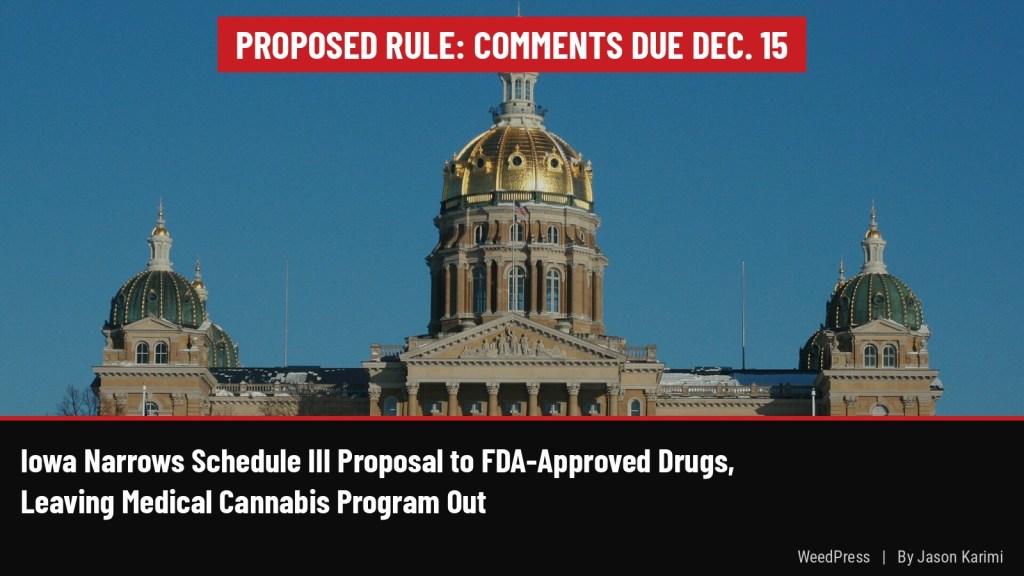
The Iowa Board of Pharmacy has narrowed its proposal to move marijuana into Schedule III of the Iowa Controlled Substances Act. The revised version would cover only U.S. Food and Drug Administration-approved prescription drugs, leaving out products from Iowa’s medical cannabidiol program.
The change appears in a revised Notice of Intended Action, ARC 0756D, published in the Iowa Administrative Bulletin on Nov. 25, 2026. It replaces language from a Sept. 30 Regulatory Analysis that would have placed marijuana, marijuana extract and naturally derived delta-9 THC in Schedule III when “in a U.S. Food and Drug Administration-approved product or subject to a state medical marijuana license in accordance with Iowa Code chapter 124E.” Chapter 124E governs Iowa’s medical cannabidiol program.
The revised notice drops the chapter 124E language. Each of the three proposed Schedule III entries now ends with “in a U.S. Food and Drug Administration-approved prescription drug medication.”
The board gives its reason in one sentence: “Changes from the Regulatory Analysis have been made to better align this proposed rulemaking with Iowa Code section 124.201A(2).” The notice says the proposal would add cannabis-derived products “that are components of a Food and Drug Administration (FDA)-approved prescription drug medication to Schedule III of the Iowa CSA in response to similar action by the federal Drug Enforcement Administration and as required by Iowa Code section 124.201A(2).”
The proposal is not final. Written comments are due by 4:30 p.m. Dec. 15, 2026, and a public hearing is set for 11:30 a.m. that day at 6200 Park Ave., Suite 100, in Des Moines.
What the statute says
Iowa Code section 124.201A(2) reads:
“If a cannabis-derived product approved as a prescription drug medication by the United States food and drug administration is eliminated from or revised in the federal schedule of controlled substances by the federal drug enforcement administration and notice of the elimination or revision is given to the board, the board shall similarly eliminate or revise the prescription drug medication in the schedule of controlled substances under this chapter.”
That mandatory “shall similarly” language applies to FDA-approved prescription drug medications. The section does not mention marijuana sold under a state medical license.
Under the revised proposal, medical cannabidiol program products would not be listed in state Schedule III. Marijuana and marijuana extract outside FDA-approved prescription drugs would remain in Iowa’s Schedule I under section 124.204.
The federal rule
The Iowa proposal responds to a federal final rule published April 28, 2026 (91 FR 22714). It placed two marijuana categories in federal Schedule III: marijuana in FDA-approved drug products and marijuana “subject to a state-issued license to manufacture, distribute, and/or dispense marijuana or products containing marijuana for medical purposes.” All other marijuana remains in Schedule I while a separate federal proceeding considers broader rescheduling.
Iowa’s revised proposal would adopt only the FDA-approved drug category.
How the states are responding
Trigger states with an objection option. Some states follow federal scheduling changes unless an official objects. Wyoming law directs the state to control a federally rescheduled substance “in the same manner as federal law” within 30 days but allows an objection and hearing. Attorney General Keith Kautz objected in May, held a hearing in June and announced July 7 that “all marijuana products, including marijuana subject to a state medical marijuana license, shall remain on Schedule I of the Wyoming Controlled Substances Act.” He wrote that the question “is for the Wyoming Legislature and should not be done through the administrative rule making process.”
Alabama objected, then withdrew. In May, the State Committee of Public Health voted to object to allow more time for input. State Health Officer Dr. Scott Harris said the state “fully intends” to make the change. After a July hearing, the committee unanimously withdrew the objection on Sept. 17, a move officials called procedural.
Contested conformity language. South Carolina law calls for the health department to issue an order matching a federal scheduling change within 30 days unless the General Assembly directs otherwise. Sen. Tom Davis, R-Beaufort, argued on the Senate floor in April that the federal order had triggered the state’s 1980 therapeutic marijuana law, the Charleston City Paper reported. In a Nov. 19 letter, Davis said the window closed May 28 and gave the Department of Public Health 30 days to explain why it had not acted, The Marijuana Herald reported.
Board acts by rule. Ohio law says the state Board of Pharmacy “periodically shall update the schedules by rule” to match changes in federal law (Ohio Rev. Code 3719.41). Iowa also acts by board rule, but section 124.201A limits mandatory conformity to FDA-approved prescription drug medications.
Legislature required. Tennessee acted before the federal rule took effect. Gov. Bill Lee signed Public Chapter 789 on April 23. It bars state rescheduling or deletion of marijuana after a federal change “unless the general assembly has established a regulatory framework for marijuana” and authorized the move. In South Dakota, Attorney General Marty Jackley’s Official Opinion 26-06, issued Oct. 6, concluded the federal change likely will have a “negligible impact” on the state’s medical program and that any state rescheduling “would have to be taken by either the Legislature or the voters.”
Already rescheduled. Minnesota moved marijuana to state Schedule III by statute. Its 2023 adult-use law, H.F. 100 (2023 Minn. Laws ch. 63), includes an article titled “Scheduling of Marijuana” that took marijuana and naturally occurring tetrahydrocannabinols out of Schedule I and listed them in Schedule III, now Minn. Stat. 152.02, subd. 4(i). The bill was signed May 30, 2023, and the scheduling sections took effect the next day. WeedPress has covered Minnesota’s move, in April and in November. In 2021, at a Minnesota colleague’s request, WeedPress wrote a summary of an earlier Minnesota bill, H.F. 1023, that proposed moving marijuana out of Schedule I.
Oregon moved marijuana off its state Schedule I years before federal action. A 2009 law, Senate Bill 728, directed the Board of Pharmacy to reclassify it, and the board voted June 16, 2010, to move marijuana to Schedule II. A board news release said the change did not make marijuana available by prescription.
Analysis
This section is WeedPress analysis.
Read the rules side by side and Iowa’s revision makes sense. The federal rule did two things; Iowa’s statute speaks to one: FDA-approved prescription drugs. The board matched the federal action where lawmakers told it to and stopped there. That keeps Iowa consistent with the federal rule without stretching a narrow statute to cover a medical program lawmakers left out of the trigger. If lawmakers want program products in a lower schedule, the statute shows where that decision belongs.
Don’t expect uniform state scheduling. Wyoming said no. Alabama hesitated, then stepped aside. South Carolina’s agency hasn’t acted. Tennessee locked the door in advance. Iowa split the federal rule down the middle. Each result traces back to that state’s own law, which is how a federal system is supposed to work.
That variety is not a malfunction. The scheduling system has safety valves. Under 21 U.S.C. 811(a), proceedings to add, move or remove a substance may be started by the attorney general “on his own motion,” at the request of the health secretary, “or on the petition of any interested party.” Section 811(c) lists eight factors, including “scientific evidence of its pharmacological effect” and “the state of current scientific knowledge.” Iowa’s law mirrors those factors in section 124.201 and requires the board to recommend schedule changes to the legislature every year. The structure assumes the schedules will be revisited as evidence comes in. It was never meant to freeze a substance in place forever.
The flaw was Schedule I itself. Schedule I placement requires a finding of “no currently accepted medical use in treatment in the United States” (21 U.S.C. 812(b)). Proving medical use takes research, and Schedule I made research hard. As late as August 2016, the DEA said “there is only one entity authorized to produce marijuana to supply researchers in the United States: the University of Mississippi, operating under a contract with NIDA.” In 2022, Congress passed the Medical Marijuana and Cannabidiol Research Expansion Act, co-authored by Iowa Sen. Chuck Grassley, to remove “existing barriers for researchers that frequently slow the research process,” as its Senate sponsors described it. That was the catch-22: no accepted medical use without research, and limited research while marijuana sat in Schedule I.
The April rule and Iowa’s response reflect a system that corrects itself slowly, one schedule and one statute at a time. On Dec. 15, Iowa’s version of that process gets its next hearing.
Header photo: Iowa State Capitol, Des Moines, by Ashton B Crew, via Wikimedia Commons, CC BY 3.0; text added by WeedPress.





Leave a Reply