
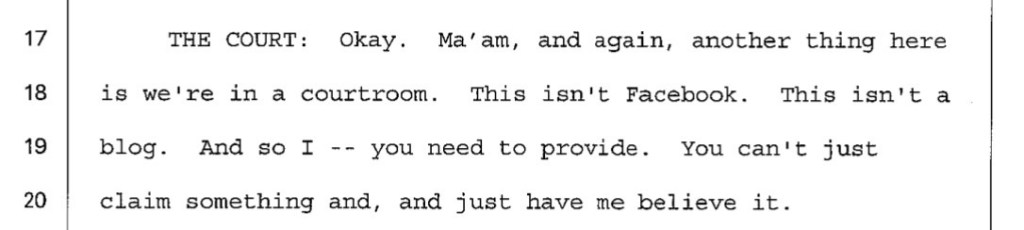
Here’s the transcripts front Mentele v WeedPress, where Mentele spent six months trying to silence WeedPress from advocating for federal law changes because she was afraid, in her own court testimony, I would replace her somehow as a leader in South Dakota cannabis. So desperate to maintain her delusions of self importance and leadership that she lied to Sioux Falls judges and got caught on the record, as these transcripts showed back on July 11 with no reply.
Over 20,000 people have now read the court transcripts where a Sioux Falls judge directly questioned Melissa Mentele’s credibility and found that she lied under oath. That’s not social media drama. That’s a court record.
For someone who spent years positioning herself as the leading voice for medical cannabis patients in South Dakota and attacking anyone who dared to suggest the laws could be improved, the response since those transcripts dropped has been revealing. While Mentele has been largely silent on the court loss and advocacy issues, she has remained active on a separate Facebook profile — one where critics are blocked — posting personal updates and working on building credentials.
This isn’t the first time she’s gone quiet when things get difficult. Mentele has built a public style of being loud and aggressive when she’s on the offensive. But when the damage comes from somewhere she can’t easily control — like a courtroom — the pattern has been to disappear from advocacy conversations or pretend it didn’t happen. That approach might feel like self-protection in the moment, but it creates long-term problems for everyone else who supported her and New Approach South Dakota.
Patients and supporters who backed the organization are now left carrying questions about leadership and credibility that she refuses to address publicly. When someone in a visible leadership role gets hit with a serious credibility issue in court and then goes quiet on those exact issues while staying active elsewhere, it doesn’t just affect their personal reputation. It weakens the broader effort. Opponents and lawmakers notice these things. Every time a prominent advocate gets exposed and then hides from the topic, it makes it harder to build real trust and power where it actually matters.
This matters even more right now. The medical cannabis program is still under political pressure. Patients need leadership that can take accountability, be transparent when things go wrong, and keep fighting without creating new vulnerabilities. Instead, they’ve been left with years of the same pattern — loud when it helps the personal brand, silent when it doesn’t.
WeedPress has taken a different approach. We’ve focused on doing the legal and policy work quietly, sharing analysis and contacts with South Dakota leaders for free, with no expectation of money, fame, or power in return. Real protection for patients happens through steady, behind-the-scenes work — not through loud claims on social media that go silent the moment credibility gets destroyed in court, only to reappear elsewhere for personal posts and credential-building.

Comments and videos frequently mislead consumers & investors, libel companies and individuals, diminish our sector’s professionalism, and often break the law:” https://open.substack.com/pub/mitchellosak/p/beware-cannabis-influencers-and-creators?r=ytqpz&utm_medium=ios
Patients deserve leadership that puts their interests first, even when it’s uncomfortable. Loud advocacy that disappears the second it gets hit doesn’t serve patients. It serves the person doing the talking. That distinction is becoming clearer by the day.




Owning a Business and Performing Services While Receiving SSDI: Analysis of Substantial Gainful Activity Rules for Self-Employed Individuals
The Social Security Administration’s (SSA) rules governing Substantial Gainful Activity (SGA) for self-employed individuals present a complex and often misunderstood framework. While many SSDI beneficiaries understand that traditional wage employment is subject to monthly earnings limits, fewer appreciate the distinct and more nuanced standards that apply when an individual owns a business and performs ongoing services for it—such as weekly auditing, management, or operational work. This article examines the statutory and regulatory structure governing self-employment under SSDI, with particular focus on how regular work performed for one’s own company is evaluated.
Statutory and Regulatory Framework
SSDI eligibility turns in significant part on whether an individual is engaging in SGA. The Social Security Act itself does not define SGA with precision, leaving the contours of the concept to regulation. SSA has promulgated detailed rules in Title 20 of the Code of Federal Regulations.
The foundational regulation for self-employed individuals is 20 C.F.R. § 404.1575, titled “Evaluation guides if you are self-employed.” This regulation establishes that SSA will evaluate self-employment work activity based on the value of the services provided to the business, “regardless of whether you receive an immediate income for your services.”¹ Under § 404.1575, SSA evaluates self-employment using three regulatory evaluation guides to determine whether an individual’s work activity constitutes SGA.²
These guides consider:
Test One — whether the individual renders services that are significant to the operation of the business and receives substantial income from the business.
Test Two — whether the individual’s work activity—in terms of hours, skills, energy output, efficiency, duties, and responsibilities—is comparable to that of unimpaired individuals in the same or similar businesses in the community.
Test Three — whether the work activity, even if not comparable to unimpaired individuals, is clearly worth the applicable SGA amount when considered in terms of its value to the business or when compared to the salary an owner would pay an employee to perform the same work.
For 2026, the monthly SGA threshold for non-blind individuals is $1,690.³ SSA also provides interpretive guidance through its Program Operations Manual System (POMS), although the POMS does not carry the force of law.⁴
Application to Regular Work Performed for One’s Own Company
When an SSDI recipient owns a company and performs regular services—such as weekly auditing—the analysis under § 404.1575 becomes particularly consequential. Depending on its nature, auditing may constitute skilled work requiring specialized knowledge or judgment. SSA evaluates the actual duties performed rather than the job title. Even in the absence of a formal salary, SSA may attribute substantial value to those services.
If those services are integral to the business’s operations, regulatory compliance, or financial management, SSA may determine that they are “significant” under Test One or have sufficient economic value under Test Three.
Moreover, because the regulation expressly states that work activity is evaluated “regardless of whether you receive an immediate income,” the fact that the individual is not drawing a paycheck does not insulate the activity from SGA analysis. Regular, recurring performance of skilled services for one’s own business is treated differently from purely passive ownership or sporadic, minimal involvement.
Whether services are considered “significant” depends in part on the structure of the business. SSA applies different standards depending on whether the business has employees and the owner’s role in daily operations.
The Trial Work Period and Its Interaction with Self-Employment
The Trial Work Period (TWP) under 20 C.F.R. § 404.1592 allows beneficiaries to test their ability to work without an immediate determination that their work activity disqualifies them from benefits.⁵ During the TWP, an individual may perform services and earn any amount without losing SSDI benefits. A TWP month is triggered either by earning more than the monthly TWP threshold ($1,210 in 2026) or, for self-employed individuals, by working more than 80 hours in the business in a given month.⁶
Once the Trial Work Period ends, however, SSA evaluates whether ongoing work constitutes SGA during the Extended Period of Eligibility. During this 36-month period, benefits are paid only for months in which the individual’s work does not constitute SGA.⁷
For self-employed individuals performing regular work such as auditing, careful tracking of both hours and the value of services is essential. Exceeding 80 hours in a month during the TWP or engaging in work whose value meets or exceeds SGA levels after the TWP can have significant consequences.
Distinguishing Passive Ownership from Active Services
A key distinction exists between merely owning equity in a business and actively performing services for it. Purely passive ownership, standing alone, generally does not constitute SGA because ownership itself is not considered work activity. In contrast, when the beneficiary performs regular, skilled work (such as auditing financial records on a weekly basis), SSA evaluates that labor under the self-employment tests in § 404.1575.
This distinction is particularly relevant in closely held companies where the owner may wear multiple hats. The fact that the work benefits the owner’s own enterprise does not exempt it from scrutiny. SSA’s regulations make clear that the economic value of the services to the business is the relevant inquiry.
Practical and Strategic Implications
Individuals on SSDI who own businesses and wish to perform ongoing work should consider several protective measures.
First, they should document the nature and extent of their involvement with precision. Hours worked, specific duties performed, and any compensation (or lack thereof) should be recorded contemporaneously. SSA evaluates self-employment based on the evidence in the administrative record, making contemporaneous documentation of work activity particularly important.
Second, they should be aware that even unpaid services can trigger SGA analysis if they are significant and have substantial value to the business.
Third, they should consider structuring their involvement to remain below relevant thresholds where possible—particularly during and after the Trial Work Period.
Finally, certain impairment-related work expenses may affect SSA’s SGA analysis in appropriate cases. Because these deductions are highly individualized, beneficiaries should discuss them with a Work Incentives Planning and Assistance (WIPA) counselor or qualified representative.
Because these determinations are highly fact-specific, individuals facing this situation are strongly encouraged to obtain guidance from a qualified Work Incentives counselor through the SSA’s WIPA program or an attorney experienced in SSDI self-employment issues before significantly increasing work activity.
Conclusion
SSA’s treatment of self-employment differs fundamentally from its treatment of wage employment. Rather than relying exclusively on monthly earnings, the agency evaluates the significance of the individual’s services, whether those services are comparable to those performed by unimpaired individuals engaged in similar businesses, and the economic value of those services to the enterprise. As a result, an SSDI beneficiary who owns a business may engage in SGA even if little or no salary is paid, while another beneficiary with similar ownership but only passive investment activity may not. Ultimately, the question is not simply how much money a business owner receives, but whether the services performed demonstrate the capacity to engage in substantial gainful activity under SSA’s regulatory framework. Understanding that distinction is essential for SSDI beneficiaries seeking to remain compliant while participating in entrepreneurial or self-employed activities.
Footnotes
¹ 20 C.F.R. § 404.1575(a)(2) (2026).
² 20 C.F.R. § 404.1575(a)(2), (b)–(d) (2026).
³ Social Security Administration, Substantial Gainful Activity (last visited July 21, 2026).
⁴ SSA Program Operations Manual System (POMS) (evaluation of self-employment).
⁵ 20 C.F.R. § 404.1592 (2026).
⁶ 20 C.F.R. § 404.1592(d) (2026).
⁷ 20 C.F.R. § 404.1592a (2026).
Editor’s Note: This article provides a general overview of SSA’s regulations governing self-employment and Substantial Gainful Activity. Because SSDI eligibility determinations depend on the specific facts of each case, readers should consult SSA guidance or qualified legal or benefits professionals before making decisions that could affect their benefits.
 WeedPress: The Paper Trail
Leave a comment