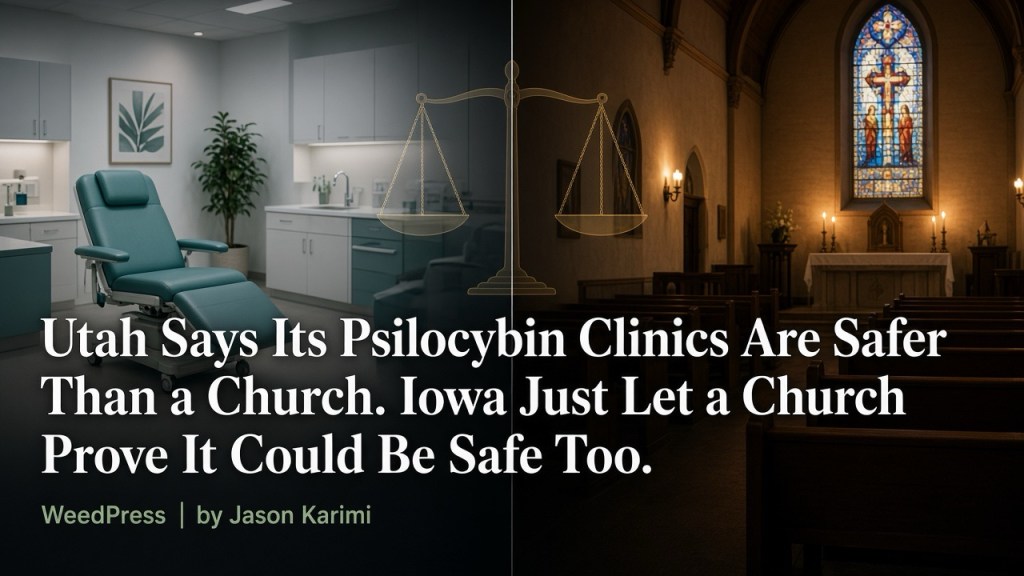
On October 5, 2026, a unanimous Tenth Circuit panel told a Utah psilocybin church that a federal court could not stop the State of Utah from prosecuting its founder, and that Utah’s regulated medical-psilocybin pathway is not the kind of “secular comparator” that turns a drug law into religious discrimination under the First Amendment. Jensen v. Utah County asks “what happens when a religious tenet includes the use of a drug that is otherwise prohibited under a state’s criminal law?”1
Also on October 5, according to Iowa Capital Dispatch, the Iowa Board of Pharmacy agreed to grant the Iowaska Church of Healing a probationary state controlled-substances registration. According to the paper, DEA and the church told a federal court that their agreement resolved only the first stage of DEA’s two-step process; the state registration is the next step, after which DEA would “expeditiously” process the federal exemption, registrations, and permits the church needs to import concentrated ayahuasca paste and brew ceremonial tea. That process rests on a memorandum of agreement with the Drug Enforcement Administration that the parties asked a federal court to keep under seal.2 One religious community was sent back to a state criminal court; another was folded into a registration system whose central document the public cannot read.
Why a Utah Psilocybin Case Matters in South Dakota
Jensen is a Tenth Circuit decision about psilocybin in Utah. It does not bind any court in South Dakota, Iowa, or Nebraska. But its central question is one every medical-cannabis state now faces: when a state lets patients use a controlled substance under a regulatory program, must it treat comparable religious use the same way? South Dakota, Iowa, and Nebraska each have a medical-cannabis law, and each has enacted a state religious-freedom statute since 2021. Jensen is a recent, published appellate opinion that addresses that comparison directly.
For patients, the case shows that a medical program’s safeguards can be used to distinguish religious use rather than support it. For religious claimants, Iowa’s ayahuasca registration shows that federal and state regulators can arrive at a structured accommodation for a controlled substance. The state’s conditions are public; the federal agreement’s terms are not.
Three Kinds of Authority
This article relies on three kinds of authority, and they carry different weight:
- Binding appellate holdings: holdings that control lower courts within their jurisdiction, such as the Supreme Court’s controlling holdings on free exercise and RFRA, which bind as to applicable federal law everywhere, and Jensen’s holdings within the Tenth Circuit. Not every statement in an opinion is a holding.
- Persuasive decisions from other jurisdictions: what Jensen is in South Dakota, Iowa, and Nebraska. Courts there may find its reasoning useful but need not follow it.
- Negotiated agency accommodations: the Iowaska memorandum of agreement and the Board’s consent agreement. They bind only their parties and set no rule of decision for courts, but they are evidence of what an agency has found workable.
What the Court Actually Did
The disposition is narrower than early summaries suggest:
- Vacated: the district court’s injunction against the state criminal proceedings — an anti-suit injunction, not the preliminary injunction issued under Utah’s Religious Freedom Restoration Act.3
- Vacated: the denial of the motion to dismiss the First Amendment claim “on the issue of preferential treatment for secular use,” reached through pendent appellate jurisdiction.4
- Not decided: whether Utah law creates a system of individualized exemptions. The panel declined to decide the individualized-exemption theory, leaving that issue for the district court to address in the first instance, and dismissed that part of the appeal for lack of pendent jurisdiction.5
- Dismissed: the appeal of the ruling on the Fourth Amendment claim.6
- Untouched: the Utah RFRA claim. In its final footnote the panel explained that the state defendants “haven’t appealed the preliminary injunction or addressed the claims under the Utah Religious Freedom Restoration Act. So we express no opinion on the validity of the preliminary injunction.”7
So the Utah RFRA claim was not remanded; it was never before the court of appeals. The February 20, 2025 preliminary injunction under Utah RFRA, which barred the defendants “from treating Plaintiffs’ religious use of psilocybin as unlawful under the Utah Controlled Substances Act” — was not appealed and was not vacated.8
Background
Bridger Lee Jensen founded Singularism, whose adherents (“voyagers”) use psilocybin in ceremony. After police seized more than 450 grams, the church sued; the defendants removed the case; the federal court ordered the psilocybin returned; and within days the State charged Jensen with felony drug offenses.9 In August 2025 the district court denied the motion to dismiss and enjoined the state prosecution.10
The district court had reasoned that Utah’s healthcare-system psilocybin exemption carried the same risks as religious use, “especially since the medical exemption imposes no sourcing, testing, or chain-of-custody requirements.”11 The Tenth Circuit rejected that reasoning.
Part One: Younger Abstention
The panel’s first and independent ground is abstention. Under Younger v. Harris, a federal court ordinarily must not interfere with an ongoing state criminal prosecution when the state forum is adequate and important state interests are involved; the parties agreed those conditions were met.12
The panel rejected each reason the district court gave for intervening. Removal of the civil case did not waive abstention; that reasoning “conflates the civil and criminal cases,” because a Utah state court could not have enjoined the criminal case either.13 Complaints about the search, a media statement, a letter to the landlord, and civil-discovery tactics did not show a bad-faith prosecution.14 And because Jensen could raise his constitutional defenses in the criminal case, continuing it was not irreparable injury; a chilling effect on others “should not by itself justify federal intervention.”15
The abstention ruling was a loss of forum, not a merits determination. But the panel separately rejected the First Amendment preferential-treatment theory. Those are two different losses, and they should not be confused.
Part Two: Is a Medical Psilocybin Program a Secular Comparator?
The panel then addressed the merits: “Even if abstention were unnecessary, an injunction would be proper only if the district court could rely on a violation of the First Amendment.”16 Formally an alternative ground, the analysis also drove Part III’s vacatur of the motion-to-dismiss ruling, so it is not mere dicta.
The doctrine
Under Employment Division v. Smith, a neutral and generally applicable law needs only a rational basis. The plaintiffs conceded rationality and did not contest neutrality, so everything turned on general applicability.17 A law is not generally applicable if it (1) “invites the government to consider the particular reasons for a person’s conduct by providing a mechanism for individualized exemptions,” or (2) “prohibits religious conduct while permitting secular conduct that undermines the government’s asserted interests in a similar way.”18 Under Tandon v. Newsom, strict scrutiny applies “whenever they treat any comparable secular activity more favorably than religious exercise,” and comparability “is concerned with the risks various activities pose, not the reasons why people gather.”19
The panel’s comparator analysis
The panel framed the task this way: “To address the possibility of preferable treatment, we compare the effects of religious and secular activities.”20 It then compared religious use with Utah Code § 58-37-309, which allows only qualified healthcare systems to run psilocybin programs, with use “only under the direct supervision and control of the healthcare system” and reporting to the Legislature. “For religious uses of psilocybin, however, Utah law lacks any statutory or regulatory protections.”21
Three moves did the work. General applicability is measured by the law’s “structure and implementation” rather than “safeguards voluntarily undertaken,” a phrase borrowed from the Tenth Circuit’s St. Mary Catholic Parish decision, now under Supreme Court review.22 Singularism’s own disclaimer that clinicians’ advice “supersedes our spiritual advice” conceded “the unique risks from unsupervised use.”23 And “the statutory and regulatory safeguards render secular use less likely to undermine the government’s interests than Singularism’s religious use.”24
The most contestable step is footnote 10, and it frames the strongest version of the regulatory-asymmetry critique. Tandon says that where the government permits secular activity with precautions, “it must show that the religious exercise at issue is more dangerous than those activities even when the same precautions are applied.” The panel confined that sentence to narrow tailoring, not general applicability.25 That reading lets a state defeat the threshold comparison by pointing to precautions it imposes on the secular actor and declines to offer the religious one. A claimant could respond that Tandon itself located the comparison at the threshold, and that the state’s refusal to offer the same precautions to religion is the very asymmetry the doctrine polices.26 The serious question is not whether Jensen necessarily got the law wrong. It is whether a state can rely on safeguards available to secular users while denying religious claimants a comparable opportunity to operate under safeguards.
The individualized-exemption question the panel did not answer
The plaintiffs also pointed to Utah Code § 58-37-105(2)(d), which lets an agency exempt individuals from licensing requirements when “consistent with public health and safety.” The panel held only that this criterion does not “indisputably create an open-ended system of subjective decision-making,” distinguishing “objectively defined categories” from open-ended standards.27 The panel then declined to decide the individualized-exemption theory, leaving that issue for the district court to address in the first instance.28
That leaves a threshold problem. Utah’s § 58-37-105(2)(d) is an administrative mechanism, and Fulton says the mere “creation of a formal mechanism for granting exceptions renders a policy not generally applicable, regardless whether any exceptions have been given.”29 But where a legislature writes a categorical exception, such as Iowa’s peyote carve-out for the Native American Church, which is written into the schedule itself, the exception does not itself call for an agency decision, and a state will argue there is no individualized-exemption mechanism at all.30
The undecided individualized-exemption theory concerns a discretionary administrative mechanism, and the panel’s treatment of “objectively defined categories” suggests a closed legislative exclusion will not satisfy that prong. Claimants facing categorical schemes are pushed toward the comparable-conduct prong, where the structure of the secular program becomes decisive.
Why Iowa’s medical-cannabis program is a different comparator
Jensen’s comparator holding rests on the features of Utah’s psilocybin program: hospital systems, direct clinical supervision, and reporting. Iowa’s Medical Cannabidiol Act looks different in ways the panel’s reasoning makes relevant. A practitioner certifies a qualifying condition; the state issues a registration card; licensed dispensaries sell products subject to a 4.5-gram total-THC cap per 90 days (practitioners may waive it); and the patient takes the product home and uses it without clinical supervision.31 Iowa HHS reported 17,741 participating patients and 524 caregivers in August 2026.32 Iowa also permits registered retail sale of consumable hemp products capped at four milligrams of THC per serving and ten per container.33
Under Jensen’s method, that matters. A take-home program with thousands of participants, unsupervised use, and adjustable limits is a closer analogue to religious use, measured by risk. A state would answer that certification, testing, licensing, and THC caps are safeguards of their own. That is the risk-and-evidence fight Tandon requires. Jensen supplies the vocabulary both sides will use. That comparison does not make psilocybin and cannabis legally or medically interchangeable. It asks whether the risks of the specific religious conduct are comparable to risks the government already permits under its own rules.
There is a sequencing trap as well. A state-RFRA court that rules at the substantial-burden threshold (reasoning, say, that lawful hemp THC already gives the claimant access to cannabis) never reaches the risk comparison, which under a RFRA belongs inside compelling interest and least-restrictive means. Holt v. Hobbs shows the comparison at work: Arkansas could not explain why “the vast majority of States and the Federal Government” permitted half-inch beards, although the Court did “not suggest” a state must grant an exemption “as soon as a few other jurisdictions do so.”34
The Supreme Court may change the test
Jensen relied on a Tenth Circuit framework now under Supreme Court review. On April 20, 2026, the Court granted certiorari in St. Mary Catholic Parish v. Roy, limited to two questions, including “[w]hether proving a lack of general applicability under Employment Division v. Smith requires showing unfettered discretion or categorical exemptions for identical secular conduct.” It declined to take up whether Smith should be overruled.35 Jensen’s “structure and implementation” premise moves with whatever St. Mary holds.
One other recent decision bears only on remedies. Landor v. Louisiana Department of Corrections held that RLUIPA, a Spending Clause statute, does not authorize damages against officials in their individual capacities absent their consent.36 The state statutes discussed below are not Spending Clause legislation and expressly authorize damages, so Landor does not control them by its own terms. Availability of damages against particular defendants remains subject to state immunity law and other limitations.
Part Three: State RFRA Is a Different Animal
Federal RFRA cannot be applied against states; City of Boerne v. Flores held Congress exceeded its Fourteenth Amendment enforcement power, and the statute now reaches only the federal government.37 State religious-freedom statutes matter because they impose strict scrutiny on substantial burdens without asking whether the law is generally applicable — Iowa’s says so expressly, “even if the burden results from a rule of general applicability” — so they provide an independent strict-scrutiny theory that does not require a claimant first to defeat general applicability under Smith. Actual pleading choices depend on the jurisdiction and the facts.
- Utah declares free exercise “a fundamental right” that “applies to all government action, including action that is facially neutral.” This was the basis of Singularism’s surviving preliminary injunction.38
- Iowa (2024) applies strict scrutiny to substantial burdens “even if the burden results from a rule of general applicability,” allows the statute to be asserted “as a claim or defense,” and authorizes “damages, injunctive relief, or other appropriate redress,” with fees and costs to a prevailing plaintiff.39
- South Dakota (2021) goes further. Besides the strict-scrutiny rule, SDCL § 1-1A-4(2) forbids government to “[t]reat religious conduct more restrictively than any secular conduct of reasonably comparable risk.” That is a statutory most-favored-nation clause framed in terms of risk, the exact frame Jensen used. The statute authorizes damages, injunctive relief, use as a defense, and fees to a prevailing plaintiff.40
- Nebraska’s First Freedom Act (2024), codified at Neb. Rev. Stat. §§ 20-701 to -705, applies strict scrutiny “in this particular instance”; its comparator clause is limited to religious services during a state of emergency. It authorizes actual damages, equitable and declaratory relief, and reasonable attorney’s fees and litigation costs.41
South Dakota’s statute does not automatically exempt religious cannabis use from prosecution. But it does give a claimant a statutory argument that is distinct from the federal First Amendment claim rejected in Jensen. The state must confront its own comparable-risk language, including the protections and restrictions it imposes on medical cannabis patients. Whether that comparison succeeds depends on the evidence and the application of South Dakota law, not on Jensen alone. None of these state statutes affects federal law: unauthorized possession of a controlled substance remains a federal offense, and state RFRAs do not bind federal agencies; claims for federal religious accommodation may arise under federal RFRA and other applicable federal law.42
Part Four: O Centro, the DEA Process, and the Iowa Ayahuasca Exemption
Gonzales v. O Centro is the federal RFRA template. The Court affirmed a preliminary injunction for a church’s hoasca (DMT) tea, held that the “burdens at the preliminary injunction stage track the burdens at trial,” and rejected the government’s reliance on “the general characteristics of Schedule I substances.”43 It noted that the government’s arguments about DMT applied “in equal measure to the mescaline in peyote,” while allowing that an exemption may fail if it “would seriously compromise its ability to administer the program.”44
The Iowaska Church of Healing lost a tax-exemption fight with the IRS in the D.C. Circuit in 2024, then sought mandamus against DEA for years of inaction on its exemption petition.45 According to Iowa Capital Dispatch, DEA and the church later told the court that sealing their agreement was “necessary to protect important public and privacy interests,” and that the agreement recognized the church’s “right under the Religious Freedom Restoration Act to practice its Sacrament of Ayahuasca, subject to agreed conditions.” The sealing motion reportedly identified the categories of confidential information in the agreement: members’ personal identifying information, the names of individuals responsible for handling the controlled substances, security measures for storing them, and the manner of import.46 That description comes from the parties’ motion as reported, not from independent verification of the agreement’s operative conditions.
The Iowa chronology. The public record and contemporary reporting fix the sequence, though not every date can be tied to a specific act:
- May 29, 2026: the date the Board’s consent agreement attributes to the DEA memorandum of agreement.47
- June 2026: Justice Department lawyers told the federal court in the church’s litigation that the parties had signed the agreement, and the parties moved to file it under seal.48
- June 16, 2026: the church applied for an Iowa CSA-business registration.49
- September 16, 2026: the Board considered the application at a public meeting and approved the consent agreement, which by its terms takes effect on the date the church signs it.50
- October 5, 2026: according to Iowa Capital Dispatch’s reporting, the date of the Board’s order agreeing to issue the registration. The Board documents reviewed for this article do not themselves confirm that date.51
- October 12, 2026: the date under which the Board’s public index lists the Iowaska action; the accompanying Board bulletin describes a consent agreement granting the church an Iowa CSA business registration.52
The church’s signature date is not legible on the copy reviewed. The agreement also recites that the church “applied for and received an exemption” from the federal Act in order to be registered as an importer. Iowa Capital Dispatch reports that, under the parties’ description, the remaining DEA registrations and permits were to be processed after the state registration issued.53
The Board of Pharmacy’s consent agreement is public. It recites that the DEA memorandum of agreement “effectively grants” federal importer and bulk-manufacturer registrations, with the stated purpose “to avoid unnecessary and substantial burden on Petitioner’s sincere religious exercise.”54 In approving it, the Board weighed the factors in Iowa Code § 124.303(1). The church’s registration is on probation for one year, conditioned on Board-approved policies and procedures, compliance with the federal MOA, and reporting within five business days of any adverse event requiring off-site medical care, with attendance numbers.55 Those are the state’s stated conditions, and they are the kind of structure Jensen treated as decisive on the secular side. What the public Board record cannot establish is which safeguards DEA accepted in the sealed federal agreement, beyond the Board’s description of what that agreement grants.
The process behind it is thin. DEA’s guidance bars any CSA-prohibited activity until a petition is granted and a registration issued; and provides that nothing in the guidance authorizes action not permitted by state law — which is why the Iowa registration was a necessary second step.56 GAO found that from fiscal 2016 through January 2024, 24 petitioners sought religious exemptions and none had been granted; some had been pending for years.57 GAO made four recommendations; all remain open. DEA’s implementing rule remains in internal review.58 Iowaska is a recent, publicly documented example of a religious accommodation advancing through a negotiated DEA agreement and a state registration. It does not erase the delays GAO documented, nor does it establish that similarly situated petitioners will receive comparable treatment.
A caution about coverage: a Mind Medicine Law briefing characterized the arrangement as transparent, described the church’s identity as confidential, and reported terms such as unannounced inspections.59 Those characterizations are that publication’s. The church is named in the public Board record, and because the federal agreement is sealed, the reported federal terms could not be confirmed.
Part Five: The Regulatory Asymmetry
The Iowaska agreement is not precedent. It does not bind DEA to grant another church an exemption, and it does not establish a general right to import or distribute ayahuasca. But it is evidence that DEA can negotiate a controlled-substances accommodation with operational safeguards. The public can see parts of that structure through Iowa’s order. What it cannot see is the complete set of conditions DEA accepted.
The federal statute and regulations already contain discretionary exemption tools. The Attorney General may waive registration “if he finds it consistent with the public health and safety,” and DEA’s Administrator “may grant an exception in his discretion” to any regulation.60 The Iowaska accommodation, by contrast, emerged from a negotiated agreement reached during litigation and filed under seal.
The Ninth Circuit’s decision in AIMS v. DEA shows how those tools work when the request is medical rather than religious. Dr. Sunil Aggarwal, co-director of the Advanced Integrative Medical Science Institute, a Seattle integrative oncology clinic, sought psilocybin for terminally ill cancer patients with anxiety and depression.61 He asked DEA for authorization under the federal Right to Try Act, immunity from prosecution, and, if registration was required, a waiver through § 822(d) rulemaking.62 DEA refused, concluding that the Right to Try Act does not override the Controlled Substances Act, that the request did not state the scope of the regulation sought, and that the proposal was “inconsistent with public health and safety.”63 Applying review it called “extremely limited” and “highly deferential,” the court denied the petition, citing a “threadbare proposal” that offered no safety information, treatment plan, or safety controls.64 The court did not hold that a better-supported request must fail, and it found O Centro inapposite because no claim required heightened scrutiny; religious exemptions, it noted, “trigger different legal standards.”65 That distinction matters. The two matters share an agency, not an identical legal pathway: AIMS was a medical Right to Try and § 822(d) waiver request reviewed deferentially, while Iowaska involved a religious RFRA petition, litigation, and a negotiated accommodation, under a statute that puts the burden of justification on the government. What AIMS shows about the waiver route specifically is that the existence of an exemption mechanism does not guarantee access, and that when DEA declines to act, deferential review largely shields its choice. The contrast highlights how much turns on the legal theory a claimant can invoke and on DEA’s discretion.
Two problems follow for cannabis claimants.
- No benchmark. Least-restrictive-means analysis depends on what the government already tolerates. When the conditions of a recent DMT accommodation are sealed, the next claimant — ayahuasca or cannabis — cannot point to specific terms the government accepted.
- Circularity. Any petitioner can request a religious accommodation from DEA, but Iowaska’s negotiated agreement followed by state registration does not establish a generally available or guaranteed sequence for other petitioners. For cannabis, Iowa’s express channels are categorical legislative ones, peyote and medical cannabidiol. Those statutory exceptions do not themselves establish a general religious-cannabis exemption. The pathway exists on paper; how often it opens, and for whom, is not public.
The threshold question: Is it religion?
In footnote 6 of Jensen, the panel noted that the state defendants had argued Singularism fails the circuit’s test for a “sincerely held religious belief,” citing United States v. Meyers.66 Meyers is the Tenth Circuit’s “Church of Marijuana” case: sincerity was not disputed, but the court endorsed a multi-factor test and held the defendant’s beliefs were a philosophy or way of life, not a religion.67 Its appearance here shows that the threshold “is it religion?” inquiry remains available to the government.
What Jensen Does Not Decide
- It does not decide the Utah RFRA claim or disturb the Utah RFRA preliminary injunction.
- It does not decide the individualized-exemption theory.
- It does not hold that medical programs can never be secular comparators. The holding rests on Utah’s specific supervision and reporting structure, on a preliminary record.
- It does not address cannabis, federal RFRA, or DEA exemptions, and it is persuasive authority only in South Dakota, Iowa, and Nebraska.
South Dakota, Iowa, and Nebraska: A Patient and Religious-Claimant Lens
Plan for state court. Once a state criminal prosecution is underway, a federal injunction stopping that prosecution faces a substantial abstention barrier. Jensen illustrates why claimants should be prepared to raise their religious-freedom defenses in state court rather than assume a separate federal lawsuit will stop the prosecution. Narrow exceptions exist for bad-faith or harassing prosecutions, irreparable injury, and flagrantly unconstitutional statutes, but the claimant bears a heavy burden.68 All three state statutes expressly permit a religious-freedom defense.69
Consider the state statute as an independent theory. State RFRAs provide a strict-scrutiny theory that does not require a claimant first to defeat general applicability under Smith. Whether and how to plead them alongside a First Amendment claim depends on the jurisdiction and the facts. In South Dakota, both § 1-1A-4(1) and the comparable-risk clause in § 1-1A-4(2) are available, and either benefits from a risk-based record: what the secular program actually requires, and what it does not.
A medical card is not a religious exemption, and the medical program is evidence, not a trump card. Under Jensen’s method, the more a secular program relies on unsupervised, take-home use, the stronger the comparison. South Dakota’s program includes cardholder home cultivation.70 Nebraska’s rules bar flower, vaping, and infused foods, a structure the State will cite as a safeguard.71 Each structure cuts both ways.
Ask for something a court can administer. The Board’s public consent agreement shows the conditions Iowa imposed: Board-approved written policies, compliance with the federal agreement, adverse-event reporting, and a year of probation. According to Iowa Capital Dispatch, the parties’ sealing motion identified handler identities and storage security among the agreement’s confidential information; that is a description of what the agreement contains, not independent verification of its operative conditions, which are not public. An open-ended request invites a least-restrictive-means loss.
Read the fee clauses. Iowa and South Dakota award fees only to a prevailing plaintiff; Nebraska lists fees among the relief available on a claim or defense.72
Coda (Commentary)
This section is the author’s opinion.
Jensen is careful and defensible on its record. Singularism asked a federal court to stop a state prosecution it could defend against, and it lost twice: on forum, and on the First Amendment comparison. But the comparator half of the opinion lets a state build a regulatory structure around secular use, decline to offer one for religious use, and then count the absence of that structure against the believer. The question is whether a state can rely on safeguards available to secular users while denying religious claimants a comparable opportunity to operate under safeguards. Iowa just showed that a religious use can be fitted into a registration system. The practical issue is who gets offered one, and whether a court or a sealed agreement decides.
Notes
- Jensen v. Utah Cnty., No. 25-4115, slip op. at 2–3 (10th Cir. Oct. 5, 2026) (published), https://www.ca10.uscourts.gov/sites/ca10/files/opinions/010111520627.pdf. ↩
- Consent Agreement Granting Iowa CSA-Business Registration, In re Iowaska Church of Healing at 1–5 (Iowa Bd. of Pharmacy approved Sept. 16, 2026), https://documents.iowa.gov/#document=10703042; Clark Kauffman, Secret Deal with Feds Moves Iowa Church Closer to Use of Controlled Substances, Iowa Cap. Dispatch (Oct. 13, 2026), https://iowacapitaldispatch.com/2026/10/13/secret-deal-with-feds-moves-iowa-church-closer-to-use-of-controlled-substances/, republished in Marijuana Moment (Oct. 17, 2026), https://www.marijuanamoment.net/psychedelic-churchs-secret-agreement-with-dea-and-approval-from-iowa-officials-allows-import-and-manufacturing-of-ayahuasca/. ↩
- Jensen, slip op. at 26–27. ↩
- Id. at 23–25. ↩
- Id. at 25–27. ↩
- Id. at 25–26. ↩
- Id. at 27 n.11. ↩
- Memorandum Decision & Order Granting Motion for Stay of Proceedings at 1–3, Jensen v. Utah Cnty., No. 2:24-cv-00887-JNP-CMR (D. Utah Dec. 5, 2025) (ECF No. 122), https://www.govinfo.gov/content/pkg/USCOURTS-utd-2_24-cv-00887/pdf/USCOURTS-utd-2_24-cv-00887-2.pdf (describing Jensen v. Utah Cnty., No. 2:24-cv-00887, 2025 WL 582812 (D. Utah Feb. 20, 2025)). ↩
- Jensen, slip op. at 3–4 & n.1; Memorandum Decision & Order Granting Motion for Stay, supra note 8, at 1–3. ↩
- Memorandum Decision & Order Denying Defendants’ Motion to Dismiss & Granting Plaintiffs’ Motion for Anti-Suit Injunction at 5–8, Jensen v. Utah Cnty., No. 2:24-cv-00887-JNP-CMR (D. Utah Aug. 4, 2025) (ECF No. 102), https://www.govinfo.gov/content/pkg/USCOURTS-utd-2_24-cv-00887/pdf/USCOURTS-utd-2_24-cv-00887-1.pdf. ↩
- Id. at 6. ↩
- Jensen, slip op. at 5–6 (citing Younger v. Harris, 401 U.S. 37 (1971); Winn v. Cook, 945 F.3d 1253, 1258 (10th Cir. 2019)). ↩
- Id. at 7–9 (citing Ohio C.R. Comm’n v. Dayton Christian Schs., Inc., 477 U.S. 619, 626 (1986); Nielson v. Schiller, 66 P.2d 365, 367–68 (Utah 1937)). ↩
- Id. at 11–14 (applying Weitzel v. Div. of Occupational & Pro. Licensing, 240 F.3d 871, 877 (10th Cir. 2001)). ↩
- Id. at 15–17 (quoting Younger, 401 U.S. at 50; Winn, 945 F.3d at 1259). ↩
- Id. at 17. ↩
- Id. at 17–18 & n.8 (quoting Grace United Methodist Church v. City of Cheyenne, 451 F.3d 643, 649 (10th Cir. 2006); citing Emp. Div. v. Smith, 494 U.S. 872, 879 (1990)). ↩
- Fulton v. City of Philadelphia, 593 U.S. 522, 533–34 (2021), https://www.supremecourt.gov/opinions/20pdf/19-123_g3bi.pdf; see also Church of the Lukumi Babalu Aye, Inc. v. City of Hialeah, 508 U.S. 520, 531, 537 (1993) (as cited in Jensen, slip op. at 21 n.10, 22). ↩
- Tandon v. Newsom, 593 U.S. 61, 62 (2021) (per curiam), https://www.supremecourt.gov/opinions/20pdf/20a151_4g15.pdf. ↩
- Jensen, slip op. at 18. ↩
- Id. at 19–20 & n.9 (discussing Utah Code § 58-37-309(1)–(4); Utah Admin. Code r. R432-100-25, R432-100-27). ↩
- Id. at 20–21 (quoting St. Mary Cath. Par. in Littleton v. Roy, 154 F.4th 752, 768 (10th Cir. 2025), cert. granted, No. 25-581 (U.S. Apr. 20, 2026)). ↩
- Id. at 21. ↩
- Id. at 21–22. ↩
- Id. at 21 n.10 (discussing Tandon, 593 U.S. at 62–63). ↩
- Tandon, 593 U.S. at 63. ↩
- Jensen, slip op. at 22–23 (citing Axson-Flynn v. Johnson, 356 F.3d 1277, 1297–98 (10th Cir. 2004); quoting Utah Code § 58-37-105(2)(d)). ↩
- Id. at 24–25 (citing Rife v. Okla. Dep’t of Pub. Safety, 854 F.3d 637, 653 (10th Cir. 2017)). ↩
- Fulton, 593 U.S. at 537; see also Smith, 494 U.S. at 884. ↩
- Iowa Code § 124.204(8) (2026), https://www.legis.iowa.gov/docs/code/124.204.pdf; 21 C.F.R. § 1307.31, https://www.ecfr.gov/current/title-21/chapter-II/part-1307/section-1307.31. ↩
- Iowa Code § 124E.3 (practitioner certification), § 124E.4 (registration card), § 124E.9(14)–(15) (4.5-gram, 90-day THC cap and practitioner waivers) (2026), https://www.legis.iowa.gov/docs/code/2026/124E.html. ↩
- Iowa Dep’t of Health & Hum. Servs., Regulatory Analysis (Iowa Admin. Bull. Aug. 19, 2026) (reporting “17,741 patients and 524 caregivers”), https://www.legis.iowa.gov/docs/aco/bulletincontent/08-19-2026.Regulatory%20Analysis_1785513043929.pdf. ↩
- Iowa Code §§ 204.2(2)(c)(2), 204.7 (2026), https://www.legis.iowa.gov/docs/code/204.pdf. ↩
- Holt v. Hobbs, 574 U.S. 352, 368–69 (2015), https://www.law.cornell.edu/supremecourt/text/13-6827. ↩
- Questions Presented, St. Mary Cath. Par. v. Roy, No. 25-581 (U.S. cert. granted Apr. 20, 2026, limited to Questions 1 and 2), https://www.supremecourt.gov/qp/25-00581qp.pdf. ↩
- Landor v. La. Dep’t of Corr. & Pub. Safety, No. 23-1197, slip op., syllabus at 1–2 (U.S. June 23, 2026), https://www.supremecourt.gov/opinions/25pdf/23-1197_new_1p24.pdf. ↩
- City of Boerne v. Flores, 521 U.S. 507 (1997), https://www.law.cornell.edu/supct/html/95-2074.ZO.html; see 42 U.S.C. §§ 2000bb-1, 2000bb-2(1). ↩
- Utah Code § 63G-33-201(1)–(3) (2024), https://le.utah.gov/xcode/Title63G/Chapter33/C63G-33_2024050120240501.pdf; Memorandum Decision & Order Denying Motion to Dismiss, supra note 10, at 14–18. ↩
- Iowa Code § 675.4(1)–(2) (2026), https://www.legis.iowa.gov/docs/code/675.pdf. ↩
- S.D. Codified Laws § 1-1A-4 (2021), https://sdlegislature.gov/Statutes/1-1A-4. ↩
- Neb. Rev. Stat. §§ 20-701 to -705 (2024) (First Freedom Act), https://nebraskalegislature.gov/laws/statutes.php?statute=20-701; id. § 20-703, https://nebraskalegislature.gov/laws/statutes.php?statute=20-703; id. § 20-704(1), (3), https://nebraskalegislature.gov/laws/statutes.php?statute=20-704. ↩
- See 21 U.S.C. § 844(a); Boerne, 521 U.S. at 536; 42 U.S.C. § 2000bb-2(1). ↩
- Gonzales v. O Centro Espírita Beneficente União do Vegetal, 546 U.S. 418, 429–32 (2006), https://www.law.cornell.edu/supct/html/04-1084.ZO.html. ↩
- Id. at 433, 435. ↩
- Iowaska Church of Healing v. Werfel, 105 F.4th 402 (D.C. Cir. 2024), https://media.cadc.uscourts.gov/opinions/docs/2024/06/23-5122-2060947.pdf; Petition for Writ of Mandamus, In re Iowaska Church of Healing, No. 25-1140 (D.C. Cir. filed June 9, 2025), https://iowaskachurchofhealing.com/wp-content/uploads/2025/06/CADC-25-1140-Iowaska-Petition-and-Appendices-FILED130503571.1.pdf; Jason Karimi, Iowa Ayahuasca Church’s Bid to Force DEA Action Argued in D.C. Circuit, Decision Pending, WeedPress (Jan. 30, 2026), https://weedpress.org/2026/01/30/iowa-ayahuasca-churchs-bid-to-force-dea-action-argued-in-d-c-circuit-decision-pending/. ↩
- Kauffman, supra note 2. ↩
- Consent Agreement, supra note 2, ¶ 4. ↩
- Kauffman, supra note 2. ↩
- Consent Agreement, supra note 2, ¶ 1. ↩
- Id. ¶¶ 7, 10(a), at 5. ↩
- Kauffman, supra note 2. ↩
- Iowa Bd. of Pharmacy, Board Orders October 2026 (Oct. 12, 2026), https://content.govdelivery.com/accounts/IACIO/bulletins/42ee4c6; Iowa Dep’t of Inspections, Appeals & Licensing, Board Actions (Board of Pharmacy, entry dated Oct. 12, 2026), https://dial.iowa.gov/i-need/board-actions. ↩
- Consent Agreement, supra note 2, ¶ 3; Kauffman, supra note 2. ↩
- Consent Agreement, supra note 2, ¶¶ 1–6. ↩
- Id. ¶¶ 7–8, 13 & Final Order ¶¶ A–E. ↩
- Drug Enf’t Admin., Guidance Regarding Petitions for Religious Exemption from the Controlled Substances Act Pursuant to the Religious Freedom Restoration Act ¶¶ 6–9 (last updated Feb. 26, 2018), as filed in Church of the Eagle & the Condor v. Garland, No. 2:20-cv-02373-ROS (D. Ariz. Aug. 10, 2021) (ECF No. 122-3), https://storage.courtlistener.com/recap/gov.uscourts.azd.1256382/gov.uscourts.azd.1256382.122.3.pdf; Drug Enf’t Admin., Diversion Control Div., Guidance Document (Revised) (Nov. 20, 2020), https://www.deadiversion.usdoj.gov/GDP/(DEA-DC-5)(EO-DEA-007)(Version2)RFRA_Guidance_(Final)_11-20-2020.pdf. ↩
- U.S. Gov’t Accountability Off., GAO-24-106630, Drug Control: DEA Should Improve Its Religious Exemptions Petition Process for Psilocybin (Mushrooms) and Other Controlled Substances (May 30, 2024), https://www.gao.gov/products/gao-24-106630. ↩
- Id. (recommendation status, reporting NPRM submitted to the Office of Legal Policy Jan. 12, 2026, and returned with comments Feb. 13, 2026). ↩
- DEA and Iowa Approve Ayahuasca Import for Psychedelic Church, Mind Medicine L. (Oct. 17, 2026), https://mindmedicinelaw.com/briefing/dea-and-iowa-approve-ayahuasca-import-for-psychedelic-church-20261017-52027. ↩
- 21 U.S.C. § 822(d); 21 C.F.R. § 1307.03, https://www.ecfr.gov/current/title-21/chapter-II/part-1307/section-1307.03. ↩
- Advanced Integrative Med. Sci. Inst., PLLC v. DEA, No. 22-1568, slip op. at 4–5, 10–11 (9th Cir. Feb. 13, 2025), https://cdn.ca9.uscourts.gov/datastore/opinions/2025/02/13/22-1568.pdf. ↩
- Id. at 11–12. ↩
- Id. at 14–15, 19–21. ↩
- Id. at 19, 22–23. ↩
- Id. at 23, 27 n.8. ↩
- Jensen, slip op. at 14 n.6. ↩
- United States v. Meyers, 95 F.3d 1475, 1482–84 (10th Cir. 1996), https://openjurist.org/95/f3d/1475/united-states-v-meyers. ↩
- Jensen, slip op. at 10–11 & n.4 (quoting Phelps v. Hamilton, 59 F.3d 1058, 1066 (10th Cir. 1995)). ↩
- See Iowa Code § 675.4(2); S.D. Codified Laws § 1-1A-4; Neb. Rev. Stat. § 20-704(1). ↩
- S.D. Codified Laws § 34-20G-1(1)(c)–(d) (2026), https://sdlegislature.gov/Statutes/34-20G-1 (allowable amount includes plants for a cardholder whose registry card allows cultivation); id. § 34-20G-2(1), https://sdlegislature.gov/Statutes/34-20G-2 (cardholder protection where plants are cultivated in an enclosed, locked facility); see also Jason Karimi, LRC Says South Dakota Health’s New Homegrow Restriction May Lack Statutory Authority, WeedPress (Sept. 23, 2026), https://weedpress.org/2026/09/23/lrc-says-south-dakota-healths-new-homegrow-restriction-may-lack-statutory-authority/. ↩
- See Jason Karimi, Nebraska Built a Medical Cannabis Program That Sells Nothing Patients Can Actually Use, WeedPress (Oct. 15, 2026), https://weedpress.org/2026/10/15/nebraska-built-a-medical-cannabis-program-that-sells-nothing-patients-can-actually-use/. ↩
- Iowa Code § 675.4(2); S.D. Codified Laws § 1-1A-4; Neb. Rev. Stat. § 20-704(3). ↩



Leave a Reply