Related: Robert Mikos Warned of Rescheduling’s “False Promise.” The April 2026 Order Tests His Argument.
Disclosure: WeedPress publisher Jason Karimi, who wrote this article, is a party to pending litigation with Melissa Mentele, executive director of New Approach South Dakota, who is discussed in this article. That litigation, Mentele v. Karimi, No. 49TPO26-000343, is on appeal and is not the subject of this article. Factual statements here are drawn from the public records cited in the notes. Readers should weigh his interest accordingly. Corrections: weedpressnewstips@gmail.com.
The short version: The Americans with Disabilities Act does not protect an employee who is “currently engaging in the illegal use of drugs,” and federal courts have treated state-authorized medical marijuana as illegal drug use because federal law didn’t authorize it. The April 2026 federal order moved marijuana “subject to a state medical marijuana license” to Schedule III and created a federal path for DEA-registered, state-licensed dispensers to dispense on state medical certifications. That creates a serious new argument that some patients’ use is now authorized by federal law. It is an argument, not a holding, and South Dakota law still lets employers act on positive tests in safety-sensitive jobs.
The federal rescheduling of medical marijuana in 2026 changes the legal analysis for off-duty, state-authorized medical cannabis use under the ADA. The leading federal appellate decision that placed medical marijuana patients outside the ADA relied heavily on two things: marijuana’s Schedule I status, and the absence of any federal authorization for patients’ use. For marijuana covered by a state medical marijuana license, the first has changed and the second is now contestable.
South Dakota voters wrote a related state-law principle into Initiated Measure 26. The law says a registered patient who uses cannabis for a medical purpose must be treated, in dealings with an employer and in employer drug testing, as if the patient “were solely prescribed a pharmaceutical medication.”¹ Federal rescheduling strengthens the argument that South Dakota employers and regulators should apply comparable standards when evaluating accommodation requests involving off-duty medical cannabis use.
How courts kept medical marijuana outside the ADA
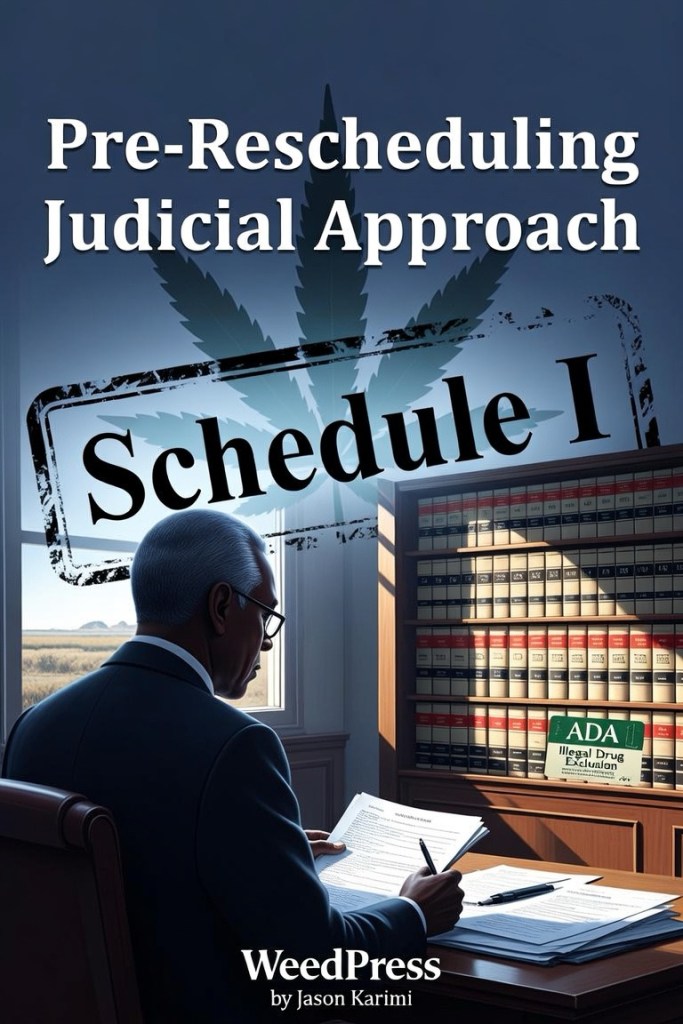
Title I of the ADA, which generally covers employers with 15 or more employees, excludes from protection “any employee or applicant who is currently engaging in the illegal use of drugs, when the covered entity acts on the basis of such use.”² The statute defines “illegal use of drugs” as the use of drugs whose possession or distribution “is unlawful under the Controlled Substances Act,” but carves out “the use of a drug taken under supervision by a licensed health care professional, or other uses authorized by the Controlled Substances Act or other provisions of Federal law.”³
In James v. City of Costa Mesa, the U.S. Court of Appeals for the Ninth Circuit read that carve-out narrowly. The case arose under Title II, which covers public entities and uses a parallel definition. The court held that “doctor-supervised marijuana use is an illegal use of drugs not covered by the ADA’s supervised use exception.”⁴ Its reasoning tied the result to marijuana’s federal status: reading the exception to cover state-authorized medical marijuana “would undermine the CSA’s clear statement that marijuana is an unlawful controlled substance that has ‘no currently accepted medical use in treatment in the United States.’” The court added: “for now Congress has determined that, for purposes of federal law, marijuana is unacceptable for medical use.”⁵
The court distinguished federally authorized research and experimental uses, which it described as “authorized by federal law, and subject to a comprehensive federal regulatory regime.”⁶
James is a Ninth Circuit decision. It does not bind federal courts in South Dakota, which sit in the Eighth Circuit, but it has been the leading appellate statement of the rule. The practical result was that medical cannabis was treated differently from other controlled substances with accepted medical uses, even when a patient used it only off duty, on a practitioner’s certification, and in full compliance with state law.
What the April 2026 order changed
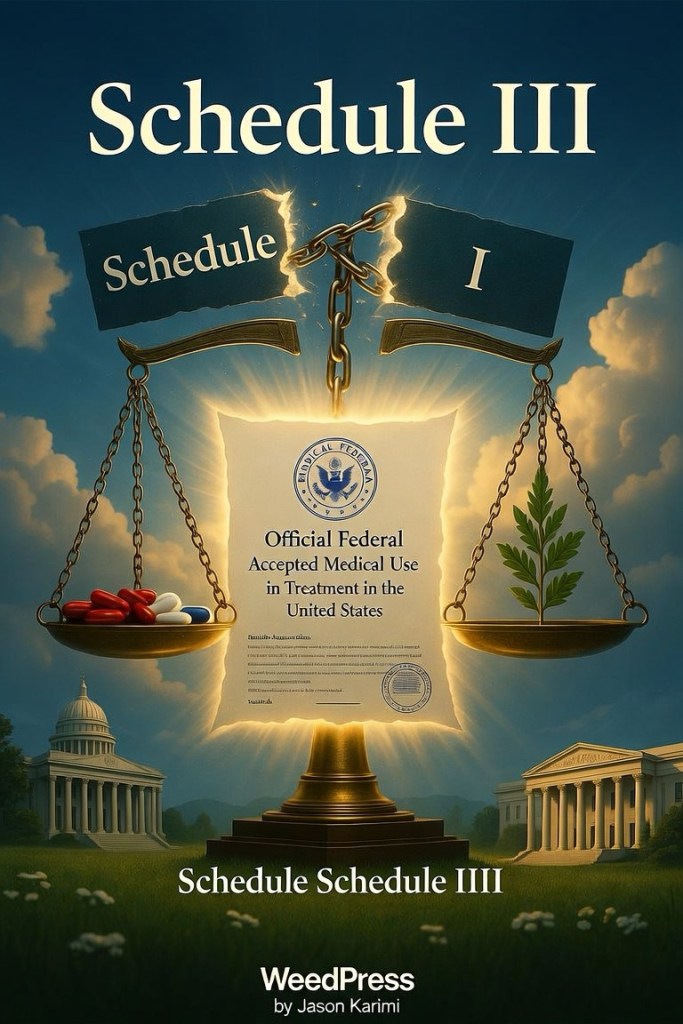
The April 28, 2026, order moved marijuana, marijuana extract and naturally derived delta-9 THC to Schedule III when they are in an FDA-approved product or “subject to a state medical marijuana license.” The order does not cover synthetically derived THC, which remains in Schedule I.⁷
Two features of the order matter for the ADA.
First, the Schedule I label is gone for state-licensed medical marijuana. James relied on the statutory description of Schedule I drugs as having “no currently accepted medical use.” That description no longer applies to marijuana covered by a state medical license. One caution: the order was issued under a treaty-based provision, 21 U.S.C. § 811(d)(1), that allows scheduling “without regard to the findings” ordinarily required.⁸ So the order itself is not a federal finding of accepted medical use. The finding came earlier, from HHS, which concluded in its 2023 scheduling review that marijuana has a currently accepted medical use.⁹
Second, the order gives state certifications a federal role. It lets DEA register state-licensed businesses as manufacturers, distributors and dispensers, with the state license as “conclusive evidence” of state authorization. A registered dispenser may dispense to “individuals authorized by state law to possess marijuana . . . for medical purposes.” And “[n]otwithstanding part 1306,” the federal prescription rules, a state certification “shall be sufficient to permit dispensing” if it is dated and signed on the day issued, bears the patient’s name and address, and carries the practitioner’s name, address and state license number.¹⁰ Registrations “do not authorize” non-medical use, and a DEA registration is automatically suspended if the state license lapses.¹¹
That second feature is the stronger ADA hook. The ADA’s exclusion turns on whether the use is unlawful under the Controlled Substances Act or instead falls within one of the statute’s exceptions, including “other uses authorized by the Controlled Substances Act.” A patient who obtains marijuana from a DEA-registered dispenser, on a certification that meets the federal requirements, has a real but untested argument that the purchase and resulting medical use are federally authorized enough to fall outside the ADA’s “illegal use of drugs” exclusion. If that argument holds, the patient would be much closer to the position of an employee using another lawfully dispensed Schedule III medication: protected from disability discrimination, but still subject to rules on impairment, safety, essential job functions and other federal disqualifications.
No appellate court has decided that question. The answer will depend on facts that will vary by state and by dispensary, including whether the dispensary actually holds a DEA registration and whether South Dakota’s certification and licensing documents fit the federal definitions. WeedPress has examined that South Dakota-specific question in earlier coverage.¹²
The same principle federal agencies apply to medication for opioid use disorder provides a useful analogy. The Justice Department’s guidance says a person whose drug test shows a medication taken as prescribed, under a licensed health care professional’s supervision, “may not be denied, or fired from, a job for this legal use of medication, unless they cannot do the job safely and effectively, or are disqualified under another federal law.”¹³ That guidance concerns a different drug, but it shows how the ADA treats a lawfully dispensed controlled substance used for a disability.
What IM 26 already says about work
IM 26 does not contain separate legislative findings, but its operative sections set a similar rule: authorized medical cannabis is to be treated like other medicine in specified contexts.
- Employment and drug testing. A registered qualifying patient must be afforded “the same rights under state and local law” as a person “solely prescribed a pharmaceutical medication” regarding “[a]ny interaction with a person’s employer” and employer drug testing.¹
- Medical care. For medical care, including transplants, a patient’s authorized use “is considered the equivalent of the authorized use of any other medication used at the discretion of a practitioner.”¹⁴
- Limits. The law does not protect anyone performing a safety-sensitive job “under the influence of cannabis,” does not require any employer to allow cannabis in the workplace or work while under the influence, and permits drug-free workplace policies, with no cause of action for enforcing a policy that complies with the chapter.¹⁵
- Federal carve-out. The employment protections do not apply to the extent they conflict with an employer’s obligations under federal law or would cost the employer a federal monetary or licensing benefit.¹⁶
- 2024 change. The Legislature amended the employment section in 2024 to say employers may take adverse action, or refuse to hire, “based solely on a positive test result for cannabis metabolites” for a safety-sensitive job.¹⁷ State law defines a safety-sensitive job as one with duties the employer “reasonably believes” could cause illness, injury or death, or serious property damage.¹⁸
Taken together, these provisions give patients significant state-law protection while preserving employer authority over safety-sensitive jobs, workplace impairment, federal-compliance obligations and lawful drug-free policies. When state law says authorized medical cannabis is to be treated like a pharmaceutical medication for employment and drug-testing purposes, a rigid policy that automatically penalizes off-duty use outside safety-sensitive jobs can be hard to square with IM 26, depending on the policy and whether it complies with the chapter. That conclusion is strongest for jobs that are not safety-sensitive, which is where state law gives patients the most protection.

Employer policies and the interactive process
A zero-tolerance drug policy can treat any detection of cannabis metabolites as grounds for adverse action, whether or not the use was off duty, state-authorized and free of any impairment at work. Whether a given policy is lawful under IM 26 depends on the job and on whether the policy complies with the chapter. Policies written before April may not account for the new federal classification.
After rescheduling, blanket approaches face more legal pressure when applied to employees with qualifying disabilities. The ADA lets employers prohibit illegal drug use and alcohol use at the workplace, require that employees not be under the influence at work, and hold all employees to the same performance standards.¹⁹ It also lets employers in federally regulated transportation, defense and nuclear industries require compliance with those federal drug rules.²⁰ None of that changes.
What changes is the starting point. If a patient’s use is not “illegal use of drugs,” the ordinary ADA rules apply: a covered employer must consider a reasonable accommodation request from a qualified employee with a disability, and federal regulations describe an “informal, interactive process” for identifying an appropriate accommodation.²¹ Automatic termination, or refusing to engage at all, for off-duty, state-compliant medical cannabis use is harder to reconcile with those obligations than it was before April.²²
Until courts or regulators address these requests, employees and employers are working through significant uncertainty.
The case for updating South Dakota’s approach
Melissa Mentele, executive director of New Approach South Dakota, cautioned against reading the president’s December 2025 executive order directing rescheduling as an immediate legal change. She told Dakota News Now that “[t]he signing of that was not an immediate change,” and that “[p]eople will still be arrested on a Schedule 1 substance if they don’t have a South Dakota medical marijuana card.”²³ That was accurate when she said it.
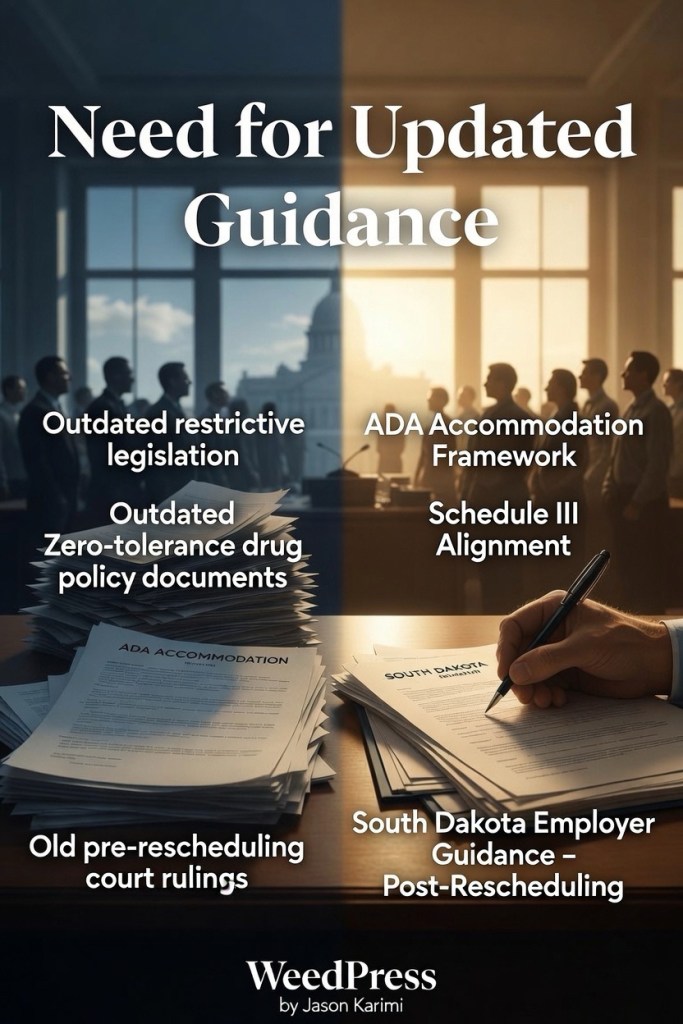
In my view, the April order changed the picture. The Schedule III placement and the questions it raises under the ADA indicate that legislative and regulatory updates are now warranted to align South Dakota’s implementation with the new federal framework.
WeedPress has reported that federal rescheduling has produced four distinct state responses so far, and that most states have not yet chosen one.²⁴ South Dakota patients and employers would benefit from clear guidance rather than continued reliance on pre-rescheduling distinctions that federal law has now called into question.

Recommendations for South Dakota
South Dakota should clarify, by statute or administrative guidance, that off-duty, state-authorized medical cannabis use by registered patients is to be evaluated under the same ADA framework that applies to other lawfully used medications. Specifically:
- Employers covered by the ADA should be expected to engage in the interactive process when an employee requests an accommodation for off-duty medical cannabis use, while keeping full authority to address actual impairment, on-the-job use and safety-sensitive duties.
- The state should say whether South Dakota’s medical cannabis licenses and certifications are intended to satisfy the federal order’s definitions, so patients and employers know whether purchases from a DEA-registered dispensary can qualify as federally authorized use.
- Guidance should distinguish jobs that are safety-sensitive under state law from those that are not, because the state’s 2024 amendment applies only to safety-sensitive jobs.
IM 26 was designed to provide meaningful access to medicine for seriously ill South Dakotans. Realizing that purpose after rescheduling requires implementation that reflects marijuana’s new federal status.
Whether courts will require employers to accommodate off-duty medical cannabis use under the ADA is still an open question. But the federal change strengthens the argument that South Dakota should update its guidance so IM 26 works consistently with both state policy and current federal law. Clearer guidance would reduce uncertainty for patients and employers alike.
Related coverage
- Robert Mikos Warned of Rescheduling’s “False Promise.” The April 2026 Order Tests His Argument.
- South Dakota Cannot Enact Federal Schedule III. Minnesota Already Moved Cannabis to State Schedule III in 2023. Here Is the 2027 Path.
- Federal Rescheduling Increases ADA Scrutiny of South Dakota’s Medical Cannabis Policies
- South Dakotan Safety-Sensitive Jobs Sit on Two Desks. Schedule III Moved Neither One.
- A Written Certification Is Not a Part 1306 Prescription
- The April Rescheduling Order Asks for a License. Pierre Issues Four Certificates.
- What Rescheduling Still Doesn’t Fix for Probationers, Workers, and Patients
- Federal Medical Cannabis Rescheduling Has Produced Four Distinct State Responses—But Most States Still Have Not Chosen One
Notes
¹ S.D. Codified Laws § 34-20G-22 (Initiated Measure 26, approved Nov. 3, 2020; as amended by 2024 S.D. Sess. Laws ch. 135, § 1), https://sdlegislature.gov/Statutes/34-20G-22.
² 42 U.S.C. § 12114(a), https://www.govinfo.gov/content/pkg/USCODE-2024-title42/html/USCODE-2024-title42-chap126-subchapI-sec12114.htm; see id. § 12111(5)(A) (employer means a person with 15 or more employees), https://www.govinfo.gov/content/pkg/USCODE-2024-title42/html/USCODE-2024-title42-chap126-subchapI-sec12111.htm.
³ 42 U.S.C. § 12111(6)(A); see also id. § 12210(a), (d)(1) (parallel provisions), https://www.govinfo.gov/content/pkg/USCODE-2024-title42/html/USCODE-2024-title42-chap126-subchapIV-sec12210.htm.
⁴ James v. City of Costa Mesa, 700 F.3d 394, 403 (9th Cir. 2012), https://cdn.ca9.uscourts.gov/datastore/opinions/2012/05/21/10-55769.pdf.
⁵ Id. (slip op. at 5297, 5300) (quoting 21 U.S.C. § 812(b)(1)(B)).
⁶ Id. (slip op. at 5296–97).
⁷ Schedules of Controlled Substances: Rescheduling of Food and Drug Administration Approved Products Containing Marijuana From Schedule I to Schedule III; Corresponding Change to Permit Requirements, 91 Fed. Reg. 22714, 22719, 22722–23 (Apr. 28, 2026), https://www.federalregister.gov/documents/2026/04/28/2026-08176/schedules-of-controlled-substances-rescheduling-of-food-and-drug-administration-approved-products.
⁸ Id. (quoting 21 U.S.C. § 811(d)(1)).
⁹ Id. (describing HHS’s Aug. 29, 2023 scheduling recommendation); Robert A. Mikos, The False Promise of Rescheduling, 60 Tulsa L. Rev. 1 (2024), https://digitalcommons.law.utulsa.edu/tlr/vol60/iss1/6 (discussing HHS’s accepted-medical-use analysis).
¹⁰ 91 Fed. Reg. at 22721–22 (to be codified at 21 C.F.R. § 1301.13(k), (k)(1)(iii), (k)(2), (k)(5)).
¹¹ Id. (to be codified at 21 C.F.R. § 1301.13(k)(1)(iv), (k)(3)).
¹² See Jason Karimi, The April Rescheduling Order Asks for a License. Pierre Issues Four Certificates, WeedPress (Sept. 11, 2026), https://weedpress.org/2026/09/11/the-april-rescheduling-order-asks-for-a-license-pierre-issues-four-certificates/; Jason Karimi, A Written Certification Is Not a Part 1306 Prescription, WeedPress (Sept. 11, 2026), https://weedpress.org/2026/09/11/a-written-certification-is-not-a-part-1306-prescription/.
¹³ U.S. Dep’t of Justice, Civil Rights Div., The ADA and Opioid Use Disorder: Combating Discrimination Against People in Treatment or Recovery (Apr. 5, 2022) (Question 9), https://www.ada.gov/resources/opioid-use-disorder/.
¹⁴ S.D. Codified Laws § 34-20G-20, https://sdlegislature.gov/Statutes/34-20G-20.
¹⁵ Id. §§ 34-20G-18(5), -24, https://sdlegislature.gov/Statutes/34-20G-18; https://sdlegislature.gov/Statutes/34-20G-24.
¹⁶ Id. § 34-20G-23, https://sdlegislature.gov/Statutes/34-20G-23.
¹⁷ Id. § 34-20G-22; S.B. 12, 99th Leg. Sess. (S.D. 2024) (signed Feb. 15, 2024), 2024 S.D. Sess. Laws ch. 135, https://sdlegislature.gov/Session/Bill/24698.
¹⁸ S.D. Codified Laws § 34-20G-1(24), https://sdlegislature.gov/Statutes/34-20G-1.
¹⁹ 42 U.S.C. § 12114(c)(1), (2), (4).
²⁰ Id. § 12114(c)(5).
²¹ 42 U.S.C. § 12112(b)(5)(A); 29 C.F.R. § 1630.2(o)(3), https://www.ecfr.gov/current/title-29/section-1630.2.
²² See U.S. Equal Emp. Opportunity Comm’n, Enforcement Guidance on Reasonable Accommodation and Undue Hardship Under the ADA (Oct. 17, 2002), https://www.eeoc.gov/laws/guidance/enforcement-guidance-reasonable-accommodation-and-undue-hardship-under-ada.
²³ Beth Warden, Marijuana Reclassification: What It Means for South Dakotans, Dakota News Now (Dec. 22, 2025), https://www.dakotanewsnow.com/2025/12/23/marijuana-reclassification-what-it-means-south-dakotans/.
²⁴ See Jason Karimi, Federal Medical Cannabis Rescheduling Has Produced Four Distinct State Responses—But Most States Still Have Not Chosen One, WeedPress (Aug. 4, 2026), https://weedpress.org/2026/08/04/federal-medical-cannabis-rescheduling-has-produced-four-distinct-state-responses-but-most-states-still-have-not-chosen-one/.




Leave a Reply