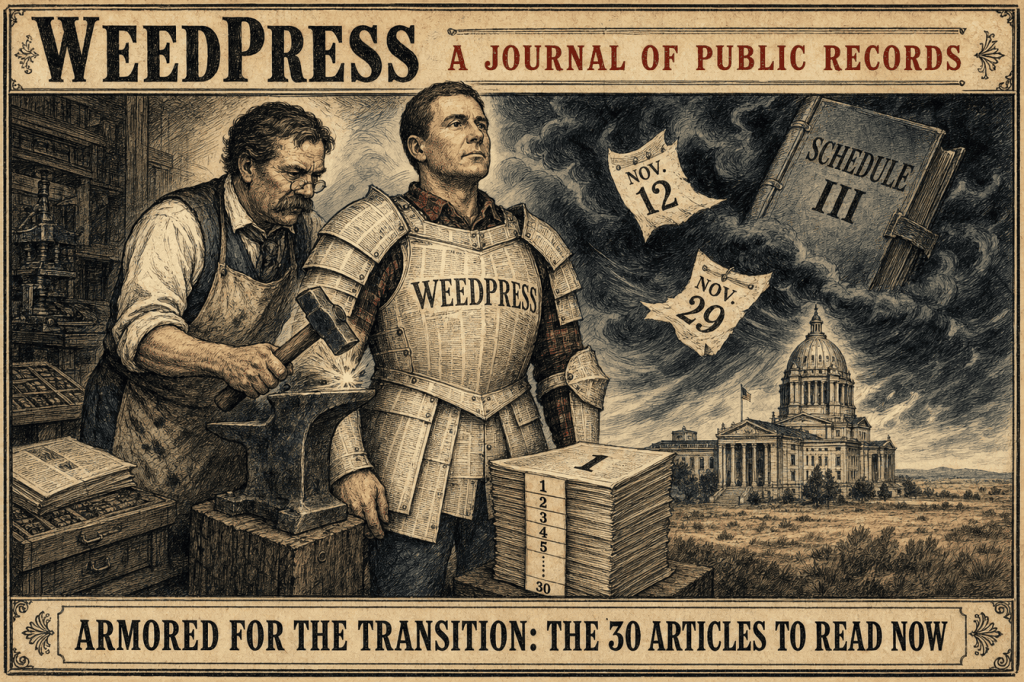
Three federal dates arrive over the next several weeks. These 30 WeedPress articles explain what the rules say, what they leave open and what readers can do next.
Federal cannabis law changed on April 28, 2026, when the Justice Department and the Drug Enforcement Administration, or DEA, moved marijuana “subject to a state medical marijuana license” into Schedule III. That order did not end the hard part. It began the transition.
The coming weeks stack three federal dates on top of one another. On Nov. 12, the first part of Congress’ rewrite of the federal hemp definition takes effect, with the rest following Dec. 11. On Nov. 29, DEA says timely applicants are expected to have compliant supply chains, dealing only with other timely applicants or DEA registrants. Behind both sits Oct. 30, when the Justice Department said DEA had registered more than 900 dispensaries in seven states, including South Dakota, while warning that “state licensure alone does not automatically grant federal registration.”
At the same time, South Dakota’s revised medical cannabis rules took effect Nov. 5, the state still lists THC in its own Schedule I, and the Department of Health is preparing a 2027 licensing bill.
That is what a legal transition looks like: two systems, federal and state, changing at different speeds, with patients, operators, lawyers and lawmakers standing in the gap. WeedPress has covered this transition in depth, from the treaty to the dispensary counter. If you read only 30 articles, read these, in this order.
The list is ranked by urgency and practical value for the next 90 days of federal and state change. The most urgent and most actionable pieces come first. The legal foundations that will shape the next five years come later because they are less immediate, not because they matter less.
Part I: Nov. 12 and Nov. 29 — the next 30 days
1. DEA Warns South Dakota Cannabis Operators Without Federal Status: “You Should Not Be Operating,” Source Says — In an Industry Told in May the Transition “Should Be Smooth”
Nov. 6, 2026
Start here for the federal supply-chain rule: the register-first prohibition in 21 C.F.R. § 1301.13(a), the timely-applicant exception in § 1301.13(k)(7), and DEA’s warning that trading with the wrong partner “could be potential grounds” for denial or revocation. Readers learn the gap between DEA’s Oct. 30 inventory sentence and its Nov. 29 supply-chain date, plus the paperwork DEA says to collect “at a minimum” before any deal.
2. What Should My South Dakota Dispensary Do Before Nov. 29? A DEA Supplier Checklist
Nov. 2, 2026
This is the site’s most practical page for a dispensary owner. Built from DEA’s guidance sheet and website, it shows how to check whether a supplier qualifies, what to ask for, what to verify and what records to keep.
3. What DEA Tells Buyers to Get From South Dakota Growers and Manufacturers Before Nov. 29: A Producer’s Paperwork Guide
Nov. 4, 2026
This is the other side of the checklist. Growers and manufacturers learn what documents buyers are likely to request before Nov. 29 and where DEA’s documents leave answers unclear. Producers come away knowing what to prepare before customers ask.
4. What DEA’s Nov. 29 Date Means for South Dakota Medical Cannabis Patients
Nov. 4, 2026
This is the patient’s version of the Nov. 29 date. It explains what the date does and doesn’t mean for dispensary supply and patient cards, what to ask a dispensary and what remains unknown. Patients leave with specific questions instead of rumors.
5. Congress Gave Delta-8 Another Month. It Didn’t Give It Schedule III.
Oct. 25, 2026
Hemp changes in two steps: products with cannabinoids the plant is “not capable of” producing lose hemp status Nov. 12, and the rest of Congress’ rewrite, including the treatment of converted delta-8, takes hold Dec. 11. The article explains why, for products sold outside a Food and Drug Administration approval or a state medical license, both readings it identifies lead to Schedule I, not Schedule III. Retailers learn why the article says to check certificates of analysis for every cannabinoid, not just the one on the label.
6. Three Weeks Before DEA’s Nov. 29 Supply-Chain Guidance Date, South Dakota Faces Questions the Rule and Guidance Leave Open
Nov. 8, 2026
This piece lays out what the rule’s text does not settle for South Dakota’s direct grower-to-dispensary structure and its single listed testing lab. It quotes DEA’s footnote that analytical laboratories are not covered by the timely-applicant provision. Lawyers and operators get a focused list of open questions to put to DEA or counsel.
7. DEA’s Timely-Applicant List by the Numbers: 6,041 Entries Nationwide, 13 in South Dakota
Nov. 2, 2026; updated Nov. 10, 2026
This article counts every line of DEA’s timely-applicant list against DEA’s raw files: totals by registration type, every state and South Dakota’s 13 entries, with changes since Oct. 30. It also explains why coming off the list does not by itself prove a business is registered. Readers learn how to read the list without over-reading it.
Part II: Registration, the paper behind it and the new state rules
8. Ruthie’s Dispensary Got Its DEA Registration. Its Supplier Question Matters Across South Dakota.
Nov. 2, 2026
The first South Dakota dispensary to tell WeedPress it had received a DEA registration asked the question operators across the state now face: which suppliers qualify? The article sets out what the federal rule, DEA’s guidance and South Dakota law say, and what no one can yet answer from public records. It shows why even a registered business has to do its own homework.
9. DEA’s Proposed Denial in Minnesota Cites Three Problems. Here Is How South Dakota Law Compares
Nov. 10, 2026
Marijuana Moment reported that DEA moved to deny a Minneapolis dispensary federal registration, citing Minnesota’s dual licensing, a veterans’ attestation path and “synthetic” products. The order is proposed, not final, and the article does not suggest any South Dakota business was denied. It sets each reported ground beside SDCL 34-20G and ARSD 44:90. Operators can see where South Dakota’s rules differ from Minnesota’s, and where questions remain.
10. When the State Certificate Is Suspended, the Federal Registration Is Suspended Too.
Sept. 22, 2026
The April order says that if the state medical marijuana license is suspended, revoked or expires, the federal registration “is automatically suspended.” This article applies that sentence to a South Dakota shop. Operators learn why a state compliance problem can quickly become a federal one.
11. The April Rescheduling Order Asks for a License. Pierre Issues Four Certificates.
Sept. 11, 2026
The federal order speaks of a “state medical marijuana license”; South Dakota issues registration certificates in four types. This article sets the federal text beside the papers Pierre issues and identifies what the state has not published. Lawyers get a framework for the still-unpublished crosswalk between the federal license language and South Dakota’s certificates.
12. What Changes for South Dakota Medical Cannabis Patients and Caregivers as Revised Rules Took Effect Nov. 5, 2026
Nov. 5, 2026
For cardholders, the new rules replace the two-part home-grow card, tell caregivers to destroy cards instead of returning them, raise the per-serving THC cap for edibles to 100 milligrams and drop a proposed home-grow ban for patients under 21. The 3-ounce limit and card fees don’t change. Patients and caregivers learn exactly what is different this month.
13. South Dakota’s Revised Medical Cannabis Rules Took Effect Nov. 5, 2026; Department’s Latest Posted Version Omits Two Proposed Corrective-Action Penalty Sentences
Oct. 27, 2026
This is the operator’s version of the Nov. 5 rules. It explains the amendments to 35 sections of ARSD Article 44:90 and how the department’s latest posted version lists first offenses in Categories 4 and 5 with a corrective-action plan instead of a dollar fine. Operators and their lawyers learn the key Nov. 5 changes to the state penalty structure.
14. South Dakota’s New Lab Rules Took Effect With One Testing Lab Listed
Nov. 6, 2026
South Dakota’s new lab rules took effect Nov. 5 with one testing facility on the state’s list. WeedPress rechecked the roster, inspection reports and adopted rule text and put written questions to the department about testing capacity. Operators and patients see why one listed lab is a pressure point in the supply chain.
Part III: Patients, families and workers
15. DEA’s New Transfer Warning Collides With South Dakota’s Caregiver and Patient-Transfer Laws
Sept. 28, 2026
South Dakota still lets a designated caregiver buy and carry cannabis for a patient and protects certain no-value transfers between cardholders. Federal Schedule III warning language says it is a crime to transfer the drug to anyone other than “the patient.” Caregivers and patients learn where state permission and the federal warning may collide.
16. A Written Certification Is Not a Part 1306 Prescription
Sept. 11, 2026
The April order says South Dakota’s written certification can suffice to dispense under federal conditions, but it doesn’t make the certification a Part 1306 prescription. Patients learn what their written certification does and doesn’t prove under federal dispensing rules.
17. Federal Rescheduling Strengthens the Case for ADA Accommodation of Medical Cannabis in South Dakota. Here’s What It Does and Doesn’t Change.
Nov. 9, 2026
The court decisions that kept medical cannabis patients outside the Americans with Disabilities Act leaned on marijuana’s Schedule I status, and for state-licensed medical marijuana that status changed in April. The article explains why the employment question is now open, and that no court has answered it yet. Patients and employment lawyers get the argument and its limits.
18. South Dakotan Safety-Sensitive Jobs Sit on Two Desks. Schedule III Moved Neither One.
Sept. 22, 2026
This is the warning commercial drivers and other safety-sensitive workers need. Federal transportation guidance from May 15, 2026, says a medical review officer may not verify a marijuana positive as negative because the employee used a state-licensed product. Workers learn that state cards, certifications and dispensary receipts don’t count as a legitimate medical explanation in federal transportation drug testing.
19. Can You Lose Child Custody for Medical Marijuana in South Dakota? What the Law Actually Says
Sept. 21, 2026
SDCL 34-20G-21 says a cardholder may not be denied custody, visitation or parenting time solely for holding a card, but it has limits, and the Legislature changed a protection voters originally approved. Parents learn what the statute protects, what it doesn’t and what conduct can still matter to a court.
20. Helping a Parent Use Medical Cannabis in South Dakota? Start Here.
Nov. 3, 2026
This practical guide for adult children and spouses covers applications, caregiver registration, dispensary pickup, care-facility policies and the federal questions that remain open. It explains that being a relative, or carrying a patient’s card, does not by itself give you authority to buy. Families leave with checklists and questions to ask before a care transition.
21. Does the DEA’s New Prescription Rule Apply to State-Authorized Homegrown Medical Cannabis? An Unanswered Legal Question
July 13, 2026
DEA’s revised prescription language was drafted around a traditional doctor-to-pharmacy dispensing model, not a patient’s home grow. This piece explains that no published federal interpretation yet answers how the revised prescription definition applies to state-authorized home cultivation. Home growers learn why their federal status remains an open question, not a settled one.
22. South Dakota’s Medical Cannabis Map: 63 Dispensaries in 23 Counties, None in 43. State Health Data Puts 2,123 Cardholders in Those 43 Counties.
Nov. 7, 2026
The state’s list shows 63 dispensaries in 23 of 66 counties, down from 78 in February 2024, and a Department of Health handout to lawmakers put 2,123 cardholders in the 43 counties with none, though the department has since said it keeps no records tracking patients by county. About 185,000 people live in those 43 counties. Patients and lawmakers can see where listed dispensary access is already thinnest as the federal transition unfolds.
Part IV: The legal foundations, and the 2027 fight
23. Why Business Lawyers and Lawmakers Must Master the U.S. Reinterpretation of the Single Convention: Treaty Flexibility as the Foundation for Durable Cannabis Reform
May 6, 2026
For decades, DEA cited the 1961 Single Convention as a barrier to loosening federal controls. This article explains the State Department’s reinterpretation of the treaty as aimed mainly at cross-border trafficking, and how that reading laid the foundation for the April 2026 order. Lawyers and lawmakers learn why the article argues the treaty is no longer the wall it was once said to be.
24. Treaty Obligations Meet Constitutional Reality: How Article 36 of the Single Convention Preserves U.S. Flexibility on Cannabis Policy
July 2, 2026
The companion piece. Article 36 requires parties to criminalize intentional violations, but it repeatedly subordinates that duty to each nation’s “constitutional limitations” and domestic law. Readers get the treaty-flexibility argument to answer claims that the Single Convention forbids state medical programs.
25. What Does “Accepted Medical Use” Actually Mean? A 40-Year Legal Fight Now Matters in South Dakota
Sept. 15, 2026
South Dakota’s Schedule I law turns on “no accepted medical use in the United States” but doesn’t define the phrase. This article traces the federal fight over those words and explains why federal rulings on the phrase are history, not binding state law, in Pierre. It gives readers the vocabulary for the state scheduling arguments to come.
26. South Dakota’s Schedule I Listing Still Shapes Real Cases. Moving Cannabis to Schedule III Would Change Who Gets Charged How.
Sept. 2, 2026
South Dakota polices natural marijuana by weight but treats concentrates through its Schedule I listing, which can feed felony charges. The article explains what a state Schedule III move would and wouldn’t change. Defense lawyers and lawmakers see where the state code still carries its heaviest consequences.
27. South Dakota’s Attorney General Answered the Schedule III Question. The Department of Health Still Has Its Own Statute to Answer.
Oct. 13, 2026
Official Opinion 26-06 concludes the federal order will likely have a “negligible impact” on South Dakota’s program and that 21 C.F.R. § 1301.13(k) supplies a registration path. This article explains what the opinion settled and the separate state statute it left to the Department of Health. Readers understand the state’s official position and the limits of that opinion.
28. South Dakota Cannot Enact Federal Schedule III. Minnesota Already Moved Cannabis to State Schedule III in 2023. Here Is the 2027 Path.
Nov. 4, 2026
Federal Schedule III did not change South Dakota’s own controlled-substances list, where THC still sits in Schedule I. This article lays out a narrow 2027 legislative path modeled on Minnesota’s 2023 change. Lawmakers get a concrete starting point for the 2027 debate.
29. South Dakota Health Department Preparing 2027 Cannabis Licensing Bill, Email Shows
Nov. 3, 2026
A Sept. 21 department email says the state is preparing 2027 legislation on local authority over registration preferences and on removing or modifying certain establishment requirements. As of that article, no bill had been filed and WeedPress had not seen the draft. Operators and local officials learn which issues to watch when the session opens.
30. Robert Mikos Warned of Rescheduling’s “False Promise.” The April 2026 Order Tests His Argument.
Nov. 7, 2026
A Vanderbilt law professor argued that Schedule III would deliver far less than the industry hoped and that broader reform requires Congress. This article tests his argument against the order DEA issued, including the Section 280E tax point Mikos identified as the one clear benefit. It is a fitting note to end on: rescheduling is a beginning, not a finish line.
Keep checking the federal partner list
Reading is the first step. Checking is the second. WeedPress keeps a running list of South Dakota medical cannabis businesses and their reported federal status, updated as operators send WeedPress documentation: South Dakota establishment status and federal trading partners. Treat it as a starting point, not a substitute for confirming a partner’s status with the partner, DEA and counsel. DEA says registrants are responsible for their own due diligence, and its guidance describes the document checks that review should include.
This reading guide is general information and journalism, not legal advice. Federal and state requirements are changing quickly; for decisions about your business, card or case, consult a licensed attorney. Dates and figures reflect the linked articles as of their publication or last update.





Leave a Reply